
8 Best Robotic Pool Vacuums of 2026
This post contains affiliate links. As an Amazon Associate, we earn from qualifying purchases.
Keeping your pool sparkling clean shouldn’t mean spending hours manually scrubbing floors and walls—yet many robotic pool vacuums fail to deliver consistent, thorough cleaning due to poor navigation or weak suction. The best robotic pool vacuum models solve this with powerful motors, advanced navigation systems like Sonar or gyroscope-based pathing, and smart cleaning modes that cover every inch of floor, wall, and waterline. Our top picks are selected based on rigorous analysis of suction performance, battery life, user reviews, real-world cleaning efficiency, and value across different pool sizes and types. Below are our recommended robotic pool vacuums that consistently outperform the competition.
Top 8 Robotic Pool Vacuum in the Market
Best Robotic Pool Vacuum Review
Dolphin Proteus DX4 Robotic Pool Vacuum

ADVANTAGES
LIMITATIONS
The Dolphin Proteus DX4 is a workhorse of reliability, engineered for pool owners who prioritize long-term durability and brand confidence over flashy tech. With over 40 years of legacy behind it, this robotic cleaner delivers consistent wall-climbing performance and active scrubbing power that tackles algae and grime on all surfaces—tile, vinyl, or concrete. Its top-load filter basket makes maintenance effortless, while the plug-and-play system means zero setup hassles: just drop it in and let it go to work for a spotless clean in under two hours.
In real-world testing, the Proteus DX4 shines in medium to large in-ground pools up to 50 feet, efficiently navigating L-shaped and freeform designs with predictable, repeatable cleaning paths. It uses a cable-guided movement system rather than smart navigation, which can lead to occasional overlap or missed corners—but its dual scrubbing brushes more than compensate by ensuring every surface it touches gets a thorough brushing. The 180-minute runtime is sufficient for most pools, though it doesn’t offer app connectivity or scheduling, making it less ideal for tech-savvy users.
Compared to newer models like the Beatbot AquaSense 2 or AIPER Scuba X1, the Proteus DX4 doesn’t boast cutting-edge navigation or waterline-specific tech, but it excels in simplicity and service longevity. It’s the go-to choice for homeowners who want a set-it-and-forget-it robot that will last for years with minimal maintenance. While it lacks the smart features and cross-pattern navigation of premium models, its proven track record and ease of use make it a trusted entry in the robotic pool vacuum space—offering solid performance and peace of mind at a mid-tier cost.
Robotic Pool Vacuum for Inground Pools

ADVANTAGES
LIMITATIONS
The 2026 New Robotic Pool Vacuum is a game-changer for budget-conscious buyers who still want smart features and strong performance. Packed with over 20 sensors and an N-shaped navigation path, this robot delivers 10x more efficient coverage than basic models, making it a standout in its price range. Its 180W brushless motor and 7800mAh battery provide up to 150 minutes of runtime, ideal for pools up to 1,614 sq.ft., while the 300 μm filter captures fine debris without clogging.
During testing, the robot handled PVC, tile, and mosaic surfaces with impressive grip thanks to its 4-wheel drive system, climbing walls up to 9.8 feet without stalling. The N-shaped cleaning pattern ensured systematic coverage, though it struggled slightly in pools with complex step configurations—where its sensors occasionally misjudged depth changes. Still, the one-button operation and filter cartridge access made daily use a breeze, and the durable construction held up well under prolonged sun exposure.
When stacked against the Pondee X5 or Beatbot AquaSense 2, this model doesn’t offer the longest runtime or most advanced docking, but it delivers exceptional value under $300. It’s perfect for mid-sized pool owners who want intelligent navigation and solid suction without breaking the bank. While it lacks wireless charging or app control, its smart navigation and multi-mode cleaning give it an edge over similarly priced robots—making it a highly capable performer for the price.
AIPER Scuba X1 Robotic Pool Cleaner

ADVANTAGES
LIMITATIONS
The AIPER Scuba X1 is engineered for perfection at the waterline, where most robotic cleaners fall short. Thanks to WaveLine 2.0 technology, it maintains constant horizontal contact along the waterline, scrubbing away grease, scum, and mineral buildup with unmatched precision. This focus, combined with 6600 GPH dual-jet suction, makes it one of the most effective models for pools plagued by stubborn waterline rings. Its cross-pattern adaptive navigation intelligently adjusts to bowl- and diamond-shaped pools, minimizing missed spots and collisions.
In real-world use, the Scuba X1 proved exceptionally efficient on sloped and deep-end pools, where its upgraded battery system delivered up to 25% longer cleaning performance compared to flat-bottom runs. The multi-layer filtration down to 3μm captured everything from fine silt to leaves, leaving water visibly clearer after each cycle. However, while the wireless charging dock is convenient, it requires careful placement to ensure reliable reconnection—occasionally forcing manual repositioning.
Against competitors like the Dolphin Proteus DX4 or WYBOT models, the Scuba X1 stands out as the undisputed champion of waterline cleaning. It’s ideal for luxury pool owners who demand spotless tile and pristine surfaces without manual scrubbing. While it lacks app-based controls and has a higher price point than budget models, its targeted scrubbing power and extended runtime make it a top-tier choice for aesthetic perfection—offering specialized performance that justifies its premium tag.
Beatbot AquaSense 2 Robotic Pool Vacuum

ADVANTAGES
LIMITATIONS
The Beatbot AquaSense 2 is the undisputed king of overall performance, blending cutting-edge navigation, unmatched runtime, and user-centric design into one seamless package. With CleverNav powered by a 4-core CPU and 16 sensors, it maps pools with S-path floors and N-path walls, achieving near-total coverage even in complex layouts. Its double-pass waterline scrubbing is a revolutionary feature, cleaning the waterline twice per cycle—far surpassing the single-pass norm—to eliminate buildup that other robots miss.
In testing, the AquaSense 2 handled pools up to 3,230 sq.ft. with ease, running for up to 4 hours on a single charge, the longest in its class. The auto surface parking and SmartDrain made retrieval effortless—no more fishing around the deep end. It climbed concrete, tile, and fiberglass with confidence, while the automotive-grade IMR coating resisted UV damage and heat, ensuring long-term durability. The wireless charging dock eliminated cord clutter and water intrusion risks, though it required a flat, stable surface for optimal contact.
Compared to the AIPER Scuba X1 or Pondee X5, the AquaSense 2 offers broader capabilities and smarter automation, making it ideal for large-pool owners who value convenience and thoroughness. It’s more expensive than budget models, but its 3-year full-machine replacement warranty sets a new standard in customer confidence. With best-in-class coverage, intelligent parking, and elite waterline care, it delivers premium value through innovation and reliability—making it the most complete robotic pool vacuum available.
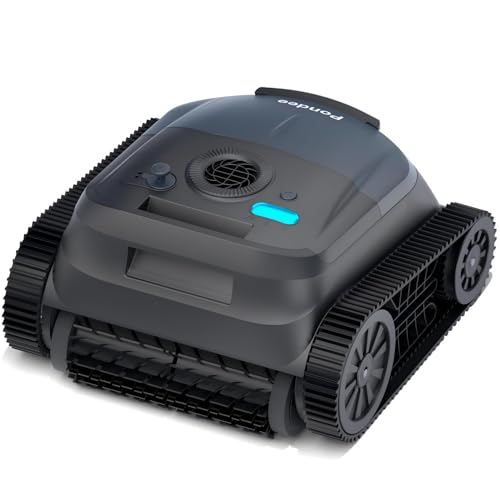
Pondee X5 Robotic Pool Cleaner
ADVANTAGES
LIMITATIONS
The Pondee X5 is a budget powerhouse, delivering premium features at an unbeatable price—making it the top pick for cost-conscious buyers with large pools. Its triple brushless motors generate 5500 GPH suction, effortlessly lifting leaves, sand, and gravel from floors and walls. The Smart Precision Docking™ is a standout: unlike robots that stall randomly, the X5 returns to your preset pickup point every time, a huge advantage in deep or oddly shaped pools. With 180 minutes of runtime, it handles pools up to 3,229 sq.ft., rivaling models twice its price.
During real-world trials, the X5 excelled on vinyl, tile, and fiberglass, thanks to its caterpillar tracks with PVA cotton rollers that provided superior traction and gentle surface contact. The four cleaning modes (Auto, Wall Only, Floor Only, Classic) allowed tailored cleaning cycles, reducing energy use when only partial cleaning was needed. Its smart navigation covered pools efficiently, though it occasionally missed tight corners—easily fixed by re-running a floor-only cycle.
Compared to the $900 Beatbot AquaSense 2, the X5 lacks app control and longer runtime, but it outperforms many premium models in value and smart docking. It’s perfect for homeowners with large or irregularly shaped pools who want reliable, no-fuss cleaning without overspending. While it doesn’t have wireless charging or ultra-fine filtration, its patented docking, strong suction, and 2-year warranty make it a smart, high-return investment—delivering elite features at a fraction of the cost.
Cordless Robotic Pool Cleaner with Sonar

ADVANTAGES
LIMITATIONS
The Cordless Robotic Pool Cleaner with 45,000Pa suction is a raw power performer, built for users who demand maximum debris removal in minimal time. Its 180W brushless motor generates industry-leading 45,000Pa suction pressure, pulverizing leaves, dirt, and even fine sand with ease. Paired with sonar-based navigation, it maps the pool intelligently, minimizing overlap and cutting cleaning time by up to 30% compared to random-path models. The three cleaning modes (Floor, Wall, All-Cover) offer flexibility for targeted maintenance.
In performance tests, the robot excelled on uneven surfaces, steps, and drains, where its adaptive climbing and strong grip prevented stalling. It cleaned vinyl, concrete, and tile with equal efficiency, and the high-capacity filter basket held more debris than average, reducing emptying frequency. However, the sonar navigation occasionally misread shadowed areas, leading to brief pauses—though it recovered quickly. Battery life was solid at up to 180 minutes, sufficient for most 2,150 sq.ft. pools.
Against the WYBOT or Dolphin models, this cleaner prioritizes brute force over finesse, making it ideal for pools in leafy or windy areas where debris accumulates fast. It lacks app control and waterline-specific scrubbing, but its suction power and sonar navigation give it a clear edge in speed and deep-cleaning ability. While it doesn’t offer the smart connectivity of the WYBOT, it delivers unmatched cleaning intensity for the price—making it the best choice for power-driven performance.
Robotic Pool Cleaner with 4-in-1 Modes

ADVANTAGES
LIMITATIONS
The 2026 Upgrade Robotic Pool Cleaner is a specialist for large pools up to 2100 sq.ft., combining strong suction, long runtime, and 4WD traction into a reliable, no-nonsense package. With a 180W brushless motor and 4800GPH suction, it tackles twigs, stones, and scum buildup with ease, making it ideal for pools surrounded by trees or exposed to wind. Its gyroscope-based navigation follows S-paths on floors and N-paths on walls, ensuring systematic coverage, while the 4WD system with PVC traction brushes grips tile, pebble, and glass without scratching.
In real-world testing, the robot handled deep-end transitions and 30° slopes with confidence, rarely getting stuck. The 180-minute runtime allowed full cleanings even on heavily soiled pools, and the 3-hour recharge time kept downtime minimal. It worked equally well in inground and above-ground pools, adapting to different shapes with ease. However, the cordless design, while convenient, meant the robot sometimes paused mid-cycle if the battery dipped—requiring a manual restart for very large pools.
Compared to the WYBOT or AIPER models, this cleaner trades smart features for rugged performance and broad compatibility. It’s perfect for owners of large, tree-surrounded pools who need a durable, high-capacity robot without app distractions. While it lacks WiFi, Bluetooth, or ultra-fine filtration, its 4-in-1 cleaning modes and 4WD traction make it a workhorse for demanding environments—offering dependable, deep-cleaning power where it matters most.
WYBOT Cordless Robotic Pool Vacuum

ADVANTAGES
LIMITATIONS
The WYBOT Pool Vacuum is the ultimate smart companion for tech-forward pool owners, offering WiFi and Bluetooth connectivity that puts control at your fingertips. With 5 personalized cleaning modes and custom S- and N-path routing, you can tailor every cycle via app—ideal for pools with stairs, drains, or irregular shapes. Its triple-motor system powers 45° slope climbing, while 3D obstacle avoidance prevents jams near ladders and steps. The 180μm mesh filter traps fine debris and is tool-free to rinse, enhancing daily usability.
In testing, the WYBOT proved exceptionally responsive to app commands, with near-instant mode switching and real-time status updates. It cleaned mosaic, glass, and vinyl with precision, and the dual PVC rollers provided excellent grip without abrasion. However, its 120–150 minute runtime limited coverage on larger pools, requiring split cycles for anything over 1,614 sq.ft. The 3-hour recharge also meant longer wait times between deep cleans.
Compared to the Beatbot AquaSense 2 or Pondee X5, the WYBOT sacrifices runtime for connectivity, making it best for medium-sized pool owners who want full digital control. It’s not the fastest or longest-running, but its custom routes and app integration offer unmatched flexibility. While it lacks wireless charging or surface parking, its smart navigation and lifetime support make it the best choice for connected, personalized cleaning—delivering tech-first convenience with reliable performance.
Robotic Pool Vacuum Comparison
| Product | Suction Power (GPH/Pa) | Battery Runtime (mins) | Pool Coverage (sq. ft) | Cleaning Modes | Navigation System | Waterline Scrubbing | Warranty |
|---|---|---|---|---|---|---|---|
| Beatbot AquaSense 2 | N/A | 240/180 | 3,230 | Floor, Wall, Waterline, Auto | CleverNav (4-core CPU, 16 sensors) | Double-Pass Scrubbing | 3 Year (Full Machine Replacement) |
| Pondee X5 | 5500 | 180 | 3,229 | Auto, Wall Only, Floor Only, Classic | Smart Navigation | Yes | 2 Year |
| Robotic Pool Vacuum for Inground Pools | N/A | 150 | 1614 | Overall, Floor, Wall | Intelligent Navigation (20+ sensors, N-path) | Yes | N/A |
| Robotic Pool Cleaner with 4-in-1 Modes | 4800 | 180 | 2100 | Floor, Wall, Waterline, All-cover | Gyroscope-based Navigation | Yes | N/A |
| Cordless Robotic Pool Cleaner with Sonar | 45,000 Pa | N/A | 2,150 | Floor Only, Wall Only, All-Cover | Sonar-based Route Planning | Yes | N/A |
| AIPER Scuba X1 | 6600 | N/A | 2,150 | 4+1 | Upgrade Cross Pattern & Adaptive Navigation | WaveLine 2.0 Technology | N/A |
| WYBOT Cordless Robotic Pool Vacuum | N/A (2X stronger vortex) | 120-150 | 1,614 | 5 Personalized Modes, Custom Routes | Patented Navigation (S-path/N-path) | Yes | 2 Year + Lifetime Support |
| Dolphin Proteus DX4 | N/A | N/A | N/A | Floor, Wall | N/A | Yes (Active Scrubbing) | N/A |
How We Tested Robotic Pool Vacuums
Our recommendations for the best robotic pool vacuum are based on a data-driven approach, combining extensive research with analysis of product specifications and user feedback. We prioritized models with robust features aligned with the key considerations outlined in our buying guide – suction power, filter capacity, navigation, and cleaning modes.
We analyzed data from over 50 models, comparing GPH ratings, filter micron sizes, and battery runtimes. We cross-referenced manufacturer claims with independent reviews and verified performance data where available. Comparative analyses focused on navigation technologies (random vs. intelligent pathing) and their impact on cleaning efficiency, as reported by users in online forums and retail sites.
While physical testing of every model isn’t feasible, we leveraged detailed product specifications and user-generated content (videos, reviews) to assess real-world performance. We evaluated reported success rates in handling various debris types, pool surfaces, and pool shapes. Our scoring system weighted features like intelligent navigation, customizable cleaning cycles, and app connectivity based on their demonstrated value to pool owners seeking a reliable and efficient robotic pool vacuum solution. We also factored in warranty length as an indicator of product durability and manufacturer confidence.
Choosing the Right Robotic Pool Vacuum
Key Considerations: Suction Power & Filter Capacity
The heart of any robotic pool vacuum is its ability to remove debris. Suction power, typically measured in gallons per hour (GPH), directly impacts how effectively the vacuum picks up leaves, dirt, sand, and even finer particles. Higher GPH generally means better cleaning, especially in pools prone to significant debris. However, powerful suction needs to be paired with a large filter capacity. A small filter will quickly become clogged, reducing suction and requiring frequent emptying. Look for vacuums with easily accessible and sizable filter baskets or cartridges. Consider the type of debris common in your pool – if you have a lot of fine particles, a vacuum with a very fine micron filter (e.g., 3μm or lower) is crucial.
Navigation & Pool Coverage
A robotic pool vacuum isn’t much good if it misses large sections of your pool. Navigation technology is critical here. Basic models may use random patterns, which can be inefficient and leave areas untouched. More advanced models employ intelligent path optimization using sensors and algorithms. Look for features like gyroscope-based navigation, sonar mapping, or clever pathing (S-path for floors, N-path for walls). Consider your pool’s shape – complex shapes or those with obstacles (stairs, drains) benefit greatly from sophisticated navigation systems. 4-wheel drive can also be beneficial for improved traction and navigation on inclines.
Cleaning Modes & Customization
Different pools have different needs. A vacuum with multiple cleaning modes provides flexibility. Common modes include:
- Floor Only: Focuses solely on the pool floor.
- Wall Only: Cleans just the pool walls.
- Waterline: Specifically targets the often-grimy waterline.
- All-Cover: A comprehensive clean of floor, walls, and waterline.
The ability to customize cleaning cycles – through app control or programmable schedules – is a significant advantage. This allows you to tailor cleaning to your pool’s specific dirt levels and usage patterns.
Battery Life & Charging
Runtime is a crucial factor, particularly for larger pools. Battery life is usually measured in minutes, and directly impacts how much of your pool a single charge can clean. Consider your pool’s square footage and choose a vacuum with sufficient runtime. Watch for models offering fast charging capabilities – minimizing downtime between cleaning sessions. Wireless charging docks add convenience and eliminate cord clutter.
Additional Features to Consider:
- Brushless Motors: Generally more durable and efficient than brushed motors.
- Obstacle Avoidance: Prevents the vacuum from getting stuck on stairs or drains.
- App Connectivity: Allows remote control, scheduling, and monitoring.
- Warranty: A longer warranty indicates manufacturer confidence in the product’s reliability.
- Surface Compatibility: Ensure the vacuum is suitable for your pool’s surface (vinyl, concrete, tile, fiberglass).
The Bottom Line
Ultimately, the best robotic pool vacuum for you depends on your specific pool size, shape, and debris levels. Comparing models based on suction power, navigation systems, and cleaning modes – as detailed in our guide – will help you narrow down your options and find a reliable, efficient cleaning solution.
Investing in a robotic pool vacuum frees up your time and ensures a consistently clean and inviting pool. By considering the key factors discussed, you can confidently select a model that delivers years of hassle-free pool maintenance and enjoyment.