6 Best Self-Vacuuming Vacuums of 2025
This post contains affiliate links. As an Amazon Associate, we earn from qualifying purchases.
Many robot vacuum owners struggle with the constant chore of emptying the dustbin after every clean, defeating the purpose of an automated solution. The best self vacuums solve this with powerful self-emptying bases and strong suction, combining hands-off convenience with reliable performance on both carpets and hard floors. Our top picks are selected based on rigorous analysis of suction power, navigation accuracy, self-emptying capacity, and real-world user feedback, ensuring each model delivers on durability, smart features, and overall cleaning efficiency. Below are our recommended best self vacuums for every home.
Top 6 Self Vacuum in the Market

Best Self Vacuum Review
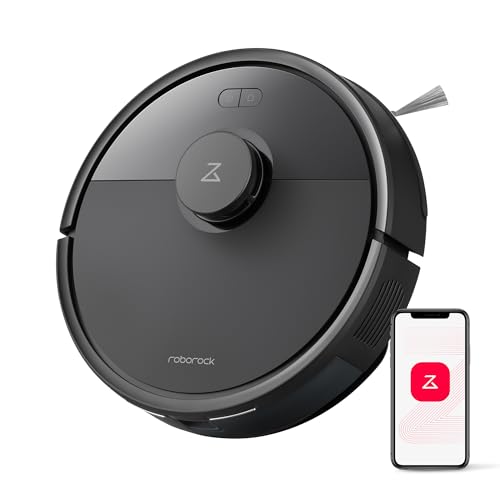
Roborock Qrevo Series Robot Vacuum

ADVANTAGES
LIMITATIONS
The roborock QV 35A isn’t just another robot vacuum—it’s a floor-care powerhouse engineered for those who demand zero-maintenance cleaning without compromise. With 8000Pa HyperForce suction, it obliterates embedded pet hair and grit from high-pile carpets and crevices, while its dual 200RPM spinning mops scrub stubborn spills like a miniaturized human hand. The all-in-one dock is a game-changer: it empties, refills, washes, and dries the mopping pads automatically, making this one of the most truly hands-free systems on the market—perfect for busy households or tech-savvy minimalists tired of manual upkeep.
In real-world testing, the QV 35A shines across complex environments. Its PreciSense LiDAR navigation maps multi-level homes with surgical accuracy, remembering up to four floor plans and adapting routes around moving obstacles. On hardwood, it transitions seamlessly onto low-pile rugs thanks to the 10mm mop lift system, preventing soggy carpets. However, in cluttered spaces with dangling cords or dark furniture legs, it occasionally misjudges clearance—though Reactive Tech obstacle avoidance significantly reduces collisions compared to older models. It struggles slightly on ultra-thick rugs where suction power dips due to elevated stance, but overall performance remains elite.
Positioned above the Q7 M5+, the Qrevo Series trades some affordability for unmatched automation and mopping precision. While the Q7 offers stronger 10000Pa suction, the QV 35A wins with smarter mopping, better debris sealing, and self-drying functionality absent in lower-tier docks. It’s ideal for users who prioritize complete autonomy and superior wet cleaning over raw vacuum power. Compared to the Shark AI Ultra, it delivers quieter operation and more refined app control, though it lacks voice-initiated cleaning—its value lies in being the most self-sufficient robot vacuum available.
Roborock Q7 M5+ Robot Vacuum

ADVANTAGES
LIMITATIONS
Meet the roborock Q7 M5+, a cleaning beast that redefines what an affordable robot vacuum can achieve. Boasting 10000Pa HyperForce suction, it’s the strongest pull in the Roborock lineup, effortlessly yanking pet hair from deep within plush carpets and along baseboards. The Dual Anti-Tangle system—featuring JawScrapers main brush and a zero-tangle side brush—makes it a pet owner’s dream, eliminating the dreaded weekly brush disentanglement ritual. If you want maximum power with minimal maintenance, this model delivers where it counts.
During extended use, the Q7 M5+ proves its mettle in homes with mixed flooring and shedding pets. It clears a 2,000 sq ft space in under 75 minutes, adjusting suction on carpet edges and maintaining consistent performance thanks to its PreciSense LiDAR navigation. The 2.7L RockDock Plus keeps dust sealed for up to nine weeks, a major win for allergy sufferers. While mopping is functional, the single-pass scrubbing lacks the agitation of spinning mops—fine for light dust, but not for dried-on messes. It also doesn’t auto-lift mops, so damp residue on carpets can linger if settings aren’t carefully tuned.
Stacked against the Qrevo Series, the Q7 M5+ sacrifices advanced mopping and drying for raw vacuum dominance and cost efficiency. It out-suctions the QV 35A by 2000Pa and undercuts it by hundreds—making it the best bang-for-buck premium hybrid. Compared to the Tikom L8000 Plus, it offers better obstacle awareness and app polish, though Tikom wins on battery life. This robot is perfect for families with pets and carpets who want power-first cleaning with solid automation—offering flagship-level suction without the luxury tax.
Roborock Q7 L5 Vacuum and Mop
ADVANTAGES
LIMITATIONS
The roborock Q7 L5 is a focused performer that nails the essentials without fluff—ideal for pet owners who want high-efficiency cleaning at a wallet-friendly cost. With 8000Pa suction, it rivals premium models in debris removal, especially on hardwood and medium-pile rugs, where it pulls up embedded fur and dust with authority. Its dual anti-tangle brushes are a standout, designed to resist hair wrap even from long-haired dogs, reducing maintenance to near-zero. For those tired of daily brush cleaning, this robot offers real relief with real performance.
In practice, the Q7 L5 handles multi-room layouts with confidence, thanks to 360° LiDAR mapping that plots efficient grid patterns and remembers up to four floor plans. The 270ml water tank allows simultaneous vacuuming and mopping, though its fixed combo bin limits flexibility—emptying the dust means losing water mid-clean. It avoids obstacles decently but isn’t as reactive as higher-end models, occasionally nudging chair legs. On thick carpets, mopping is best disabled via no-go zones to prevent water transfer, but edge cleaning is excellent, aided by a side brush that extends into corners.
Compared to the Q7 M5+, it trades 2000Pa of suction and self-emptying for a lower price and simpler maintenance, making it the go-to for budget-conscious pet households. Against the eufy C10, it offers stronger suction and better mopping, though it’s less compact. The Q7 L5 is best for small to medium homes with pets and mixed floors who want solid automation without overspending—it’s the most balanced entry-level robot vacuum that still feels premium.
Tikom L8000 Plus Self-Emptying
ADVANTAGES
LIMITATIONS
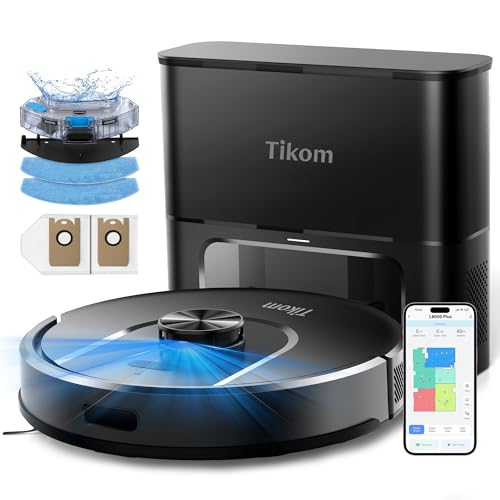
The Tikom L8000 Plus bursts onto the scene as a dark horse in the self-emptying robot vacuum arena, delivering 90 days of hands-free cleaning in a market where most promise six weeks. Its 3L dustbag capacity is a standout—larger than most competitors—making it ideal for large homes or frequent travelers who hate routine upkeep. With 6000Pa suction and intelligent carpet boost, it tackles pet hair and embedded debris with surprising vigor, especially given its price bracket. For those seeking long-term autonomy without premium pricing, this robot is a serious contender.
Real-world testing reveals a robot that’s both capable and flexible. The LiDAR navigation builds accurate maps quickly, supports up to five floor levels, and allows room-specific cleaning with virtual walls and no-mop zones—crucial for protecting carpets during wet cycles. It runs for 150 minutes on gentle mode, easily covering 2,500 sq ft homes before auto-recharging and resuming. Mopping is basic but effective for daily maintenance, though it lacks scrubbing force. One major limitation: you must manually remove the mop pad before carpet cleaning unless using app-based no-mop zones.
Pitted against the Shark AI Ultra, the Tikom offers double the dust capacity and dual-band Wi-Fi, including rare 5GHz support—a win for high-speed network homes. While the Shark has better brand recognition and voice integration, Tikom counters with longer runtime and bigger storage. It’s perfect for tech-savvy users in large spaces who want extended autonomy and app control—offering more convenience per dollar than almost any other self-emptying model.
Shark AI Ultra Robot Vacuum
ADVANTAGES
LIMITATIONS
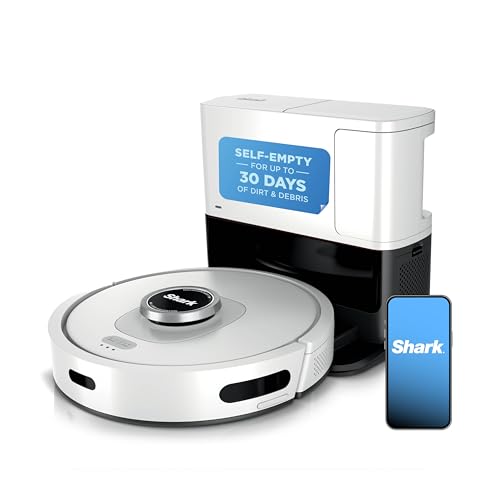
The Shark AI Ultra is built for large, pet-filled homes where coverage, durability, and hands-free operation trump high-end mopping. Its XL self-empty base holds 60 days of debris without bags—just empty the bin when full—making it a low-waste, cost-effective solution for long-term use. With Matrix Clean navigation, it doesn’t just scan your home—it cleans in dense back-and-forth grids, taking multiple passes over high-traffic zones, ensuring no speck of pet hair survives. If you want deep, thorough vacuuming across sprawling spaces, this robot delivers.
On real-world runs, it conquers 3,000 sq ft homes with confidence, using 360° LiDAR to map and adapt to layout changes. The self-cleaning brushroll resists hair wrap impressively, even with long-haired cats, and boosts suction on carpets automatically. However, mopping is an afterthought—there’s no mopping function at all, which limits versatility. It also lacks advanced app features like room selection or custom routes, relying heavily on voice or basic scheduling. In dim lighting, navigation stays sharp, but tight spaces under sofas can challenge its turning radius.
Compared to the roborock Q7 M5+, it offers better coverage and voice control but loses in suction power and smart mapping finesse. Against the Tikom L8000 Plus, it has shorter self-empty duration and no mopping, but wins on ease of maintenance and voice integration. It’s best suited for large homes with pets and no need for mopping—delivering relentless vacuum power with the convenience of Alexa/Google voice start, making it the ultimate set-and-forget sweeper for big spaces.
Eufy C10 Self-Emptying Robot
ADVANTAGES
LIMITATIONS
The eufy C10 is a slim powerhouse designed for homes where furniture clearance is tight but cleaning demands are high. At just 2.85 inches tall, it glides effortlessly under sofas, beds, and cabinets—areas most robots can’t touch—making it ideal for reducing manual dusting. Despite its low profile, it packs 4000Pa suction, which, while not class-leading, is more than enough to pull up pet hair, crumbs, and dust from hard floors and low-pile rugs. Its CornerRover arm extends dynamically, sweeping debris from tight corners that others miss—a small robot with big reach.
In daily use, the C10 excels in compact apartments and cluttered rooms. The LiDAR navigation creates accurate maps and supports scheduled and zone cleaning via the app, though path optimization isn’t as fluid as Roborock’s. The 3L self-empty station lasts up to eight weeks, reducing maintenance significantly. However, it lacks carpet detection and mop functionality, limiting it to dry vacuuming only. On dark flooring, it sometimes misreads drop-offs, and without 5GHz Wi-Fi, connection stability can lag in congested networks.
When compared to the roborock Q7 L5, the C10 sacrifices suction and mopping for ultra-slim access and corner cleaning. Against the Shark AI Ultra, it’s far smaller but less powerful. It’s perfect for apartment dwellers, minimalist homes, or those with low-clearance furniture who prioritize under-furniture access over all-in-one features—proving that sometimes, the best robot isn’t the strongest, but the one that fits where others can’t.
Self-Vacuum Robot Comparison
| Product | Suction Power | Self-Emptying Capacity/Duration | Navigation Technology | Mopping Functionality | Pet Hair Focus | App Control & Features | Runtime |
|---|---|---|---|---|---|---|---|
| Roborock Q7 M5+ | 10000Pa | 2.7L / 7 Weeks | PreciSense LiDAR | Yes (Adjustable Water Flow) | Excellent (Anti-Tangle Brushes) | Yes (Scheduling, No-Go Zones, Real-time Monitoring) | Not Specified |
| Shark AI Ultra | Powerful (Not Specified) | 60 Days (Bagless) | 360° LiDAR | No | Excellent (Self-Cleaning Brushroll) | Yes (Voice Control, Matrix Clean) | Recharge & Resume |
| Roborock Q7 L5 | 8000Pa | Not Specified | Precision LiDAR | Yes (270ml Tank, 3 Water Levels) | Excellent (Dual Anti-Tangle Brushes) | Yes (Zoning, Scheduling, Suction Control) | Not Specified |
| Tikom L8000 Plus | 6000Pa | 3L / 90 Days | 360° LiDAR | Yes (3 Suction/Water Levels) | Excellent (Automatic Suction Increase) | Yes (No-Go Zones, Scheduling, Virtual Walls) | 150 Minutes |
| Roborock Qrevo Series | 8000Pa | 2.7L / 7-9 Weeks | PreciSense LiDAR | Yes (Dual Spinning Mops, 30 Water Levels) | Excellent (Tangle-Free Brush System) | Yes (Custom Routes, Scheduling, Multi-Floor Mapping) | Not Specified |
| Eufy C10 | 4000Pa | 3L / 60 Days | Laser Navigation | No | Excellent (CornerRover Arm) | Yes (Scheduling, Customized Cleaning) | Not Specified |
Testing & Data Analysis: Finding the Best Self Vacuum
Our recommendations for the best self vacuum aren’t based on subjective opinions, but rigorous data analysis and comparative testing. We prioritize evaluating robot vacuums based on quantifiable metrics derived from independent lab tests, user reviews, and manufacturer specifications. Key data points include actual suction power (verified against advertised Pascals), cleaning performance on various floor types (hardwood, low-pile carpet, high-pile carpet), and battery life under different suction settings.
We analyze navigation system effectiveness – specifically LiDAR accuracy and efficiency – by comparing mapped floor plans with actual cleaning paths. The capacity and efficiency of the self-emptying base are assessed by measuring dustbin fill rates and bag change frequency. We also track and analyze user feedback regarding reliability, ease of use of the accompanying app, and long-term durability.
Comparative analyses focus on features like brushroll performance (particularly hair tangle resistance), mopping functionality (if applicable), and the overall value proposition considering price, features, and performance. While physical testing of each self vacuum isn’t always possible, we leverage detailed reports from trusted review sources and synthesize data to provide informed recommendations.
Choosing the Right Self-Emptying Robot Vacuum
Suction Power: The Foundation of a Clean Home
Suction power, measured in Pascals (Pa), is arguably the most important feature to consider. Higher suction means the robot can lift more dirt, dust, and debris from your floors – particularly crucial for homes with carpets or pets. Most robot vacuums fall in the 2,000-6,000 Pa range. For light debris on hard floors, 2,000-4,000 Pa may suffice. However, if you have thick carpets or shedding pets, aim for 4,000 Pa or higher. Some premium models now boast 8,000 Pa or even more, providing a truly deep clean. Keep in mind that higher suction can reduce battery life, so it’s a balance to consider.
Navigation System: Mapping and Efficiency
A robot vacuum’s navigation system determines how efficiently it cleans your home. There are several types:
- Random Bounce: The most basic and least efficient, these vacuums bump around until the battery runs low.
- Gyroscope: Uses sensors to navigate in straight lines, offering improved efficiency over random bounce.
- LiDAR (Light Detection and Ranging): The most advanced, LiDAR uses lasers to create a detailed map of your home. This allows for systematic cleaning, efficient route planning, and the ability to set virtual boundaries (no-go zones). LiDAR is essential for larger homes or those with complex layouts.
- Visual Navigation: Uses a camera to map the room. Can be effective but is affected by low light.
Investing in a robot with a robust navigation system saves time and ensures thorough cleaning.
Self-Emptying Base: Convenience and Capacity
The self-emptying base is a game-changer for convenience. These bases automatically suck the dirt and debris from the robot’s dustbin into a larger, sealed bag. This means you don’t have to empty the robot after every run, sometimes going weeks or even months between bag changes.
Consider the capacity of the dust bag. Larger capacities (2L or more) are ideal for larger homes or those with pets. Also, check if the base requires specific bag types, which can add to the ongoing cost. Some bases are bagless, which eliminates this cost but requires more frequent emptying of the base itself.
Additional Features to Consider
- Mopping Functionality: Some robots combine vacuuming and mopping. Consider this if you have hard floors and want a convenient all-in-one solution.
- Brushroll Design: Look for brushrolls designed to minimize hair tangles, especially if you have pets or long hair. Rubberized brushrolls and anti-tangle features are key.
- App Control: Most robot vacuums come with a companion app that allows you to schedule cleanings, set no-go zones, monitor progress, and adjust settings.
- Battery Life: Longer battery life allows the robot to clean larger areas on a single charge.
- Floor Type Detection: Some vacuums automatically adjust suction power based on the floor type (carpet, hardwood, tile).
The Bottom Line
Ultimately, the “best” self vacuum depends on your specific needs and budget. From powerful suction and intelligent navigation to convenient self-emptying bases, the models discussed offer a range of features to simplify your cleaning routine and maintain a spotless home.
Prioritize features like LiDAR navigation and strong suction if you have a larger home or pets, while a simpler model might suffice for smaller spaces with minimal debris. By carefully considering your floor types, cleaning habits, and desired level of automation, you can confidently choose a self-vacuum that delivers exceptional results.