
Cordless Vacuum vs Corded Vacuum: Which Is Right for You?
This post contains affiliate links. As an Amazon Associate, we earn from qualifying purchases.
The choice between a cordless vacuum and a corded vacuum comes down to three concrete factors: the square footage you need to clean in one session, the type of debris you tackle most often, and whether you prioritize unlimited power or total freedom of movement. For homes under 1,500 sq ft with mostly hard floors, a modern cordless stick vacuum like the Dyson V12 Detect Slim is the default. For whole-house cleans, deep carpets, or workshop duty, a corded vacuum’s consistent power wins.
That runtime number is the first lie you’ll encounter. A cordless vacuum’s advertised 60-minute runtime is measured in its lowest eco mode on a bare floor, not the auto or turbo mode you’ll actually use on a carpet. In real use, that 60 minutes becomes 20. The corded vacuum’s promise of unlimited power is real, but it trades that for a physical tether that dictates your cleaning path and reach.
What follows is a breakdown of power, runtime, and the specific tools that turn each type from a chore into a solution. By the end, you’ll know which category fits your home’s layout and your cleaning habits, not just the marketing claims.
Key Takeaways
- Cordless runtime is a best-case scenario. The 80-minute claim on a Bosch Unlimited 10 is for eco mode; switch to auto or turbo for pet hair and you’ll get 25–35 minutes before the battery demands a charge.
- Corded power is measured in airflow (CFM) and water lift (mbar). A workshop vac like the RIDGID HD1900 moves 202 cubic feet of air per minute, cordless vacuums don’t publish this figure because they can’t compete on sustained suction.
- Automatic dust sensors only matter on cordless models. They preserve battery by ramping up power only when needed, which is why a Bosch with a sensor can outperform a Dyson in lab tests using default auto modes.
- Your floor type decides the winner. Cordless excels on hard floors and low-pile rugs where maneuverability is key. Corded uprights and canisters are necessary for deep-cleaning wall-to-wall carpet.
- The “one vacuum” solution doesn’t exist. Plan for a cordless stick for daily quick cleans and a corded machine for weekly deep cleans or workshop messes.
The Corded vs. Corded Power & Runtime Trade-Off
This isn’t about convenience. It’s an engineering trade-off between stored energy and direct current.
A corded vacuum plugs into a wall outlet that delivers a continuous 1,200 to 1,400 watts of power. There’s no battery to deplete, so suction doesn’t fade from the first minute to the sixtieth. The measure here is air movement. A RIDGID HD1900 wet/dry vac delivers 202 CFM (cubic feet per minute) and 396 air watts, specs that let it pick up a 2×4 wood scrap. This is raw, sustained power for big jobs.
A corded vacuum’s motor draws power directly from your home’s electrical system. This allows for larger, more powerful motors that generate consistent high suction and airflow, measured in CFM and water lift (mbar), without the performance decay of a discharging battery.
A cordless vacuum runs on a battery, typically an 18V to 25.2V lithium-ion pack. Its power is limited by what that battery can discharge safely before overheating. The motor is smaller, and the suction is brilliant but finite. The Bosch Unlimited 10’s claim of “up to 80 min. Runtime” is a lab result under perfect, minimal-load conditions. In your home, using the auto mode that engages the dust sensor, you’ll get half that.
The table below shows how the specs translate to real-world use. Notice that corded vacuums list motor wattage and airflow; cordless vacuums list voltage and estimated runtime.
| Specification | Cordless Vacuum (e.g., Bosch Unlimited 10) | Corded Vacuum (e.g., RIDGID HD1900) |
|---|---|---|
| Power Source | 18V Lithium-ion Battery | 120V Wall Outlet |
| Key Metric | Runtime (Up to 80 min. In Eco mode) | Airflow (202 CFM) |
| Suction Consistency | Declines as battery depletes | Constant from start to finish |
| Best-Use Time | 25–35 minutes in Auto/Turbo mode | Unlimited |
Where this goes sideways: Buying a cordless vacuum for its max runtime number. You will never clean in eco mode on a bare floor for 80 minutes straight. Your cleaning mixes floor types and debris, which triggers higher power modes and slashes that number.
Who Actually Wins for Your Floors?
The debate ends at your baseboards. Your flooring material dictates which vacuum type can clean it effectively, not just quickly.
For Hardwood, Tile, and Low-Pile Rugs: Cordless. The agility of a lightweight stick vacuum is unbeatable here. Models like the Dyson V12 Detect Slim (7.6 lbs) swivel easily around furniture legs and kitchen table feet. The laser on the Fluffy Optic head reveals dust you’d otherwise miss. On hard floors, you don’t need the massive suction of a corded machine; you need precision and ease of movement. A good cordless stick vacuum is the right tool for this job.
For Wall-to-Wall Carpet and High-Pile Rugs: Corded. Deep carpet fibers trap dirt at the base. Dislodging it requires a motor strong enough to create high airflow (CFM) that lifts the carpet pile and pulls the dirt out. This is where even the best cordless vacuums hit a wall. A corded upright or canister vacuum, with its larger motor and often a motorized brush roll, provides the sustained power needed for a deep, restorative clean. For pet owners, this is non-negotiable for removing embedded hair and dander.
For Workshops, Garages, and Wet Messes: Corded. This is a total mismatch. A cordless vacuum’s dustbin is too small, its filter clogs with fine dust, and its battery will die mid-job. A corded shop vacuum like the Kärcher WD 7 Control is built for this. It has a 30-liter stainless steel tank, a 6-meter power cord, and a HEPA filter system designed for drywall dust. Its integrated power outlet even turns the vacuum on automatically when you start your corded sander.
The Hidden Features That Reshape the Fight
Beyond power cords and batteries, modern features redefine what each type can do. These aren’t gimmicks, they change the user experience fundamentally.
Cordless Intelligence: Dust Sensors and Auto Mode. This is the biggest advancement in cordless tech. Vacuums like the Bosch Unlimited 10 and Dyson Gen5detect have optical sensors that detect dust density in real-time. The vacuum automatically increases suction when it sees more dirt, then drops back to save battery. In a Wirecutter cordless stick vacuum guide, this automatic adjustment was noted as key for efficient cleaning. It means the vacuum uses its limited battery power strategically, which can lead to better cleaning results in default mode compared to a dumb, full-power blast.
Corded Tool Synchronization. For workshop vacuums, this is a game-changer. The Kärcher WD 7 Control has a “2-in-1 remote control” with automatic vibration detection. Start your cordless drill, and the vacuum turns on. Stop drilling, and it runs for a few more seconds to clear the hose, then shuts off. This is a consumer guide to cordless vacuums for tools, not homes. It’s a specific solution for a specific problem that cordless home vacuums can’t address.
Common mistake: Using a cordless vacuum’s turbo mode for an entire cleaning session. This drains the battery up to three times faster than auto mode, often without a noticeable improvement in clean results on hard floors. You get a dead vacuum and a half-cleaned home.
The other hidden factor is maintenance. A cordless vacuum with a removable battery (like many Ryobi models) extends the machine’s life. A corded vacuum with a washable HEPA filter (like the RIDGID WD1850) saves money and maintains performance. These design choices impact long-term cost and convenience more than the initial price.
Cordless Vacuum vs Corded: Direct Comparison by Scenario
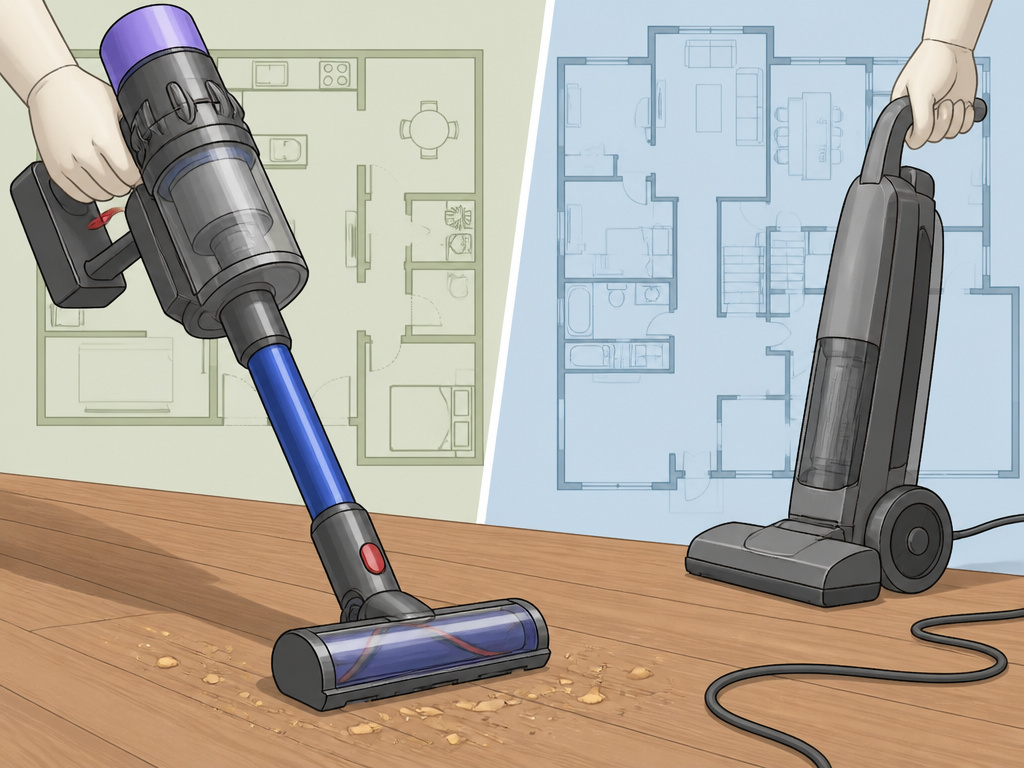 Should you buy one or the other? The answer is almost always “both, for different jobs.” But if you must choose a single primary vacuum, this table matches the tool to your dominant cleaning reality.
| Your Primary Cleaning Scenario | Recommended Type | Why It Wins | A Top-Tier Example |
|---|---|---|---|
| Daily quick cleans (crumbs, pet hair) | Cordless Stick | Lightweight, instantly available, perfect for quick pickups. | Dyson V12 Detect Slim |
| Whole-house weekly clean (1500+ sq ft) | Corded Upright/Canister | Unlimited runtime, deeper carpet cleaning, no battery anxiety. | Miele Classic C1 Cat & Dog |
| Apartment living (hard floors, small space) | Cordless Stick | Easy storage, maneuverability, sufficient power for small areas. | Bosch Unlimited 10 |
| Workshop & renovation cleanup | Corded Wet/Dry Vac | Massive capacity, tool-activation, power for heavy debris. | RIDGID HD1900 |
| Home with shedding pets & carpets | Both (Cordless for daily, Corded for weekly) | Cordless gets surface hair daily; corded extracts embedded dander weekly. | Dyson for daily, Sebo for weekly |
The evidence for needing both isn’t theoretical. Consumer Reports lab-tested vacuum reviews consistently show that while cordless vacuums excel on hard floors, their performance on medium-pile and deep carpet still lags behind that of a good corded upright. Your floors are a system, and you need the right tool for each layer of that system.
Before You Buy: The 3 Questions That Give You the Answer
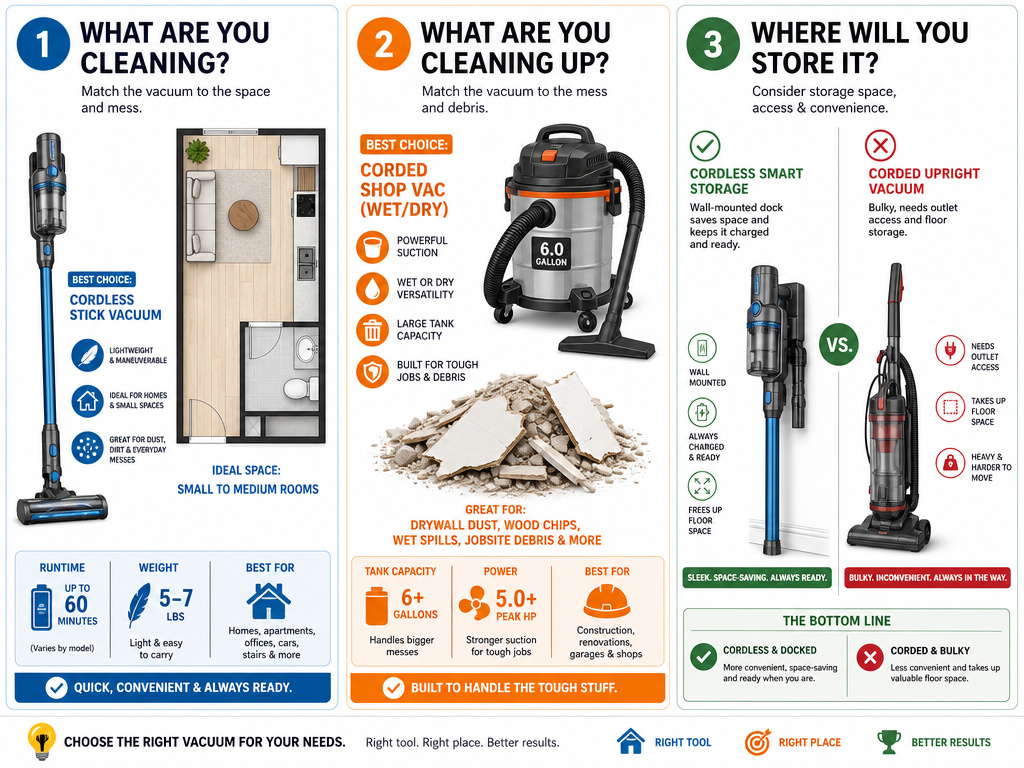 Stop looking at marketing. Answer these questions honestly, and the choice makes itself.
- What is the largest area you will clean without stopping? If it’s a single room or a quick kitchen pass, cordless is fine. If it’s your entire downstairs living area, a corded vacuum’s unlimited runtime is not a luxury, it’s a requirement.
- What is your worst cleaning task? Is it fine dust on hardwood? A cordless vacuum with a soft roller brush is your fix. Is it wet drywall mud in the garage? Only a corded shop vac with a large tank and a drain plug will work.
- Where will you store it? A cordless vacuum needs a wall dock or closet corner. A corded upright needs floor space. A canister needs closet depth. If you have to drag a heavy corded vacuum up from a basement, you’ll use it less. Convenience drives frequency.
If you answer these and still see a 50/50 split, your home is telling you something. You might need two tools. Start with the tool for your most frequent task, likely a cordless stick vacuum for daily messes, and add a corded vacuum later for the deep cleans.
Frequently Asked Questions
Is a cordless vacuum as powerful as a corded one?
On paper, for the first 30 seconds, some high-end cordless models can match the peak suction of a corded vacuum. However, a corded vacuum maintains its maximum power continuously, while a cordless vacuum’s power output drops as the battery discharges. For sustained, heavy-duty cleaning, corded power is unbeatable.
How long do cordless vacuum batteries really last?
Lithium-ion battery in a vacuum typically lasts 2 to 5 years before its capacity significantly degrades. The runtime per charge decreases by about 10-20% each year. Choosing a model with a removable battery lets you replace it and extend the vacuum’s life, rather than replacing the entire machine.
Can you use a corded shop vacuum indoors?
Yes, but you must use the correct filter. For dry fine dust (like drywall or fireplace ash), you need a HEPA filter bag and a HEPA after-filter to trap particles and prevent them from being blown back into the room. Without this setup, you are just recirculating dust.
What does “M-class” mean on a corded dust extractor?
M-class is a European certification for dust extractors, indicating they filter at least 99.9% of dust down to 0.3 microns. It’s a safety standard for hazardous dusts like concrete silica or certain wood dusts. A vacuum like the Bosch GAS 35 M AFC has this certification, making it suitable for professional renovation work.
Are cordless vacuums worth the high price?
They are worth it for the specific convenience they provide: quick daily cleanups without the hassle of a cord. If your primary need is a fast, lightweight tool for maintaining already-clean floors, they are excellent. If your primary need is deep-cleaning power for large, carpeted areas, their high price is harder to justify compared to a similarly priced corded vacuum.
Which type is better for pet hair?
You need a two-pronged approach. A cordless vacuum with an anti-tangle brush roll (like the Dyson Gen5detect) is perfect for daily removal of surface pet hair. For hair and dander embedded deep in upholstery and carpet, a corded pet vacuum with a powerful motorized brush and sealed HEPA filtration is necessary for a truly deep, allergen-reducing clean.
The Bottom Line
The cordless vacuum offers freedom and immediacy for daily life. The corded vacuum offers relentless power for deep cleaning and big jobs. Most homes are best served by owning both: a cordless stick for the daily battle against crumbs and dust, and a corded machine for the weekly war on dirt.
For the single-vacuum solution, let your largest floor type decide. All hard floors? Get a Dyson V12 Detect Slim. Mostly carpet? Get a Miele canister. Trying to force one type to do everything is how you end up with a dead battery mid-clean and a closet full of resentment. Pick the right tool, and cleaning stops being a debate and starts being a solved problem.