
Vacuum Cleaner vs Steam Cleaner: Key Differences & Best Uses
This post contains affiliate links. As an Amazon Associate, we earn from qualifying purchases.
A vacuum cleaner removes loose dry debris with suction and filtration. A steam cleaner sanitizes and lifts stuck-on grime with pressurized, high-temperature steam and often uses a vacuum to extract the dirty water. You need a vacuum for weekly maintenance on carpets and hard floors. You need a steam cleaner for periodic deep cleaning and disinfection of hard surfaces, tiles, and sealed grout.
The distinction isn’t about which one is “better.” It’s about which tool matches the physical state of the dirt you’re fighting. Dry, loose particles respond to airflow. Grease, biofilms, and dried spills require heat and moisture to break their bond to the surface. Picking the wrong tool doesn’t just waste time; it can damage the machine.
What follows is a breakdown of the mechanisms, the failure modes, and the hard numbers on water and time. By the end, you’ll know whether your next purchase should be a Philips PowerPro Expert for daily drudgery, a Kärcher SC 4 for kitchen tiles, or if you’re in the minority of homes that genuinely needs both.
Key Takeaways
- Vacuum cleaners are for dry pickup only. Introducing liquid kills the motor filter and voids warranties, as noted in Electrolux manuals.
- Steam cleaners work on a heat-and-extract principle, using steam around 145°C at up to 4 bar pressure to dissolve grime, then a vacuum function to pull the dirty water back in.
- For deep-cleaning carpets, you need a dedicated carpet steam cleaner or steam vacuum for carpets, not a standard hard-surface steam mop.
- A 2019 hospital study found steam cleaning used 90% less water and 50% less staff time than chemical methods for the same microbial kill rate.
- Most households need a good vacuum. Add a steam cleaner only if you have extensive hard flooring, allergies, or pets that cause frequent biological messes.
What Each Machine Actually Does (Mechanically)
They look similar. They both have nozzles, cords, and tanks. But their internal physics are opposites. Confusing them is how you end up with a broken vacuum or a perpetually damp, smelly floor.
A vacuum cleaner creates a pressure differential. A motor spinning at over 50,000 RPM (like the one in the Philips FC9747/09) forces air out of a sealed chamber, lowering the pressure inside. Higher-pressure air from your floor rushes in through the nozzle, carrying dust and hair with it. That debris is captured by a HEPA filter or a dust bag before the air is exhausted.
The suction is only half the job. The filtration is the other half. A bagless model like the Philips PowerPro Expert uses PowerCyclone 8 technology, air swirling at over 185 km/h, to fling heavier particles into a bin before they reach the main filter. This keeps suction strong. The goal is moving air to move dirt.
A steam cleaner is a pressurized boiler on wheels.
A steam cleaner heats water in a sealed tank to around 145°C, generating steam at pressures up to 4 bar (per the Kärcher SG 4/4 professional datasheet). This superheated, dry steam is forced through a nozzle onto a surface. The thermal energy breaks the bonds between dirt and the floor, and the pressure helps blast it loose. Most models then use a separate vacuum motor to suck the now-dirty water into a recovery tank.
The critical word is “dry.” Effective steam is vapor, not a puddle of hot water. A good machine delivers steam with low moisture content so surfaces dry quickly, preventing mildew.
The Core Jobs: Weekly Pickup vs. Periodic Purge
Your cleaning schedule dictates which machine earns its keep. A vacuum handles frequency. A steam cleaner handles intensity.
The Vacuum’s Domain: Dry Debris Management
This is a daily or weekly task. It’s about removing surface-level allergens, dust, sand, and pet hair before they get ground in. * Carpets: Suction lifts pile and pulls out embedded grit. A motorized brush roll (like on a Kenmore BU1018) agitates the fibers. * Hard Floors: Suction alone works, but a soft roller or a switch to turn off the brush roll prevents scattering. * Upholstery & Drapes: Use the hose and attachments. The goal is surface cleaning without moisture.
The vacuum’s success is measured by what’s not in the air you breathe back out. Hence the importance of a true HEPA filter system, which traps 99.97% of particles down to 0.3 microns.
The Steam Cleaner’s Domain: Sanitization and Deep Extraction
This is a monthly or seasonal task. It’s for situations where “clean” means “free of pathogens and sticky residues.” * Sealed Hard Floors (Tile, Vinyl, Sealed Hardwood): Steam dissolves spilled juice, cooking grease, and tracked-in mud without chemicals. It’s the tool for kitchen and bathroom floors. * Grout Lines: Pressurized steam blasts into the porous surface, removing mold and discoloration that wiping can’t touch. * Appliance Exteriors & Windows: Steam cuts through greasy film on stovetops and fridge doors, leaving a streak-free finish. * Sanitization: The heat, not chemicals, does the work. The Kärcher SC 3 EasyFix claims removal of 99.999% of viruses on hard surfaces, following a specific protocol.
Where this goes sideways: Using a steam mop on unsealed wood or porous stone. The moisture will warp wood and degrade the stone’s finish within a few cleaning cycles. Know your floor’s seal.
| Job | Vacuum Cleaner | Steam Cleaner | Winner |
|---|---|---|---|
| Pet Hair on Carpet | Suction + brush roll lifts it. | Ineffective; wets hair into a mat. | Vacuum |
| Dried Mud on Tile | Picks up loose bits, smears the rest. | Steam loosens entire patch for easy wipe. | Steam Cleaner |
| Allergen Reduction (Dust Mites) | HEPA filtration traps allergens. | Heat kills mites, but doesn’t remove carcasses. | Vacuum first, then steam. |
| Spring Deep Clean | Essential first step to remove loose dirt. | Essential second step to sanitize surfaces. | Both, in sequence. |
The Cost & Time Math Most Comparisons Skip
Commodity advice says “steam cleaners are more work.” The data from actual use, especially in professional settings, shows a different trade-off: higher upfront cost for massive savings in consumables and labor.
Let’s break down the real resource costs, drawn from the PMC peer-reviewed cleaning study in a hospital ICU.
The Consumables War: Water & Chemicals
A vacuum uses almost no consumables beyond bags or filter replacements. Its “fuel” is electricity. A steam cleaner’s consumable is water, but far less than you’d use with a mop and bucket.
The study compared three methods for disinfecting a hospital room: 1. Two-step clean: Detergent, then 5,000 ppm bleach. 2. Two-step clean: Detergent, then 1,000 ppm bleach. 3. Steam technology alone.
| Method | Water Used per Bed | Chemical Cost per Bed | Staff Time per Bed |
|---|---|---|---|
| 5,000 ppm Bleach | 33 Liters | $0.91 | 20 Minutes |
| 1,000 ppm Bleach | 33 Liters | $2.44 | 20 Minutes |
| Steam Technology | 3 Liters | $0.22 | 10 Minutes |
The steam method used 90% less water. It was 76–91% cheaper than chemical methods because it used zero detergent or bleach. It also cut labor time in half. The thermal energy for the steam came from the wall outlet; the “chemical” was tap water.
For a home, this translates to no more buying floor cleaners, disinfectant sprays, or grout bleach. You trade that recurring cost for the higher initial purchase price of a machine like a Rowenta Steam Power or a Kärcher. Over five years, the math often favors the steam cleaner if you currently buy specialty cleaners.
The Time Investment Reality
Yes, you must fill the tank and wait for it to heat (4 minutes for a Kärcher SC 4, 9 minutes for a professional SG 4/4). You also empty the dirty water tank after. But you skip: measuring chemicals, rinsing to avoid residue, waiting for surfaces to dry from excess liquid, and ventilating fumes. The total hands-on time for a kitchen floor can be a wash. The advantage is in the result, a sanitized surface, not just a visually clean one.
Failure Modes & What Breaks First
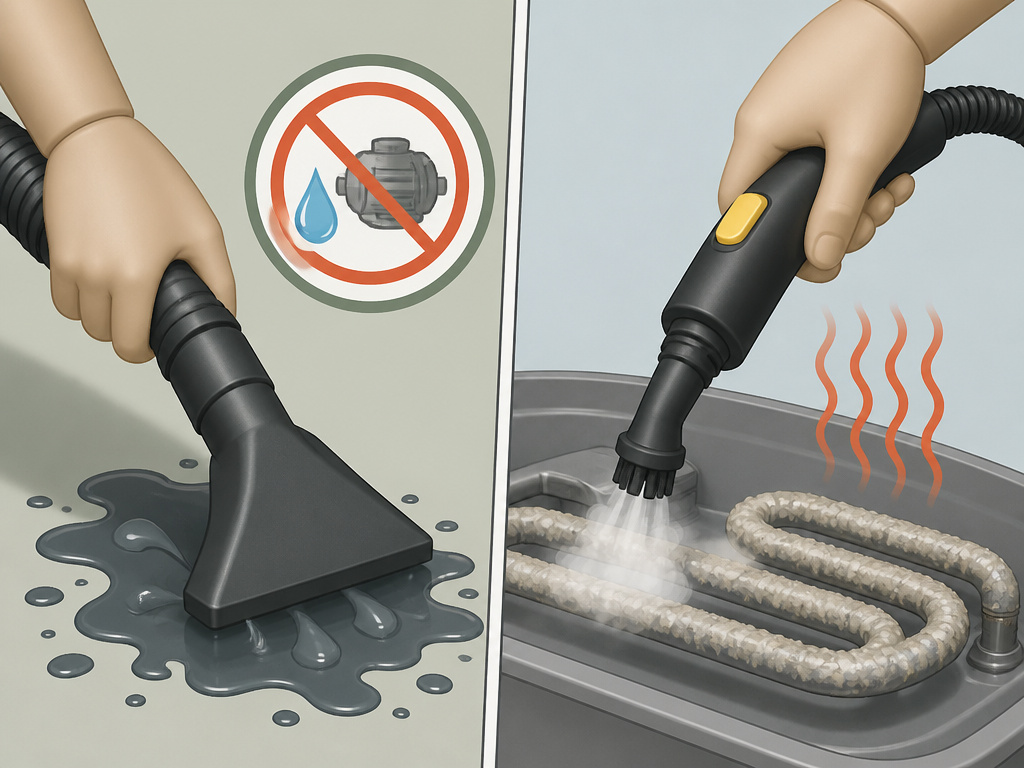
These machines fail in predictable ways. The failures are almost always because the user forced them to do the other machine’s job.
How to Kill a Vacuum Cleaner
The number one cause of motor death is liquid. 1. Vacuuming Wet Debris: This includes wet pet food, spilled drinks, or a damp carpet after a shampoo. The Electrolux manual states it plainly: “Damage to the motor caused by water or liquids is not covered by the warranty.” Moisture coats the fine dust on the motor filter, creating a paste that chokes airflow. The motor overheats and burns out. 2. Clogging the Air Path: Suction is a flow. If the hose, nozzle, or filter is blocked by a sock or a dense clump of hair, the motor strains against zero airflow. It will get hot, smell like burning plastic, and eventually fail. 3. Neglecting the Filter: A clogged filter has the same effect as a blockage. Airflow drops, suction vanishes, and the motor works harder to pull air through the mud-like barrier. On bagless models, this can happen within a month if you have pets.
How to Kill a Steam Cleaner
Steam cleaners are killed by neglect and mineral scale. 1. Using Hard Water: Heating tap water with high mineral content (calcium, lime) leaves scale deposits inside the boiler tank. Over time, this scale insulates the heating element, making it less efficient and eventually causing it to overheat and burn out. The fix is using distilled water or the manufacturer’s descaling sticks. 2. Not Emptying the Recovery Tank: The dirty water you suck up is full of soil and bacteria. Leaving it in the sealed tank for weeks creates a biofilm that smells and can clog the internal tubing. Empty and rinse it after every use. 3. Running it Dry: Most have a low-water cutoff, but repeatedly letting the boiler run dry stresses the heating element. The sound changes from a steady hiss to a louder, rattling boil.
Vacuum Types vs. Steam Cleaner Types: A Matchmaking Guide
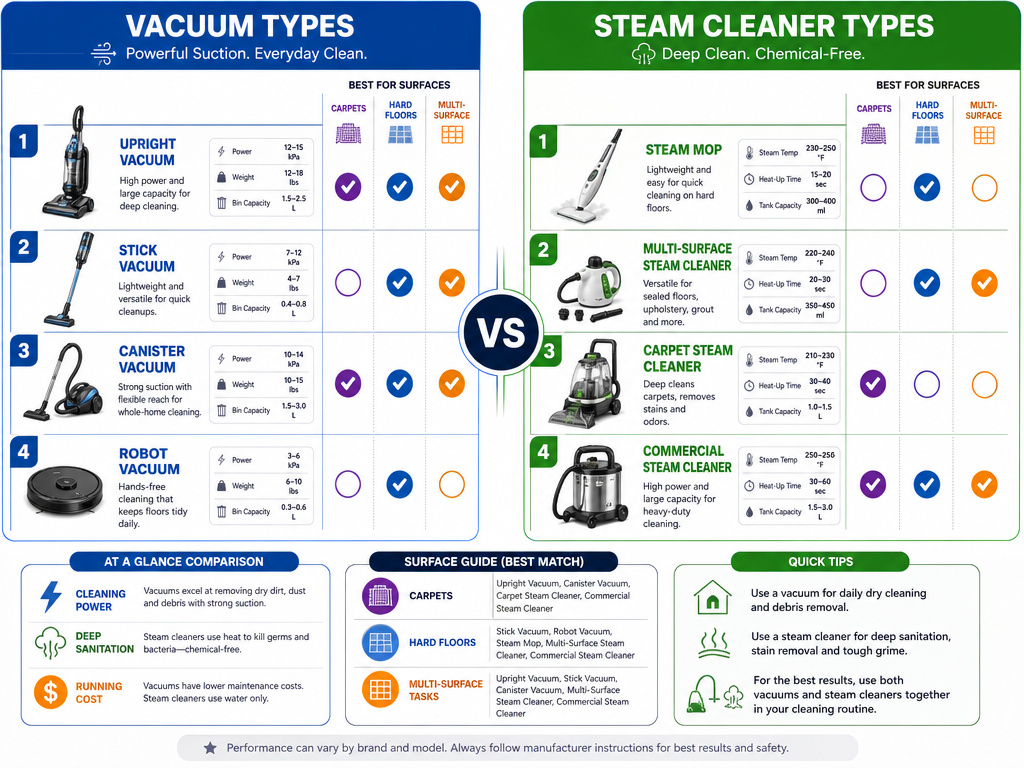
Not all vacuums are equal. Not all steam cleaners are for floors. Picking the right subtype is as important as choosing the category.
Vacuum Cleaner Ecosystem
- Upright/Corded (Philips FC9747/09, Kenmore BU1018): Maximum sustained power for whole-house cleaning. Best for large carpeted areas. The trade-off is weight and bulk.
- Stick/Cordless (Philips SpeedPro Max, Kärcher VC 6 Cordless Premium): Agility and convenience for quick cleanups and hard floors. The Kärcher VC 6 offers 50 minutes of runtime. The trade-off is smaller dust bins and less suction endurance for deep carpets.
- Canister: Powerful and versatile, with a separate motor unit and long hose. Excellent for stairs, cars, and above-floor cleaning. The trade-off is awkward storage and maneuvering.
- Robot (Samsung Jet Bot): Maintenance cleaning. Runs daily to keep surface dust down. The trade-off is it cannot deep clean or handle corners well.
Steam Cleaner Ecosystem
- Steam Mops (Rowenta Steam Power): Lightweight, purpose-built for sealed hard floors. They have a simple pad system. They do not have a vacuum recovery function, they steam and you mop up the residue. Good for quick kitchen cleans.
- Multi-Surface Steam Cleaners (Kärcher SC 4): The home-owner’s workhorse. They have a boiler, a hose, hand tools, and often a floor nozzle. They apply steam but rely on wiping or a small vacuum function. Ideal for countertops, windows, and floors.
- Carpet Steam Cleaners / “Steam Vacuums”: These are the heavy-duty hybrids. They spray a hot cleaning solution, agitate it with brushes, and use powerful wet-dry vacuum suction to extract the dirty water. This is what you rent for annual carpet cleaning. For a purchase, look at dedicated steam vacuum cleaner models.
- Commercial Steam Cleaners (Kärcher SG 4/4): Higher pressure (4 bar), larger tanks, and certifications like EN 16615 for disinfection. Overkill for a home, but the benchmark for performance.
Common mistake: Buying a basic steam mop to “deep clean” a carpet. It will only dampen the surface, potentially driving dirt deeper and creating a mildew risk. For carpets, you need extraction.
The Verdict: Which One Do You Actually Need?
Most homes need a capable vacuum first. It’s the foundation. The question is whether your situation justifies adding a steam cleaner’s specialized capabilities.
You need only a vacuum if:
- Your home is mostly carpet.
- Your hard floors are limited and you’re happy with a damp-mop routine.
- Your primary concern is dust, pet hair, and dry allergens.
- Your cleaning philosophy is “quick and tidy.”
Get a corded upright for power or a high-performance stick vacuum like the Kärcher VC 7 Signature Line for convenience. Check the Consumer Reports vacuum ratings for the latest lab-tested frontrunners.
You need to add a steam cleaner if:
- You have extensive tile, vinyl, or sealed hardwood floors.
- You have allergies or sensitivities to chemical cleaners.
- You have pets or young children, leading to frequent biological messes.
- You see grout discoloration or want a truly sanitized kitchen/bathroom.
Start with a multi-surface steam cleaner like the Kärcher SC 4. It’s the most versatile entry point. If you have significant carpeting, look at a dedicated steam vacuum for carpets for your annual deep clean.
Consider a combo machine if:
Your space is small (apartment, condo) and you want one device. A true steam vacuum cleaner combo exists, but be wary. Most are compromises, mediocre at dry vacuuming and underpowered on steam. They can be a good fit if your needs are light and your storage space is minimal.
Frequently Asked Questions
Can a steam cleaner replace a vacuum?
No. A steam cleaner is designed for washing and sanitizing hard, non-porous surfaces. It requires the surface to be free of loose dirt first, or you’ll just steam dirt into a muddy paste. You must vacuum thoroughly before you steam.
Is steam cleaning better than vacuuming?
It’s not “better,” it’s different. Vacuuming is a mechanical dry removal process. Steam cleaning is a thermal cleaning and sanitizing process. For removing dust and allergens from carpets, vacuuming is irreplaceable. For killing bacteria and removing sticky residues from tile, steam is superior.
Can I use a steam cleaner on carpet?
Only with a specific type of machine: a carpet steam cleaner or extractor. These machines inject a cleaning solution, agitate it, and, crucially, use strong vacuum suction to pull the dirty water back out. A standard hard-surface steam mop will only wet your carpet, which can lead to mold and mildew in the pad.
Do steam cleaners use chemicals?
Pure steam cleaners use only water. The high temperature (typically 140–160°C) is what sanitizes. Some models have a separate compartment for adding a cleaning solution for especially greasy jobs, but it is not required for disinfection. This chemical-free operation is a key advantage documented in the steam technology comparison research.
What should I not steam clean?
Do not use a steam cleaner on unsealed hardwood, unglazed tile, porous stone (like marble or limestone), painted surfaces that might peel, or delicate fabrics. The heat and moisture can cause warping, cracking, or damage to the finish.
Before You Go
The choice isn’t vacuum or steam. It’s vacuum first, then steam if your floors and tolerance for chemicals demand it. A good vacuum is non-negotiable home maintenance. A steam cleaner is a strategic upgrade for deep hygiene.
Invest in a vacuum that won’t quit, prioritize a sealed HEPA system and a motor with a strong warranty. If you add steam, start with a versatile multi-surface model and use distilled water. Remember the sequence: dry clean, then wet sanitize. That order keeps both machines, and your floors, working for years.