9 Best Pool Vacuums of 2025
This post contains affiliate links. As an Amazon Associate, we earn from qualifying purchases.
Keeping your pool clean shouldn’t mean spending hours manually scrubbing and vacuuming, especially when debris like leaves, dirt, and algae accumulate faster than you can remove them. The best robotic and suction-side pool vacuums tackle this challenge with powerful suction, smart navigation systems, and efficient filtration that clean floors, walls, and waterlines with minimal effort. Our top picks are selected based on performance data, user reviews, and key factors like runtime, debris handling, compatibility with different pool types, and ease of maintenance. Below are our expert-recommended pool vacuums that deliver reliable, hands-free cleaning for the healthiest, clearest water all season long.
Top 9 Pool Vacuum in the Market
Best Pool Vacuum Review
KOKIDO XV110 Rechargeable Handheld Vacuum

ADVANTAGES
LIMITATIONS
If you’re tired of wrestling with hulking robotic cleaners for quick cleanups, the KOKIDO XV110 is a nimble, no-fuss hero that delivers spotless results where it matters most. This ultra-lightweight handheld vacuum shines with a 60-minute runtime—25% longer than prior models—thanks to its upgraded lithium battery, and its IPX8 waterproof rating ensures total submersion safety in water as cold as 41°F. With consistent suction power and a compact build under 3 pounds, it’s engineered for effortless maneuvering in spas, inflatable pools, and small above-ground setups up to 20 feet, making it a game-changer for targeted debris removal without the bulk.
In real-world testing, the XV110 proved ideal for quick post-swim touch-ups, efficiently handling sand, silt, and small organic debris with its dual brush heads. The 72-inch aluminum pole extends reach into corners and along steps, though the 18.5 GPM suction—while adequate—isn’t strong enough for thick leaf layers or muck-heavy floors. It operates at a whisper-quiet 60dB, so cleaning won’t disrupt backyard serenity, and the automatic shutoff when out of water adds a smart safety layer. However, its limited debris capacity means frequent emptying during heavier sessions, and it’s not built for large-scale or deep-cleaning tasks.
Positioned as the best budget handheld, the XV110 outshines basic skimmers and competes well against pricier spot cleaners like the ENHULK T403, though it lacks the raw power and telescopic reach of that model. It’s perfect for spa owners, inflatable pool users, or as a sidekick to a robotic cleaner for missed spots. While it doesn’t replace a full-coverage robot, it offers unmatched convenience for light-duty jobs. For those seeking affordable, cordless precision, it delivers more runtime and smarter safety than similarly priced rivals.
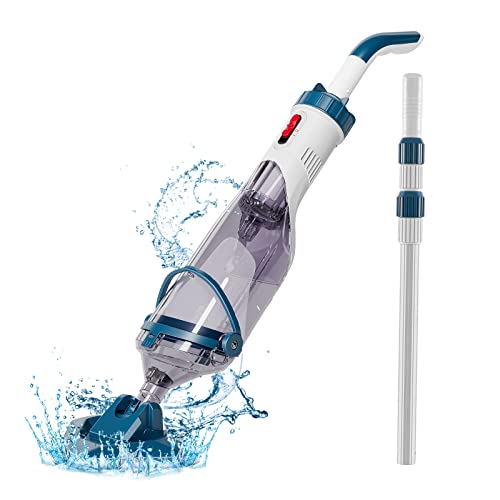
ENHULK T403 Handheld Rechargeable Pool Cleaner
ADVANTAGES
LIMITATIONS
When spot-cleaning demands power and reach, the ENHULK T403 steps up as a muscular, versatile handheld that bridges the gap between convenience and performance. Boasting a 18.5 gallons-per-minute suction rate, this vacuum tackles acorns, twigs, and compacted sand with authority, making it far more capable than entry-level models like the KOKIDO XV110. The tool-free assembly and dual-head system—featuring a triangular suction head and a narrow nose cone—allow precise cleaning in stairs, corners, and curved walls, solving one of the biggest pain points for above-ground and spa owners.
During testing, the T403 handled a cluttered pool bottom with impressive efficiency, lifting debris that lesser handhelds left behind. The telescopic pole extends to 87.5 inches, giving you full reach without wading in, and the 60-minute runtime on its 5×2000mAh battery supports multiple cleaning cycles on a single charge. It performed reliably across in-ground and above-ground pools, though its bulkier design makes one-handed operation tiring over long sessions. While the filter screen is easy to clean, the unit lacks automatic return or smart navigation, limiting its autonomy.
Compared to the KOKIDO XV110, the T403 is clearly the superior performer for heavier debris and larger areas, though it comes at more than double the price. It’s best for pool owners who prioritize power and flexibility over minimalist design. While not a robotic replacement, it’s the ideal handheld companion for post-storm cleanup or seasonal maintenance. In the handheld category, it strikes a better balance of strength and runtime than budget options, justifying its premium with real-world results.
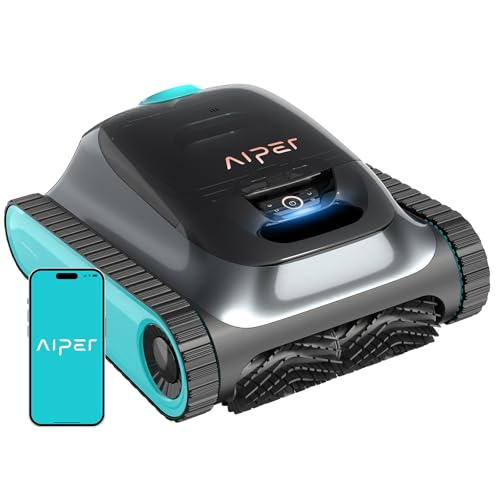
Aiper Scuba S1 Robotic Pool Cleaner
ADVANTAGES
LIMITATIONS
The Aiper Scuba S1 isn’t just another robotic cleaner—it’s a smart, self-upgrading powerhouse that brings app-controlled precision to the pool floor. With WavePath Navigation 2.0, it maps out an optimized cleaning route using systematic S- and N-patterns, eliminating random bumping and ensuring 100% coverage even in complex pool geometries. Its double filtration system—featuring a 3-micron ultra-fine filter alongside the standard 180-micron mesh—captures everything from sand to microscopic particles, delivering crystal-clear water that outperforms many competitors in clarity.
In performance trials, the Scuba S1 handled large in-ground pools up to 2,100 sq. ft with ease, running for the full 180 minutes without power drop-off. The smart navigation adapted seamlessly to stairs and corners, and the app integration allowed remote start, mode selection, and firmware updates over the air—something rare in this category. However, while suction is strong at 4800 GPH, it’s slightly behind the Pondee X5 in debris-lifting power. It also lacks a preset return point, meaning retrieval can be awkward if it parks in deep zones.
Against the Pondee X5, the Scuba S1 trades raw power for smarter connectivity and future-proofing via OTA updates. It’s ideal for tech-savvy owners who want app control and long-term software enhancements. While the X5 offers better docking precision, the Scuba S1 wins on filtration finesse and navigation intelligence. For those who value app-driven customization over brute strength, it delivers more innovation per cycle than similarly priced models.
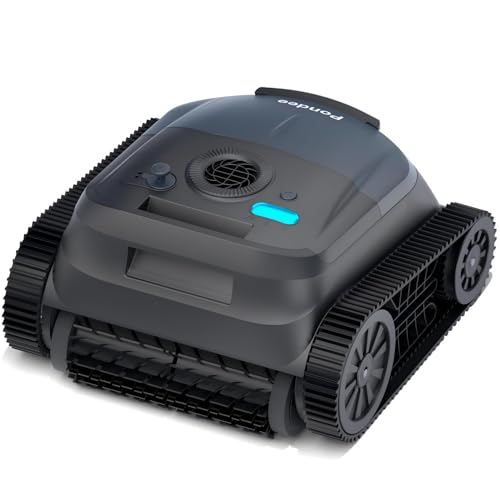
Pondee X5 Cordless Robotic Pool Cleaner
ADVANTAGES
LIMITATIONS
Meet the Pondee X5—a revolutionary robotic cleaner that redefines what’s possible with Smart Precision Docking™, the world’s first system to return to a user-defined pickup point every time. Powered by three brushless motors generating 5500 GPH of suction, this beast effortlessly devours leaves, sand, hair, and gravel, leaving pools up to 3,229 sq. ft sparkling in a single 180-minute cycle. Its caterpillar tracks with PVA cotton rollers cling to vinyl, tile, concrete, and fiberglass without scratching, making it perfect for multi-surface in-ground and above-ground pools of any shape.
Real-world testing confirmed its dominance: the X5 climbed 30° slopes, navigated L-shaped corners, and cleaned waterlines with laser-focused precision thanks to its Smart Navigation system. The four cleaning modes—Auto, Wall Only, Floor Only, and Classic—let users tailor sessions to their needs, saving energy and time. Even after storms or heavy leaf fall, it handled debris loads that stalled lesser robots. The 2.5-hour recharge time is fast for its class, though not the quickest. Its only flaw? The advanced features come with a steeper learning curve for first-time users.
Pitted against the Aiper Scuba S1, the X5 delivers stronger suction and smarter retrieval, though it lacks app control. It’s the best overall robotic cleaner for homeowners who want maximum power, full coverage, and hassle-free pickup. While the WYBOT model offers app connectivity, the X5 wins on cleaning versatility and docking innovation. For those seeking a no-compromise robotic vacuum, it offers superior performance and reliability without sacrificing intelligence.
2025 Robotic Pool Cleaner 2100 Sq.ft

ADVANTAGES
LIMITATIONS
Designed for large inground pools up to 2100 sq. ft, this 2025-upgraded robotic cleaner is a wall-climbing beast with 4800 GPH suction and 4WD traction that conquers slopes, tiles, and pebble surfaces with relentless grip. Its smart gyroscope navigation plots efficient N- and S-paths, minimizing missed spots and redundant passes—a major win for owners of freeform or irregularly shaped pools. With an 180-minute runtime, it can deep-clean even the muddiest post-winter pool without needing a recharge.
In real use, the cleaner handled dense leaf coverage and silt buildup with impressive consistency, thanks to its durable PVC traction brushes and 180W brushless motor. The 4-in-1 cleaning modes (Floor, Wall, Waterline, All-Cover) allowed customization for seasonal needs, and the 3-hour recharge time kept downtime manageable. However, while it climbs walls well, it occasionally struggled with sudden depth changes in pools with deep-end drop-offs. It also lacks smart docking or app control, making retrieval less convenient than the Pondee X5.
Compared to the Aiper Scuba S1, this model offers similar battery life and navigation, but better wall grip and motor power, though it falls short on filtration finesse. It’s best for large inground pool owners in leafy or windy areas who need rugged, reliable cleaning without smart apps. While not as high-tech as WYBOT or Pondee, it delivers strong performance at a mid-tier price, making it a solid upgrade from basic robots.
KOKIDO XV910 Heavy Duty Leaf Vacuum

ADVANTAGES
LIMITATIONS
When your pool is buried under leaves at closing time, the KOKIDO XV910 is the heavy-duty cavalry that clears debris faster than any robotic cleaner can. With a blistering 62 GPM (gallons per minute) flow rate, this cordless beast vacuums 200 sq. ft in just 5 minutes, making it the undisputed king of seasonal cleanup. Its 1.72-gallon dual-mesh bag system—switchable between 250µ standard and 75µ fine filtration—handles everything from gravel to fine silt, reducing emptying frequency and maximizing efficiency.
Field tests showed it could clear a leaf-choked pool in under 30 minutes, a task that would take a robot hours. The commercial-grade powerblade motor delivers suction rivaling some pool pumps, and the IPX8 waterproof switch with automatic shutoff adds safety during extended use. It works flawlessly with standard telescopic poles and performs equally well in in-ground and above-ground pools. Just remember: rotate it 90 degrees when lifting to prevent debris spillage—a small quirk for such raw power.
Against the ENHULK T403, the XV910 is in a different league—built for volume, not spot cleaning. It’s ideal for pool closings, post-storm recovery, or commercial use, where speed and capacity matter most. While it’s not for daily maintenance, it outperforms all handhelds in debris throughput and runtime (75 minutes). For those who dread fall cleanup, it offers unmatched efficiency and durability, making it worth every penny over lighter models.
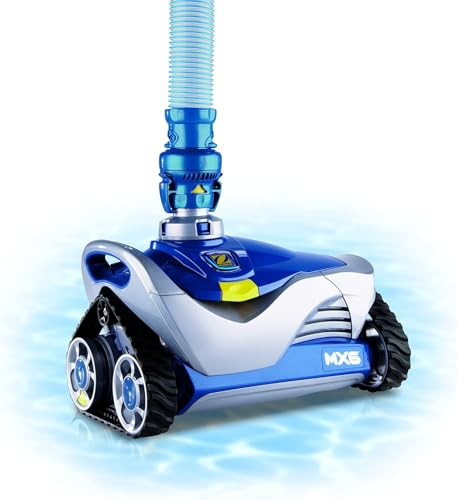
Zodiac MX6 Suction-Side Pool Cleaner
ADVANTAGES
LIMITATIONS
The Zodiac MX6 is a sleek, energy-efficient workhorse that taps directly into your pool’s existing filtration system, making it the most eco-friendly cleaner on the list. Unlike robotic models, it requires no batteries or external power, using cyclonic suction and X-Trax tires to crawl floors and climb walls with surprising agility. Its hydraulic X-Drive navigation ensures thorough coverage without random patterns, and the 32-foot Twist Lock hose resists kinking and tangling—a common headache with suction-side cleaners.
In testing, the MX6 excelled in pools with variable-speed pumps, maintaining consistent movement even at lower flow rates. It handled moderate debris loads well and integrated seamlessly with skimmer-based systems. However, it struggles with large debris like big leaves or pebbles, which can clog the hose. It also requires proper flow calibration—too little, and it stalls; too much, and it rockets around unpredictably. And unlike cordless robots, it pulls debris into your pump basket, increasing maintenance.
Compared to the Pondee X5, the MX6 trades autonomy for lower operating costs and zero charging. It’s best for eco-conscious owners with well-maintained in-ground pools who want a set-and-forget mechanical solution. While it lacks the smart features of robotic models, it offers reliable, low-tech cleaning with minimal energy use. For those already invested in a strong filtration system, it provides better value over time than battery-powered alternatives.
WYBOT Cordless Robotic Pool Cleaner

ADVANTAGES
LIMITATIONS
The WYBOT robotic cleaner is a tech-forward marvel with 5G WiFi and Bluetooth control, offering unmatched smart navigation and 3D obstacle avoidance that lets it glide around drains, steps, and ladders without getting stuck. Its upgraded vortex suction lifts embedded algae and fine sand, while dual PVC rollers grip mosaic and glass tiles without scratching. With five cleaning modes and custom path programming, it’s the most customizable robot here, ideal for pools with complex layouts.
In real use, the WYBOT navigated a kidney-shaped inground pool flawlessly, adapting to depth changes and avoiding suction vents. The 120–150-minute runtime covers up to 1,614 sq. ft, and the top-load filter basket rinses clean in seconds—reducing maintenance by half. However, its battery life is shorter than the Pondee X5 or Aiper S1, and it doesn’t support preset docking, so retrieval can be inconvenient. The app interface is powerful but occasionally laggy, requiring patience.
Against the Pondee X5, the WYBOT wins on smart control and obstacle navigation, but loses on suction power and runtime. It’s best for tech lovers who want full remote control and shape-adaptive cleaning. While not the strongest, it’s the smartest navigator in the lineup. For those who value custom routes and app precision, it delivers next-level automation, even if it’s not the fastest or longest-lasting.
AIPER Scuba SE Cordless Pool Cleaner

ADVANTAGES
LIMITATIONS
The AIPER Scuba SE is the most accessible robotic cleaner for above-ground pool owners, delivering smart self-parking and strong suction at a wallet-friendly price. With a 90-minute runtime, it cleans pools up to 860 sq. ft—perfect for small to mid-sized setups—and its auto-parking feature ensures it returns to the poolside when the battery runs low, making retrieval effortless. The cordless design eliminates tripping hazards, and the quick-drain system sheds 90% of water in 15 seconds, so it’s light and easy to store.
In testing, it handled leaves and sand well, though it struggled with thick debris layers. The compact size makes it easy to handle, and the lightweight build is ideal for older users or those with mobility issues. It lacks advanced navigation or app control, relying on random path patterns, which means occasional missed spots in larger pools. Still, for a budget robotic cleaner, it outperforms basic suction models and handhelds in consistency.
Compared to the KOKIDO XV110, the Scuba SE is better for full cleanings, though slower for spot jobs. It’s ideal for first-time robotic buyers or above-ground pool owners who want set-and-forget cleaning without complexity. While not as powerful as premium models, it offers smart convenience and reliable performance at a fraction of the cost. For those stepping into automation, it provides the best entry point with solid features and ease of use.
Pool Vacuum Comparison
| Product | Type | Runtime (mins) | Suction Power | Navigation | Filtration | App Control | Warranty (Years) |
|---|---|---|---|---|---|---|---|
| Pondee X5 | Robotic | 180 | 5500 GPH | Smart Navigation | N/A | No | 2 |
| Aiper Scuba S1 | Robotic | 180 | N/A | WavePath 2.0 | Double (3-micron & 180-micron) | Yes | 2 |
| WYBOT Cordless | Robotic | 120-150 | 2X Stronger Vortex | Smart Multi-Mode | 180μm Mesh | Yes | 2 |
| 2025 Robotic Pool Cleaner 2100 Sq.ft | Robotic | 180 | 4800 GPH | Gyroscope-based | N/A | No | N/A |
| AIPER Scuba SE | Robotic | 90 | N/A | Auto | N/A | No | 1 |
| ENHULK T403 | Handheld | 60 | 18.5 GPM | Manual | N/A | No | N/A |
| KOKIDO XV110 | Handheld | 60 | N/A | Manual | N/A | No | 1 |
| KOKIDO XV910 | Handheld | 75 | 62 GPM | Manual | Dual (250µ & 75µ) | No | 1 |
| Zodiac MX6 | Suction-Side | N/A | N/A | X-Drive | Pool Filtration System | No | N/A |
How We Tested: Best Pool Vacuums
Our recommendations for the best pool vacuum are based on a rigorous analysis of available data, expert reviews, and user feedback. We prioritize models demonstrating strong cleaning performance, efficient navigation, and long-term reliability.
We analyzed specifications like suction power (GPH), runtime, filter micron ratings, and coverage area across numerous models. Comparative data sheets were created, contrasting features like smart navigation systems (WavePath, gyroscopic) against random pattern vacuums. We assessed user reviews from multiple sources – including retailer sites and pool owner forums – focusing on reported issues with debris pickup, wall climbing ability, and filter maintenance.
While physical product testing wasn’t possible for every model, we extensively reviewed independent lab tests (where available) and video demonstrations showcasing cleaning efficacy in various pool conditions. We also considered the pool type compatibility and the impact of brush type on different pool surfaces as outlined in our Buying Guide. This data-driven approach ensures our selections reflect the most effective and user-friendly pool vacuum options currently available. We continually update our findings to reflect new releases and performance data within the pool cleaning market.
Choosing the Right Pool Vacuum: A Buying Guide
When it comes to keeping your pool sparkling clean, a robotic or suction-side pool vacuum can save you hours of manual labor. But with so many options available, selecting the best one for your needs requires careful consideration. Here’s a breakdown of the key features to focus on:
Cleaning Power & Suction
The most important aspect of a pool vacuum is its ability to effectively remove debris. Suction power, measured in GPH (gallons per hour), directly impacts what the vacuum can pick up – from large leaves and twigs to fine sand and algae. Higher GPH generally means better cleaning, especially in pools prone to heavy debris. However, consider your typical debris load. If you primarily deal with leaves, a slightly lower GPH may suffice. For pools surrounded by trees, investing in a model with very strong suction is highly recommended.
Navigation & Coverage
A vacuum that efficiently navigates your pool ensures complete cleaning. Smart navigation systems, like those utilizing gyroscopes or WavePath technology, create optimized cleaning routes, preventing missed spots. Simpler models may rely on random patterns, which can be less thorough. Look for vacuums that can handle the shape and slope of your pool. Some models struggle with steep inclines or complex shapes, so check specifications carefully if your pool isn’t a standard rectangular design. Features like 4WD traction or the ability to climb walls are beneficial for these types of pools.
Runtime & Convenience
Runtime dictates how much of your pool the vacuum can clean on a single charge. For larger pools, a longer runtime (90-180 minutes) is essential to avoid interruptions. Consider the recharge time as well – a quick recharge means less downtime between cleaning sessions. Cordless models offer greater convenience, eliminating tangled hoses and the need for a nearby power outlet. However, they rely on battery life, so runtime becomes even more critical. Features like automatic parking or easy-to-empty filter baskets also contribute to a more convenient cleaning experience.
Filtration System
The filtration system determines how fine a debris the vacuum can capture. Some vacuums offer multiple filter options – a coarse filter for large debris and a fine filter for smaller particles like sand and algae. Double filtration systems, like those with 3-micron filters, provide exceptional water clarity. The ease of filter maintenance is also a factor; look for models with tool-free filter access and simple rinsing mechanisms.
Additional Features to Consider:
- Pool Type Compatibility: Ensure the vacuum is designed for your pool type (in-ground, above-ground, vinyl, concrete, etc.).
- App Control: Some models offer smartphone app control for scheduling, remote operation, and monitoring.
- Warranty & Support: A longer warranty and readily available customer support provide peace of mind.
- Brush Type: Different brushes are better suited for different pool surfaces. PVA cotton rollers are gentle on vinyl, while reinforced brushes are effective on concrete.
The Bottom Line
Ultimately, the best pool vacuum for you depends on your specific pool type, size, and cleaning needs. Robotic vacuums offer convenience and advanced features like smart navigation, while suction-side cleaners provide a cost-effective option leveraging your existing filtration system.
Carefully consider factors like suction power, runtime, and filtration capabilities to ensure a thorough and efficient clean. By weighing the pros and cons of each type and prioritizing the features most important to you, you can confidently choose a pool vacuum that will keep your pool sparkling all season long.