
Vacuum Cleaner vs Cleaning Robot: Which Cleans Better?
This post contains affiliate links. As an Amazon Associate, we earn from qualifying purchases.
Choosing between a vacuum cleaner and a cleaning robot isn’t about which is better. It’s about which solves your specific dirt problem. A traditional vacuum, like the Philips FC9747/09, delivers 32.5 liters per second of airflow for deep, on-demand cleaning. A robot, like the Kärcher RCV 3, offers 2500 Pa of suction for automated, daily maintenance. The right pick depends on your home’s layout, your tolerance for manual labor, and a realistic 3-year cost that includes bags, filters, and replacement batteries.
That airflow number from the Philips spec sheet is the load-bearing metric. It’s the physical force moving dirt from your floor into the bin, and it dwarfs what any robot can currently muster. Robots trade raw power for autonomy. They’re a scheduling tool, not a deep-cleaning tool.
This guide walks the numbers. We’ll compare the suction specs you can actually measure, the weekly hands-on time each machine demands, and the long-term cost of filters, bags, and batteries that most buying guides treat as an afterthought. By the end, you’ll know whether to buy a workhorse or a scheduler.
Key Takeaways
- Power isn’t close. A good upright vacuum moves over 30 l/s of air; even powerful robots like the Kärcher RCV 3 manage 2500 Pa (about 2.5 kPa). For embedded pet hair or high-pile rugs, the vacuum wins every time.
- Robots are for maintenance, not rescue. They keep a clean floor clean. They panic on thick shag rugs, get stuck on dark floor thresholds, and can’t handle a sudden spill of cereal.
- The 3-year cost flips the script. A bagged upright might cost you in HEPA filters and bags. A robot’s lithium-ion battery will almost certainly need replacing within 2-3 years, a $70-$120 hit most buyers don’t budget for.
- Your back and your schedule decide. If you hate the weekly chore, a robot running daily is a quality-of-life upgrade. If you need to clean a specific mess right now, you’ll be waiting for a robot to finish its 90-minute map cycle.
- For most homes, you still need both. The robot handles the daily dust and hair on hard floors. The vacuum tackles stairs, cars, upholstery, and the deep quarterly carpet clean.
The Power Gap: What the Spec Sheets Actually Mean
You see “powerful suction” on every box. The numbers behind that phrase tell two different stories.
What’s the actual cleaning power difference?
The Philips FC9747/09 bagless vacuum cleaner generates a maximum airflow of 32.5 liters per second (source: Philips spec sheet). The Kärcher RCV 3 robot vacuum produces 2500 Pa of suction pressure. These are different measurements of force, but the scale is telling: the vacuum moves a massive volume of air; the robot creates a localized pressure zone.
Airflow, measured in liters per second (l/s) or cubic feet per minute (cfm), is the volume of air a vacuum can move. It’s what lifts dirt from carpet fibers and pulls it down the hose. Waterlift, measured in inches, is the sealed suction power—think of it as the strength to lift a column of water. A good upright, like the Kärcher Sensor S2 HEPA, has a 90-inch waterlift. Most robot vacuums don’t even publish a waterlift figure; their focus is Pa (Pascals).
2500 Pa sounds impressive. Converted, it’s about 10 inches of waterlift. That’s enough for hard floors and low-pile rugs, but it struggles with embedded sand or the kind of ground-in dirt a family tracks through a high-traffic area. The vacuum’s 90-inch waterlift has nine times the pulling force.
Why this matters for your floors: On hard surfaces, both can pick up surface dust. On medium-pile carpet, the robot will make multiple passes. On thick carpet or rugs with fringe, the robot may stall, overheat, or simply skip the area because its cliff sensors see the fringe as a drop-off.
| Cleaning Scenario | Best Tool: Vacuum | Best Tool: Robot | Why |
|---|---|---|---|
| Fresh, loose debris (cereal, dust bunny) | Good | Good | Both have enough suction for surface-level pickup. |
| Pet hair embedded in carpet | Excellent | Poor | Robot brush rolls tangle; lacks airflow to pull hair from deep fibers. |
| Weekly whole-home clean | Slow, thorough | Fast, superficial | Vacuum takes 30 mins of work; robot takes 90 mins of idle time. |
| Hard floor & area rug combo | Excellent (with nozzle switch) | Good (with mapping) | Vacuum adjusts head; robot may need a no-go zone for tassels. |
| Post-renovation dust cleanup | Excellent | Will destroy robot | Fine drywall dust clogs robot filters and gears in one session. |
The hidden power drain: filtration and air quality
A vacuum’s job isn’t just to pick up dirt; it’s to trap it. This is where the HEPA standard cuts through the marketing. The Philips FC9747/09 uses an Allergy H13 filter system at a HEPA13 level. The Kärcher RCV 3 uses a HEPA-grade filter in its compact bin.
HEPA 13 captures 99.95% of particles at 0.3 microns. For allergy sufferers, this is the spec that matters more than any decibel rating. A bagged vacuum like the Kärcher Sensor S2 has a built-in advantage: the bag itself is the primary filter, so less fine dust ever reaches the final HEPA filter, extending its life. Bagless vacuums and robots cyclone dust into a bin, but a cloud of the finest particles always escapes into the internal filter immediately.
Where this goes sideways: Assuming a “HEPA filter” means clean air. The filter only works if it’s intact and seated correctly. A torn filter or a poorly sealed bin on a bagless model spews dust back into the room. Robots are worse offenders here—their tiny bins press dust against a small filter surface, clogging it fast.
If your goal is improving indoor air quality, a bagged, sealed-system vacuum with a true HEPA final filter is the engineering gold standard. A robot is a floor cleaner, not an air purifier.
The Daily Reality: Autonomy vs. Immediate Control
This is the lifestyle choice. One is a tool you use. The other is an appliance you manage.
How much time do you really save?
A robot vacuum promises hands-free cleaning. The reality is hands-on maintenance. The Kärcher RCV 3 runs for 120 minutes per charge and covers about 85 square meters per hour. It will clean a floor and then stop. You must then: 1. Empty its 0.5-liter dustbin (every run if you have pets). 2. Rinse its filter (weekly, or it loses suction). 3. Cut hair and string from its brush rolls (weekly). 4. Wipe its sensors (monthly). 5. Check its wheels for thread wrap (monthly).
A traditional vacuum demands 20-30 minutes of active labor, but then you’re done. There’s no daily or weekly checklist beyond emptying the bag or bin. The labor is concentrated, not distributed.
The scheduling illusion: You can set a robot to run at 10 a.m. Daily. But if your floor isn’t robot-ready—a stray sock, a charging cable, a child’s toy—the job fails. The vacuum doesn’t care. You bring it to the mess, and you control the environment.
The “set and forget” myth of mapping and navigation
Modern robots like the RCV 3 use LiDAR sensors to map your home. This is genuine progress. They create a usable map, let you set no-go zones, and clean in efficient lines. But the map is fragile. Move a piece of furniture significantly, and the robot may get confused. Dark black floor mats or very shiny floors can appear as cliffs to its sensors, creating phantom no-go zones.
A vacuum has no such illusions. You are its navigation system. This is a limitation and a strength. You can instantly clean under a specific chair, target a corner, or switch to an upholstery tool without editing an app.
Common mistake: Thinking a robot will replace all vacuuming. It won’t clean your stairs, your car interior, your curtains, or your bookshelves. It’s a floor appliance. A canister or upright vacuum with a tool kit is a whole-home cleaning system.
For a mostly clear, single-level home with hard floors or short carpet, a robot is a brilliant maintenance tool. For a multi-level home with varied floor types, kids, and pets, the robot becomes just one tool in an arsenal that still requires a traditional vacuum. Our guide to the best robot vacuum cleaner models dives deeper into which nav systems handle real-world clutter best.
The 3-Year Cost Breakdown (The Math Most People Skip)
The sticker price is a lie. The real cost is in the consumables and replacements over a typical ownership period.
Let’s assume a mid-range upright ($300) versus a mid-range robot ($500). Here’s where the money actually goes.
| Cost Category | Traditional Vacuum (e.g., Bagged Upright) | Cleaning Robot (e.g., LiDAR Model) | Notes |
|---|---|---|---|
| Initial Purchase | $300 | $500 | Robot carries a tech premium. |
| Year 1 Consumables | $40 (HEPA filters, bags) | $20 (HEPA filter replacement) | Bags cost more; robot filters are smaller/cheaper. |
| Year 2 Consumables | $40 | $20 | Pattern holds. |
| Year 3 Consumables | $40 | $100 (Battery Replacement) | The robot’s lithium-ion battery degrades. This is near-certain. |
| Potential Repairs | $50 (belt, brush roll) | $150+ (wheel motor, LiDAR sensor) | Robot repairs are more complex and costly. |
| Estimated 3-Year Total | ~$470 | ~$790 | The robot’s higher upfront cost and battery replacement tip the scale. |
The battery is the robot’s Achilles’ heel. Lithium-ion batteries have a finite number of charge cycles. The Kärcher RCV 3 manual lists a 3.2 Ah battery. Daily charging and discharging for two years will significantly reduce its capacity, leading to shorter runs and incomplete cleaning. Replacing it isn’t optional; it’s a scheduled expense.
A traditional vacuum’s motor, if not abused, can last a decade. Its consumables are predictable: a box of bags and a HEPA filter once a year. There’s no secret $100 bill waiting in year three.
I prefer bagged vacuums for long-term cost control. Not because they’re cheaper per clean, but because the bag seals the dirt away, protecting the motor and the final filter. The motor lasts longer, and the air stays cleaner. A bagless vacuum’s cyclone system is fine, but you breathe in a dust cloud every time you empty it.
This cost analysis changes if you opt for a self-emptying robot vacuum with a base station. Now you’re adding another $200-$300 to the initial cost, plus the cost of proprietary dust bags for the base. You’re trading manual bin emptying for a recurring bag cost. The calculus is about your time, not your wallet.
Head-to-Head: Which Machine Wins for Your Home?
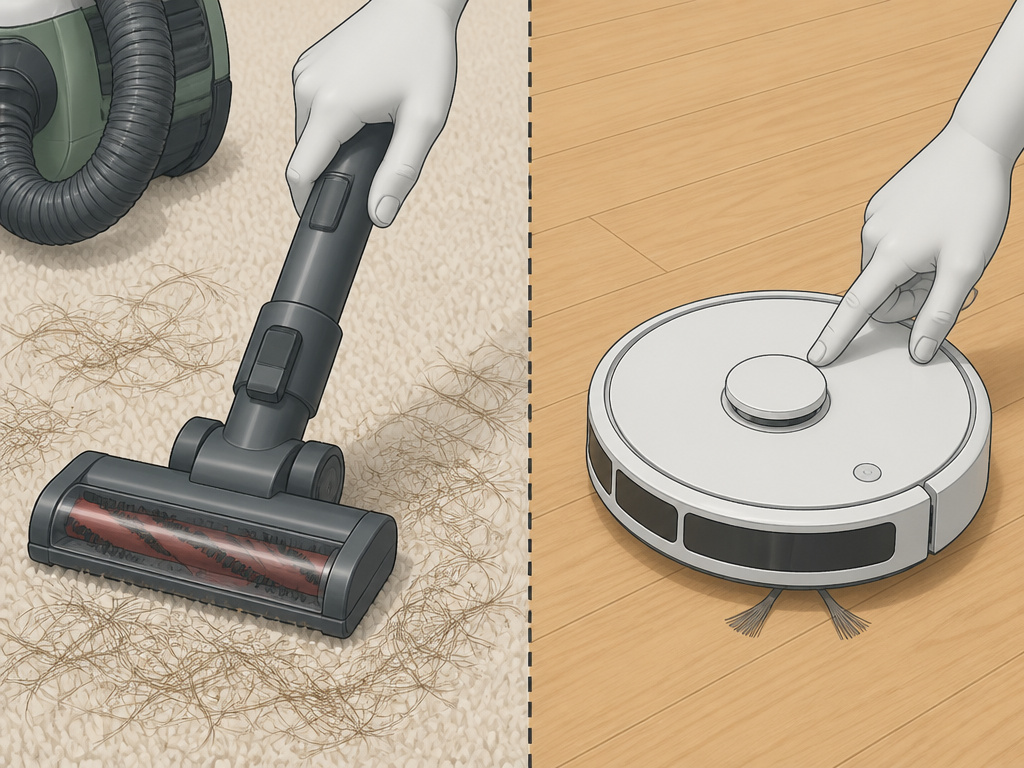
Stop looking for a single winner. Decide based on your primary cleaning enemy.
For pet hair: The vacuum (with a specific nozzle)
Robots tangle. The brush roll is a hair magnet, and the small bin fills with fur in one room. A vacuum like the Bosch BCS8224GB cordless or a canister with a motorized turbo brush will out-clean any robot on pet hair. The powered brush roll agitates the carpet, and the high airflow lifts the hair. You can then use the crevice tool to get hair out of corners and upholstery. If pets are your main concern, start with a strong traditional vacuum and consider a robot as a secondary hair-gatherer for daily touch-ups. Our dedicated resource on robot vacuums for pet hair and dander explains which bot features actually help.
For large, open-plan hard floors: The robot
This is its sweet spot. A robot with a good side brush will methodically sweep and vacuum a large area of tile, vinyl, or hardwood every day. You’ll notice less dust along baseboards. The daily micro-cleaning prevents grit from building up. A cordless stick vacuum like the Kärcher VC 7 Signature Line is also excellent for quick hard-floor cleans, but you still have to do the work.
For deep cleaning carpets: The vacuum, no contest
Carpet cleaning requires airflow, agitation, and waterlift. Robots have none of these in sufficient measure. You need a vacuum with a height adjustment and a beater bar. According to Consumer Reports vacuum cleaner ratings, top uprights like the Kenmore BU1018 excel at removing embedded dirt from carpets. A robot will only skim the surface. For carpeted homes, the vacuum is non-negotiable. Check our guide on the best vacuum cleaners for deep cleaning carpets for tested recommendations.
For a multi-level home: You likely need both (or a light cordless)
A robot can only clean one level at a time. If you want it to clean upstairs, you must carry it up and re-start the mapping process. For multi-level homes, a lightweight cordless vacuum you can easily carry upstairs often makes more sense than a single robot. Alternatively, budget for two cheaper robots—one for each floor—which brings us back to the cost discussion.
The verdict: Match the tool to the task. A robot is a fantastic automation for hard floors. A vacuum is a necessary powerhouse for carpets, stairs, spot cleaning, and everything else. The most satisfied owners I know use both: the robot on a daily schedule for floors, and the vacuum for weekly detail work and above-floor cleaning.
The Physical Reality: What You Actually Do Every Week
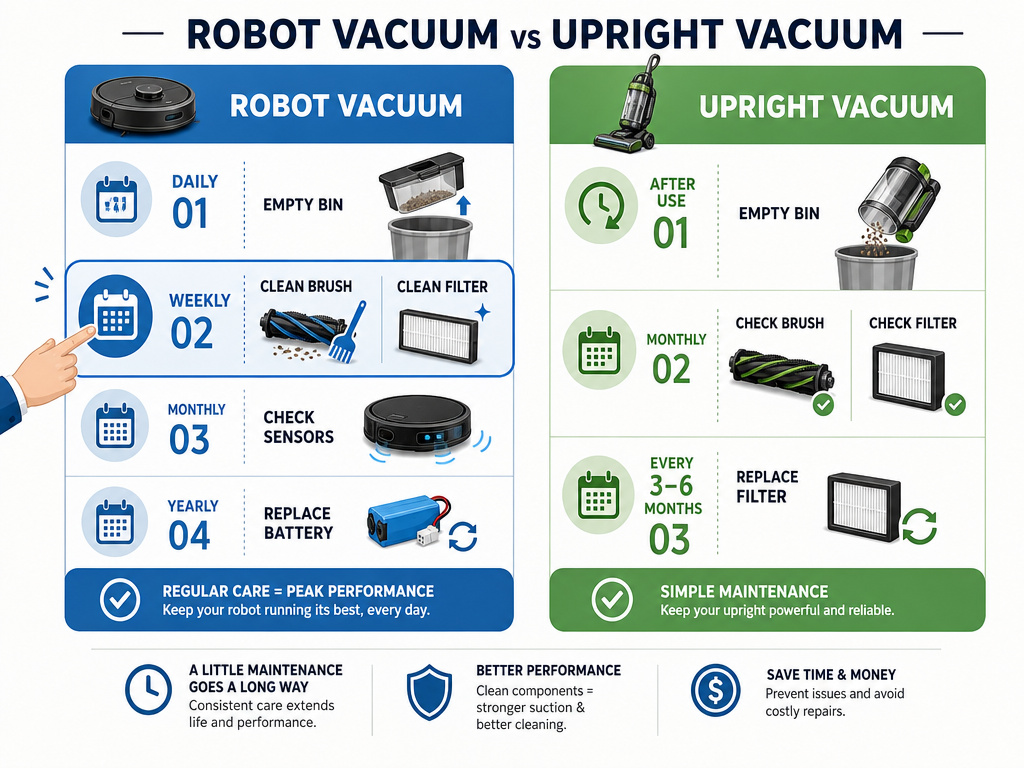
Forget the ads. Here’s the maintenance ledger.
For a Robot:
- Daily/Every Run: Empty the dustbin. Check for and remove blockages in the brush roll intake.
- Weekly: Remove brush roll, cut away wound hair and threads. Rinse the foam and HEPA filters, let dry 24+ hours. Wipe cliff sensors and charging contacts.
- Monthly: Inspect side brushes for wear. Check wheels for debris. Clean the LiDAR sensor window.
- Yearly: Budget for and replace the battery.
For a Traditional Vacuum (Bagless Upright):
- After each use: Empty the dustbin.
- Monthly: Check the brush roll for tangles. Rinse the pre-motor filter (if washable). Wipe down the exterior.
- Every 3-6 Months: Replace or wash the final HEPA filter.
- As needed: Replace the drive belt or brush roll.
For a Traditional Vacuum (Bagged Canister/Upright):
- When full: Replace the bag (every 1-3 months).
- Every 6 Months: Replace the final HEPA filter.
- As needed: Replace the belt or brush roll.
The robot’s maintenance is more frequent and more fiddly. You’re dealing with small, precise parts. The vacuum’s maintenance is less frequent but sometimes messier (emptying a full bin). The bagged vacuum is the cleanest and simplest: swap a bag, change a filter once in a while. No dust clouds.
Before You Buy: The 5-Question Checklist
Answer these before you spend any money.
- What’s your primary floor type? Hard floors/short carpet = robot-friendly. Medium/deep pile carpet = vacuum-required.
- What’s your biggest cleaning headache? Daily dust/hair = robot. Weekly deep clean of carpets/upholstery = vacuum.
- Can your home pass the “robot readiness” test? Are floors consistently clear of cords, clothes, and toys? If not, a robot will be high-maintenance.
- What’s your 3-year budget, including $100 for a robot battery? If the total gives you pause, a vacuum is the fiscally conservative choice.
- Are you buying for convenience or for power? Convenience = robot scheduler. Power = vacuum on demand.
Your answers will point you clearly. If you’re still split, the safe, versatile choice is a quality cordless stick vacuum. It offers near-robot convenience with vacuum-level power.
Frequently Asked Questions
Can a robot vacuum replace a regular vacuum completely?
No. It can replace the floor vacuuming portion of your chores if you have mostly hard floors and no pets. It cannot clean stairs, upholstery, ceilings, car interiors, or draperies. It also struggles with deep carpet cleaning and large, sudden messes. For a complete home clean, a traditional vacuum is still necessary.
Are robot vacuums worth the high price?
They are worth it as a time-saving appliance for maintenance cleaning. If you value having your floors cleaned daily without your direct involvement, and your home is suited for it, the price is justified. If you see it as a way to avoid ever vacuuming again, you’ll be disappointed. Think of it as buying back 30 minutes a week, forever.
How long do robot vacuums typically last?
The mechanical parts of a quality robot vacuum can last 3-5 years with proper care. The lithium-ion battery, however, will typically need replacement after 2-3 years of daily use due to cycle degradation. This is a significant recurring cost that shortens the effective lifespan compared to a traditional vacuum motor, which can last 10+ years.
What should I look for in a vacuum for a robot-complement?
Look for a powerful, versatile vacuum to handle everything the robot can’t. A cordless stick vacuum is ideal for quick pickups and stairs. A canister vacuum is best for above-floor cleaning and deep carpet work. Key features: strong suction (high waterlift/airflow), a HEPA filtration system, and a good set of attachments for upholstery and crevices. The top robotic vacuum cleaners work well, but their traditional counterparts handle the rest.
Do I need a vacuum with a HEPA filter if I have a robot?
Yes, if air quality is a concern. A robot’s small HEPA filter deals only with the dust it picks up. A whole-home vacuum with a true HEPA system will capture allergens during above-floor cleaning, when you’re stirring dust into the air from shelves, blinds, and furniture. The vacuum’s filtration system is far more consequential for overall indoor air quality.
The Bottom Line
Get the robot if your goal is automated daily floor maintenance and your home is a single level of hard surfaces. The Kärcher RCV 3 or similar LiDAR models are competent tools for this job. But understand you are buying a scheduler with a 3-year battery replacement timer.
Stick with a traditional vacuum if you have carpets, pets, a multi-level home, or need immediate control over cleaning. The Philips PowerPro Expert or a Kärcher Sensor S2 HEPA will clean deeper and last longer for less total money.
For the majority of homes, the ideal setup is both: a robot for the daily grind and a powerful cordless or canister vacuum for the weekly battle. The robot manages the floor; the vacuum handles the rest of your world. Start with the vacuum—it solves more problems. Add the robot later as a luxury that buys you time.