
Canister Vacuum vs Stick | The 4 Specs That Decide It
This post contains affiliate links. As an Amazon Associate, we earn from qualifying purchases.
Choose a canister vacuum for deep cleaning, allergy control, and carpets. Pick a stick vacuum for speed, daily touch-ups, and multi-level homes. The decision turns on four measurable specs: suction power (Air Watts or water lift), airflow (CFM), weight, and filtration grade. A Kärcher T 11/1 HEPA canister moves 89 CFM and traps 99.995% of particles; a Philips SpeedPro Max stick offers 65 minutes of cordless runtime but less than half the raw air movement.
That spec gap isn’t academic. It’s the line between removing embedded grit from a rug and picking up surface crumbs. Your floor type, cleaning frequency, and storage space lock in the answer before you look at a single model.
What follows: a side-by-side breakdown of the four decisive specs, the physical trade-offs you’ll feel after a week of use, and the named models that prove the rule for carpets, bare floors, and fast daily runs.
Key Takeaways
- Suction isn’t everything; airflow (CFM) matters more for deep carpet cleaning. A canister like the Tennant V6 moves 85 CFM; most stick vacuums don’t publish CFM because their motors prioritize compact size over air volume.
- True HEPA is a canister game. Look for the DIN EN 1822:2019 certification and a HEPA 14 label, like on the Kärcher T 11/1, which filters 99.995% of particles at 0.3 microns. Most “HEPA-like” stick filters are not independently certified.
- Weight distribution beats total weight. A 16-pound canister’s weight is in a rolling base; a 6-pound stick’s weight is all in your hand and wrist. Your shoulder feels the difference on the second flight of stairs.
- Stick vacuums win on “cleaning frequency.” If you’ll vacuum more often because it’s fast and cordless, the stick’s lower peak performance becomes irrelevant. The best tool is the one you actually use.
The Core Specs Showdown
Forget “powerful” and “convenient.” Those are marketing words. The real difference between a canister and a stick vacuum lives in four numbers you can find on a spec sheet: airflow, suction pressure, weight, and filtration efficiency. One type dominates the first three; the other wins the fourth.
A canister vacuum’s performance is quantified by airflow (CFM) and water lift (inches). A stick vacuum’s performance is measured in Air Watts and runtime (minutes). Comparing CFM to Air Watts is like comparing horsepower to torque, they’re related but measure different physical actions.
Airflow, measured in cubic feet per minute (CFM), is the volume of air a vacuum can move. It’s critical for lifting dirt from deep within carpet fibers. Suction pressure, often shown as water lift (inches of water) or sealed suction (Air Watts), is the vacuum’s pulling strength at a closed nozzle, important for sealed surfaces and hose tools.
| Specification | Typical Canister Vacuum (e.g., Kärcher T 11/1) | Typical Stick Vacuum (e.g., Philips SpeedPro Max) | Why It Decides the Winner |
|---|---|---|---|
| Airflow (CFM) | 85–129 CFM | Not typically published (estimated 20-40 CFM) | Canister wins. Higher CFM is necessary for effective deep carpet cleaning and soil recovery. |
| Suction Power | 228 mbar / 89″ water lift | 150 Air Watts (max) | Canister wins. Higher sustained suction for upholstery tools and embedded debris. |
| Weight | 9.7 – 16.7 lbs (machine only) | 6 – 7 lbs (total) | Stick wins. Lighter total weight held in the hand, but canister weight is carried by wheels. |
| Filtration | HEPA 14 (99.995% @ 0.3µm, DIN EN 1822) | Washable motor filter, “HEPA-like” | Canister wins. Certified medical-grade filtration for allergens; stick filters often lack independent certification. |
| Primary Cord / Runtime | 33–49 ft power cord | 21–65 min battery (5 hr charge) | Tie. Cord offers unlimited runtime but must be managed; cordless offers freedom but limited by battery. |
The Tennant V6 commercial canister moves 85 CFM on a 49-foot cord. The Nilfisk VP400 hits 225 Air Watts of suction power. These are numbers for moving dirt for hours in a school or hotel. A Philips SpeedPro Max stick vacuum runs for 65 minutes and offers “>1000 L/min” airflow, a different metric that doesn’t translate directly to carpet-cleaning CFM. This is the first filter: if your priority is deep cleaning carpets once a week, the canister’s spec sheet is non-negotiable. If your priority is a fast daily pass on hard floors, the stick’s runtime and weight matter more.
Where the Canister Vacuum Is Unbeatable
Canister vacuums are built for sustained, deep cleaning. Their design separates the heavy motor and dust collection into a rolling canister, connecting to the cleaning head via a hose and wand. This gives them three concrete advantages.
First, they deliver certified air quality. A true HEPA filter isn’t just a fine mesh; it’s a standardized, tested barrier. The Kärcher T 11/1 Classic HEPA uses a HEPA 14 filter with a 99.995% filtration and separation degree, certified to the DIN EN 1822:2019 standard. It traps viruses, aerosols, and germs at the micrometer level. This is why hospitals and clinics use canisters. Most stick vacuums use a washable cloth or foam filter that may capture large particles but lacks this level of verified, standardized efficiency.
Second, they have superior carpet and tool performance. The combination of high CFM and strong water lift (like the 89-inch lift on the Kärcher T 12/1) creates the agitation and lift needed to pull sand and pet hair from carpet backing. When you attach a powered brush roll, a canister vacuum with powerhead, the motor in the head beats the carpet while the canister’s motor provides relentless suction. This two-motor system is why models like the Miele Complete C3 Marin score top marks for pet hair removal in Consumer Reports canister vacuum ratings. A stick vacuum’s single, smaller motor must both spin the brush and create suction, often leading to a compromise.
Common mistake: Choosing a canister for a small apartment with only hard floors. You’re paying for and storing deep-cleaning power you’ll never use. The noise and cord management become pure hassle.
Third, they are serviceable and durable. Commercial canisters like the Tennant V6 are rated for thousands of hours of use. Their bags hold 9 to 12 liters of dust, meaning fewer changes. Their parts are designed to be replaced. This makes them a long-term investment. For a full home with carpets, a quality canister isn’t just a cleaner; it’s a 10-year appliance. Our guide to the best canister vacuums details which models are built for this lifespan.
Where a Stick Vacuum Actually Wins
Stick vacuums are not weak canisters. They are a different tool for a different job: frequent, fast, convenient cleaning. Their win is in reducing friction, not in maximizing raw power.
The biggest advantage is psychological: you will use it more. A cordless stick lives on a wall mount. You grab it, hit a button, and clean a kitchen floor in 90 seconds after dinner. There’s no plug to find, no cord to unwind and re-wrap. This “low activation energy” means you might vacuum three times a week instead of once. For daily debris like crumbs, pet hair, and dust bunnies, frequency trumps peak suction.
Their second win is access and multi-level cleaning. Weighing under 7 pounds, a stick vacuum is trivial to carry up and down stairs. It goes fully flat to slide under low furniture like beds and sofas. The best stick vacuums for carpet can handle surface-level cleaning on medium-pile, though they’ll struggle with deeply embedded grit. For a townhouse or a home with lots of stairs, this alone can decide the canister vs cordless debate.
Where this goes sideways: Using a stick vacuum as your only cleaner in a fully carpeted home. The battery will die halfway through, the dustbin will fill after two rooms, and the carpet will look clean on the surface but feel gritty underfoot within a month. That grit abrades the carpet fibers.
Finally, stick vacuums are space-savers. They store vertically on a wall, taking up zero floor space. In a small apartment, condo, or home with limited closet space, this is a legitimate deciding factor. A high-performance stick vacuum cleaner can be a perfect primary vacuum if your home is mostly hard floors with area rugs.
The Physical Trade-Offs You Feel
Specs on paper are one thing. How the machine feels in your home after a week of use is another. The trade-offs are physical.
Noise: A canister vacuum like the PPR 390 runs at 49 dB(A). The Philips SpeedPro Max stick runs at 84 dB. That’s a massive difference. The canister is a low hum; the stick is a high-pitched whine. If you clean while others are home, the canister’s quiet operation is a tangible benefit.
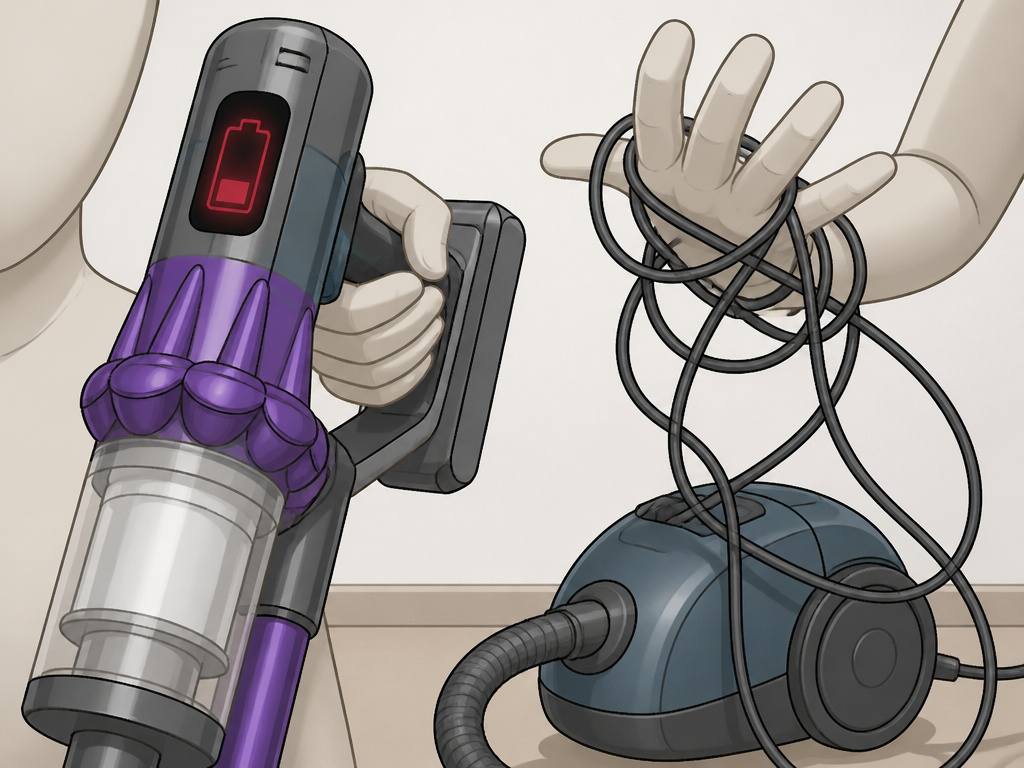
Cord vs. Battery Anxiety: A 40-foot cord gets tangled around furniture and requires outlet hopping. It’s a chore. A battery offers freedom but creates a timer in your head. You’ll rush as the battery icon drops, or you’ll forget to charge it and find it dead when you need it. There’s no perfect answer, only which annoyance you prefer to manage.
Emptying the Bin: A canister uses a bag. When it’s full, you pull and toss it. There’s no dust cloud. A bagless stick vacuum has a tiny 0.6L bin like the Philips model. You empty it into the trash, and a plume of fine dust escapes unless you do it slowly outside. For allergy sufferers, the sealed bag system is a genuine health feature.
Wrist Fatigue vs. Back Strain: A stick’s weight is all in your hand and wrist, which can tire during a longer session. A canister’s weight is on the floor, but you are constantly pulling it behind you and navigating the hose, which can twist your torso. People with wrist issues often prefer a canister; people with back issues might prefer the upright posture of a stick.
The Final Decision: Which One Should You Buy?
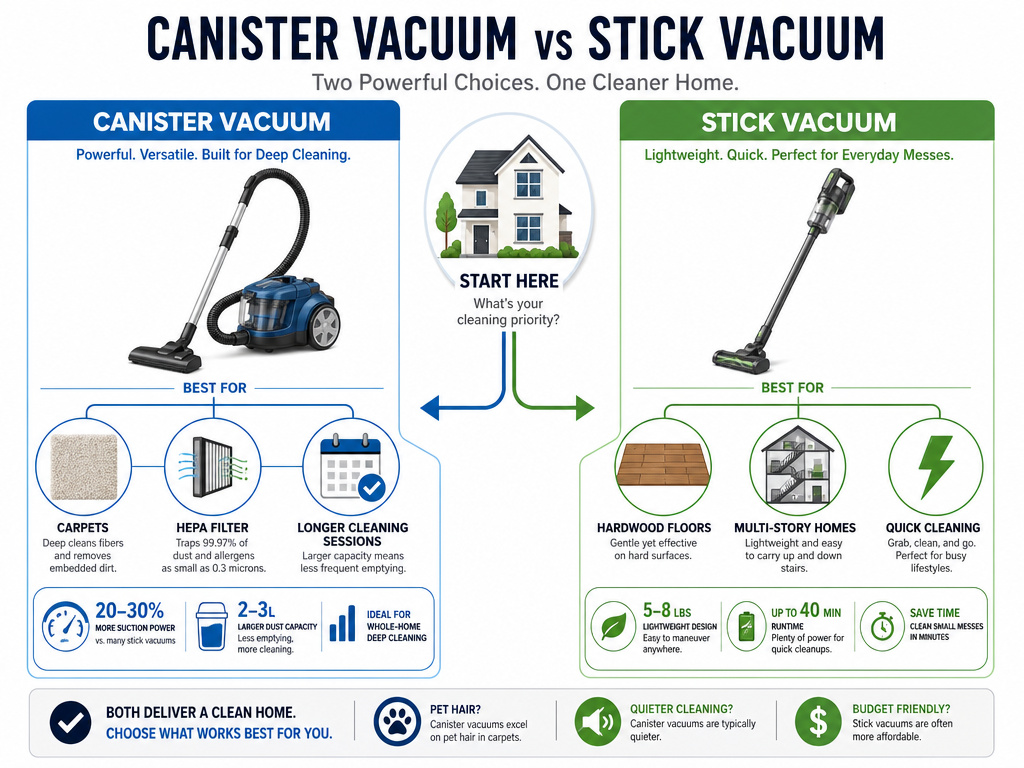
Stop looking at both categories. Your home answers the question for you. Follow this path.
Choose a Canister Vacuum if:
- More than 50% of your floors are medium- or high-pile carpet.
- Someone in your home has allergies or asthma requiring certified HEPA filtration.
- You have a large, single-level home and prefer a thorough weekly clean over daily touch-ups.
- You want the vacuum to last a decade or more.
Start your search with the Kärcher T 11/1 Classic HEPA for unmatched filtration, or the Eureka Mighty Mite 3670G for a budget-friendly, lightweight entry. For carpet dominance, look for a canister vacuum for carpet with a powered brush roll.
Choose a Stick Vacuum if:
- More than 70% of your floors are hard surfaces (hardwood, tile, vinyl).
- You live in a multi-level home and hate carrying a vacuum up stairs.
- Your cleaning style is “a little bit, often” rather than “a marathon on Saturday.”
- Storage space is extremely limited.
Start your search with the Philips SpeedPro Max for long runtime and clever design, or explore our curated list of best stick vacuums for models excelling on hard floors and low-pile rugs. For homes with mixed flooring, prioritize a stick vacuum for carpet with a strong motorized brush.
For the majority of homes with a mix of hard floors and carpets, the most practical solution is often both: a canister for the weekly deep clean and a stick for the daily upkeep. If you must choose one, let your predominant floor type and your honest cleaning frequency be your guide.
Frequently Asked Questions
Is a stick vacuum as powerful as a canister?
No, not in terms of sustained suction and airflow (CFM) needed for deep carpet cleaning. A stick vacuum is powerful for its size and purpose, quick clean-ups on hard floors and surface cleaning on carpets. Its motor is smaller and must also spin the brush roll, dividing its effort. A canister’s dedicated motor provides undivided suction, and a powered head has its own motor for brush agitation.
Can a stick vacuum replace an upright or canister?
It can replace one if your home is predominantly hard-floored, you clean frequently, and you have low-pile or area rugs. It cannot fully replace a canister or upright in a fully carpeted home because it lacks the sustained airflow and large dust capacity for a complete cleaning session. It’s a replacement for convenience, not for deep-cleaning performance.
Are canister vacuums harder to store and use?
They are harder to store because they are bulkier and don’t mount on a wall. They require closet or utility room space. They can be slightly harder to use due to managing the hose and pulling the canister behind you, but their rolling base means you’re not carrying the weight. Many find the hose and wand system easier for cleaning stairs and under furniture compared to a bulky upright.
Which is better for pet hair?
For embedded pet hair in carpets, a canister vacuum with a powerhead is significantly better. The combination of strong suction and a motorized brush roll lifts and captures hair from deep within fibers. For surface pet hair on hard floors and furniture, a stick vacuum with a turbo brush attachment is very effective and more convenient for daily use.
How long do stick vacuum batteries last?
Typical runtime on a standard mode is 30 to 65 minutes, as seen with the Philips SpeedPro Max’s 65-minute claim. Turbo or max suction modes reduce that by 50-70%. Batteries degrade over time, often losing noticeable capacity after 2-3 years of regular use. Canister vacuums, being corded, have unlimited runtime but are tethered to an outlet.
The Bottom Line
The canister versus stick debate ends with a tape measure and an honest look at your habits. Map your floor types. Count your stairs. Ask yourself how often you actually vacuum now.
For deep cleaning and certified air purity, the canister’s superior airflow and filtration win. For effortless daily living in a hard-floored home, the stick’s cordless convenience wins. Don’t buy for a hypothetical version of your life where you deep-clean carpets every day. Buy for the floors you have and the person you are. That’s how you get a cleaner home without the regret.