
Can I Vacuum Bees? | The Tool That Burns Out in 45 Minutes
This post contains affiliate links. As an Amazon Associate, we earn from qualifying purchases.
You can vacuum bees, but only with a specialized, low-powered vacuum cleaner called a bee vac. It uses gentle suction to collect bees alive for relocation or sampling. Using a regular household vacuum will kill the bees instantly and is considered inhumane extermination. The process requires matching three critical settings: hose diameter, suction pressure via a bypass valve, and ventilation in the catch box to prevent overheating.
This isn’t a cleaning task. It’s a live-animal relocation or a scientific sampling procedure. The equipment is built to a specific tolerance, and the margin for error is small. Get the suction wrong by a few kilopascals and you break wings. Block the ventilation screen and you cook the colony in under an hour.
What follows is the gear breakdown, the step-by-step safety protocol, and the two commercial models that define the field. By the end you’ll know whether this is a job for a pro or a project you can tackle yourself.
Key Takeaways
- A bee vacuum is a low-powered, specialized tool that cannot be substituted with a household vacuum. Suction is measured in kilopascals, not raw horsepower.
- Ventilation is non-negotiable. A catch box must have a screened top; turning the vac off without airflow cooks bees in minutes on a warm day.
- Battery-powered models like the Humble Bee Bee Vac have a hard runtime limit, around 45 minutes on a full charge. Plan your cut-out or swarm collection around this.
- Sample collection for disease testing (like Nosema) uses a modified vacuum to gather about 30 bees per colony into alcohol.
- Legal removal of established colonies from structures often falls under state apiary or pest control regulations, not a DIY vacuum job.
What Is a Bee Vacuum and How Does It Work?
A bee vacuum is a purpose-built tool that uses negative pressure to create a gentle, controlled suction. Its power is deliberately limited. Where a shop vac might pull 100+ kPa, a bee vac operates in the 10-20 kPa range. This is strong enough to lift a bee off a comb but weak enough that the insect doesn’t slam into the collection chamber wall.
The mechanism is a simple airflow path. A motor pulls air through a wide, smooth-bore hose, carrying the bee into a catch box. The catch box has a screened top. This screen is the critical component, it lets air pass through to the motor but blocks the bee, which drops safely into the container below. The entire system is designed to minimize bends, pinches, and impact points.
A bee vacuum operates on negative pressure with a target suction range of 10–20 kilopascals. This is achieved by balancing motor power with an adjustable air bypass valve, which bleeds off excess suction to prevent injury to the bees as they travel through the hose into a ventilated catch box.
The adjustable bypass valve is the control panel. Opening it decreases suction by letting air bypass the catch box. Closing it increases suction directly at the hose nozzle. The official Colorado Bee Vac instructions mandate starting with the valve half-open and closing it only as much as necessary. The goal is the minimum effective suction.
The Two Types of Bee Vacuum Jobs: Relocation vs. Sampling
You don’t use the same setup for pulling a swarm out of a wall as you do for collecting a disease sample. The equipment and the end goals are different.
Live Bee Relocation is for swarm collection or cut-outs (removing a colony from a structure). Here, the goal is to collect thousands of bees, including the queen, alive and unharmed, and transfer them to a new hive box. You need a high-capacity catch box, the Colorado Bee Vac’s pine box holds up to 10 pounds of bees. The process is slower, gentler, and focused on colony integrity. After collection, you place the catch box over a prepared hive body, open a slide bottom, and let the bees walk down into their new home.
Scientific or Diagnostic Sampling is for beekeepers or inspectors checking for diseases like Nosema. This uses a smaller, often DIY, vacuum attachment. The goal is to collect a specific number of bees (about 30 per colony) with minimal disturbance. The bees are vacuumed directly into a tube with a screen end, then shaken into a bag or jar containing 70% isopropyl alcohol for preservation. The vacuum used is often a modified handheld unit like a Black & Decker Dustbuster, as outlined in the University of Georgia bee vacuum guide.
| Job Type | Primary Goal | Key Equipment | Sample/Bee Count | End State |
|---|---|---|---|---|
| Relocation | Move entire colony | High-capacity catch box (10 lbs), 1.5–2″ hose, adjustable valve | Entire swarm (1000s of bees) | Bees alive in new hive |
| Sampling | Collect for disease testing | Small vacuum attachment, collection tube, screen | ~30 bees per colony | Bees preserved in 70% alcohol |
Critical Safety and Setup Rules (The Non-Negotiables)
This is where most first-time failures happen. The process is simple, but the tolerances are tight. Skip one of these and you risk killing the colony or destroying your equipment.
Before you start: You are working with live, defensive insects. Wear a full bee suit, gloves, and a veil. Have a smoker on hand. The vacuum motor is loud and can agitate bees, place it as far from the work area as the hose allows, ideally in the shade.
First, keep the hose straight. Coiling the hose creates friction points that damage bees as they tumble through. The Colorado Bee Vac manual is explicit: plan your setup so the hose runs in as straight a line as possible from the vacuum to the swarm.
Second, manage suction with the bypass valve. Start with it half-open. You should feel just enough pull at the hose nozzle to lift a bee. Only close it further if bees aren’t being drawn in. The instant you have sufficient suction, stop adjusting.
Where this goes sideways: Closing the blast gate after turning the vac off. The vacuum creates negative pressure in the hose. When you turn the motor off, that pressure equalizes, sucking air, and bees, back out of the catch box and into the hose. They will clog it solid. Always close the gate on the catch box before you hit the power switch.
Third, control heat from minute one. A screened catch box with a vacuum running on top moves air. The moment you turn the vacuum off or remove it for a break, that airflow stops. On a 75°F day, the temperature inside a static, sunlit box can hit lethal levels for bees in under 30 minutes. If you take a break, remove the vacuum top entirely to expose the screen. Give the bees a mist of water through the screen.
The Colorado Bee Vac vs. The Humble Bee Vac
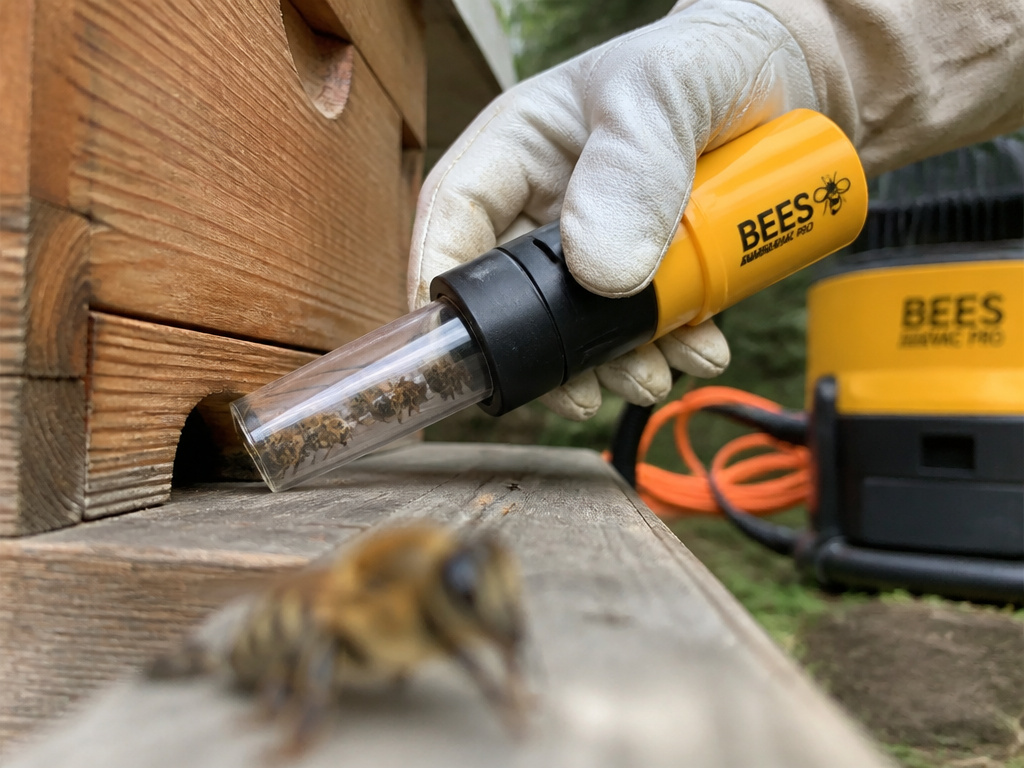
Two commercial models define the current market: the corded, professional-grade Colorado Bee Vac and the cordless, hobbyist-focused Humble Bee Bee Vac. Your choice dictates your workflow.
The Colorado Bee Vac is the industry standard for removals. Its 1.75 hp motor draws up to 6.5 amps and requires a 120v outlet. You’ll need a long extension cord or a generator. The power is consistent, and the large Eastern White Pine catch box can handle big cut-outs. Its design is brute-force reliable, but it’s loud and not portable beyond your cord’s length.
The Humble Bee Bee Vac is a cordless, battery-powered unit designed to suck bees directly into a standard poly nuc box. Its 20V lithium battery lasts about 45 minutes on full power. This is its defining constraint. It’s perfect for a single swarm in an accessible location but risky for a large, difficult cut-out where you might run out of suction halfway through. The company explicitly states it’s for live rescue where reducing flying bees increases safety.
For most hobbyists dealing with the occasional swarm, a wet-dry vacuum adapted with a proper catch box is a viable DIY path. It requires adding a bypass valve and ensuring the motor isn’t too strong. This approach mirrors the principles used in building a deep cleaning vacuums for tough jobs, where motor durability and suction control are paramount.
| Model | Power Source | Key Spec | Best For | Biggest Limitation |
|---|---|---|---|---|
| Colorado Bee Vac | 120v Corded | 1.75 hp, 6.5 amp draw, 10 lb catch box | Professional removals, large cut-outs | Requires external power; not portable |
| Humble Bee Bee Vac | 20V Battery | ~45 min runtime, direct-to-nuc design | Hobbyists, single swarms, indoor removals | Fixed battery life; not for long jobs |
| DIY Wet/Dry Vac | Varies | Dependent on donor vacuum motor | Budget-conscious beekeepers | Calibrating suction is critical |
The Step-by-Step Relocation Process
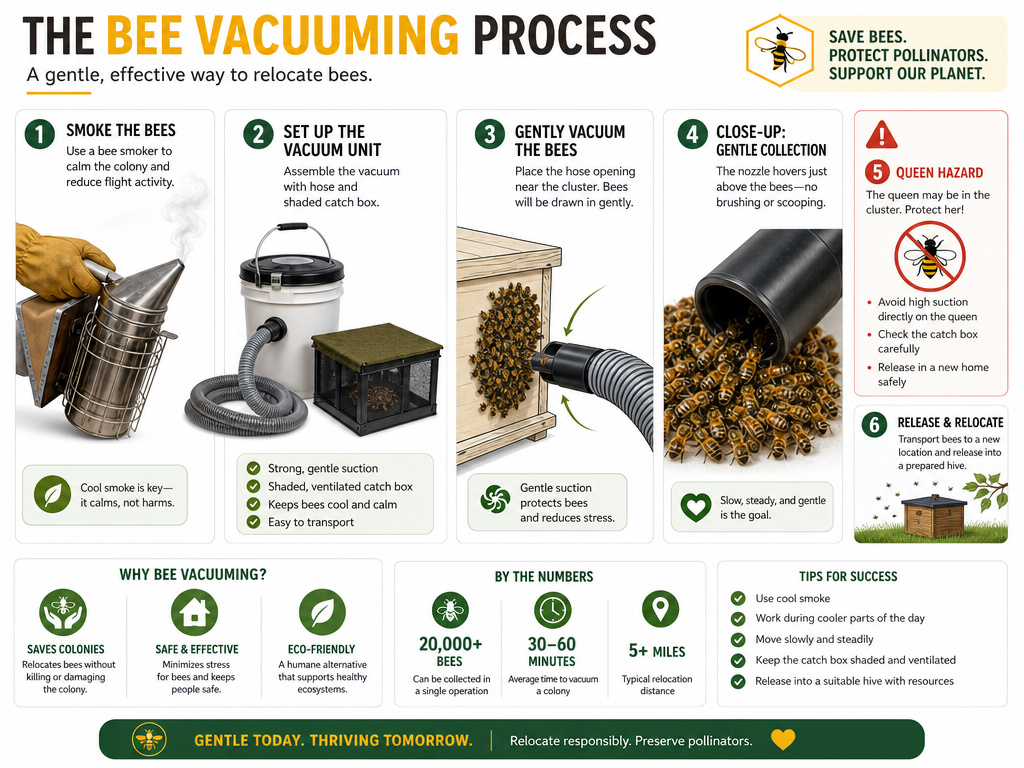
Follow this sequence. The order matters.
- Suit up and smoke the colony. This calms the bees and makes them less likely to defend. Give it a few minutes.
- Assemble and position the vacuum. Set the catch box in the shade. Connect the hose, ensuring it’s as straight as possible. Plug in the unit or ensure the battery is charged.
- Set the suction. Open the blast gate on the catch box fully. Turn the bypass valve to the half-open position. Turn the vacuum on.
- Begin collection. Gently guide the hose nozzle over clusters of bees. Work methodically, trying to locate and capture the queen early. If bees stop being drawn in, slightly close the bypass valve. Use the minimum adjustment needed.
- Manage breaks. If you must stop, turn the vacuum off, close the blast gate, and immediately remove the vacuum top from the catch box. Mist the bees with water if it’s warm.
- The queen hazard. If the queen is in the catch box, worker bees will cluster on the top of the screen. Before restarting, you must brush these bees off. If you set the vacuum top down on them, they get sucked into the motor. The Colorado Bee Vac warranty does not cover this damage.
- Transfer. Once collected, move the catch box to your apiary. Set it directly over a hive body with frames. Open the slide bottom. Most bees will walk down within hours. Close the bottom and remove the empty box.
When Not to Use a Bee Vacuum
This tool has clear boundaries. Using it outside these boundaries is ineffective, illegal, or cruel.
Do not use a bee vac for extermination. Vacuuming bees to kill them is inhumane. If you must destroy a colony, a pest control professional will use approved insecticides. In many areas, including Georgia, the official bee control state rules regulate the “control and removal” of honeybees from structures, often requiring licensed operators.
Do not use a standard pet vacuum groomers or a household upright. The suction is orders of magnitude too high and the internal mechanisms will kill bees instantly. Similarly, a UV vacuums or a carpet shampoo vacuums is built for pathogens and deep cleaning, not live insect collection.
Do not attempt a cut-out from a living space without training. If the colony is deep inside a wall, the job involves carpentry, pest law, and advanced bee handling. Call a professional beekeeper who does removals.
Frequently Asked Questions
Will the vacuum suction harm the bees?
If calibrated correctly, no. Commercial bee vacs are designed to be bee-safe. Injury occurs from excessive suction (closing the bypass valve too much) or impact (from a coiled hose or a full-speed impact on the catch box wall). The mortality rate spikes in hives with a lot of liquid honey, which can coat and suffocate bees during the process.
How long can bees stay in the catch box?
Few hours at most, and only with careful management. They need ventilation (the screened top) and shade. On a hot day, you have less than an hour before heat stress sets in. Always transfer them to a proper hive as soon as logistically possible.
Can I use a shop vac if I turn down the power?
Not directly. A shop vac lacks the necessary bypass valve for fine suction control and typically has a narrow hose that causes bee damage. You can build a bee vac using a shop vac motor, but you must incorporate a valve and a wide, smooth bore hose. This is a DIY project, not a simple setting change.
Are cordless bee vacs any good?
For the right job, yes. A rechargeable vacuums like the Humble Bee model is excellent for a single, straightforward swarm where its 45-minute runtime is sufficient. Its portability is a major advantage. For a multi-hour cut-out from a house wall, the corded model’s unlimited runtime is the only safe choice.
Is it legal to remove bees myself?
It depends on your location and the situation. Removing a swarm from a tree branch on your property is generally fine. Removing an established colony from a building often falls under pest control regulations. Some states, like Georgia, have specific administrative codes governing honeybee removal from structures. Always check local ordinances first.
The Bottom Line
You can vacuum bees, but it’s a specialist operation with zero room for improvisation. The tool is a bee vac, not a household cleaner. The corded Colorado Bee Vac is the pro’s choice for serious removals. The cordless Humble Bee Bee Vac works for single swarms if you respect its 45-minute clock.
The physics are simple: gentle suction, a straight hose, and constant ventilation. Get those three right and you can move a colony. Get one wrong and you have a box of dead insects and a warranty-voided motor. For a one-time swarm in an easy spot, calling a local beekeeper is still the smartest move. For the rest, now you know the rules.