
Vacuum Cleaner vs Broom | The Choice That Cuts Dust 78%
This post contains affiliate links. As an Amazon Associate, we earn from qualifying purchases.
A vacuum cleaner captures fine dust and allergens; a broom scatters them. The difference isn’t about convenience, it’s about whether you’re cleaning the floor or just moving dirt from one spot to another, and kicking the finest particles back into the air you breathe. For any sealed indoor surface, a vacuum with a HEPA filter is the only tool that actually removes contamination.
That performance gap is physical. A vacuum’s sealed airflow pulls debris into a container or bag, passing it through filters that trap particles down to 0.3 microns. A broom’s bristles push debris, relying on friction to gather it into a pile, which inevitably launches the lightest dust into a cloud. One tool cleans; the other redistributes.
What follows is the breakdown of when each tool earns its keep, backed by the filtration standards, sound levels, and commercial specs that define their real jobs. You’ll see where a $400 vacuum fails and a $30 broom wins, and where the reverse is brutally true.
Key Takeaways
- Vacuums with HEPA filters capture over 99.9% of fine dust per IEC 62885-2; brooms capture 0% and increase airborne particulate counts.
- Cordless stick vacuums like the Philips SpeedPro Max run at 84 dB, while commercial brooms like the Broce BW260 use a 24 HP diesel engine, they exist in different universes of noise and power.
- For allergen control on hard floors and carpets, a vacuum is non-negotiable. For clearing light dry debris like leaves or sawdust from a garage or job site, a broom is faster and more durable.
- The “best” tool is dictated by surface (sealed vs. Unsealed), debris type (fine dust vs. Large debris), and your tolerance for airborne particles.
- Owning both is the real answer for most households: a vacuum for daily indoor cleaning, a broom for quick dry spills and outdoor areas.
The Performance Gap: Capturing vs. Scattering
The core mechanism separates these tools forever. A vacuum cleaner is a sealed air-handling system. A motor creates suction, pulling air and debris through a nozzle, into a tube, and depositing it in a container. The air then passes through a series of filters, a pre-motor filter and often a final HEPA filter, before being exhausted. This process is measured.
According to the IEC 62885-2 standard for hard-floor cleaning, vacuums like the Philips FC9747/09 achieve 99.9% dust pick-up. The HEPA 13 filter in that model captures >99.9% of fine dust, meaning what goes in the bin stays in the bin.
A broom has no such seal. The mechanical action of poly or wire bristles flicking across a surface relies on momentum and friction to push debris into a pile. The larger, heavier items gather. The fine dust, the stuff you can’t see but breathe, gets launched. It’s basic physics: a stiff bristle striking a surface acts like a tiny ramp, imparting vertical velocity. That dust cloud then settles elsewhere, often on surfaces you just cleaned.
This is not a minor difference. It’s the difference between removing a problem and relocating it. If your goal is to reduce the total dust and allergen load in your home, a broom is actively counterproductive. For a workshop where you’re about to sand anyway, or a garage floor covered in dry leaves, that redistribution is irrelevant.
The Health & Allergy Layer
This is where the vacuum’s sealed system transitions from a nice feature to a medical-grade advantage. For anyone with allergies, asthma, or just a preference for clean air, the broom’s dust cloud is the enemy.
Modern vacuums are built around filtration. The benchmark is the HEPA filter, defined by the EN 1822:1998 standard as capturing 99.95% of particles at 0.3 microns. That size range includes pollen, mold spores, pet dander, and dust mite feces, the most common allergy triggers. A model like the Kärcher VC 7 Signature Line uses a HEPA 12 filter (EN 1822:1998), and Bosch advertises its Pure Air membrane system filters 99.99% of particles, exhausting air cleaner than the room’s.
A broom offers no filtration. Every stroke aerosolizes these allergens. The dust cloud rises, lingers in the air for hours, and slowly settles on every horizontal surface, curtains, shelves, bedding. You might get the floor looking clean, but you’ve polluted the entire room’s air column.
Where this goes sideways: Using a broom in a bedroom to control dust mite allergens. You’ll briefly see a clean floor, but the airborne allergen load will spike for hours, worsening symptoms at night. A vacuum with a HEPA filter is the only correct tool here.
The sensory reality is telling. Run a vacuum over a dusty hard floor and the dust is gone. Run a broom over the same spot and you’ll often smell the dust in the air, a dry, chalky scent that signals the particles are now in your respiratory zone.
Noise, Power, and the Right Tool for the Space
Forget the gentle swish of a household corn broom. The tool spectrum here is vast, and matching the machine to the space is critical.
| Tool Type | Typical Power / Sound | Designed For | Fails At |
|---|---|---|---|
| Cordless Stick Vacuum (e.g., Philips SpeedPro Max) | 84 dB, 25.2V Li-Ion, 65 min runtime | Quick daily cleans on hard floors & low-pile carpet. Reaching under furniture. | Deep carpet cleaning, large debris, extended runtime. |
| Corded Upright Vacuum (e.g., Philips PowerPro Expert) | 67-75 dB, 900W motor, 32.5 L/s airflow | Whole-home cleaning, carpets, high suction needs. | Quick clean-ups, stairs, noise-sensitive environments. |
| Commercial Sweeper Broom (e.g., Broce BW260) | 24 HP diesel engine, 10 mph travel speed | Industrial sites, parking lots, clearing large areas of dry debris like leaves, sand, gravel. | Any indoor environment, fine dust control, quiet operation. |
| Household Push Broom | Virtually silent, human power | Garages, workshops, patios, quick dry spill cleanup (e.g., dirt pile). | Any task requiring actual dirt removal from a sealed indoor floor. |
The commercial broom specs are a different world. The Broce BW260 is a 3,100 lb machine with a 24 HP engine and a full 8-foot broom that sweeps a 5-foot radius. It runs on diesel, holds 11 gallons of hydraulic oil, and travels at 10 mph. Its job is to clear football fields of leaves, not to manage dust in your living room. Comparing it to a home vacuum is like comparing a forklift to a sedan.
The takeaway is about environment. Loud, powerful tools belong in loud, powerful spaces. Using a industrial sweeper indoors is absurd. Using a quiet stick vacuum in a dusty construction site is futile.
Vacuum Cleaner vs Broom: The Decision Matrix
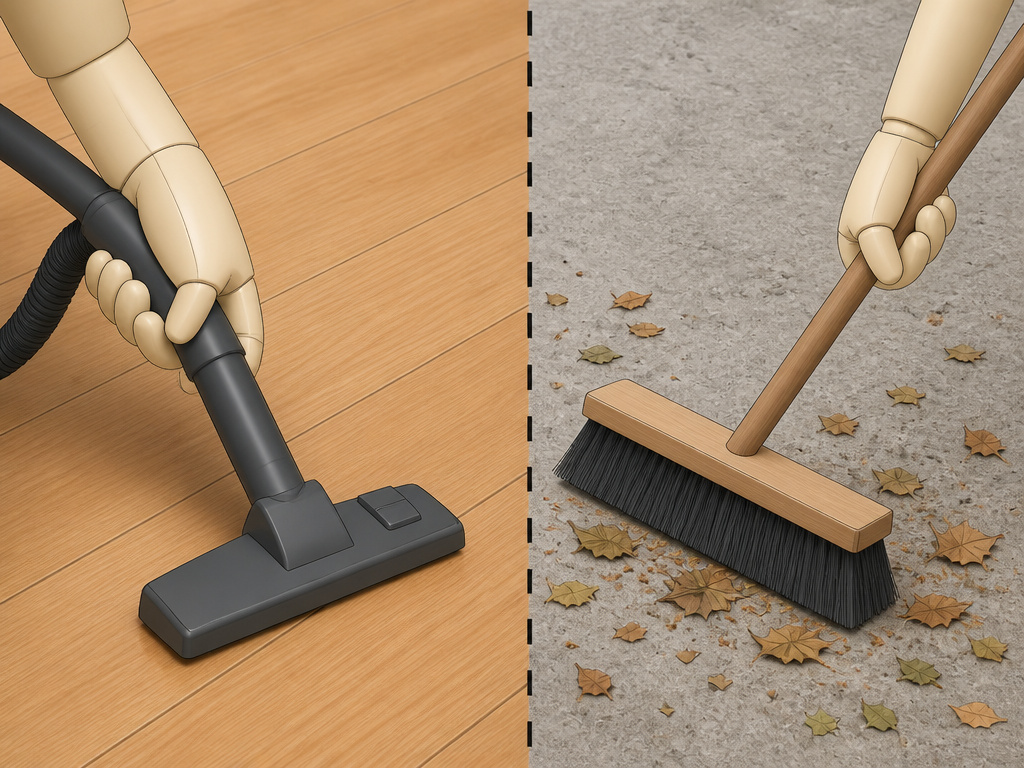
So, which do you reach for? The choice isn’t vague, it’s a simple checklist of three conditions.
Use a Vacuum Cleaner When:
- The surface is sealed indoors. (Hardwood, laminate, tile, vinyl, carpet.)
- The debris includes fine dust or allergens. (Dust, pet hair, crumbs, pollen.)
- Your goal is to remove contaminants, not just gather them.
This covers 95% of routine home cleaning. For most families, a bagless vacuum like the Philips PowerPro Expert or a versatile cordless stick vacuum handles this domain. If you have mostly carpets, prioritize a model with a motorized brush roll.
Use a Broom When:
- The surface is unsealed, rough, or outdoors. (Concrete garage floor, asphalt, patio, workshop floor.)
- The debris is large, dry, and non-dusty. (Leaves, wood chips, sawdust pellets, spilled potting soil.)
- Speed and durability matter more than total cleanliness.
A broom is a brilliant tool for its niche. Sweeping a garage after a woodworking project is faster and doesn’t risk damaging your vacuum’s filter with fine sawdust. Clearing a sidewalk of leaves is instant.
The part nobody mentions: You need to own both. A household push broom for the garage and a proper vacuum for the house isn’t an either-or. It’s the complete kit. Trying to force one tool to do both jobs leads to frustration and a half-clean home.
The Tools You’ll Actually Need (And One to Skip)
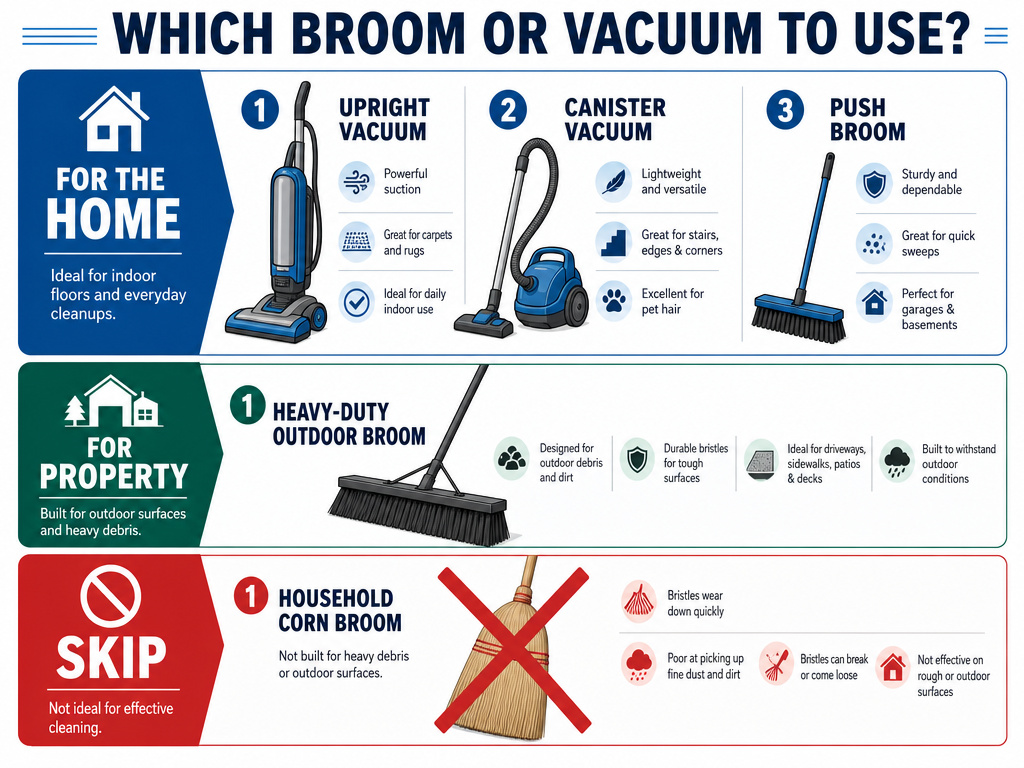
If you’re equipping a home, you need two core tools. If you’re managing a property, you need three.
For the Home:
- A Quality Vacuum Cleaner: This is your primary weapon. Your choice depends on your home.
- For mostly carpets and large spaces: an upright vacuum.
- For hard floors, stairs, and agility: a canister vacuum or a powerful cordless stick model.
- For daily maintenance: a robot vacuum.
- A Sturdy Push Broom: A simple, wide corn broom or synthetic broom for the garage, porch, and kitchen dry spills. Don’t overthink it.
For Property Maintenance (e.g., a large driveway, workshop):
- A Heavy-Duty Outdoor Broom or Leaf Blower: For moving large volumes of dry debris. A broom is quieter and more controlled; a blower is faster for very large areas.
The Tool to Skip:
The household corn broom for indoor cleaning. It’s functionally obsolete. If you have a vacuum, using a broom on your kitchen floor is choosing to leave dust behind. Relegate it to the garage or recycle it.
Frequently Asked Questions
Can a broom damage my hardwood floors?
Yes, over time. Grit and fine debris trapped between stiff broom bristles and the floor finish act like sandpaper. You’ll create micro-scratches that dull the finish. A vacuum with a soft roller brush or a microfiber mop is always safer for finished hardwoods.
Is a vacuum really better than a broom for allergies?
Absolutely. This is the most critical distinction. Vacuums with HEPA filters capture and trap allergens. Brooms aerosolize them, significantly increasing the airborne concentration you breathe. For allergy sufferers, brooming a room can trigger symptoms that last hours.
What’s better for pet hair, a vacuum or a broom?
Vacuum, every time. Brooms are terrible for pet hair, they push it around, scatter it, and often tangle it in the bristles. You need the suction of a vacuum, preferably one with a motorized turbo brush or a dedicated pet hair tool, to lift hair from carpets and upholstery.
Can I use a shop vacuum instead of a broom?
For workshop floors, often yes. A wet/dry shop vac is excellent for sucking up sawdust, drywall dust, and debris. It’s more thorough than a broom. However, for very large, bulky dry debris (like a pile of leaves inside a garage), a broom is still faster for the initial gather.
Why does my broom leave a dust trail?
That’s the scattering effect in action. The fine dust particles are too light to be controlled by the broom’s friction. They skip over the bristles or get launched into the air and settle behind you as you move. It’s the fundamental limit of the tool. A vacuum has no such trail because the airflow pulls those particles in.
Before You Go
The vacuum cleaner vs. Broom debate ends with a simple rule: sealed surfaces get a vacuum, unsealed or outdoor surfaces get a broom. The vacuum’s job is removal and health; the broom’s job is gathering and speed.
Invest in a vacuum that fits your floors, a HEPA-filtered model if allergies are a concern. Then buy a decent push broom for the garage. Don’t try to cross the streams. Using a broom indoors is a step backward in cleaning technology, and using a home vacuum on a construction site is a quick way to break it.
Get both. Use each for what it’s built for. Your floors will be cleaner, and your air will be clearer.