
Can I Vacuum Baking Soda? Why It Can Void Your Vacuum Warranty
This post contains affiliate links. As an Amazon Associate, we earn from qualifying purchases.
You can vacuum baking soda, but you absolutely should not with a standard household vacuum. Manufacturer manuals from Vax, Bosch, and others explicitly prohibit it, citing risks of filter clogging, motor abrasion, and voided warranties. The fine, abrasive powder bypasses standard filtration, grinds against motor bearings, and can trigger a thermal cut-out within minutes.
That prohibition is printed in black and white. The Vax VCC-05 manual states point 19: “Do not vacuum baking soda or any other powder-based carpet refresher or deodoriser.” Ignoring that line is how a $300 vacuum becomes a $300 paperweight before the warranty claim is processed.
What follows is the breakdown of why that rule exists, the one exception that sometimes works, and the three safe methods that actually let you use baking soda for cleaning without destroying your machine.
Key Takeaways
- Manufacturer manuals explicitly forbid it. The Vax VCC-05/VCC-07 user guide lists baking soda as a prohibited substance; violating this voids the warranty.
- The powder is an abrasive. Baking soda’s fine particles act like grinding paste on a vacuum’s motor bearings, causing premature failure.
- Filters clog instantly. Standard paper or cloth pre-motor filters cannot handle the volume, causing suction loss and overheating.
- Use a wet/dry shop vac with a filter bag. This is the only vacuum type with a fighting chance, as it’s designed for fine dust like drywall.
- Pre-treatment is the safe method. Sprinkle, wait, then vacuum—this allows the soda to work on odors without overwhelming the machine.
The Short Answer: What the Manuals Say
“Do not vacuum baking soda or any other powder-based carpet refresher or deodoriser.” – Vax VCC-05/VCC-07 User Guide, General Safety Information, point 19.
This isn’t a suggestion. It’s a condition of use. When a manufacturer prints a specific substance in a “do not vacuum” list, they are drawing a legal line. Sucking it up provides them with immediate grounds to deny a warranty claim for motor or filter damage. The Bosch manual reinforces this principle, warning that damage from unsuitable use isn’t covered.
The reason is mechanical, not arbitrary. Your vacuum’s air path is a carefully balanced system. The fan motor pulls air through an intake, past a pre-motor filter that catches large debris, and then through the motor itself for cooling before exiting. Baking soda is a fine powder with particles around 70-250 microns. That’s small enough to slip through or instantly coat many standard cloth or foam pre-filters.
When that powder reaches the motor chamber, two things happen. First, it acts as an abrasive on the motor’s bearings and fan blades. Second, it insulates the motor, blocking the airflow it needs to stay cool. The motor’s built-in thermal cut-out will trip, shutting the unit down. Do this repeatedly, and you’re conducting a stress test the machine was never designed to pass.
Why Baking soda Is a Vacuum Killer
It looks harmless. It smells fresh. Its texture is soft. None of that matters to the machine’s internal geometry. The damage follows a predictable sequence.
First, the filter fails. Unless you have a vacuum with a sealed HEPA system and a pre-motor filter designed for fine dust—like some deep cleaning vacuums—the powder coats the filter media within seconds. Airflow drops by half. You’ll hear the motor pitch change, working harder to pull air through the paste now forming on the filter.
Then, the powder migrates. What gets past the filter enters the motor housing. Here, the particles interact with moving parts spinning at 20,000 to 40,000 RPM. Baking soda is sodium bicarbonate, a mild abrasive. At high speed, it functions like a grinding compound against the motor’s sleeve bearings or the fan blade tips.
Finally, the system overheats. Reduced airflow from a clogged filter means less cooling for the motor. The motor itself, working harder against friction, generates more heat. The combination triggers the thermal cut-out. The vacuum shuts off. Per the Vax manual, you must then unplug it, empty it, clean the filters, and wait an hour for it to cool. This cycle strains electrical components every time.
Where this goes sideways: Assuming a “quick pass” is safe. A half-cup of baking soda dumped on a carpet and vacuumed immediately represents a concentrated dose the system cannot manage. The thermal cut-out can engage in under two minutes, and the abrasive damage is cumulative.
The takeaway is simple. Using your primary upright or canister for this is a direct trade: a freshened carpet for a shortened vacuum lifespan. For tasks that generate fine dust, a dedicated dusting vacuum with appropriate filtration is a smarter long-term investment.
The One Tool That Can Handle It (Sometimes)
If you must vacuum dry baking soda directly, only one common household tool has a plausible claim: a wet-dry vacuum (often called a shop vac). These are built differently.
| Feature | Standard Household Vacuum | Wet-Dry Shop Vac |
|---|---|---|
| Motor Placement | Air flows through the motor for cooling. | Motor is mounted separately; air does not flow through it. |
| Primary Filtration | Cloth, foam, or paper filter before the motor. | Large filter bag or foam sleeve over a cage; fine dust settles in tank. |
| Intended Debris | Dirt, hair, crumbs, limited fine dust. | Construction debris, water, plaster dust, sawdust. |
| Risk from Baking Soda | High. Abrades motor, clogs filter, causes overheating. | Moderate. Can clog filter bag, but motor is physically protected. |
The key is the isolated motor. In a shop vac, the motor sits on top of a sealed tank. It creates suction in the tank, but the dirty air and debris never actually enter the motor housing. The abrasive particles get sucked into the tank and, with the right accessory, are captured.
The part nobody mentions: You must use a filter bag. Even a shop vac’s foam sleeve filter will clog if you dump baking soda directly onto it. A disposable paper filter bag lines the tank and catches the fine powder. After you’re done, you throw the bag away. No powder touches the permanent filter or the fan.
Kärcher’s manuals for its WD series wet/dry vacuums state they are for “dry vacuum cleaning,” which includes fine dust. They still recommend a filter bag for such materials. This is the critical, often-missed step. Running a shop vac without any filter will still blow the powder everywhere. Running it with just the foam sleeve will clog it.
So, the rule is: wet/dry vac + manufacturer’s filter bag = maybe okay. It’s still messy, and you’ll go through bags. But the motor will likely survive. For cleaning hard floors where baking soda is often used, pairing this method with a hard floor vacuum or a vacuum mop combo for the final cleanup is efficient.
Safe & Effective Ways to Use Baking soda With Your Vacuum
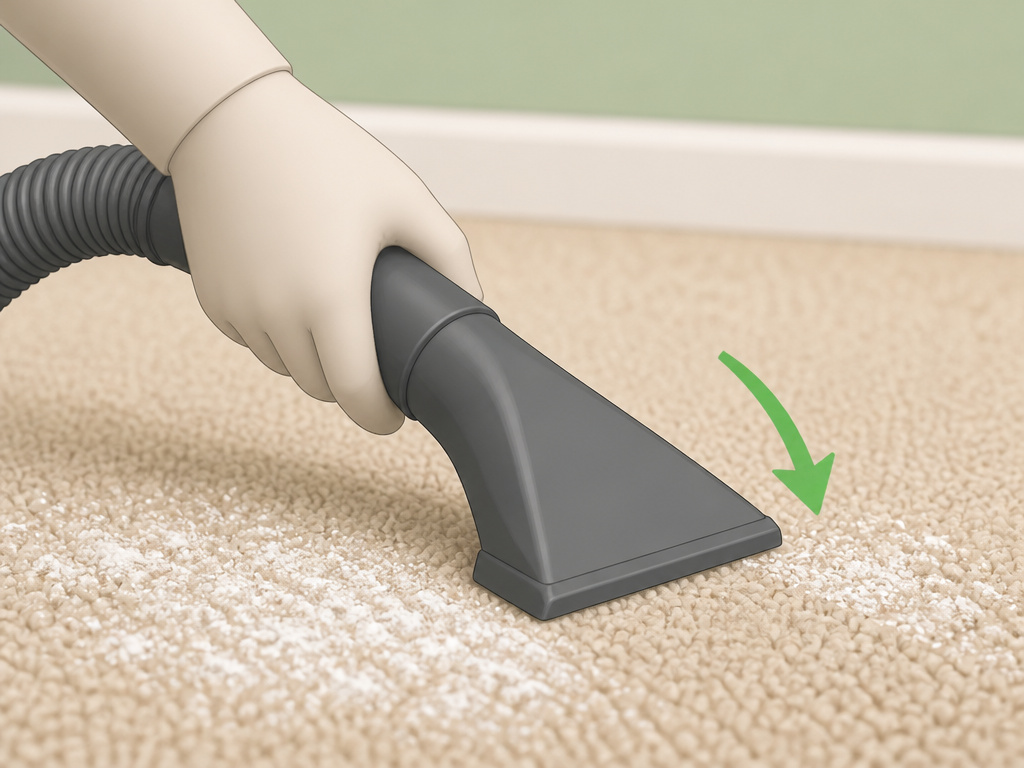
You don’t have to abandon baking soda as a cleaning aid. You just have to keep it out of your vacuum’s bloodstream. These three methods work with the machine, not against it.
1. The Pre-Treatment Method (The Only Safe Way for Carpets)
This is the technique described in most sensible guides. You use the baking soda before the vacuum does its main job. 1. Sprinkle baking soda generously over dry carpet or upholstery. 2. Let it sit for at least 30 minutes. For strong odors, leave it for several hours or overnight. The powder absorbs odors and loosens dirt. 3. Vacuum thoroughly. Use slow, repeated passes with a clean, powerful machine. A vacuum for carpets and hard floors with strong suction and a beater brush works well here.
The difference is critical. You are not vacuuming a pile of pure powder. You are vacuuming a carpet that has a thin, dispersed layer of baking soda mixed with the lifted dirt. The load on the filter is dramatically lower and manageable.
2. The Broom & Dustpan Method (For Hard Floors)
This is the simplest and safest option for spills or intentional cleaning on tile, laminate, or wood. 1. Sweep the bulk of the dry baking soda into a dustpan with a soft-bristle broom. 2. Dispose of it in the trash. 3. Use your vacuum to pick up the fine residual film. A vacuum for hard floors with a soft roller or a mop vacuum combo is perfect for this final pass.
It’s a two-step process, but it guarantees 99% of the abrasive never sees your vacuum’s interior.
3. The Dedicated Machine Method
If you use baking soda, talcum powder, or similar products frequently, consider a cheap, dedicated tool. A small, rechargeable vacuum used only for dry powders can be a sacrificial unit. Even better, a handheld dustbuster-style vac is easy to disassemble and clean completely after each use. When its motor eventually grinds to a halt, you’re out $50, not $500.
What to Do If You’ve Already Vacuumed Baking soda
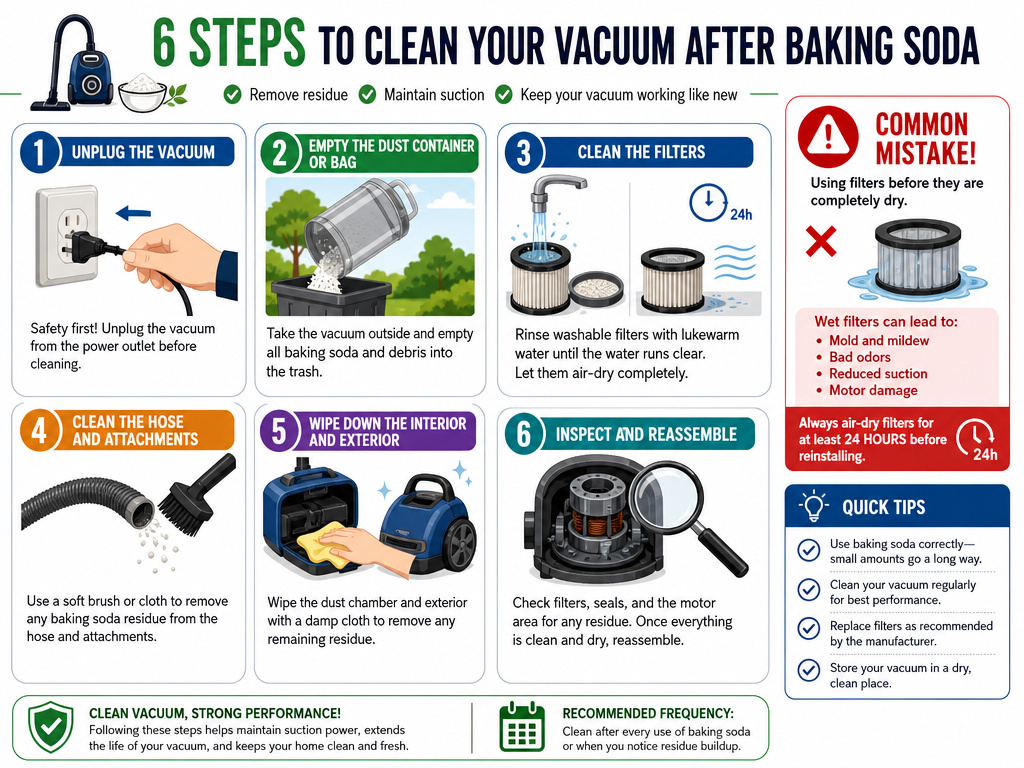
Don’t panic. One minor incident isn’t an automatic death sentence. Immediate action can mitigate the damage. Follow these steps in order.
- Unplug the vacuum immediately. Do not run it again until you’ve completed cleaning.
- Empty the dirt container or bag completely outdoors, away from the wind.
- Remove and clean every filter. This includes the pre-motor filter, any post-motor exhaust filter, and the HEPA filter if present. Tap them out vigorously. For cloth or foam filters, rinse them under cold running water until the water runs clear. Let all filters air-dry for at least 24 hours before reinstalling.
- Inspect the air path. Check the hose, wand, and intake for visible clumps of powder. Use a long brush or a damp cloth to wipe them out.
- Check the motor area. If you can access the fan intake (often behind where the hose attaches), look for a dust coating. Use a dry brush or a vacuum attachment on another vacuum to gently clean it.
- Reassemble with dry filters only. Run the vacuum for a minute on a clean, hard surface. Listen for any new grinding sounds or burning smells. If you hear or smell anything unusual, stop. The motor bearings may have been compromised.
Common mistake: Rushing the filter drying. A damp filter is worse than a dirty one. It restricts airflow more severely and can cause the motor to overheat faster than powder would. Patience is non-negotiable.
Frequently Asked Questions
Can a Dyson vacuum handle baking soda?
No, Dyson vacuums are not exempt. Their cyclonic systems are excellent for separating dirt, but fine powder like baking soda can still coat the inner cyclones, clog the post-motor HEPA filter, and be drawn into the digital motor. Dyson’s warranties also exclude damage from improper use, which would include vacuuming substances they advise against.
Does vacuuming baking soda ruin your vacuum?
It can, and often does. The risk isn’t always immediate catastrophic failure. It’s cumulative damage: worn bearings from abrasion, loss of suction from permanently clogged filters, and overheated motor windings. One time might just require a deep clean. Making a habit of it will shorten your vacuum’s usable life by months or years.
What can I use instead of baking soda to freshen carpets?
For odor absorption, try activated charcoal bags placed in the room. For cleaning, use vacuum powders specifically formulated for machines, like Bissell Carpet Powder. These products have larger, less abrasive granules designed to be vacuumed. Alternatively, a deep cleaning vacuum with a dedicated washable filter and powerful suction is built for this exact task.
Can you vacuum baking soda with a shop vac?
Yes, but only if you use a disposable paper filter bag inside the tank. Vacuuming baking soda directly onto a shop vac’s reusable foam or felt filter will ruin it. The bag contains the fine powder, which you then dispose of, protecting the machine’s internal components.
Will baking soda damage a robot vacuum?
Absolutely. Robot vacuums have tiny, less powerful motors and even smaller air paths. A pile of baking soda will completely clog their main filter and likely jam the side brush and wheels. The fine powder is a nightmare for their sensors as well. Never use baking soda on floors where a robot vacuum, like an automatic vacuum for hardwood, will run.
The Bottom Line
Read your manual. The answer to “can I vacuum baking soda” is almost certainly in the “do not” section, as it is for Vax and Bosch. The physics are against you—fine abrasives and high-speed motors are enemies.
The safe path is clear. Use baking soda as a pre-treatment, sweep up the bulk, or invest in a wet/dry shop vac with filter bags for direct cleanup. Your vacuum is a tool for maintaining your home, not a disposable appliance. Treating it according to its design specs is the cheapest repair strategy you’ll ever find.