Can I Vacuum Hair With Dyson? The Best Tangle-Free Vacuums
This post contains affiliate links. As an Amazon Associate, we earn from qualifying purchases.
Yes, you can vacuum hair with a Dyson, but only specific motorized tools are designed to handle it without jamming. The Dyson Hair Screw Tool 2.0 and the newer Motorbar™ heads with de-tangling vanes are engineered for hair. Standard brush bars on older models and the non-motorized Fluffy™ head will tangle, and using the wrong tool on delicate carpets can damage them or void your warranty.
The “brush bar OFF” function on models like the CY28 is the clause most people miss. It’s not just for delicate rugs, it’s your escape hatch when the head starts to bog down on a thick pile. That quarter-turn dial separates a clean pass from a motor-stalling snarl.
What follows: a breakdown of the four Dyson tool types rated for hair, the one debris type that officially voids your guarantee, and the step-by-step clearance drill for when a wrap happens anyway.
Key Takeaways
- The Dyson Hair Screw Tool 2.0 and modern Motorbar™ heads with de-tangling vanes are specifically designed for hair; other brush bars will tangle.
- On cylinder models like the CY28, use the brush bar OFF setting for delicate rugs and to prevent damage, the brush defaults to ON every time you power up.
- Vacuuming debris from DIY or building work (sawdust, plaster, rubble) can harm the machine and void the Dyson guarantee.
- Carbon fibre brushes on some models can cause minor skin irritation; wash your hands after handling them during a clearance.
- Always check your flooring manufacturer’s instructions before using a rotating brush bar, as some carpets will “fuzz” and be damaged.
The Short Answer: Yes, With the Right Tool
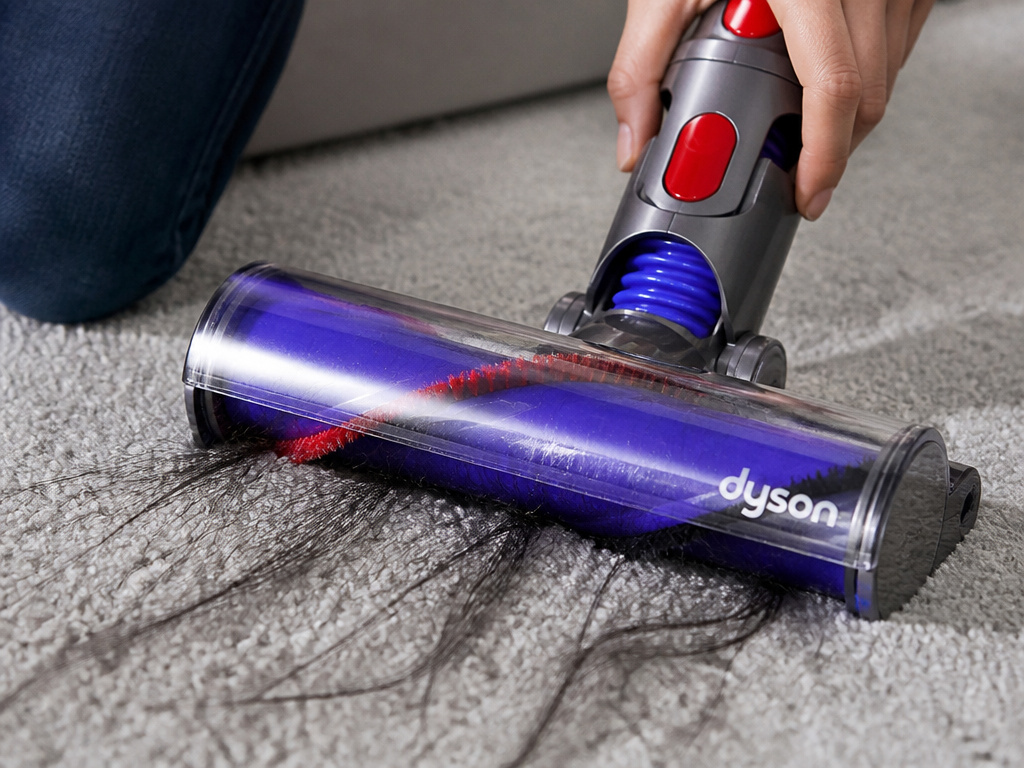
Dyson vacuums are built to pick up household dirt and hair. The official manuals state they are designed for domestic use to remove household dirt, hair, and allergens. But “designed for” doesn’t mean every attachment can handle it.
The real answer lives in your tool clip. You need a motorized tool engineered to manage long fibers. The two that qualify are the Hair Screw Tool 2.0, with its anti-tangle conical brush bar, and the newer Motorbar™ cleaner heads that feature de-tangling vanes. These vanes actively clear wrapped hair from the brush bar as you clean.
The brush bar will always default to ‘ON’ (spinning) each time you switch the machine ‘ON’. To switch the brush bar ‘OFF’ (e.g. For delicate flooring), twist the dial on the cleaner head a quarter of a turn. The brush bar will stop.
Dyson CY28 User Manual
This is the technical core. For cylinder vacuums, the brush bar spins automatically unless you manually disable it. On cordless stick models, the brush bar is integral to the motorized head and cannot be turned off, selection happens at the tool rack.
The Two Dyson Tools Designed for Hair (And Two That Aren’t)
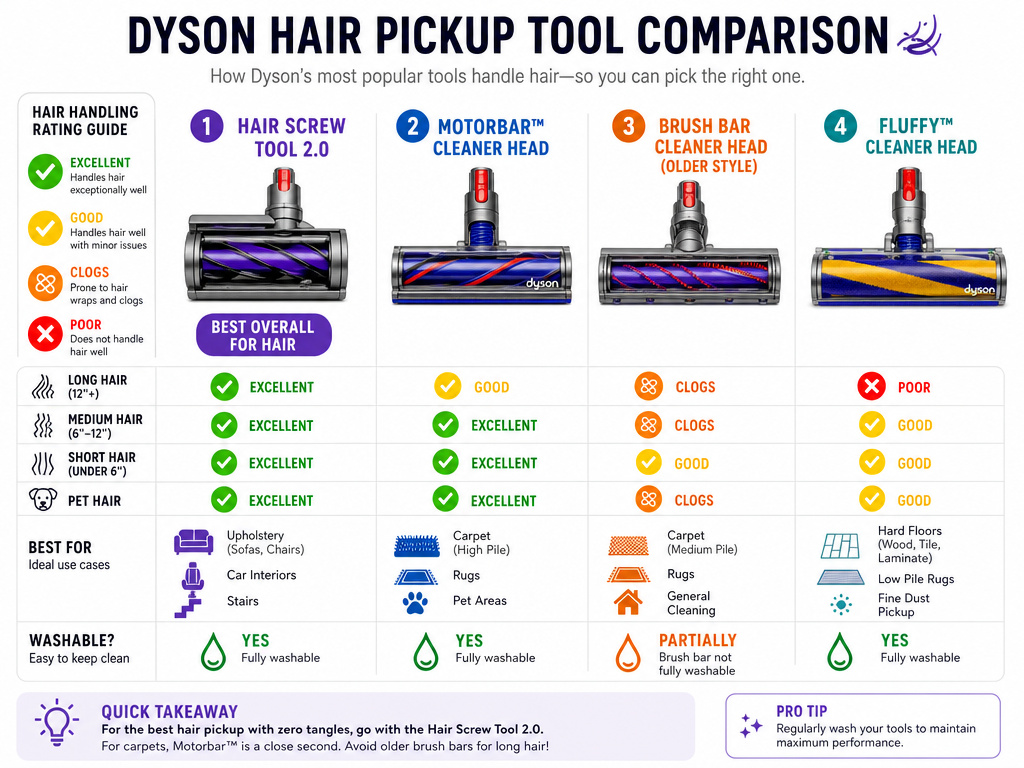
Not all motorized Dyson tools are equal for hair pickup. The design dictates whether you’ll spend thirty seconds cleaning or thirty minutes with a pair of scissors.
The Specialists: Hair Screw Tool 2.0 & Modern Motorbar™ Heads
The Dyson Hair Screw Tool 2.0 is the dedicated solution. Its conical brush bar is designed to spiral hair off and into the bin, preventing the typical wrap-around-the-cylinder tangle. It’s smaller, meant for upholstery, stairs, and tight spaces.
Modern Motorbar™ cleaner heads (and the Digital Motorbar™ on Gen5detect models) incorporate de-tangling vanes. These are plastic fins that sit close to the brush bar, physically pushing hair off the bristles as it spins. They work, but on a severe shed day, they can still be overwhelmed.
The Tangle Risks: Older Brush Bars & The Fluffy™ Head
Older Dyson motorized tools without these features are hair magnets. The brush bar is a simple cylinder; long hair wraps around it in layers, eventually stopping rotation and straining the motor.
The Fluffy™ cleaner head (and Micro Fluffy™) is a different problem. It’s not a motorized brush bar, it uses soft woven nylon and anti-static carbon fibre filaments for hard floors. Hair doesn’t tangle around a moving part here. Instead, it clogs the static filament bed, killing suction and requiring a manual pick-out.
| Tool Type | Best For | Hair Handling | Washable? |
|---|---|---|---|
| Hair Screw Tool 2.0 | Upholstery, stairs, pet beds | Excellent – Anti-tangle conical design | No – Brush bar not designed for washing |
| Motorbar™ with De-tangling Vanes | Whole-floor carpet cleaning | Good – Vanes clear wraps during use | No – Brush bar not designed for washing |
| Older Motorized Brush Bars | General carpet cleaning | Poor – Tangles easily, requires manual clearance | No – Brush bar not designed for washing |
| Fluffy™ / Micro Fluffy™ Head | Hard floors only | Clogs – Hair blocks static filaments, reduces suction | Yes – Brush bars are washable |
Common mistake: Using a Fluffy™ head on medium-pile carpet to pick up hair. The filaments drag, the hair embeds, and you lose all suction in two passes. That head is for hard floors only.
The “Brush Bar OFF” Setting You Probably Haven’t Used
If you own a Dyson cylinder vacuum like the CY28, you have a secret weapon the cordless crowd doesn’t. On the top of the cleaner head is a dial. A quarter-turn switches the brush bar off.
The manual is clear: this is for delicate flooring or carpets that might fuzz. But it’s also your immediate response when you feel the head start to drag and hear the motor strain. That strain is hair winding tight. Turning the brush bar off stops the winding, lets you lift the head, and assess before the thermal cut-out trips.
On cordless models, you don’t have this switch. Your only option is to lift the head off the floor the moment you feel resistance. Continuing to push grinds the wrapped hair tighter and risks overheating the motor.
Step-by-Step: How to Clear a Hair Tangle From a Dyson Brush Bar
When a tangle happens, stop vacuuming immediately. Forcing it can trigger the thermal cut-out or strain the motor.
- Unplug or turn off the machine. This is non-negotiable. The manual warns to switch off and unplug before looking for blockages to prevent injury.
- Flip the cleaner head over. You’ll see the brush bar running the length of the head.
- Locate the end caps. Most Dyson brush bars are held in by plastic caps at one or both ends.
- Press the tab(s) and remove the cap. You might need a flat-head screwdriver to gently pry it. Some newer models have a quick-release lever.
- Slide the brush bar out. Once the end cap is off, the brush bar should slide freely from its housing.
- Cut and remove the hair. Use scissors to cut the hair wrap along the length of the brush bar. Do not pull hard on the hair or the bristles. Slowly unwind the cut pieces.
- Check the bearings and ends. While the bar is out, clear any hair or debris from the bearing slots at each end of the head.
- Reinsert the brush bar and replace the cap. Ensure it clicks or seats fully. A loose cap will cause a loud rattling.
Where this goes sideways: Yanking tangled hair instead of cutting it. You’ll pull clumps of bristles right out of the brush bar, creating an unbalanced bar that vibrates and wears unevenly.
What Not to Vacuum: The Guarantee You Might Void
Dyson’s stance is specific and severe. The machines are for household dirt and hair. They are not designed for debris from DIY, building tasks, or larger quantities of dust like soot and sawdust.
The CY28 manual states these materials may harm the appliance and may void your guarantee. Fine dirt like flour should only be vacuumed in very small amounts. This isn’t scare talk, sawdust is abrasive and can scratch cyclone seals; plaster dust is fine enough to bypass filters and coat the motor.
If you’re cleaning up after a home project, use a shop vac first. The best corded stick vacuums for pet hair are also not the right tool for construction debris.
Dyson Hair Tools vs. The Competition
Dyson’s hair-specific tools are clever, but they exist in a market full of alternatives. The Hair Screw Tool is essentially a mini motorized tool with a specialized brush bar. Other brands tackle the problem differently.
Some use a completely brushless air-powered head to avoid tangles altogether, sacrificing deep carpet agitation. Others, like certain robot vacuums for pet hair, employ a vast extractor system that’s easier to clean. The Dyson approach, modifying the brush bar itself, keeps the cleaning power high but still requires manual intervention on heavy shed days.
For whole-home cleaning, a dedicated best vacuum for carpets and hard floors with a self-cleaning brush roll might be a better fit if hair is your primary concern. The Dyson tool ecosystem is modular; you buy the hair specialist as an add-on.
Caring for Your Floors: More Than Just Hair
Hair pickup is one challenge. Floor safety is another. Dyson manuals repeatedly instruct you to check your flooring or carpet manufacturer’s recommended cleaning instructions before using a rotating brush bar.
Some carpets will fuzz. Some delicate rugs can have threads pulled. The answer isn’t to avoid vacuuming but to use the right tool. For delicate surfaces, that means the brush bar OFF setting, or switching to a non-motorized tool like the combination tool.
For daily cleaning on mixed surfaces, an all-floor vacuum that can automatically adjust suction or brush roll speed is ideal. It removes the guesswork.
Frequently Asked Questions
Does the Dyson Pet Groom Tool vacuum hair?
No, the Dyson Pet Groom tool is not a vacuum attachment in that sense. It’s a grooming brush that captures loose hair and dander as you brush your pet, preventing it from spreading around your home. The hair collects in a removable chamber on the tool itself, which you then empty into a bin.
Can I wash my Dyson brush bar?
It depends. The brush bars on the Motorbar™ cleaner head, Hair Screw Tool, and Mini Motorized Tool are not designed to be washed, per Dyson manuals. Submerging them can damage the motor or bearings. The brush bars on the Fluffy™ and Micro Fluffy™ hard floor heads are washable. Always check your specific model’s manual.
Why does my Dyson keep stopping when vacuuming hair?
The most likely cause is a hair tangle on the brush bar so severe it causes an obstruction. Dyson machines have a thermal cut-out that automatically stops the motor if it overheats due to a blockage. Let the machine cool for 1-2 hours, then clear the brush bar and any other blockages in the hose or wand.
Is a Dyson or a Shark better for long hair?
This hinges on the specific model. Some Shark models feature self-cleaning brush rolls that are highly effective against long hair. Dyson counters with its dedicated Hair Screw Tool. For whole-home cleaning, compare a Shark with a self-cleaning power head against a Dyson stick vacuum bundled with the Hair Screw Tool. For spot cleaning upholstery, the Dyson specialty tool has an edge.
The Bottom Line
You can vacuum hair with a Dyson, but you must match the tool to the task. For focused cleaning on upholstery and stairs, the Hair Screw Tool 2.0 is your best bet. For whole carpets, a modern Motorbar™ head with de-tangling vanes is the minimum.
Owners of cylinder models should practice using the brush bar OFF switch, it’s your first line of defense against tangles and floor damage. And everyone should heed the warranty warning: leave the sawdust and plaster for a shop vac.
Your next move is to check which tools you actually own. Then, look up their specific care instructions in the Dyson manual. That’s how you turn a hair-cleaning question into a machine-preserving habit.