
How to Recycle an Old Vacuum Cleaner Safely & Responsibly
This post contains affiliate links. As an Amazon Associate, we earn from qualifying purchases.
Recycle an old vacuum cleaner by first checking its condition and your local e-waste laws. If it works, donate it to a charity like Goodwill. If broken, take it to a retailer drop-off (like Best Buy) or a municipal e-waste center. For cordless or robot vacuums, you must remove the rechargeable battery and perform a factory reset before recycling.
The legal line between trash and e-waste depends entirely on your zip code. More than 25 states ban cordless and robotic vacuums from regular trash because of their circuit boards and batteries. A corded upright might be fine for curbside recycling in New York City but illegal to toss in California.
What follows: a three-step decision tree to sort working from broken machines, the specific prep steps that keep recyclers safe, and the one item on every vacuum that almost never gets recycled.
Key Takeaways
- Check local e-waste laws first. State bans vary wildly; tossing a robot vacuum in the trash in California can violate state law.
- Remove rechargeable batteries before anything else. Tape the terminals and recycle batteries separately at a designated drop-off.
- Factory reset robot vacuums. This clears your home’s Wi-Fi details, floor maps, and saved cleaning schedules from the device’s memory.
- Filters go in the trash. HEPA, foam, and paper filters are contaminated and made of mixed materials; curbside programs almost never accept them.
- Retailer take-back is the easiest path for broken units. Stores like Best Buy offer free e-waste recycling for small appliances.
The 3-Step Decision Tree: Donate, Recycle, or Dispose
Your first move is a simple condition check. A working vacuum has a second life. A broken one is scrap, but valuable scrap.
Step 1: Can it still clean? Plug it in. Listen for the motor. If it runs but has weak suction, that’s often a clogged hose or a full filter, a fixable problem. If the motor is silent, smells of burnt plastic, or sparks, it’s broken. Don’t donate a machine that overheats; it’s a fire hazard for the next owner.
Step 2: If it works, donate. Local thrift stores like Goodwill and The Salvation Army accept working appliances. Clean the canister or replace the bag. Include all attachments, the hose, wand, and every brush head. A complete set sells faster and for more money, which funds their programs.
Where this goes sideways: Donating a vacuum with a worn-out brush roll or a cracked hose. The recipient spends more on the repair part than the machine is worth, and the vacuum often gets re-donated or trashed within a month. Check the basic functions.
Step 3: If it’s broken, recycle. This is where your location dictates the rules. The Zero Waste DC recycling guide is a good example of a municipal lookup tool, but your own city’s website is the final authority.
| Vacuum Type | Typical Disposal Path | Critical Exception |
|---|---|---|
| Corded Upright/Canister | Often accepted as “small appliance” curbside recycling (e.g., NYC) | Banned from trash in states with specific e-waste laws |
| Cordless Stick Vacuum | E-waste only. Battery must be removed separately. | Illegal to dispose of in regular trash in >25 US states |
| Robot Vacuum | E-waste only. Requires factory reset before recycling. | Contains both a battery and a computer board; always e-waste |
| Industrial (e.g., DEPURECO) | Return to dealer or designated commercial collection point per local law | Manuals cite specific national regulations (e.g., Italy’s Legislative Decree 152/2006) |
The federal EPA may treat household vacuums as general solid waste, but state laws override that guidance. When in doubt, assume it’s e-waste.
How to Prep Your Vacuum for Drop-off
Recycling centers and retailers need machines that are safe to handle. A vacuum filled with dust, a live battery, or your personal data creates problems.
- Unplug it and remove the battery. This is non-negotiable for any cordless or robotic model. Lithium-ion batteries can short-circuit and cause fires in transport or at the recycling facility. Once out, tape the battery’s terminals with clear packing tape.
- Empty all contents. Dump the dustbin or remove the bag. For wet/dry vacs, empty the water tank completely. This isn’t about being neat; it’s about removing biological contaminants and excess weight.
- Remove filters and dispose of them in the trash. Take out the HEPA filter, the pre-motor filter, and any foam sleeves. These are contaminated with fine dust and often combine plastic frames with paper or fiberglass media, so they are not recyclable curbside. Throw them away. 4. Perform a factory reset on smart vacuums. For a robot vacuum like an iRobot or ECOVACS model, find the factory reset procedure in its app or manual.This erases your Wi-Fi password, stored floor maps, and voice assistant linkages. It takes two minutes and protects your privacy.
The part nobody mentions: That factory reset also clears the machine’s error log. A recycler buying a used robot vacuum can’t tell if it was retired because of a recurring “wheel error 12” or because the owner just upgraded. You’re wiping its history, not just your data.
Gather the power cord and hose. Tie them neatly with a twist tie. A complete unit is easier to process. If the hose is detachable, click it back into place. Now it’s ready.
Where to Take Your Old Vacuum Cleaner
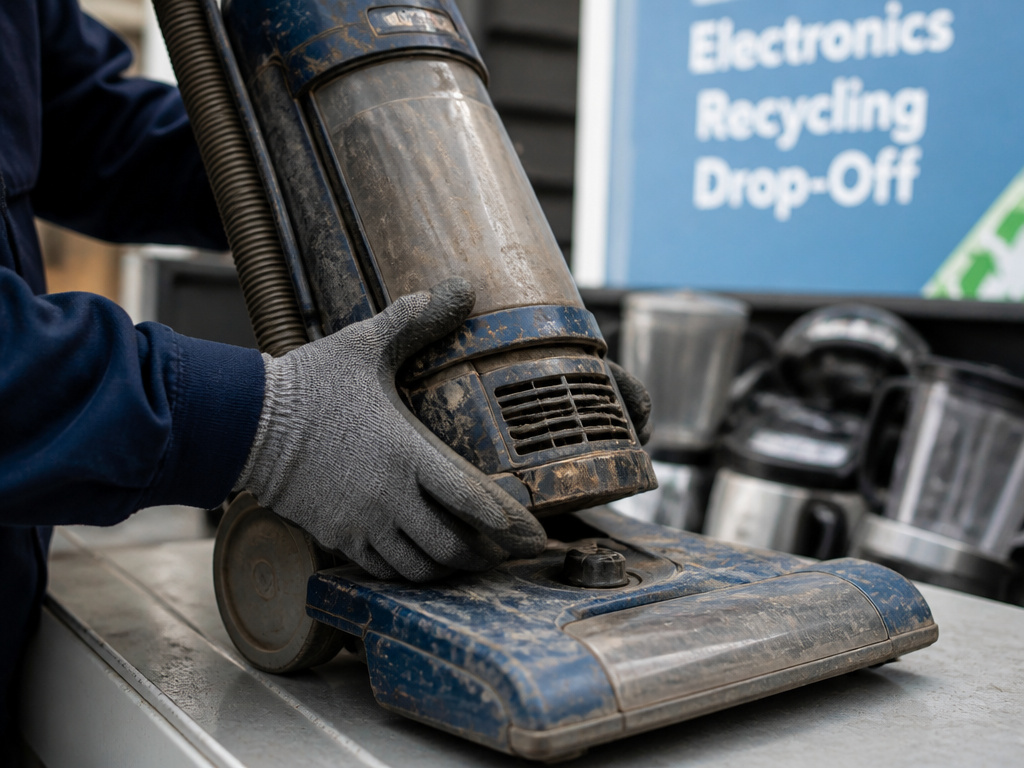 You have three reliable destinations. The best one depends on what’s closest and what type of vacuum you have.
Retailer Drop-Off Programs
Large electronics retailers often provide the most convenient e-waste recycling. Best Buy offers a free drop-off program for old electronics and small appliances, including vacuums, at most of its stores. They handle the downstream sorting and processing. Some municipalities partner with local hardware or big-box stores for periodic collection events. Check the retailer’s website for details and any item limits.
Municipal E-Waste Collection Centers
Your city or county likely operates a permanent household hazardous waste (HHW) facility or a dedicated e-waste drop-off site. This is usually free for residents. Search “[Your City] e-waste recycling” online. These facilities are equipped to handle the proper dismantling and material recovery. They are the required destination in states with strict e-waste laws.
Manufacturer or Dealer Take-Back
For commercial or industrial-grade machines, the manufacturer may mandate return. The DEPURECO Serie M manual, for instance, states end-users are responsible for returning the vacuum to the distributor or a designated collection point. This ensures professional handling of its heavy motors and HEPA H14 filters. Check the manual or the manufacturer’s compliance webpage.
Worth knowing before you start: Call ahead. Policies change. Some municipal sites only accept e-waste on specific Saturdays. Some retailers have daily weight limits. A two-minute call saves you a wasted trip with an 80-pound industrial vacuum in your trunk.
What Gets Recycled (And What Doesn’t)
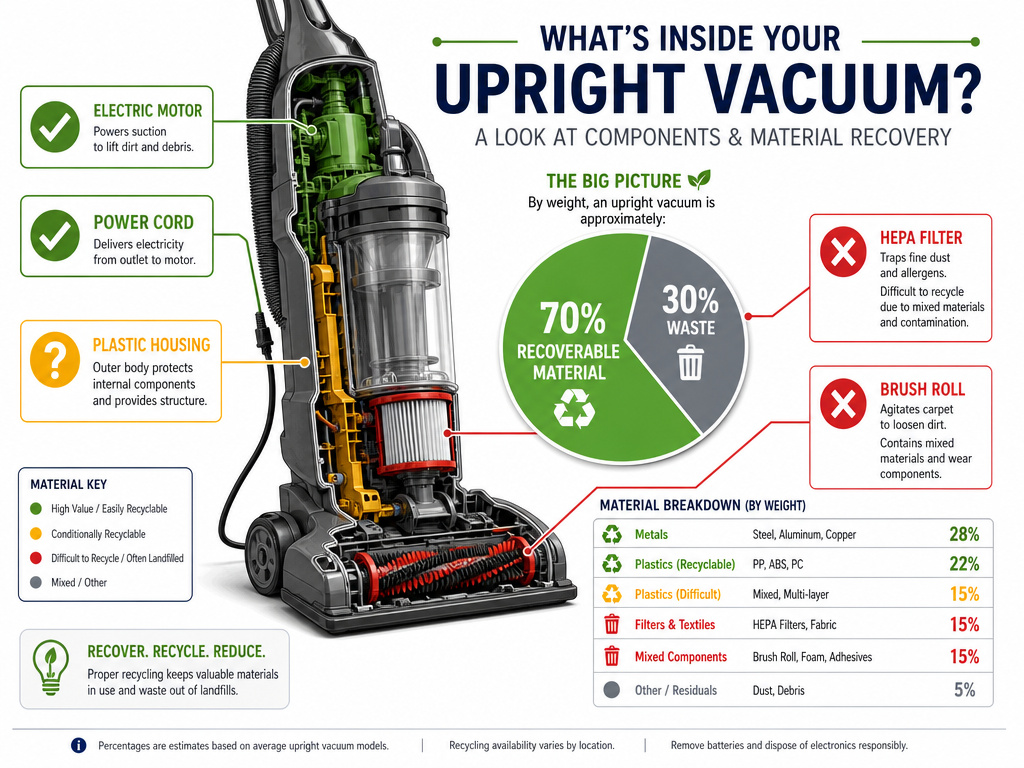 Inside a typical upright vacuum, about 70% of the weight is recoverable material. The rest is waste.
| Component | Recyclable? | Notes |
|---|---|---|
| Electric Motor (copper windings, steel housing) | Yes | High-value scrap metal. Extracted and shredded for copper recovery. |
| Power Cord (copper wire, plastic sheath) | Yes | Wire is chopped and separated to recover copper. |
| Plastic Body & Housing | Sometimes | Depends on the resin type. Contaminated plastics may be downcycled or used for waste-to-energy. |
| HEPA / Fabric Filter | No | Contaminated mixed material. Dispose of in regular trash. |
| Rechargeable Battery | Yes, but separately | Must be removed and recycled as household hazardous waste. |
| Brush Roll (plastic, rubber, hair wrap) | No | Heavily contaminated. Typically landfilled. |
The motor is the prize. A YouTube teardown of a Bissell vacuum shows a scrapper pulling out a copper armature, aluminum housing, and insulated copper wire, all destined for different recycling streams. The plastic shell, if it’s clean and marked, might be granulated.
Why filters are trash. A HEPA filter is a mix of fiberglass, plastic, and glue, saturated with fine dust that includes skin cells, pollen, and potentially mold spores. Material recovery facilities (MRFs) can’t separate those materials, and the bio-contamination makes them unsuitable for plastic recycling. They go to the landfill.
The Special Case for Robot and Cordless Vacuums
These are computers with a cleaning function. The recycling protocol has two extra, critical layers.
Battery Removal is Law
The rechargeable battery pack is the single most hazardous component. In the compact body of a cordless vacuum or a robot vacuum, it’s often a lithium-ion cell that can ignite if crushed or punctured. You must remove it. The crossed-out wheeled bin symbol on the device is a legal requirement in many jurisdictions indicating separate electronic waste handling.
Data Privacy is Your Responsibility
Your robot vacuum knows your home layout. Models from iRobot, Roborock, and ECOVACS store floor maps to navigate. The companion app may retain your Wi-Fi password and cleaning schedule. A factory reset severs this link. It’s not just about a new owner seeing your floor plan; it’s about preventing that data from being scraped if the device’s memory chip isn’t physically destroyed during recycling.
The process is simple: open the app, go to settings, find “Reset” or “Remove Device,” and confirm. The vacuum will beep and return to its out-of-box state. Do this after you’ve decided to recycle it, not before.
Frequently Asked Questions
Can I put a vacuum cleaner in the regular trash?
It depends on your location and the vacuum type. In many areas, traditional corded vacuum cleaners can be disposed of with bulk trash or recycling. However, cordless vacuum and robot vacuum models are classified as e-waste in over 25 states and are banned from regular trash. Always check your local municipality’s website first.
Does Best Buy recycle old vacuums?
Yes, Best Buy offers a free consumer electronics recycling program that accepts vacuum cleaners at most retail locations. They classify vacuums as small appliances. There may be a limit on the number of items per day, and you typically need to bring the item to the customer service desk. It’s one of the most convenient options for a broken bagless vacuum or upright vacuum.
How do I dispose of a Dyson vacuum?
Dyson vacuums, especially their popular cordless model lines, contain lithium-ion batteries. You must remove the battery pack if possible (many Dyson models have a removable battery). Recycle the vacuum body as e-waste at a retailer like Best Buy or a municipal center. The battery should be recycled separately through a battery drop-off program. Dyson also sometimes offers mail-in recycling options through their website.
Are vacuum cleaners considered e-waste?
Yes, most modern vacuum cleaners are considered electronic waste (e-waste) due to their electric motors, circuit boards, and, in many cases, rechargeable batteries. This is particularly true for any battery-powered vacuum cleaner or smart device. E-waste requires special processing to recover metals and safely handle hazardous materials, which is why specific recycling routes exist.
What parts of a vacuum cleaner are recyclable?
The metal components, primarily the copper-wound electric motor, the steel chassis, and the copper in the power cord, are highly recyclable. The plastic housing may be recyclable if it’s clean and of a single resin type. The bagged vacuum paper bag itself is not recyclable due to contamination. The durable vacuum construction of some commercial models means more metal content and higher recyclability.
Before You Go
Recycling a vacuum involves keeping plastic out of a landfill and recovering the copper and steel that went into its motor. These materials are energy-intensive to mine but relatively easy to melt down and reuse. The rule of thumb is direct: if it has a plug or a battery, it doesn’t belong in your trash can.
Find your local e-waste facility’s address and save it. The next time a motor burns out or a robot vac drives itself into a wall for the last time, you’ll know exactly where to go. That’s the whole job.