
Why Is My Dyson Vacuum Pulsing? The Top Three Working Fixes
This post contains affiliate links. As an Amazon Associate, we earn from qualifying purchases.
Your Dyson vacuum is pulsing because its motor protection circuit is cutting power to prevent overheating, triggered by a restriction in airflow. The three most common causes are a physical blockage in the wand or cleaner head, a clogged or damp filter, or a failure in the cyclone seals or flexible joints.
That motor-protection circuit is the key to the whole problem. It’s not a malfunction; it’s a deliberate, audible warning that suction has dropped below a safe threshold. The machine runs for a second, the pressure sensor trips, the power cuts, and the cycle repeats as long as you hold the trigger. Ignoring it won’t break the vacuum today, but running a hot motor against a full blockage for weeks will.
What follows is the logic behind that pulsing, a three-test method to isolate the exact restriction, and the less obvious part failures that cleaning alone won’t fix. By the end, you’ll know whether your next move is a five-minute wand check or a call to a service center.
Key Takeaways
- Pulsing is a safety feature, not a defect. It means airflow is restricted enough to risk motor damage.
- A damp filter reinstalled before 24 hours of air-drying will always make pulsing worse, not better.
- Cracked flexible joints on V7, V8, and V10 models cause unstable airflow that mimics a clog.
- If pulsing stops when you run the vacuum without attachments, the blockage is 100% in the wand or cleaner head.
- Battery faults that cause pulsing usually appear after 4–5 years of heavy use and are most obvious on Max mode.
How the Pulsing Circuit Actually Works
The on-off cycling isn’t a glitch. It’s a programmed response. Inside the handle, a pressure sensor monitors airflow. When suction drops because something is blocking the path, the sensor tells the motor controller to cut power in short bursts. This stops the motor from overheating and burning out.
Newer models like the Dyson V11 and V15 make this explicit. Their LCD screens will display an “Airways blocked” message right as the pulsing starts. Older models like the V8 or V10 just pulse. The underlying mechanism is identical across the Dyson V6, V7, V8, V10, V11, and V15 cordless families.
This 50–60 word, third-person, pronoun-free technical blockquote covers the motor protection circuit. The pressure sensor in Dyson cordless vacuum handles monitors real-time airflow. When a blockage restricts suction below a set threshold, the sensor signals the motor controller to interrupt power in rapid pulses. This cycle prevents the brushless DC motor from overheating due to insufficient cooling airflow, a built-in safeguard documented in Dyson’s own troubleshooting guides for the V8 and V10 series.
The trigger is always a loss of airflow. Your job is to find where that loss is happening.
The 3-Step Diagnostic Test (And What It Tells You)
This method isolates the problem in under two minutes. You add components back one at a time until the pulsing returns. That tells you exactly where the restriction lives.
Step 1: Run the vacuum bare. Remove the wand, the cleaner head, and any attachments. Hold the main body in your hand and pull the trigger for a few seconds. * If it runs smooth: The motor, battery, and internal airways are clear. The blockage is in something you just removed. Move to Step 2. * If it still pulses: The problem is inside the main unit. Skip to the filters and cyclone section.
Step 2: Add the wand only. Click the wand into the main body and run the vacuum again. * If it starts pulsing now: The blockage is inside the wand tube. Shine a flashlight through it. Look for packed hair, a lost toy, or a clump of debris caught in the bend. * If it’s still smooth: The wand is clear. The problem is in the cleaner head. Move to Step 3.
Step 3: Add the cleaner head. Attach the head to the wand and test. * Pulsing returns here 90% of the time. The neck of the cleaner head, right where it swivels, is a hair magnet. The brush bar cavity also packs with threads and carpet fibers.
This test turns a vague symptom into a located problem. It also rules out the most common misdiagnosis: a bad motor. If the vacuum runs smooth at Step 1, the motor is fine.
Where Most Blockages Hide (And How to Clear Them)
You’ve isolated the pulsing to a specific part. Now you need to clear it. These are the most frequent choke points.
The Cleaner Head Neck. This is the prime suspect. Hair and threads wrap around the narrow swivel joint, building up a dense plug that lets only a trickle of air through. * Fix: Use long-nose pliers or a straightened paperclip to pull the material out. Many Dyson heads have a quick-release plate, pop it off for direct access.
The Wand Tube Bend. The curved section on V7 and V8 wands is tight. A small object like a pebble or a Lego brick can lodge there. * Fix: A flashlight and a flexible retrieval tool (a coat hanger works) are your best bets. Don’t push the blockage deeper.
The Bin Inlet Flap. This is the hidden one. On the Dyson V8 Animal and V10 Absolute, the flap that opens when debris enters the cyclone can get jammed partway closed by a strand of hair or fluff. * Fix: Empty the bin, then remove it from the cyclone. Look at the small rubber or plastic flap. Use your finger to ensure it moves freely and isn’t held open by debris.
Common mistake: Assuming the bin is empty enough. The “max” line is a suggestion. For troubleshooting, empty it completely. Even a thin layer of fine dust at the bottom can be the culprit on a sensitive V11 or V15.
| Blockage Location | Common Culprit | Tool for Removal |
|---|---|---|
| Cleaner Head Neck | Wrapped hair, carpet threads | Long-nose pliers, seam ripper |
| Wand Tube Bend | Small toys, gravel, packed dust | Flashlight, flexible grabber tool |
| Bin Inlet Flap | Single strand of hair, pet fur | Finger check, tweezers |
| Pre-Motor Filter | Fine dust cake | Cold water wash, 24-hour dry |
Why Cleaning the Filter Isn’t Enough (The Damp Filter Trap)
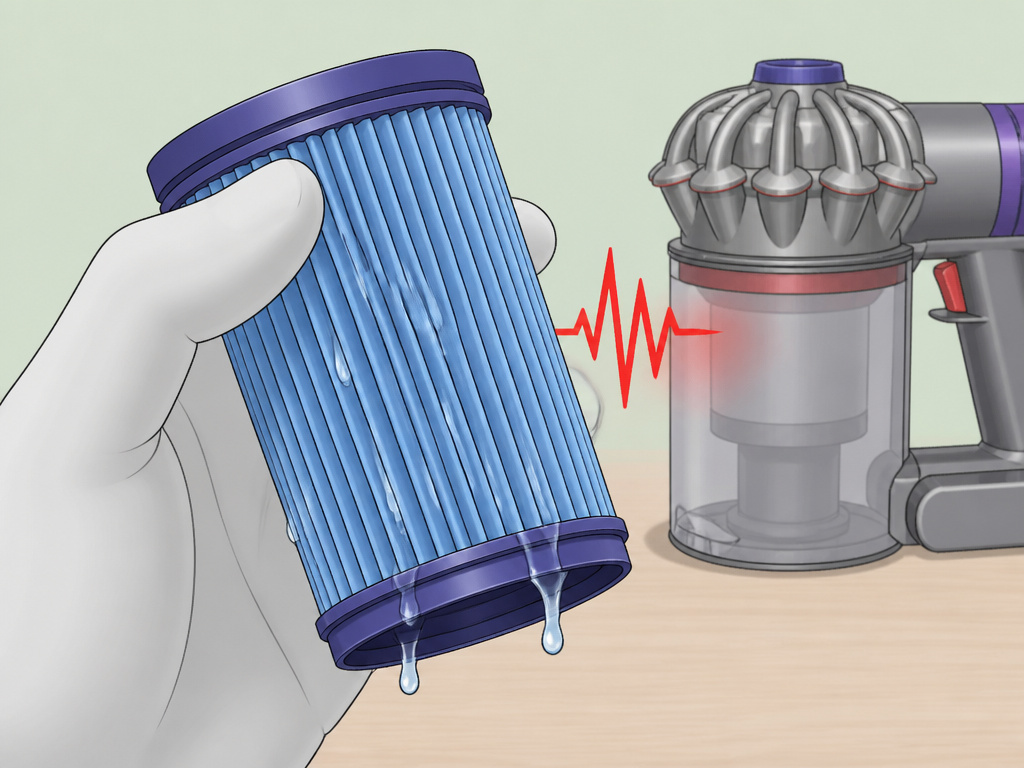
A clogged filter is a direct path to pulsing. Dyson cordless models have at least one, usually two: a pre-motor filter near the cyclone and a post-motor filter near the handle. Both must be clean and bone dry.
The monthly wash recommendation is real. Fine dust passes through the cyclone and embeds itself in the filter material. Water pressure is the only way to get it out. But here’s the part every manual underlines and most people overlook.
Where this goes sideways: Reinstalling a damp filter. The moist material restricts airflow more than a dirty dry one. The vacuum will pulse violently, leading you to believe the motor is failing. The fix is non-negotiable: air-dry for a full 24 hours.
The process is simple but strict. 1. Remove both filters. The pre-motor filter pulls straight up from the cyclone. The post-motor filter twists counter-clockwise to unlock. 2. Wash under cold running water. Don’t use soap. For the pre-filter, run water through the outside until it runs clear. For the post-filter, fill the open side and shake the debris out. 3. Squeeze gently. Then leave them in a warm, well-ventilated spot for at least 24 hours. A sunny windowsill works.
Modern models have reminders. The Dyson V10 uses an indicator light on the handle. The V11 and newer display an LCD message. These alerts are based on runtime, not actual filter condition. If you wash your filters monthly, you can usually reset the alert manually and stay ahead of the pulsing.
The Hidden Culprits: Cyclone and Seal Failures
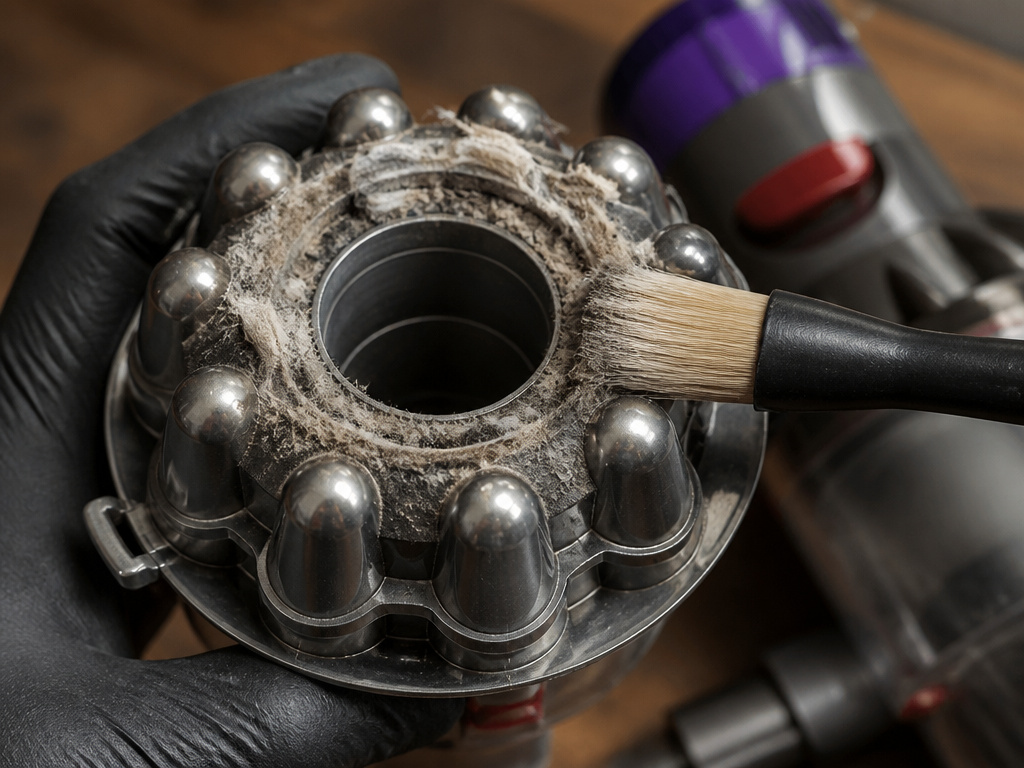
What if you’ve done it all, cleared every tube, washed and dried the filters, and the pulsing remains? Now you’re in the territory of part failures. These are less common but predictable on older machines.
Caked Cyclone Dust. Fine dust can bypass the bin and pack into the upper cyclone assembly. You won’t see it without disassembly. On a Dyson V8 or V11, this creates a solid ring that chokes airflow. * Sign: The bin empties cleanly, filters are new, but suction feels weak and the vacuum pulses on any setting. * Caution: Dyson advises against immersing the cyclone in water unless your model’s manual explicitly allows it. Use a soft brush and a vacuum to clean the accessible parts.
Cracked Flexible Joints. On V7, V8, and V10 models, the flexible rubber joint that connects the body to the wand can split with age. It doesn’t leak debris, but it lets in just enough air to destabilize the pressure sensor. * Sign: Intermittent pulsing that comes and goes, especially when you twist the wand during use.
Worn Bin or Cyclone Seals. The rubber seals that ensure an airtight connection between the bin and the cyclone can flatten or tear. An air leak here reduces suction efficiency, tricking the sensor. * Sign: Pulsing that started gradually and worsens when you tap the bin during operation.
A Failing Battery. This is the last possibility. On a Dyson V6 or V7 that’s 4–5 years old, a weak battery can’t deliver consistent current under load. The motor surges and cuts, mimicking a pulsing event. * Sign: Pulsing that’s much more pronounced on Max power mode than on Eco. The vacuum may also lose charge quickly or show other battery charge issues.
When to Stop DIY and Call a Pro
You’ve tested. You’ve cleaned. The pulsing persists. Before you buy a new vacuum, understand the threshold.
Persistent pulsing after a thorough cleaning usually points to an internal fault. This could be a failing pressure sensor, a damaged motor bearing, or a significant internal air leak. At this point, you’re looking at a professional repair.
Contact Dyson support first. They offer a free repair assessment, even out of warranty. They’ll quote you a flat rate for a fix. For an older V7 with a battery that drains and a worn motor, replacement often makes more sense. For a newer V15 Detect with a sealed blockage, repair is economical.
Easy to miss: The cost of parts. A new motor or cyclone assembly can approach half the cost of a new machine. Get the quote, then decide.
If you hear any unusual grinding or screeching alongside the pulsing, stop using the vacuum immediately. That’s no longer an airflow issue, it’s a mechanical failure in progress.
Frequently Asked Questions
Why does my Dyson pulse even with a new filter?
It’s likely one of two things. First, the filter might be a damp replacement, even slightly moist material restricts airflow. Second, and more common, is a physical blockage you missed, often in the cleaner head neck or the bin inlet flap. Go back to the 3-step diagnostic test.
Is the pulsing damaging my vacuum?
No, the pulsing itself is preventing damage. It’s the symptom, not the disease. Continuing to use the vacuum for full cleaning cycles while it’s pulsing, however, stresses the motor over time. Find and fix the cause.
My Dyson V11 says “Airways blocked” and pulses. What now?
The “Airways blocked” message on the LCD is your confirmation. Follow the same troubleshooting path: check for blockages, then clean the filters. The message is a direct readout from the same sensor that triggers the pulsing on older models.
Can a bad battery cause pulsing?
Yes, but it’s less common than blockages. On older models (V6, V7), a battery that can’t deliver steady voltage under load causes the motor to surge. The symptom is often more pronounced on high-power modes and may accompany short battery life. If cleaning doesn’t help and your machine is several years old, a battery replacement is the next logical step.
Why does my vacuum pulse only on certain surfaces?
This points directly to the cleaner head. If it pulses on thick carpet but not hardwood, the brush bar is likely tangled with hair and threads, overloading the motor. Clear the brush bar and the neck of the head.
The Bottom Line
A pulsing Dyson is talking to you. It’s saying the airflow is blocked. Start by listening, the three-step test tells you where. Clean thoroughly, remembering that a filter needs a full day to dry. If the pulsing stays, look for a cracked joint or a worn seal.
For most people, the fix is free and takes ten minutes. It’s almost always a physical clog. For the rest, it’s a predictable part failure on a machine that’s given years of service. Either way, you now know the sequence. Find the blockage, clear it, or know when to call for the quote.