
Can I Vacuum a HEPA Filter? | The Motor-Killing Mistake
This post contains affiliate links. As an Amazon Associate, we earn from qualifying purchases.
You can vacuum a HEPA filter only if it is specifically designed by the manufacturer to be cleaned, and even then, never with another vacuum. Most true HEPA filters are sealed, disposable cartridges. Vacuuming them shreds the micro-glass fibers, creates holes, and blows the very contaminants they’re meant to trap back into your air and directly into your vacuum’s motor.
That last part is critical. A clogged HEPA filter isn’t just dirty, it becomes a restriction that overheats the motor. The Kerstar KEVA manual states a clogged inlet cooling HEPA filter will trip the thermal switch and shut the unit down. You wait 30 minutes for it to cool, but if you don’t replace the filter, it happens again. That cycle kills the motor within a year.
What follows is the split in the road: the small subset of washable HEPA media filters versus the vast majority of disposable HEPA cartridges. We’ll walk through how to identify yours, the one safe cleaning method, and the specific motor-failure symptoms that tell you you’ve already damaged it.
Key Takeaways
- Vacuuming a true HEPA filter with another vacuum destroys the micro-glass fiber matrix, creating holes that allow particles as small as 0.3 microns to pass through.
- Most HEPA filters are disposable cartridges, not cleanable. The Kerstar KEVA Type H cartridge is explicitly “neither reusable nor cleanable.”
- For the rare cleanable HEPA media filter (like the Hushtone 440007773), the only safe method is a cold, low-pressure water rinse, never soap, never a brush, and never another vacuum.
- Operating any vacuum without its full, intact filtration system can clog the motor’s cooling air intake, causing it to overheat and trigger a thermal cut-off, as documented in multiple OEM manuals.
- Always check your vacuum’s specific manual. The Hushtone manual dictates a rinse every 2 months; the Bosch guide recommends annual cleaning or replacement.
The Two Types of HEPA Filters That Change the Rule
This is where generic advice fails. There isn’t one “HEPA filter.” There are two physically different products sharing a certification, and your cleaning path depends entirely on which one you have.
A true HEPA filter, per the EPA HEPA filter definition, is a pleated mechanical filter theoretically capable of trapping 99.97% of particles at 0.3 microns. That efficiency comes from a dense web of micro-glass fibers. Think of it as a labyrinth, particles get stuck in the maze. Now imagine taking a shop vac to that maze. The force collapses the walls.
The part nobody mentions: Vacuuming a HEPA filter doesn’t just dislodge dirt. The suction pressure physically fractures the brittle glass fibers. You create micro-tears invisible to the eye but large enough for 0.3-micron particles to sail through. The filter reads as “clean” but its efficiency plummets.
Disposable HEPA Cartridges: These are the majority in home and pro-grade wet/dry vacuums. They are sealed units, often with a plastic or metal frame. The RIDGID HF1000 filter and the Kerstar KEVA Type H cartridge are perfect examples. The Kerstar manual is unambiguous: “The HEPA cartridge is neither reusable nor cleanable.” Vacuuming it is pointless and destructive.
Cleanable HEPA Media Filters: Some manufacturers, like those behind the Hushtone upright, use a HEPA-rated filter media that is designed to be rinsed. The Hushtone HEPA Media Final Filter (Part No. 440007773) is one. Even here, the manual forbids vacuuming. The only instruction is to “hand rinse in cold water under low pressure” every two months.
| Filter Type | Common Examples | Cleanable? | Correct Method | What Happens If You Vacuum It |
|---|---|---|---|---|
| Disposable HEPA Cartridge | RIDGID HF1000, Kerstar KEVA Type H, most canister vac filters | No | Replace when clogged or per schedule (e.g., annually). | Fibers fracture, creating holes. Efficiency is destroyed. |
| Cleanable HEPA Media Filter | Hushtone 440007773, some aftermarket furnace filters | Yes, per manual | Cold water rinse only. Air dry completely (24 hrs). | Media can tear, pleats collapse, water-soluble adhesives fail. |
If you’re unsure which you have, stop. Find your model’s manual online. That document is the only authority that matters.
Why Vacuuming a HEPA Filter Fails (The Physics of a Clogged Motor)
The desire to vacuum a filter comes from a good place: you see dirt, you want to remove it. But with a HEPA filter, the dirt is trapped inside the media, not sitting on top. You can’t pull out what’s already stuck.
The mechanism breaks in two places.
First, the filter itself. The suction from a vacuum hose is far too aggressive. It’s designed to pull debris through open space, not through a dense filter. You’ll pull the surface layer off, but the embedded particulate remains. Worse, you’ll stress and break the fiber bonds.
Second, and more dangerously, is your vacuum’s motor. Every vacuum motor needs a constant flow of cooling air. In models like the Kerstar KEVA, that cooling air is drawn through a separate inlet cooling air HEPA filter. If the main working HEPA filter is clogged, or missing, the motor works harder, pulls in less air, and overheats. The thermal switch kicks in, and the unit shuts down.
This isn’t scare talk. It’s the explicit failure mode described in the manual: “If the thermal switch activates… The inlet cooling air HEPA filter may be clogged.”
Skipping a filter or running a damaged one doesn’t just give you bad suction. It cooks a $150+ motor assembly. The repair bill always exceeds the cost of a replacement filter.
The Step-by-Step Method for Cleanable HEPA Filters
This process applies only if your manual explicitly states your HEPA filter is washable. If it says “replace,” “disposable,” or “cartridge,” stop here and order a new one.
Before you start: Unplug the vacuum. Work in a well-ventilated area. Wear a dust mask if handling a filter used for fine dust like drywall or ash. The filter will be heavy with trapped particles, treat it gently.
- Remove the filter carefully. Take the filter out of its housing according to your manual. Avoid bending the pleats or knocking it against anything. Do this outdoors or over a trash can to contain loose debris.
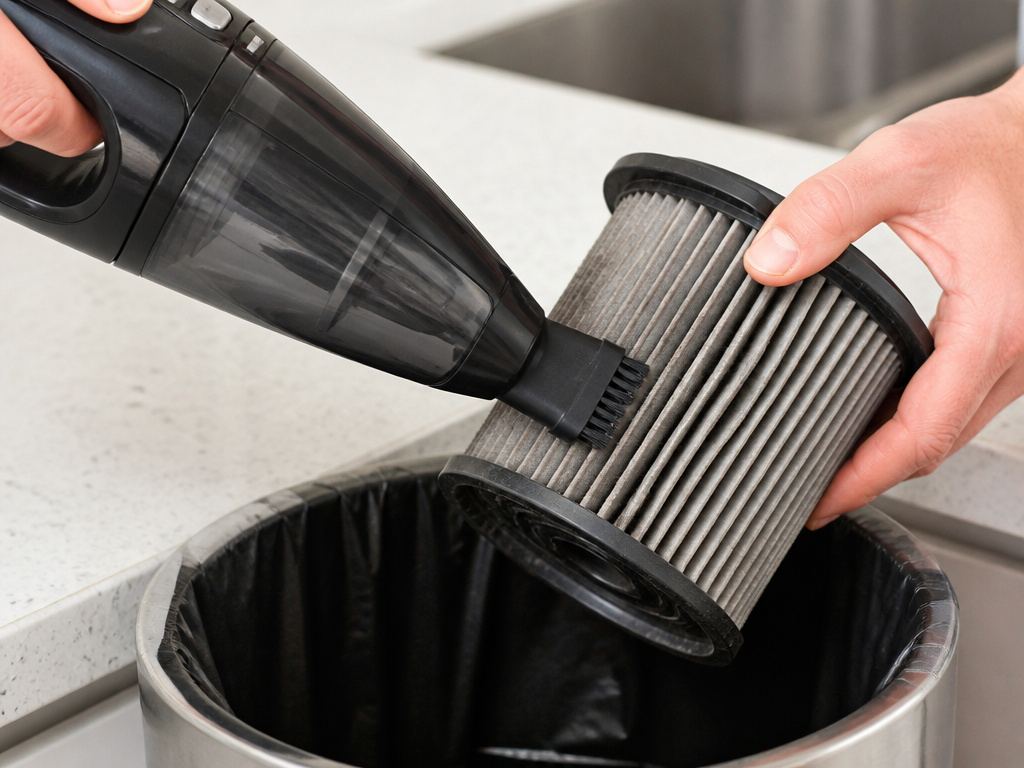
- Take it outside and tap it. Gently tap the filter against the inside of a garbage bin to dislodge any loose, dry debris. Never use compressed air, as the pressure is too high.
- Rinse with cold, low-pressure water. This is the only acceptable cleaning step. Hold the filter under a faucet or hose with cool water. Run water through the filter in the opposite direction of normal airflow (usually from the clean side to the dirty side) to push particles out. The Hushtone manual specifies “open side facing up.”
- Inspect for damage. Hold the filter up to a bright light. Look for any tears, holes, or sections where light shines through unevenly. Any damage means the filter is trash.
- Air dry completely, no shortcuts. This takes up to 24 hours. Place the filter on its side on a clean towel so air circulates around all pleats. Do not use heat, a hair dryer, or direct sunlight to speed this up. A damp filter will mold instantly and will clog with the first use, choking your motor.
The consequence of rushing: Installing a damp filter is the single most common error after cleaning a Hoover HEPA filter or a Dyson filter. The wet media restricts airflow completely. The motor strains, overheats, and either trips its thermal protector or burns out. If your Dyson vacuum is not working after a filter wash, moisture is the first suspect.
When to Replace Your HEPA Filter (The Hard Timelines)
Cleaning is a temporary measure. All HEPA filters have a finite service life. The fibers eventually become so loaded that even washing won’t restore adequate airflow.
Follow your manufacturer’s schedule first. Here’s what the manuals dictate: * Hushtone HEPA Media Final Filter: Rinse every 2 months. Replace if pleats are damaged. * Bosch HEPA hygiene filter (BBZ154HF): Clean once a year for optimum performance. * Kerstar KEVA Type H Cartridge: Replace when “excessively clogged.” It is not cleanable.
For cleanable filters, replace them when: * Water runs through but the filter material still looks deeply stained or grey. * Drying time decreases significantly (a sign the pores are permanently clogged). * Your vacuum’s suction is weak even with a clean filter and empty bag/canister. * You’ve cleaned it more than 4-6 times. The fibers degrade with each wash cycle.
For bagless vacuum filter systems, HEPA filter replacement is often tied to the pre-motor filter’s life. A clogged pre-filter makes the HEPA filter work harder and clog faster.
Frequently Asked Questions
Can I wash a HEPA filter with soap?
No. Do not use soap, detergent, or cleaning solutions. These can leave residues that clog the microscopic pores of the filter media. They can also degrade the adhesives holding the pleats together. Cold water only.
How do I clean a HEPA filter without water?
You don’t. If your HEPA filter is not designed for a water rinse, it is not designed to be cleaned. Attempting to clean it with compressed air, brushing, or tapping will damage it. Your only option is replacement. This is true for most Dyson canister filter and Dyson upright filter units.
Can I vacuum the pre-filter instead of the HEPA filter?
Yes, and you should. The pre-filter (or motor protection filter) is a foam or felt sheet designed to catch larger debris before it reaches the HEPA filter. This foam filter is often washable and can be gently vacuumed to extend its life. Keeping the pre-filter clean is the best way to protect your HEPA filter and is a key part of Hoover filter maintenance.
Why did my vacuum stop working after I cleaned the filter?
Two likely reasons. First, you installed the filter while it was still damp. Second, you damaged the filter media during cleaning, causing a tear that allowed debris to bypass the filter and clog the motor intake or damage the fan. Always ensure the filter is bone-dry and intact before reinstalling.
Are all HEPA filters the same?
No. The term “HEPA-type” or “HEPA-like” is not regulated and does not guarantee 99.97% efficiency at 0.3 microns. True HEPA filters are tested to a standard. Always verify the certification. A true HEPA filter’s cleaning instructions will be precise and limited; vague advice is a red flag.
Before You Go
The rule is simpler than it seems. Find your manual. If it says the filter is cleanable, rinse it with cold water and let it dry for a full day. If it says the filter is disposable or a cartridge, replace it. Never use another vacuum to clean any filter, you’re just moving dirt from one fragile system to another and risking a motor burnout.
For the vast majority, including the RIDGID, Kerstar, and most built-in canister filters, replacement is the only safe path. Keep the pre-filter clean, change the HEPA cartridge on schedule, and your vacuum will run cooler and last years longer. It’s a boring answer, but it’s the one that doesn’t end with a trip to the repair shop.