
Vacuum Cleaner vs Air Blower | The Power & Dust Trade-Off
This post contains affiliate links. As an Amazon Associate, we earn from qualifying purchases.
A vacuum cleaner pulls air and debris into a sealed container; an air blower pushes air out to displace debris. Vacuums capture and contain. Blowers move and scatter. The right choice hinges on whether you need to collect the mess or just relocate it.
That distinction between capture and relocation dictates everything from the motor design to the mess you’re left with. A vacuum’s job is filtration, trapping dust inside a bag or bin so it doesn’t return to your air. A blower’s job is force, using a concentrated jet to push debris off a surface and, ideally, out of the area.
What follows is a breakdown of the physics, the specs that matter, and the specific jobs where one tool fails and the other wins. We’ll ground it in manufacturer data, documented failure modes, and the real-world trade-off between a clean floor and a cleared keyboard.
Key Takeaways
- Vacuums are for containment, blowers are for displacement. Choosing wrong means either recleaning the same dust or watching it settle somewhere else.
- Suction power (measured in air watts or water lift) matters for embedded dirt; airflow (CFM or L/s) matters for surface dust. A high-CFM blower will scatter pile of sawdust faster than any vacuum.
- HEPA filtration is a vacuum standard, not a blower feature. A vacuum with a HEPA 12 filter (like the Kärcher VC 7) cleans the air it exhausts; a blower just recirculates allergens.
- Water kills vacuum motors. Electrolux’s warranty explicitly excludes liquid damage, if the filters get wet, you must dry them for 48 hours before hoping it works again.
- For most homes, a cordless stick vacuum covers daily needs. For workshops or electronics, a dedicated blower is a necessary specialty tool.
The Core Difference: Suction vs. Blast
The motors are built for opposite tasks. A vacuum motor creates a pressure drop behind an intake, pulling air and debris through a filter and into a collection chamber. An air blower motor does the reverse: it compresses air and forces it out through a narrow nozzle at high speed.
Technical Spec: The Philips PowerPro Expert FC9747/09 vacuum generates a maximum airflow of 32.5 liters per second (about 69 CFM) with a sound power level of 67–75 dB. Its PowerCyclone 8 technology separates dust from air at speeds over 185 km/h inside the cylinder. By contrast, a commercial centrifugal blower like the Republic RBX-400 moves 3,475 CFM at 40 HP, but that air isn’t filtered, it’s just moved.
This isn’t about which is stronger. It’s about what “strength” means for your task. Suction power is needed to pull dirt from deep carpet fibers or to lift a full dustbin’s contents against gravity. Airflow volume is needed to push lightweight debris like sawdust, dry leaves, or computer dust across a surface.
| Metric | Vacuum Cleaner (Philips FC9747/09) | Air Blower (Republic RBX-400 40HP) | Why It Matters |
|---|---|---|---|
| Primary Function | Capture & contain debris | Displace & scatter debris | Determines if you collect the mess or just move it. |
| Key Measurement | Airflow: 32.5 L/s | Airflow: 3,475 CFM | Blower CFM is ~50x higher, built for bulk material movement. |
| Filtration Standard | HEPA 13 equivalent (per EN60312-1-2017) | None (exhausts unfiltered air) | Critical for allergies; a blower recirculates dust and allergens. |
| Noise Level | 67 – 75 dB | 144 dB (at 40 HP) | Blowers are significantly louder; hearing protection is mandatory for industrial models. |
| Typical Use Case | Deep cleaning carpets, hard floors | Clearing workshops, construction debris, drying surfaces | Misapplying a tool leads to inefficiency or damage. |
The YouTube reviewer’s test with a wind meter is telling. The most powerful cordless air dusters he measured hit about 52 mph. The “Sunshine” corded model broke his meter. That raw speed is useless on a carpet, it just blows the dirt deeper. But for clearing dust from a PC heatsink, that focused blast is the only tool that fits.
When the Vacuum Wins: Containment and Deep Cleaning
A vacuum’s entire design is a system for getting dirt in and keeping it there. This makes it the default for any job where the debris cannot be allowed to resettle.
Filtered Exhaust is Non-Negotiable for Indoor Air Quality.
Modern vacuums like the Kärcher VC 7 Signature Line use a HEPA 12 filter (EN 1822:1998). This standard means the exhaust air is cleaner than the room air you’re breathing. For anyone with allergies, asthma, or just a desire not to redistribute dust, this is the whole point. An air blower has no equivalent. It takes dust from point A and puts it at point B, often right back into the air you’ll breathe.
Deep Cleaning Requires Physical Agitation and Suction.
Pulling embedded dirt, pet hair, or sand from a carpet pile requires a brush roll to agitate and strong suction to lift. The Kenmore BU1018 upright, noted in Consumer Reports best vacuums review for top-level suction, demonstrates this. A blower’s air stream skims the surface. It might lift the top layer of dust from a hard floor, but it will never extract ground-in grit.
Common mistake: Using a blower to “clean” a carpet or upholstered furniture. You’re driving dust and mites deeper into the padding. The only outcome is a temporarily dust-free surface and a permanently dirtier interior.
The Hygiene of Disposal.
A vacuum ends the job with the mess sealed in a bag or bin. The Philips FC9747/09 has a one-touch, dust-containment emptying system. A blower ends the job with the mess piled in a corner, or worse, evenly redistributed around the room. For daily home cleaning, the vacuum is the only tool that actually finishes the task.
When the Air Blower Wins: Displacement and Drying
For jobs where containment is impossible or undesirable, the blower is the specialist. Its value is in moving bulk material quickly or reaching where no vacuum nozzle can go.
Cleaning Electronics and Intricate Machinery.
You cannot vacuum inside a computer keyboard or a camera lens. The spaces are too tight and the components too fragile. A focused blast from a cordless air duster is the only safe method. The YouTube transcript highlights this: “for like fans or hard-to-reach places this is kind of your only option.” The Goo Nova’s convertible design, vacuum to blower, acknowledges this niche, though its blowing power is a compromise.
Clearing Dry, Bulk Debris.
A workshop floor covered in sawdust, a garage after a woodworking project, a patio after leaf fall, these are blower jobs. The high-CFM output of a shop vacuum with a blower port or a dedicated unit like the Republic RBX can clear a 10×10 area in minutes. A vacuum would require multiple passes and would clog its filter almost instantly.
Drying Surfaces.
A blower is an effective tool for drying a washed car, a flooded patio, or wet tools. It pushes water off the surface. A vacuum designed for wet pickup exists (a wet dry vacuum), but it sucks the water into a tank. For sheer speed of water removal from an open area, forced air wins.
Where this goes sideways: Using a household vacuum to suck up fine, dry powder like drywall dust or flour. It clogs the filter in seconds, overheats the motor, and often blows fine particles straight through the exhaust. That’s a blower or a commercial-grade dust-extraction vacuum’s job.
The Specs That Actually Matter for Your Choice
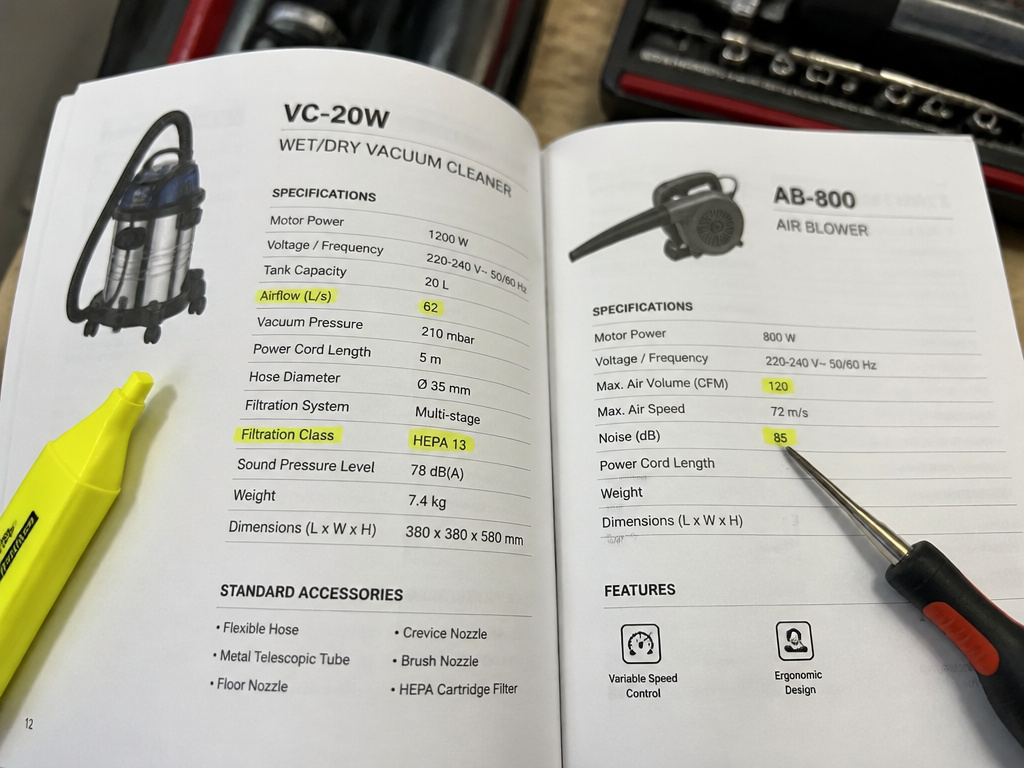
Forget marketing terms. Focus on the numbers printed in the OEM manuals.
For Vacuums: Airflow (L/s or CFM) and Filtration Class.
- Airflow: The Philips FC9747/09 spec sheet lists 32.5 L/s. This is the volume of air moving through the machine, directly tied to its ability to pick up debris. Higher is better for deep cleaning.
- Filtration: Look for the standard. HEPA 12 (EN 1822:1998) or HEPA 13 means the filter captures 99.95% of particles at 0.3 microns. This is what makes a vacuum safe for allergy sufferers.
- Sound Power: 75 dB is about the level of a vacuum cleaner. The Philips Performer Silent model operates at 66 dB, a noticeable difference for quiet cleaning.
For Blowers: Airflow (CFM) and Noise (dB).
- Airflow (CFM): This is the blower’s muscle. The Dayton centrifugal blower model 5TCK6 moves 191 CFM at 1/30 HP. The Republic RBX-400 moves 3,475 CFM at 40 HP. Match the CFM to the volume of debris.
- Noise Level: Blowers are loud. The RBX-400 hits 144 dB at 40 HP, hearing damage is immediate without protection. Even smaller cordless air dusters are significantly louder than a vacuum.
The Motor Warranty Caveat.
The Electrolux cordless vacuum manual states a critical, non-commodity fact: “Damage to the motor caused by water or liquids is not covered by the warranty.” If the filters get wet, you must let everything dry for 48 hours. If it still doesn’t work, the repair is on you. This is a specific, documented failure mode most guides gloss over.
Vacuum Cleaner vs. Air Blower: Direct Comparison by Task
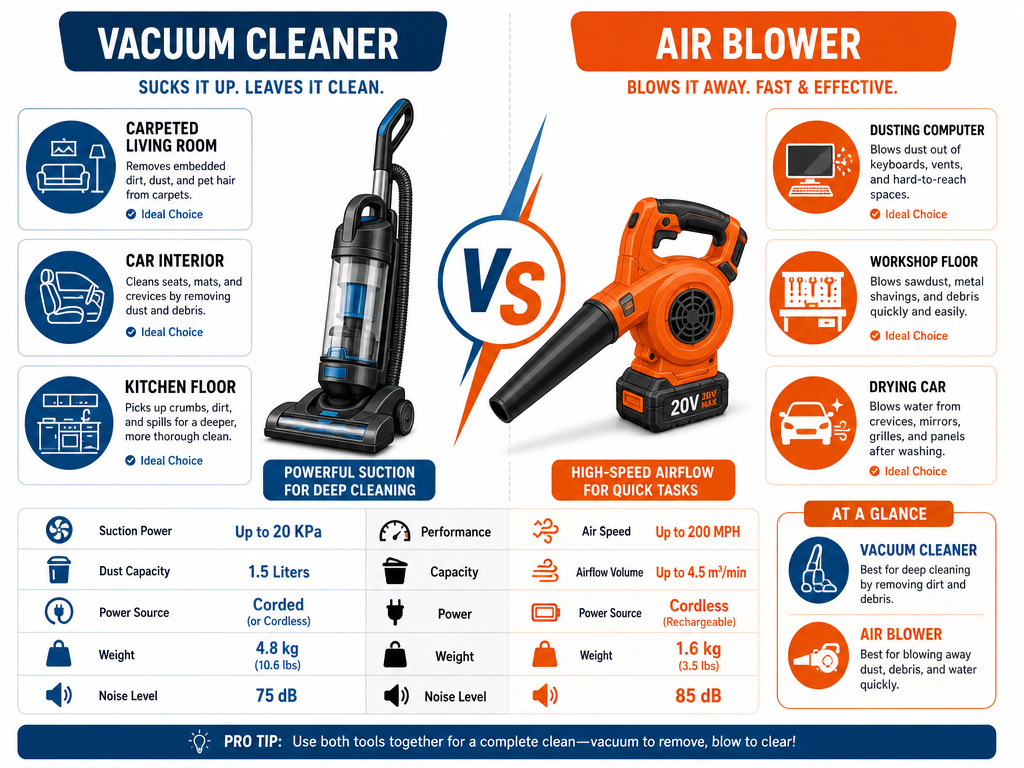
This table eliminates the guesswork. It commits to a winner for common jobs.
| Task | Best Tool | Why It Wins | A Good Example Model |
|---|---|---|---|
| Cleaning carpeted living room | Vacuum Cleaner | Suction + brush roll extracts embedded dirt and allergens. | Kenmore BU1018 Upright |
| Dusting a desktop computer & keyboard | Air Blower (Cordless Duster) | Focused jet clears debris from between keys and vents without contact. | Xpower A-2 Airrow Pro |
| Cleaning a workshop floor of sawdust | Air Blower (Shop-grade) | High CFM clears large area in seconds; a vacuum would clog. | Republic RBX-400 |
| Detailing a car interior | Vacuum Cleaner (Portable) | Suction with crevice tool pulls dirt from seats and floor mats. | A portable auto vacuum like the ThisWorx Car Vacuum |
| Drying a washed car | Air Blower (Leaf-blower style) | Broad airflow sheaths water off paint without touching it. | EGO Power+ LB6504 |
| Quick kitchen floor cleanup | Vacuum Cleaner (Cordless Stick) | Fast pickup of crumbs and debris with contained disposal. | Cordless stick vacuums like the Dyson V15 Detect |
The hybrid “vacuum/blower” combos, like the Goo Nova mentioned in the transcript, are a compromise. They are convenient for light, occasional use on electronics. Their blowing power is weaker than a dedicated duster, and their vacuum power is weaker than a dedicated stick vacuum. For primary tools, specialization beats combination.
The Verdict for Most Homes
You need a vacuum. For 95% of household cleaning, containment is the goal. A good cordless stick vacuum with a HEPA filter, like a Dyson, a Miele, or a high-end model from our best cordless vacuum reviews, handles daily floors, quick spills, and above-floor cleaning.
You might want a blower. If you have a computer, a workshop, a garage, or a patio, a dedicated tool makes sense. A cordless air duster for electronics, a shop vacuum with a blower port for the garage. Don’t buy one expecting it to replace your vacuum. It complements it.
Invest in filtration for your health and power for your task. Check the OEM spec sheet for the airflow and filter standard. Ignore the gimmicks. That’s how you choose.
Frequently Asked Questions
Can I use my vacuum’s blower port to clean my computer?
You can, but you shouldn’t. The air from a vacuum’s exhaust is not filtered to the same standard as its intake. You risk blowing dust and allergens from your dirty vacuum bin all over your electronics and into the air. Use a dedicated, cordless air duster designed for electronics.
Is a wet/dry shop vac a good substitute for an air blower?
Many wet dry vacuums have a blower port, making them a versatile two-in-one tool for a garage or workshop. The blowing power is usually adequate for clearing sawdust or leaves. It’s an excellent compromise if you have space for one larger tool instead of two separate ones.
Why is my new vacuum losing suction so quickly?
The number one cause is a clogged filter. For bagless models, empty the bin and wash the foam and HEPA filters as the manual instructs. Let them dry completely, for 48 hours if needed, per the Electrolux warning, before reinstalling. For bagged models, replace the bag. Never run a vacuum with a wet filter.
Are cordless air dusters powerful enough?
For their intended purpose, cleaning electronics, keyboards, camera gear, yes. Top models like the Xpower A-2 generate a focused blast over 50 mph, which is sufficient to dislodge dust from fans and heatsinks. They are not powerful enough to clear a workshop floor or dry a car.
What’s more important in a vacuum: suction power or airflow?
They work together. Suction power (often measured in air watts or water lift) is the force that lifts debris. Airflow (CFM or L/s) is the volume that carries it away. For deep carpet cleaning, you need high suction. For efficient cleaning of hard floors, you need consistent airflow. A good vacuum balances both.