
Can I Vacuum Hardwood Floors? Avoid Voids & Damage in
This post contains affiliate links. As an Amazon Associate, we earn from qualifying purchases.
You can vacuum hardwood floors, but the vacuum head must be a soft brush or felt type, never a beater bar or power rotary brush. Using the wrong head scratches the finish, voids manufacturer warranties from Shaw, Bruce, and Pergo, and turns a $20 cleaning session into a $2,000 floor replacement.
That head-type rule is the line between maintenance and damage. Every major flooring manufacturer publishes it in their care guides, usually buried on page two of the PDF you never read. The beater bar is for carpet pile agitation; on hardwood, its rotating bristles act like a belt sander, grinding grit into the urethane coat until the wood underneath shows through.
What follows: the exact head specs that pass, the three cleaning products that instantly void coverage, and the humidity window (35–55% relative humidity) that keeps the boards from cracking or cupping. Miss one, and the floor fails within a season.
Key Takeaways
- A vacuum with a beater bar or rotating brush head will scratch and dull a hardwood finish, voiding most manufacturer warranties.
- Maintain indoor humidity between 35% and 55% to prevent wood expansion, shrinkage, and gaps.
- Never use oil soaps, wax-based cleaners, ammonia, vinegar, or steam mops, they damage the finish and nullify warranties.
- For spot cleaning, use a manufacturer-approved hardwood floor cleaner sprayed onto a cloth, not directly on the floor.
- A canister vacuum with a soft brush wand or an upright with a bare-floor setting that retracts the brush roll is the safest choice.
The One Vacuum Attachment That Voids Warranties
Look at your vacuum’s underside. If you see a cylindrical brush roll spinning behind a row of plastic or felt beaters, you are holding a carpet tool. On hardwood, that assembly is destructive.
Warning: Vacuums with a beater bar or power rotary brush head can damage a wood floor and should never be used. – Pergo Lifestyles Hardwood Care Guide
The mechanism is simple. The beater bar’s job is to beat carpet fibers to loosen embedded dirt. On a hard surface, there’s no pile to absorb the impact. The rotating bristles, often stiff nylon, press sand and grit directly into the floor’s finish. Each pass creates microscopic scratches. Over weeks, these scratches coalesce into a dull, hazy wear path that no cleaner can polish out.
Manufacturers like Shaw and Bruce are explicit: using such a vacuum voids the warranty. They phrase it as “do not use vacuums with beater bars or hard heads” in their care documents. The financial stakes are real. A warranty claim for finish wear will be denied if the inspector finds circular scratches matching a rotating brush head.
The fix is a soft brush or felt head, often called a “hard floor” or “bare floor” attachment. This is a static brush or a soft felt pad that glides over the surface, sucking up debris without abrasion. Many upright vacuums have a setting that retracts the brush roll entirely for this purpose.
How to Vacuum Hardwood Floors Correctly (The 5-Step Sequence)
This isn’t about running a machine over the floor. It’s a sequence that removes the enemies: grit, moisture, and chemical residue.
- Dry dust mop or sweep first. Use a microfiber dust mop to collect large debris. This prevents it from being ground in by the vacuum head or scratching during the suction pass. Skip this, and you turn your vacuum into a sand-blaster.
- Attach the correct head. Connect a soft brush wand to your canister or hose, or engage your upright’s “bare floor” mode to retract the brush roll. Verify the head is clean and free of trapped grit.
- Vacuum with the grain. Pull the vacuum along the direction of the wood planks. This minimizes the chance of debris being dragged sideways across the finish, which can cause visible cross-grain scratches.
- Empty the canister or bag. A full vacuum loses suction, leaving behind fine dust that acts as an abrasive. Do this after every session on a large floor.
- Spot clean only when needed. For spills or sticky spots, spray a small amount of hardwood floor cleaner onto a clean cloth, never directly onto the wood. Wipe, then immediately dry with a second cloth. Letting liquid sit is how water marks happen.
The entire process should take five minutes for a small room. The goal is to leave the floor dry, dust-free, and completely untouched by anything abrasive.
Humidity: The Invisible Force That Warps Wood
Vacuuming removes physical dirt. Humidity control protects the wood itself. Hardwood is hygroscopic; it absorbs and releases moisture from the air. Get this wrong, and your perfectly vacuumed floor will still fail.
Manufacturers specify a relative humidity (RH) range to maintain. Shaw Hardwoods recommends 35-65% year-round. Bruce and Pergo narrow it to 35-55%. Stray outside this window, and the wood reacts predictably.
| Condition | Humidity Level | Effect on Hardwood |
|---|---|---|
| Too Dry | Below 35% RH | Wood shrinks. Planks pull apart, leaving visible gaps between boards. |
| Ideal Range | 35–55% RH | Minimal expansion/contraction. Floor remains stable and flat. |
| Too Humid | Above 55% RH | Wood expands. Planks can cup (edges rise), peak (center rises), or even delaminate. |
During heating seasons, indoor air dries out. A humidifier is mandatory to stay above 35% RH. In summer, air conditioning or a dehumidifier pulls excess moisture from the air. An inexpensive hygrometer from a hardware store lets you monitor this daily.
Where this goes sideways: Letting humidity swing wildly. The wood can’t keep up. A floor that gaps in winter may not fully close by summer, leaving permanent openings where dirt accumulates and your vacuum can’t reach.
Cleaning Products That Destroy Your Floor’s Finish
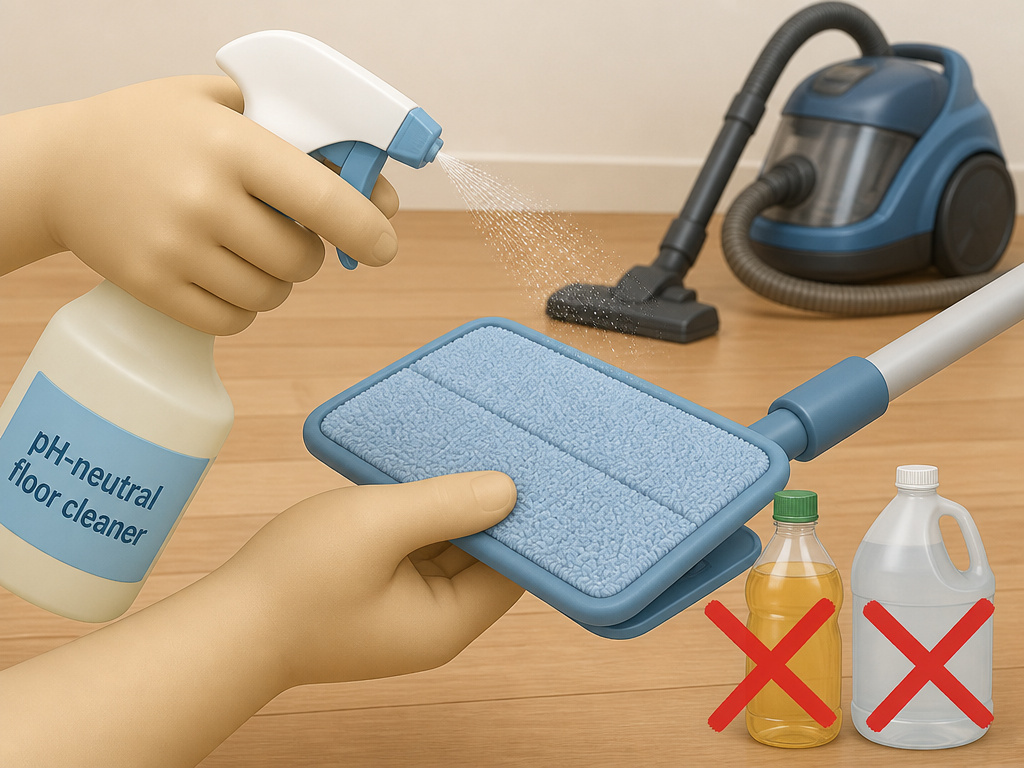
You can vacuum perfectly and still ruin your floor with the wrong cleaner. The finish, usually a urethane or aluminum oxide coat, is a wear layer, not a stain. Harsh chemicals eat through it.
The banned list is long and found in every manufacturer guide: ammonia-based cleaners, acrylic finishes, wax-based products, detergents, bleach, polishes, oil soap, abrasive cleaning soaps, vinegar, and products containing citrus, tung, or silicone oils.
These aren’t mild warnings. Shaw states that oil soaps, paste waxes, or “2-in-1 cleaners with polish additives” cause problems “which would not be considered in the warranty.” Bruce says they can “pit or etch the finish.”
Why oil soap is a disaster: It leaves a residue that creates a slippery film. Future recoating or proper cleaning becomes impossible without a full sand-and-refinish. The floor feels perpetually dirty.
Your cleaner should be a pH-neutral hardwood floor cleaner like Bona Hardwood Floor Cleaner or the manufacturer’s own brand (e.g., Bruce Hardwood & Laminate Floor Cleaner). The rule: spray it on the mop pad, not the floor. Use a microfiber pad and swap it the moment it looks dirty.
| Do Use | Never Use | Reason |
|---|---|---|
| pH-neutral hardwood floor cleaner | Oil soap (Murphy’s Oil Soap, etc.) | Oil soap leaves a residue that dulls and voids warranties. |
| Microfiber mop pad | Steam mop | Steam forces moisture into seams, causing wood to swell and laminate to delaminate. |
| Damp cloth for spot cleaning | Wet mop or bucket of water | Standing water damages wood fibers and finish. |
| Isopropyl alcohol for stubborn grease | Vinegar or ammonia solutions | Acids and ammonia etch and dull the urethane finish. |
Upright vs. Canister Vacuums for Hardwood Floors
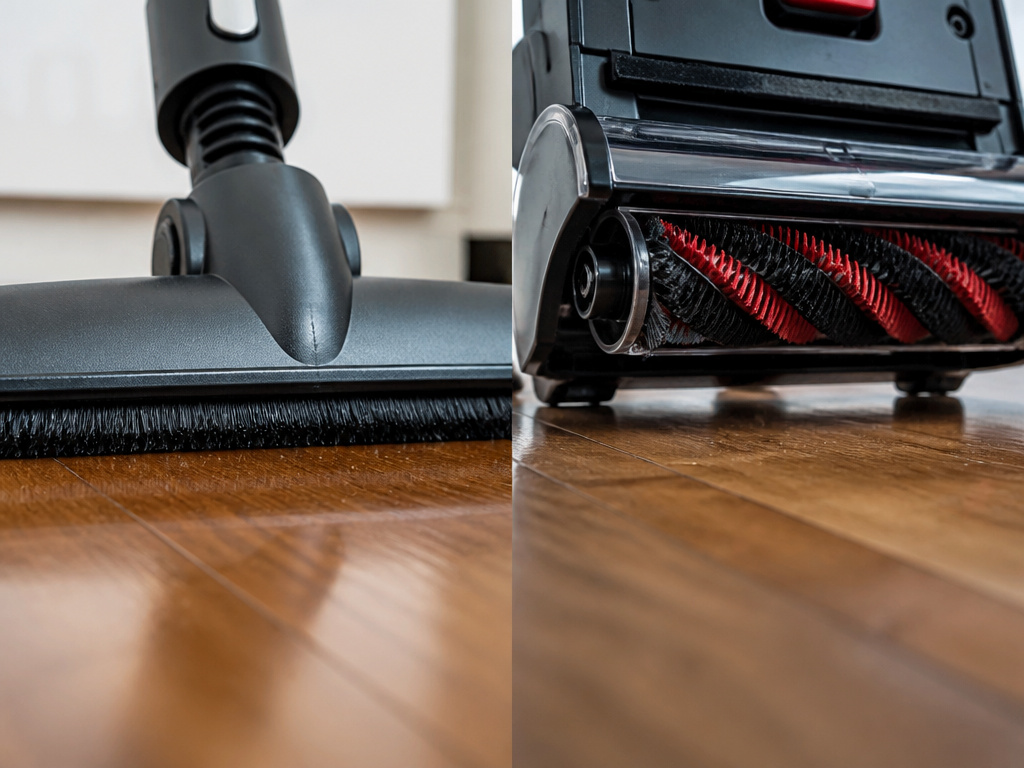
Your vacuum type changes the game. Each has pros and cons on hardwood.
Canister vacuums are the traditional choice for hard floors. The motor and dust bin are in a separate unit you pull behind you. You use a lightweight wand with a dedicated soft brush head. The advantage is pure suction directly at the floor head, with no risk of a spinning brush roll. The Miele Classic C1 Cat & Dog canister is a benchmark for this, with a parquet twister brush that’s gentle and effective.
Upright vacuums are more convenient but riskier. Many modern models have a switch or lever that retracts the brush roll for hard floors. If yours doesn’t have this, it’s a carpet vacuum. Even with retraction, the head design can be clunky for edges and under furniture. Models like the Shark Vertex UltraLight Corded Upright have a genuine “hard floor” mode that lifts the brush roll completely away from the surface.
Common mistake: Assuming an upright’s “hard floor” setting works. On some budget models, the setting only slows the brush roll; it doesn’t retract it. Check your manual. If it still spins, it can scatter debris.
The bottom line: A canister vacuum for hardwood is the safest, most controlled tool. An upright vacuum for hardwood is acceptable only if it has a verified brush roll retraction mechanism. For homes with mixed flooring, a vacuum for wood and carpet with an automatic height adjustment is the pragmatic pick.
Frequently Asked Questions
Can I use my Dyson or Shark stick vacuum on hardwood floors?
Yes, if it has a soft roller or “fluffy” head designed for hard floors. Many stick vacs, like the Dyson V15 Detect, come with a laser-equipped fluffy head that illuminates dust and uses soft nylon and anti-static carbon fiber filaments to pick up fine debris without scratching. Avoid using the motorized brush head meant for carpets.
How often should I vacuum hardwood floors?
Vacuum high-traffic areas 1-2 times per week. For lower-traffic rooms, once a week is sufficient. The Bruce guide recommends vacuuming, sweeping, or dust mopping “once a week, or more if needed.” The goal is to never let grit build up.
Is it better to sweep or vacuum hardwood floors?
Sweeping is good for quick pickups of large debris. Vacuuming is superior for removing fine dust and allergens from cracks and seams. For a thorough clean, dry dust mop first to collect large particles, then vacuum with a soft brush head to remove the fine residue a broom leaves behind.
Can vacuuming scratch hardwood floors?
Yes, but only if you use the wrong attachment. A vacuum with a beater bar, rotating brush, or a dirty hard plastic head will scratch. A clean, soft brush or felt head will not. Always ensure the attachment is free of embedded grit before use.
What is the best vacuum setting for hardwood floors?
The “bare floor” or “hard floor” setting, which either retracts the brush roll completely or turns it off. If your vacuum lacks this setting, do not use it on hardwood. Instead, use a canister vacuum with a dedicated soft brush wand, which is one of the best vacuum cleaners for hard floors.
Before You Go
You can vacuum hardwood floors. The process hinges on two non-negotiable rules: use only a soft brush or felt head, and keep the floor dry. The vacuum itself is less important than the attachment on its end.
For one answer, choose a canister vacuum for hardwood with a dedicated parquet brush. It’s the method that aligns exactly with every manufacturer’s fine print. Pair it with a pH-neutral cleaner and a hygrometer, and the floor will outlive the furniture on it.
Anything else is a gamble with a finish that can’t heal itself.