
Wet Dry Vacuum vs Electric Mop | The Real-World Trade-Offs
This post contains affiliate links. As an Amazon Associate, we earn from qualifying purchases.
The difference between a wet dry vacuum and an electric mop isn’t about which cleans better. It’s about what kind of mess you’re facing. A wet dry vacuum is a power tool built to move volume—gallons of water, piles of debris, and solid chunks. An electric mop is a floor-care appliance designed to sanitize and polish sealed hard surfaces, handling only liquid and dissolved grime.
That volume-versus-polish split decides everything. Your choice dictates the physical effort, the cleanup after the cleanup, and the types of jobs you can even attempt.
What follows is a breakdown of three specs that matter, two documented failure modes most guides skip, and the one question that ends the debate before you spend anything.
Key Takeaways
- Wet dry vacuums handle solids and liquids but are bulky, loud, and require post-use filter maintenance. Electric mops only handle liquids and dissolved dirt but are lightweight and leave floors nearly dry.
- The Kärcher FCV 4 represents the hybrid “vacuum mop” category, capable of both vacuuming dry debris and wet mopping, but it’s heavier and more expensive than a dedicated electric mop.
- Ignoring a wet vac’s float shut-off can burn out the motor in minutes. Assuming an electric mop’s pad is truly machine-washable can destroy it in one cycle.
- For workshops, basements, or post-renovation cleanup, you need a wet dry vacuum like a RIDGID 16-gallon model. For daily kitchen spills and maintaining clean hard floors, an electric mop like the Philips OneUp is faster.
- Long-term costs swing heavily: electric mops lock you into brand-specific detergent and pad replacements; wet vacs cost you in filter replacements and physical storage space.
The Core Difference: What Each Tool Is Built For
A wet dry vacuum is a recovery tool. An electric mop is a maintenance tool. Confusing them leads to broken machines and unfinished jobs.
A wet/dry vac’s automatic float shut-off, which engages when the tank is full of liquid, can cause extensive motor damage if the unit is not turned off immediately after suction stops. This is a stated warning in multiple owner’s manuals, not a hypothetical.
Wet dry vacuums are built around a drum, a powerful motor, and a filtration system. The RIDGID RV2600B, a 16-gallon model, moves 105 cubic feet of air per minute to pull in everything from wood chips to spilled paint. Its job is brute force relocation. You use it after a plumbing leak, to clean a garage floor, or to suck up drywall dust. The work is done when the debris is in the tank.
Electric mops are built around a cleaning head, a small pump, and a two-tank system. The Philips OneUp 5000 has a 281ml clean water tank and a 178ml dirty water tank. A pump dispenses soapy water onto a microfiber pad; suction pulls the dirty water back up. Its job is chemical and mechanical surface cleaning. You use it on a weekly schedule for tile or hardwood. The work is done when the floor is sanitized and streak-free.
The Mess Matrix: Which Tool Handles What?
Your mess has a physical form. That form dictates the correct tool.
| Debris Type | Wet Dry Vacuum | Electric Mop | Why It Matters |
|---|---|---|---|
| Standing Water | Excellent | Impossible | A vac’s large tank and pump handle gallons; a mop’s tiny tank floods instantly. |
| Solid Chunks (Cereal, Dirt Clumps) | Excellent | Fail | Solids clog a mop’s suction path and smear. A vac’s wide hose ingests them. |
| Fine Dust (Drywall, Sawdust) | Excellent (with fine dust filter) | Poor | Dust turns a mop’s pad into mud. A vac’s filter contains it. |
| Sticky Liquids (Juice, Sauce) | Good | Excellent | A vac can suck it, but a mop’s scrubbing action dissolves and removes the residue. |
| General Surface Grime | Poor | Excellent | Vacuuming a flat floor with a wand is inefficient. A mop’s wide head covers area fast. |
The critical line is the solids boundary. The Philips OneUp manual explicitly states you must vacuum solids first. If you drop a bowl of oatmeal, a wet dry vacuum is your only one-step tool.
Wet Dry Vacuum: Power, Capacity, and the Reality of Ownership
These are shop tools that have migrated into the home. Their specifications tell a story of raw performance and physical trade-offs.
Key Specs That Actually Matter
Forget peak horsepower. Look at tank capacity, air flow (CFM), and motor placement.
- Tank Capacity: Ranges from 2 gallons in the DEWALT DCV581H to 16 gallons in the RIDGID 1650RV. A 2-gallon model is for spot spills under a sink. A 16-gallon model is for draining a flooded basement or cleaning an entire garage. Choose the largest capacity you can physically store.
- CFM (Cubic Feet per Minute): This is air movement. The RIDGID 1650RV moves 141 CFM, which means it can pull debris through a long hose quickly. A lower CFM, like the 41 CFM on the Shop-Vac 20V cordless model, is fine for light duty but bogs down on deep pile carpet or wet leaves.
- Motor-on-Top vs. Motor-on-Bottom: Motor-on-top designs are traditional. Motor-on-bottom, like the RIDGID 1650RV, lowers the center of gravity for better stability and reduces noise directed at the user. It’s a meaningful upgrade if you’ll push it around for more than ten minutes.
Common mistake: Using a standard filter for fine dust. Drywall dust or cold fireplace ash will pass right through, coating the motor and blowing back into the room. The manual for the RIDGID WD19560 specifies using a fine dust filter for this exact scenario.
The Inconvenient Truths of Wet Vac Ownership
The power comes with baggage.
First, storage is a commitment. A 16-gallon vac is nearly three feet tall and two feet wide. You need garage or basement space. Second, they are loud—often over 80 decibels. Hearing protection isn’t a bad idea. Third, maintenance is non-negotiable. After vacuuming wet material, you must remove and dry the filter to prevent mildew. After dry material, you must tap or wash the filter clean. The motor’s cooling system pulls air through that filter; a clogged filter strains the motor to death.
The cordless revolution is here, but with limits. The DEWALT DCV581H offers a 2-gallon cordless/corded option. It’s brilliant for quick car cleanouts or workshop sawdust. But its runtime is tied to battery capacity, and its small tank means constant emptying for big jobs. Cordless means convenience, not high-volume replacement.
Electric Mop: Hygiene, Convenience, and the Consumables Trap

Electric mops sell a vision of effortless, hygienic cleaning. They deliver on that promise, but within a narrow lane and with recurring costs.
How the Two-Tank System Works (And Where It Fails)
The principle is sound: a clean tank dispenses fresh solution, a dirty tank captures used water so you never re-spread grime. The Kärcher EWM 2 uses rotating rollers that are constantly rinsed, claiming to remove 99% of bacteria. The Philips OneUp uses a flat microfiber pad with suction directly through it.
The failure point is the pad or roller itself. It’s the filter. And filters get dirty.
- The Saturation Problem: As the pad collects dirt, its suction efficiency drops. On a model without self-cleaning rollers, you’re eventually pushing a dirty pad around. The Kärcher FCV 4 addresses this with a self-cleaning station that scrubs its rollers during recharge.
- The Cleaning Problem: Philips states its OneUp pads are machine-washable. A TechRadar review found the pad “ripped apart after a single cycle” on a 40°C wash. Hand-washing a dense, non-wringable microfiber-and-foam pad is ineffective. This is a major design gap.
The Real Cost of “Convenience”
The upfront price is just the entry fee. You are buying into an ecosystem.
- Proprietary Detergent: The Philips OneUp system uses a specific cartridge that screws into the handle. You cannot pour your own floor cleaner in. A two-pack costs about seventeen dollars. Using a different solution can cause foaming that clogs the internal pump.
- Pad Replacement: Philips recommends pad replacement every six months. A two-pack costs about thirty-six dollars. If the pad deteriorates faster—and evidence suggests it can—this cost accelerates.
- Battery Life: The advertised 50-70 minute runtime is for intermittent use. Continuous mopping on a higher setting will cut that significantly. The Kärcher EWM 2 offers about 20 minutes, enough for 60 square meters. For a large home, you are charging mid-clean.
So, is it worth it? For someone with mostly hard floors who hates the bucket-and-wring routine, absolutely. The BISSELL SpinWave with its spinning pads provides scrubbing action without the backache. You trade raw power for a vastly improved user experience on approved surfaces.
Head-to-Head Comparison Table
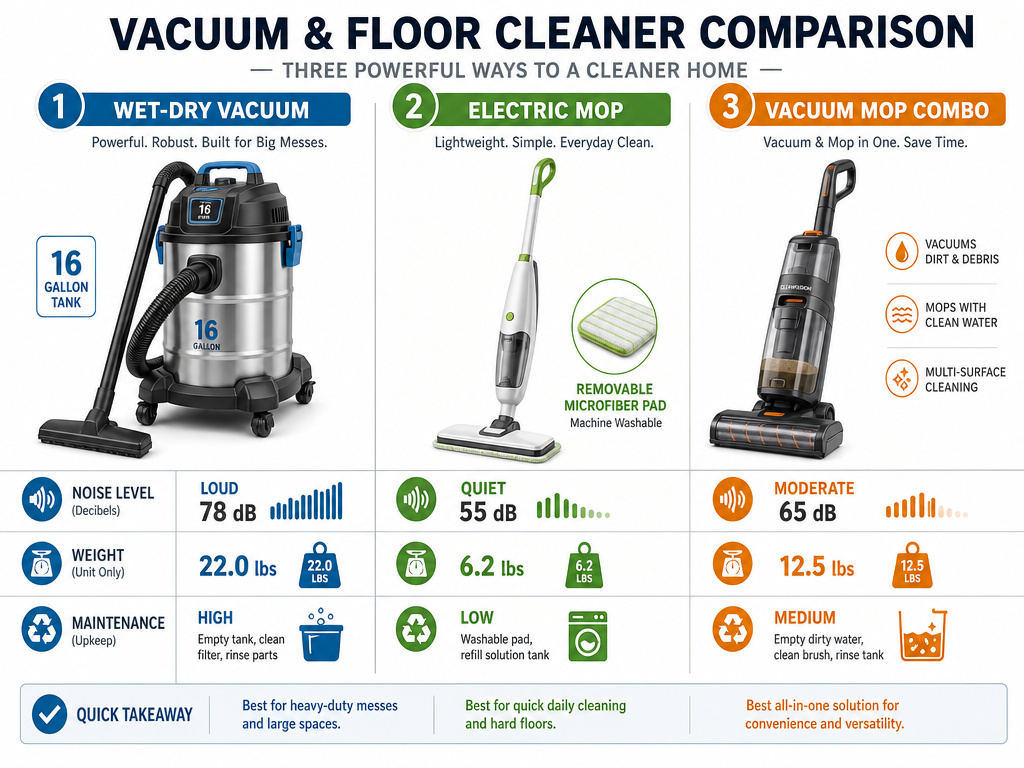
This table isn’t about which is better. It’s about which is better for you, based on your home’s needs and your physical tolerance for tool management.
| Aspect | Wet Dry Vacuum (e.g., RIDGID 16-Gallon) | Electric Mop (e.g., Philips OneUp 5000) | The Hybrid: Vacuum Mop (e.g., Kärcher FCV 4) |
|---|---|---|---|
| Primary Job | Bulk debris & liquid recovery | Hard floor sanitization & polishing | Both dry vacuuming and damp mopping |
| Handles Solids? | Yes | No | Yes, in vacuum mode |
| Noise Level | Very Loud (hearing protection advised) | Quiet | Moderate |
| Weight & Maneuverability | Heavy (40+ lbs), rolls on casters, bulky to store | Light (<5 lbs), swivel head, stores in a closet | Heavy (8+ lbs), more appliance-like |
| Post-Use Maintenance | Must empty tank, clean/dry filter, check for clogs | Empty small tanks, rinse/wash pad, charge battery | Empty tanks, clean rollers & filters, charge battery |
| Best For | Workshops, garages, basements, post-renovation, major spills | Apartments, weekly kitchen/bathroom cleaning, quick spill cleanup | Homes with mixed flooring (some carpet, mostly hard floors) |
The hybrid vacuum mop combos like the Kärcher FCV 4 try to bridge the gap. They have a true vacuum motor and a roller wash system. They can pick up cereal and then mop the juice. The compromise is weight, complexity, and a higher price. For many, it’s a “jack of all trades, master of none” scenario, but for a home with no dedicated shop vac, it can be a compelling single-appliance solution.
How to Choose: The Three Decision Points
Stop thinking about features. Start with these three questions.
- What is the largest physical mess you anticipate? If your answer involves words like “flooded,” “sawdust,” or “gravel,” your path is set. You need the capacity and hose of a wet dry vacuum. A RIDGID 1650RV is your benchmark. If your largest mess is “spilled smoothie” or “muddy footprints,” an electric mop or hybrid can cope.
- Where will it live, and who will use it? A 65-pound vac is a non-starter for a third-floor apartment. A person with shoulder pain will struggle to maneuver a heavy hybrid. The lightweight, quiet operation of an electric mop vacuum like the BISSELL SpinWave is a genuine accessibility feature.
- What is your tolerance for maintenance? Are you willing to wash a slimy filter after sucking up gutter water? Or would you rather just rinse a small plastic tank and toss a pad in the wash? Your honest answer here will steer you away from tools you’ll come to resent.
Most households don’t need a professional-grade wet dry vacuum. But most households with a basement, garage, or DIY enthusiast will find one indispensable for the two or three times a year it’s needed. The electric mop is for the other 362 days.
Frequently Asked Questions
Can an electric mop replace my regular vacuum?
No. Electric mops cannot pick up dry debris like dust, hair, or crumbs. They are designed for wet cleaning only. You must vacuum first, then mop. A hybrid vacuum mop combo is the only type that attempts both functions in one device.
I have mostly hard floors with area rugs. What should I get?
Look closely at a hybrid model like the Kärcher FCV 4. It can vacuum dry debris from your rugs (in a dedicated dry mode) and then mop your hard floors. It’s heavier than a dedicated electric mop, but it eliminates the need for two separate machines. Ensure the model you choose specifies it’s safe for low-pile rugs in dry mode.
Are cordless wet dry vacuums powerful enough?
For small to medium jobs, yes. The DEWALT DCV581H (2-gallon) or Shop-Vac 20V are perfect for spot cleanups, car interiors, or workshop benches. Their power is sufficient for their size. They are not powerful enough to drain a pool cover or clean an entire unfinished basement. Their advantage is portability and no cord to manage.
Why do electric mop pads wear out so fast?
The pad is the primary filter and scrubbing surface. It’s constantly abraded against the floor and clogged with microscopic dirt. The suction path runs directly through it on many models, packing in grime. Machine washing, as recommended, can degrade the adhesive binding the microfiber to the foam base. Expect to replace pads every 3-6 months with regular use.
What’s the biggest mistake people make with wet dry vacuums?
Failing to turn the unit off immediately after the float valve shuts off suction when vacuuming liquids. The motor continues to run with no airflow, causing it to overheat rapidly. This can burn out the motor in a single use. Always listen for the sound change and switch it off the moment the suction stops.
The Bottom Line
Don’t buy for the dream scenario. Buy for your actual floors and your actual Saturday morning.
If your cleaning involves dry debris, bulk liquids, or any kind of workshop, a wet dry vacuum is a non-negotiable tool. Start with a mid-size corded model from a pro brand like RIDGID. Its noise and bulk are the price of real capability.
If your goal is spotless hard floors without a bucket, an electric mop like the Philips OneUp 5000 is a genuine upgrade. Just budget for the detergent and pads, and never let cereal hit the ground.
For everyone stuck in the middle—homes with kids, pets, and mixed flooring—the hybrid vacuum mop combos are worth the research. They ask you to accept more weight and cost for the singular benefit of one machine doing both jobs. Just know its vacuum won’t match a shop vac, and its mop won’t be as nimble as a dedicated stick. That’s the trade-off. Choose the compromise that irritates you least.