
Wet Dry Vacuum vs Extractor – Which Removes Moisture Best?
This post contains affiliate links. As an Amazon Associate, we earn from qualifying purchases.
The difference between a wet dry vacuum and an extractor is the pump. A wet/dry vacuum uses suction to move standing liquid or debris into a tank. An extractor adds a high-pressure pump to spray cleaning solution, agitate the fibers, and then vacuum the dirty water back out. The extractor’s entire system is designed to remove embedded soil and moisture, not just collect it.
That pump changes everything. It turns a collection tool into a cleaning tool. A wet/dry vac handles spills and floods. An extractor tackles ground-in dirt in carpets and upholstery because it can inject and retrieve.
What follows: the three specs that actually matter when comparing them, a clear breakdown of which machine wins for five common jobs, and the one mistake that turns a simple cleanup into a mold problem.
Key Takeaways
- Waterlift, not CFM, measures true suction power for liquids. A higher waterlift (in inches) means stronger pull on wet debris.
- An extractor’s pump pressure (measured in PSI) is what lifts embedded dirt. Look for at least 90 PSI for restorative cleaning.
- Never leave recovered wastewater in any tank for more than 24 hours. Bacterial growth starts quickly and causes permanent odors.
- For deep cleaning fabric, you need an extractor. A wet/dry vac will only suck up surface moisture, leaving the padding wet and soiled.
- Cordless wet/dry vacuums like the DeWalt DCV581H are for quick, mobile cleanups, not gallons of water.
The Core Difference: A Vacuum Moves, An Extractor Removes
A wet/dry vacuum is a transporter. Its job is to relocate a volume of material—be it water, sawdust, or drywall debris—from your floor into its drum. The mechanism is a vacuum motor creating airflow. For liquids, a float valve shuts the motor off before the tank overflows. It’s a brilliant tool for a flooded basement, a workshop full of sawdust, or after a major plumbing incident.
An extractor is a chemical-mechanical cleaning system. It has a separate pump, typically delivering 90 PSI or more, to force a cleaning solution into a carpet or fabric. Brushes or jets agitate the fibers. Then, a dedicated vacuum motor with a specialized floating vacuum shoe pulls the now-dirty solution into a separate recovery tank. The goal is removal: of dirt, of allergens, of moisture itself.
Where this goes sideways: Using a wet/dry vacuum on a carpet spill. It will pull the surface water, but the sponge-like backing will stay soaked. That trapped moisture wicks back up, re-soiling the surface and leading to mildew in the pad within 48 hours.
The Kärcher Clipper 12 extractor manual states its system is “designed to apply cleaning solution onto carpeted floor, scrub the carpet… And then vacuum the soiled water back into the recovery tank.” That sequence—spray, agitate, recover—is the entire point.
The Three Specs That Actually Matter
Forget peak horsepower. It’s a marketing number derived from laboratory inertia, not real-world performance. When comparing these machines, focus on these three measurable specs.
| Specification | Wet/Dry Vacuum | Carpet Extractor | Why It Matters |
|---|---|---|---|
| Waterlift (inches) | Critical (e.g., RIDGID 1650RV: 141″ CFM) | Critical (e.g., Kärcher Clipper 12: 120″) | Measures sealed suction power. Higher lift pulls water more effectively against gravity. |
| Pump Pressure (PSI) | Not Applicable | The Key Spec (e.g., 90 PSI on Clipper 12) | Determines cleaning force. Under 50 PSI is for light interim cleaning; over 90 PSI is for deep restorative work. |
| Tank Design | Single tank for wet/dry (use filter for dry) | Dedicated solution and recovery tanks | Prevents cross-contamination. Lets you see how much soil you’ve removed from the carpet. |
Airflow (CFM) is still relevant for dry pickup on a wet/dry vacuum. But for liquid, waterlift is the real workhorse. A shop vacuum with high CFM but low waterlift will sound powerful but leave puddles.
Which Tool for Which Job? A Decision Table
Your project’s surface type and soil level dictate the tool. This isn’t about which machine is “better”—it’s about which is correct.
| Cleaning Scenario | Recommended Tool | Reason & Tip |
|---|---|---|
| Basement flood, spilled bucket | Wet/Dry Vacuum | You’re moving volume. Use a wet nozzle attachment and empty the tank frequently to avoid overloading the motor. |
| Deep cleaning a soiled living room carpet | Carpet Extractor | Ground-in dirt requires injection and extraction. A model like the Tennant E5 with dual spray jets is built for this. |
| Sawdust & debris in garage | Wet/Dry Vacuum | A shop vacuum with a fine dust filter (like the HEPA filter on many models) is designed for this dry particulate. |
| Spot cleaning a sofa cushion | Portable Extractor | A compact spotter like the Kärcher Puzzi 8/1 has the pump and hand tool to clean, not just dampen, the fabric. |
| Quick liquid mess on hard floor | Cordless Wet/Dry Vac | A cordless wet/dry vacuum like the Shop-Vac 20V is for speed and convenience, not deep saturation. |
The YouTube detailing community highlights this divide perfectly. A professional detailer will use a steam cleaner for plastics and grease, but for muddy paw prints embedded in car carpet, they state: “I really would not have been able to clean an interior without using an extractor.” The vacuum alone can’t pull that kind of soil out.
Common mistake: Reaching for the most versatile tool for a specialized job. Versatility often means compromise. A dedicated machine always outperforms a generalist on its home turf.
Inside an Extractor: The Pump is the Heart
The pump separates an extractor from a vacuum. It’s a positive-displacement pump that creates line pressure, turning liquid into a high-velocity spray. This force is what breaks the bond between soil and fiber.
The flow rate (measured in gallons per minute, or GPM) works with the pump pressure. A high-PSI, low-GPM system is for aggressive, low-moisture cleaning. A lower-PSI, higher-GPM system floods the area more, which is less effective and extends drying time. The sweet spot for commercial deep cleaning is around 90 PSI and 0.5-0.6 GPM, like the Kärcher Admiral 8’s specification.
After the spray, the vacuum system must be powerful enough to retrieve most of that moisture. This is where the floating vacuum shoe is critical. It automatically adjusts to carpet pile height, maintaining a consistent seal inches behind the spray jets to pull the water out immediately. If the vacuum can’t keep up, you’re just a very expensive watering can.
The Maintenance Cliff You Don’t See Coming
An extractor isn’t a vacuum you can dump and forget. The plumbing requires upkeep. Mineral deposits from hard water will clog the spray jets. Soil and hair will collect in the vacuum shoe and hose, killing suction.
The Kärcher Clipper Duo manual mandates a monthly flush with a white vinegar solution to prevent “build-up of alkaline residue in the system.” It also warns: “Do not use pins, wire, etc. To clean nozzles as this could destroy spray pattern.” Use a dedicated nozzle cleaning tool.
For the wet/dry vacuum, the maintenance is on the filter. The RIDGID owner’s manual is explicit: “Do not use with a torn filter or without filter installed except when vacuuming liquids… Dry debris ingested by the impeller may damage the motor.” A clogged filter on either machine will drop performance by over 50%.
Wet/Dry Vacuum Deep Dive: From Shop to Cordless
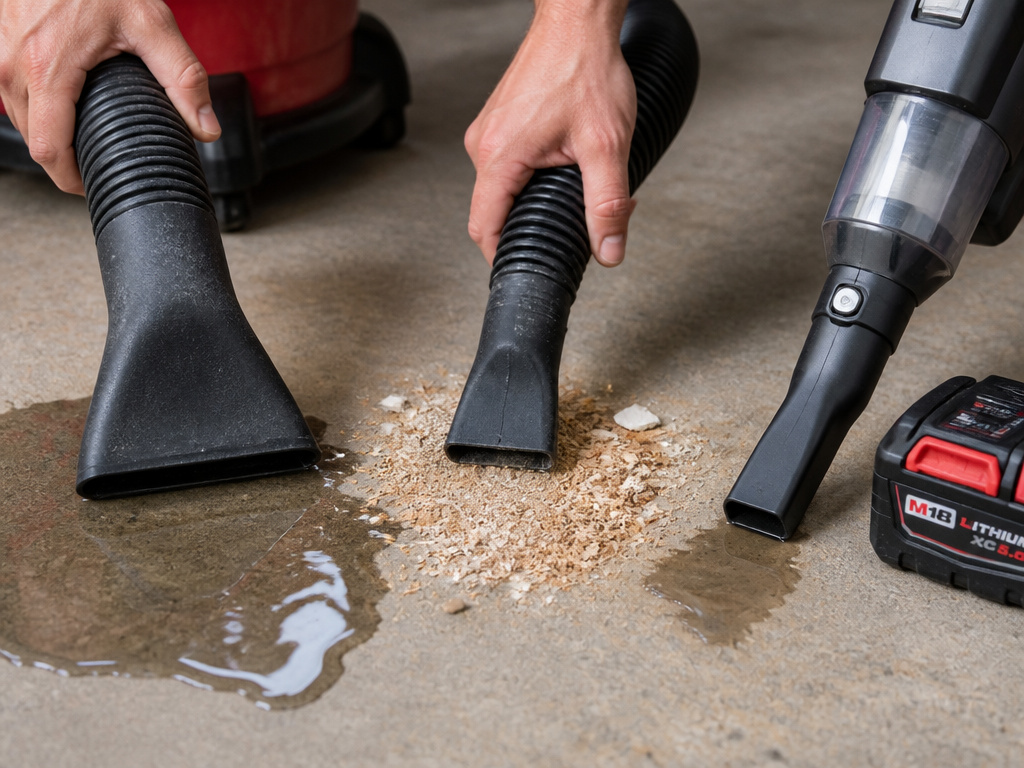 The wet/dry vacuum category has its own splits. Knowing them stops you from buying a 16-gallon monster for a condo.
The Professional Shop Vac: Models like the RIDGID 1650RV (16-gallon, motor-on-bottom) are for job sites. They have 2.5-inch hose ports for moving large debris, long cords, and durable polyethylene tanks. They are loud, powerful, and designed for abuse. They are overkill for cleaning a car interior.
The Home Wet/Dry Vacuum: These are the 8-12 gallon models, often with a narrower hose. They trade some power for quieter operation and easier storage. This is the category for a versatile wet-dry vacuum that handles garage spills, fireplace ash, and post-renovation cleanup.
The Cordless Revolution: The DeWalt DCV581H and Shop-Vac 20V represent the new tier. They are not for flooding. Their value is instant, cord-free cleanup of small liquid spills, sawdust from a single cut, or debris from a car footwell. The 2-gallon tank is a limit, not a suggestion.
The part nobody mentions: Cordless vacuum battery ratings are for dry pickup. Sucking up water places a continuous high load on the motor, which can drain a 2.0Ah battery in under 10 minutes. Have a spare charged.
Making Your Choice: The Five Question Checklist
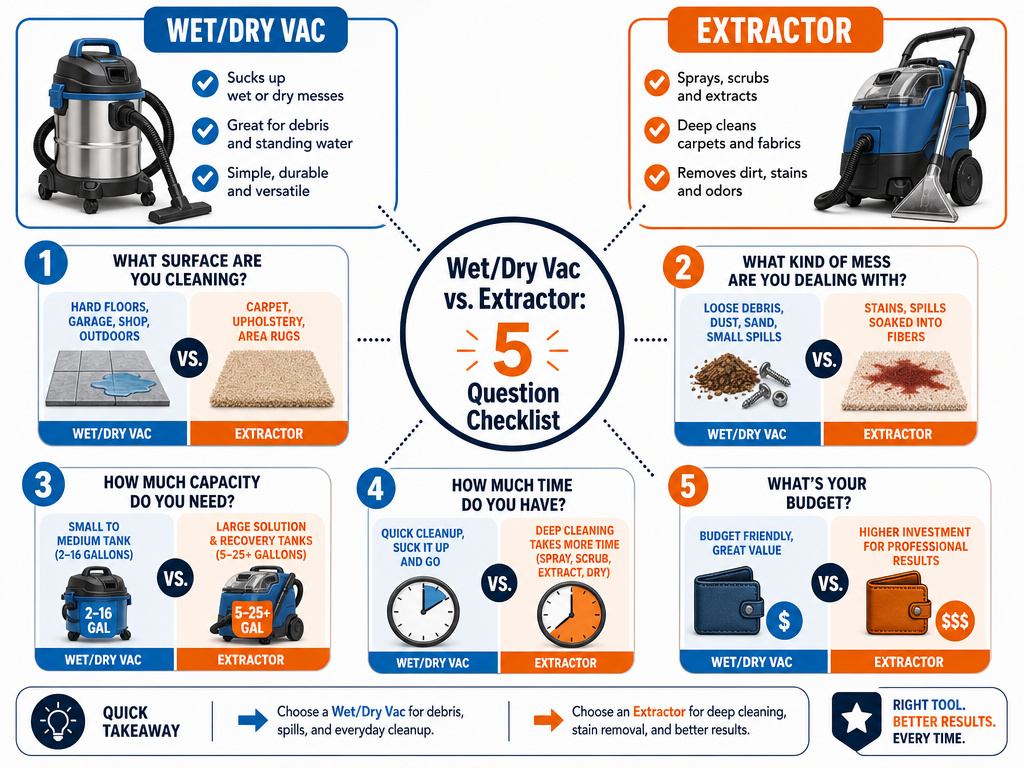 Don’t look at machines first. Answer these questions.
- What is the primary surface? Hard floors and workshops lean vacuum. Carpets and upholstery demand an extractor.
- What is the soil type? Loose debris and standing liquid are vacuum jobs. Ground-in, sticky, or oily soils need extraction.
- What’s the square footage? A 1-gallon spot extractor is for stairs and seats. A 12-gallon extractor is for whole rooms. Match tank size to area.
- How important is drying time? Only an extractor with strong vacuum recovery can promise drying in a few hours. A wet/dry vac leaves moisture behind.
- What’s your storage and budget reality? An extractor is a larger investment and requires more maintenance. A home wet and dry vacuum is a simpler, multi-purpose tool.
For the majority of homeowners who want one machine for spills, garage messes, and the occasional car cleanout, a home wet/dry vacuum is the default. For anyone with wall-to-wall carpet, pets, or a commitment to deep cleaning, the extractor is a non-negotiable addition to your arsenal. The Kärcher Admiral 8 offers a balance of power and size for serious home use.
Frequently Asked Questions
Can I use my wet/dry vacuum as a carpet cleaner?
You can use it on a carpet, but not to clean it in the way an extractor does. You can use it to suck up a fresh spill. For any cleaning that involves detergent or shampoo, you need to spray and agitate separately, and the vacuum will not remove enough moisture, leading to overwetting and residue buildup.
Is a carpet extractor worth it for home use?
If you have medium to large areas of carpet, yes. Renting one is inefficient and expensive over time. Owning a model like the Kärcher Mini Pro lets you clean on your schedule, more frequently, which extends the life of your carpet. It pays for itself versus professional cleaning services.
What’s more important, PSI or waterlift, in an extractor?
You need both, but they are sequential. The PSI (pump pressure) is needed first to inject the cleaning solution and agitate the soil. The waterlift (vacuum suction) is needed second to pull the dirty solution out. A machine with high PSI but weak waterlift will leave the carpet too wet. Balance is key.
Why does my wet/dry vacuum lose suction with water?
This is almost always a clogged or incorrectly installed filter. For wet pickup, you must remove the dry filter or install a foam sleeve. A clogged filter blocks airflow, causing the motor to overheat and the suction to plummet. Always check the filter first.
Can I use bleach in an extractor?
Generally, no. Bleach and other corrosive chemicals can damage the pump seals, hoses, and internal metal components. They also create harmful fumes when aerosolized. Use cleaning solutions specifically formulated for carpet extraction machines.
The Bottom Line
A wet dry vacuum is for collection. An extractor is for removal. This is the line.
Buy a wet-dry shop vac for your garage and basement. Its job is to handle the messes you can see and scoop. Buy a carpet extractor for your living room and bedrooms. Its job is to handle the soil you can’t see, buried deep in the fibers. Trying to force one machine to do both leads to half-cleaned carpets and frustrated weekends.
For the one-machine household, the RIDGID RV2600B covers 95% of disaster cleanup. For the household that values deep-cleaned carpets, the Kärcher Clipper 12 is the investment that pays off every time you walk barefoot across a clean, dry floor. Choose the tool for the job you actually have, not the one you imagine.