
Why Your Dyson Vacuum Cleaner Head Is Not Spinning | Fixes
This post contains affiliate links. As an Amazon Associate, we earn from qualifying purchases.
A Dyson vacuum cleaner head not spinning is caused by one of three core issues: a physical blockage (hair, thread), an electrical fault (dirty connectors, broken wire), or, on specific models, an air-turbine stall from low suction or a clogged hose. The exact fix depends entirely on your Dyson’s model year and head type, pre-2005 uprights use belts, post-2005 use a dedicated motor, and many canisters use air-driven turbines that fail silently on thick carpet.
That distinction between belt, motor, and air is where most generic advice falls apart. A belt slips. A motor trips a thermal reset. An air turbine just stops moving when the suction drops below a specific threshold, and you’ll waste an hour cleaning a spotless brush bar.
What follows: a model-specific diagnostic tree, the connector-cleaning trick repair shops use, and the one Dyson series you should never use on hard floors.
Key Takeaways
- Pre-2005 Dyson uprights (like the DC07) use a belt drive from the main motor; a broken belt means you hear the motor but the brush bar is still.
- Post-2005 Dyson uprights have a dedicated brush motor with a thermal reset button; a stalled motor requires a press of this button after clearing the blockage.
- Air-turbine heads (common on canisters like the DC08) stall on dense carpet or with any hose clog because they rely on suction airflow to spin.
- Electrical failures often trace to tarnished pins in the wand connectors; cleaning them with isopropyl alcohol and a cotton swab restores contact.
- The Dyson DC07 without brush control spins its brush bar constantly, even when upright, making it unsuitable for hard floors and a safety note for homes with pets or children.
The 60-Second Diagnostic: Check These Three Things First
Before you disassemble anything, answer these questions. They route you to the correct repair path.
- Does your model have a “brush bar on/off” or “hard floor” button? If it’s switched off, the head won’t spin. Many Dyson uprights also default the brush off when in the upright position; recline the handle to engage it.
- Is the brush bar physically locked? Unplug the vacuum. Turn the cleaner head over and try to rotate the brush bar by hand. If it doesn’t budge, you have a severe hair or thread wrap jam. If it spins freely but roughly, a bearing is failing.
- What’s your Dyson’s approximate age and type? This is the master key.
- Old upright (pre-2005, e.g., DC07): Suspect a worn or broken drive belt.
- Modern upright (post-2005, e.g., DC25, DC33): Suspect a tripped thermal reset button on the cleaner head or a clogged brush bar.
- Canister with a slim head: Likely an air-turbine head. Suspect a clogged hose or insufficient suction.
- Cordless stick (V6, V8, etc.): Suspect dirty electrical connectors between the wand and body or a depleted battery in low-power mode.
Where this goes sideways: Assuming all brush bars are driven the same way. Cleaning a hair-clogged brush bar on a model with a broken belt is a waste of time. The fix is under the hood, not on the bar.
| Your Dyson Type | Primary Drive Mechanism | First Thing to Check |
|---|---|---|
| Pre-2005 Upright | Belt from main motor | Drive belt under cleaner head cover |
| Post-2005 Upright | Dedicated brush motor | Red thermal reset button on cleaner head |
| Canister (Air Turbine) | Suction-powered air turbine | Full hose suction and end bearings for hair |
| Cordless Stick | Direct-drive motor in head | Battery charge & electrical connectors in wand |
Clearing Physical Blockages and Bearing Checks
Ninety percent of “head not spinning” calls start here. Hair, string, carpet fibers, and pet fur wrap around the brush bar ends, seizing the bearings. The process is universal, but the access point varies by model.
For most upright and stick models:
- Unplug the vacuum or remove the battery.
- Locate the end caps on the cleaner head. On models like the Dyson UP30, you press a button and hinge the cap open 90 degrees.
- Pull the brush bar straight out. On some models, it comes out as one piece; on others like the DC23 Motorhead, there are two brush bars that must be removed with their arrows pointing toward the wheels.
- Use scissors, a seam ripper, or a dedicated brush cleaning tool to cut and remove all wound material. Don’t just pull, cut along the length of the bar to avoid damaging the bristle mounts.
For robot vacuums like the Dyson RB03:
The manual specifies checking and removing hair from the brush bar at least once a month. Failure here triggers a “Brush bar stuck” alert on the LCD screen.
Common mistake: Only cleaning the center of the brush bar. Hair migrates and packs into the plastic bearing housings at each end. After removing the bar, spin each end by hand in its housing. It should spin silently. A gritty feel or resistance means hair is packed inside the bearing. Dig it out with a thin pick or unbent paperclip.
What if it’s clean but still stiff?
You have a worn or dry bearing. A few drops of lightweight silicone-based lubricant on the metal shaft ends can help, but if the bearing is visibly cracked or seized, replacement is the only reliable fix. Forcing it will burn out a drive motor or shred a belt.
Electrical Faults & Connector Cleaning
If the brush bar spins freely by hand but gets no power, the problem is electrical. On motor-driven heads, electricity travels from the main body, through the wand, down to the head. Each connection point is a potential failure site.
The telltale sign: The vacuum has power (suction works), but the brush head is dead silent when engaged. No hum, no click, no attempt to move.
Here is the systematic check, drawn from common repair logs: 1. Check the obvious switch. Ensure any “brush bar on/off” or “hard floor” button is in the “on” position. 2. Inspect the thermal reset button. On many modern uprights (DC33, etc.), a small red button is located on the cleaner head. If the motor overheated from a blockage, this button pops out. Clear the blockage, then press the button back in. 3. Clean the electrical connectors. This is the most common hidden fix. * Disconnect the wand from the main body and from the cleaner head. * Look for brass or silver metal pins or plates at each connection point. These are the electrical contacts. * Dampen a cotton swab with 99% isopropyl alcohol. Scrub each metal contact thoroughly until the swab comes away clean. Lint and oxidation are insulators. * Use compressed air or a dry swab to blow out the sockets where these pins insert.
I’ve seen Dyson stick vacuums where the head was perfectly clean, but the machine was dead to the world. The fix was never in the head itself, it was a film of dust on the two little pins inside the wand socket. Five minutes with alcohol and a swab saved a $150 part.
This connector issue is a frequent culprit after routine maintenance, which is why we have a dedicated guide on Dyson vacuum not working after cleaning filter. Disturbing the machine can shift cables and worsen a marginal connection.
Model-Specific Failures: Belts, Turbines, and the DC07 Quirk
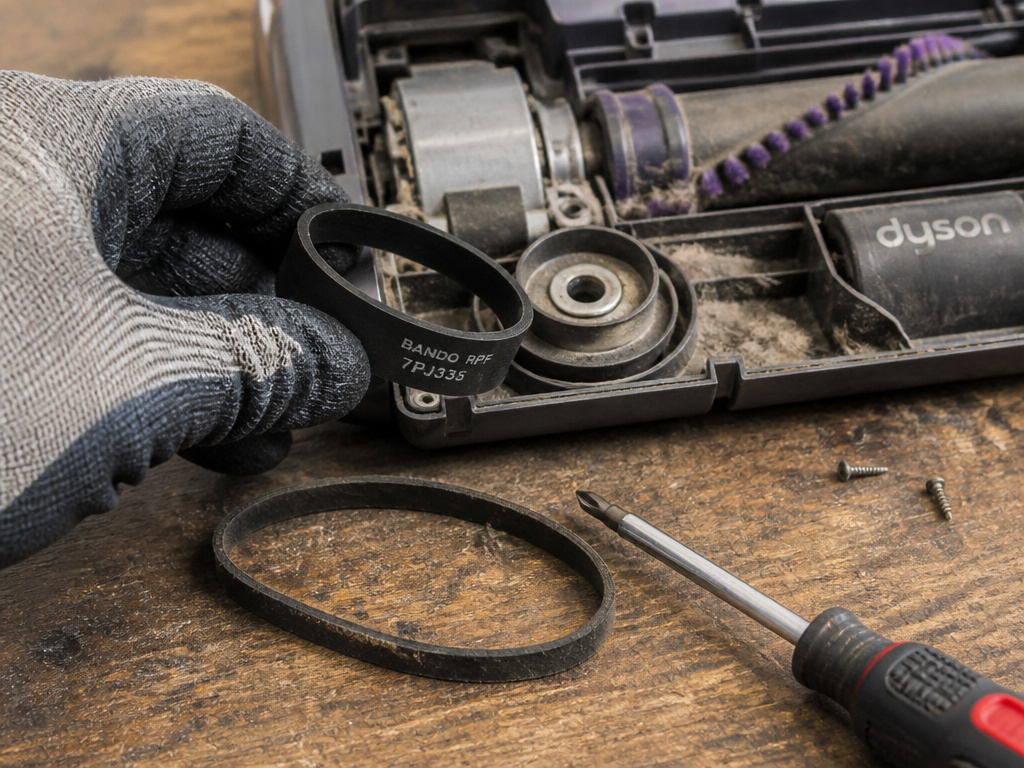
Generic advice fails here. You must know what drives your brush.
Belt-Driven Uprights (Pre-2005, e.g., DC07)
These models use a belt from the main vacuum motor to spin the brush. A broken or stretched belt is the culprit. You’ll often hear the main motor pitch change when you recline the handle, but the brush stays still. * The fix: Access requires removing the cleaner head’s bottom plate. Replace the belt with an OEM part. While you’re in there, check the clutch mechanism the belt engages with, if it’s worn smooth, it won’t grip.
Air-Turbine Heads (Many Canisters, e.g., DC08)
These heads have no motor or wires. They use suction power to spin a tiny turbine, which drives the brush. They are, as iFixit notes, “more prone to stalling, especially on dense or higher pile carpet.” * The fix: This is a system problem. Check for any hose clog, leak, or suction loss. Ensure the machine’s filters are clean. The turbine is also “very sensitive to hair wrapped around an end bearing.” You may need to fully disassemble the head to clear hair from the turbine impeller itself.
The Dyson DC07 Hard-Floor Warning
This is a critical non-commodity spec straight from the manual. Some DC07 models lack brush control entirely. The manual states: “On machines without brush control the brushbar spins at all times – even when the machine is upright… DC07 models without brush control are not suitable for hard floors.” * Why it matters: If you’re using such a model on hard floors, the constantly spinning brush can scatter debris and damage both the floor and the brush bristles. It’s not broken, it’s the wrong tool for the job.
For owners of the popular ball models, the principles are similar, but the access points differ. Our focused guide on troubleshooting a Dyson Ball brush walks through the ball housing removal.
Advanced Troubleshooting: When the Simple Fixes Fail
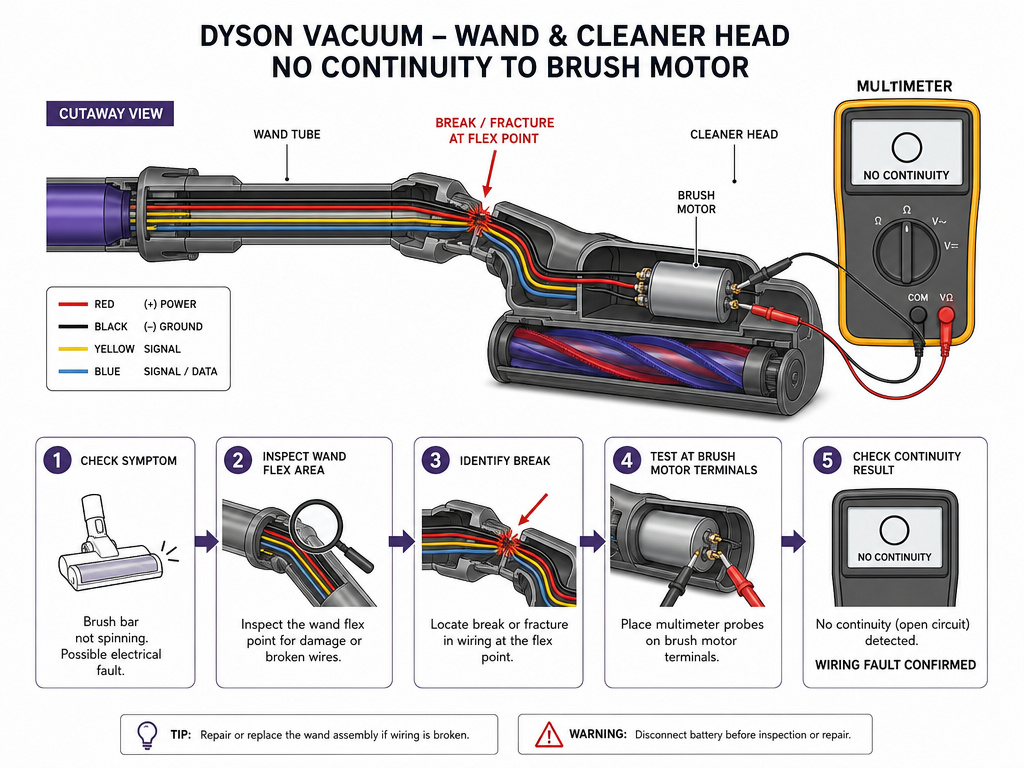
You’ve cleaned the brush, reset the button, and scrubbed the connectors. The head is still dead. Now you’re in component-level repair territory.
1. Diagnosing a Dead Brush Motor (Post-2005 Uprights)
With the cleaner head disconnected, use a multimeter to check for continuity in the motor windings. If the motor is open circuit (no continuity), it’s dead. Replacement is the only option. Before you condemn it, trace the wires back from the head for a break or burn mark.
2. Broken Wires in the Wand or Hose
Flex points over years of use can fracture internal wires. Gently bend the wand and hose along their length while the vacuum is on and the brush head is attached. Listen for a flicker of the brush motor. If it sputters, you’ve found the break. This is a common reason a Dyson stick vacuum head fails intermittently.
3. Faulty PCB or Main Board (Cordless Models)
On cordless Dyson vacuums, the main logic board regulates power to the head. If other functions work but the head gets no signal, a board fault is possible. This is a complex repair often requiring soldering.
TL;DR: Motor and board repairs are often cost-prohibitive compared to a replacement cleaner head or a certified repair. Get a quote before you buy parts.
Maintenance Routine to Prevent Future Spins
Prevention is cheaper than repair. Integrate these steps into your cleaning routine.
- Weekly: Visually check the brush bar for large debris wraps before storing.
- Monthly: Perform a full brush bar removal and deep clean. Inspect the belt (if applicable) for wear and glazing.
- Quarterly: Clean the electrical connector pins with alcohol. Check the entire hose and wand for suction obstructions that could starve an air-turbine head.
- Bi-Annually: Wash all filters and let them dry for at least 24 hours. A clogged filter murders suction, which kills air-turbine heads.
This proactive approach dovetails with general Dyson care and maintenance to avoid a cascade of issues, from a loss of suction to a complete motor stall.
Frequently Asked Questions
Why did my Dyson brush bar stop spinning suddenly?
Sudden stop is almost always a physical jam, a sock, a hair tie, or a thick bundle of thread instantly seized the bar. Unplug the vacuum and inspect the brush bar ends first. The second most likely cause for modern models is the thermal reset button popping out after the motor overheated trying to fight that jam.
Is it safe to use my Dyson if the brush head isn’t spinning?
You can use it, but you shouldn’t. On carpet, you’re losing the primary agitation that lifts dirt, making cleaning ineffective. On hard floors, a stationary brush bar is fine for some models, but on others (like certain DC07s), the bar spins uncontrollably and can damage surfaces. It’s a sign something is wrong; running it can worsen the problem, like burning out a motor or shredding a belt.
How do I know if my Dyson has a belt or a direct motor?
Age is the easiest indicator. Vacuums made before 2005 likely have a belt. Newer uprights have a dedicated motor. You can also listen: with the vacuum on and reclined, a belt-driven model has a single motor sound. A model with a separate brush motor often has a distinct, higher-pitched whir from the cleaner head itself.
Can a clogged filter cause the brush head to stop?
Yes, but only on air-turbine driven heads (common on canisters). These heads rely on strong suction airflow to spin. A clogged filter, a full bin, or a blockage elsewhere in the system reduces that airflow, causing the turbine to stall. On motor-driven heads, a clogged filter won’t stop the brush motor, but it will cause a severe loss of suction.
The Bottom Line
A non-spinning Dyson head isn’t a single problem, it’s a symptom with three main roots: blockage, electrical fault, or design limitation. Start with the 60-second diagnostic to identify your drive type. For most, a thorough brush bar clean and connector scrub will bring it back to life. Remember the edge cases: old belts break, air turbines need perfect suction, and some models simply aren’t built for hard floors. With this model-specific map, you can skip the generic advice and fix what’s actually broken.