
Cordless vs Canister Vacuum: Key Differences for Your Home
This post contains affiliate links. As an Amazon Associate, we earn from qualifying purchases.
Choosing between a canister vacuum and a cordless model comes down to three measurable specs: sustained airflow (in CFM), filtration level (HEPA grade), and operating noise (in decibels). A corded canister like the Tennant V6 delivers 85 CFM and 59.7 dBA noise for as long as you need; a cordless stick like the Kärcher T 11/1 Classic HEPA offers 89 CFM and 64 dB(A) but for a maximum of about 50 minutes per charge. The right pick isn’t about power, it’s about which constraint you can live with.
That constraint splits cleanly. If you clean large, open commercial spaces or homes with mostly hard floors, the cord and capacity of a canister vacuum are assets, not burdens. If you clean quickly in a multi-room home with mixed flooring and frequent direction changes, the cordless stick’s maneuverability and instant start-stop win. The numbers from the spec sheets tell you what each machine is built to do, not just what it’s marketed for.
What follows: a breakdown of suction power versus battery life, the real noise difference between a 59.7 dBA canister and a 64 dB(A) cordless, and the five specific home and commercial scenarios where one type consistently fails while the other excels.
Key Takeaways
- Corded canisters win on sustained suction and capacity. Models like the Tennant V6 hold 9.5 quarts of debris and pull 85 CFM continuously, essential for cleaning large, open areas without interruption.
- Cordless sticks win on maneuverability and quick cleaning. A model like the Bosch Unlimited 7 weighs under 3 kg ready-to-use and has a 40-minute runtime, perfect for daily touch-ups and multi-surface homes.
- Noise levels are closer than you think. A commercial canister operates at 59.7 dBA; a typical cordless stick runs at 64 dB(A). The cordless is slightly louder but often used for shorter bursts.
- HEPA filtration is not equal. Look for the certification standard. The Kärcher T 11/1 Classic HEPA uses a HEPA 14 filter certified to DIN EN 1822:2019, trapping 99.995% of particles down to 0.3 microns, a must for medical or allergy-sensitive spaces.
- Your flooring decides the tool. Use a canister with a dedicated powerhead for deep carpet cleaning. Use a cordless stick with an auto-adjusting brushroll for mixed hard floors and low-pile rugs.
The Suction & Power Reality: Corded Airflow vs Battery Runtime
Forget “powerful suction” as a marketing term. The real metrics are airflow (CFM) and water lift (inches or kPa), and they behave differently under corded and battery power.
A corded canister vacuum motor, like the 1.7 hp unit in the Kärcher T 12/1, generates a consistent 129 CFM and 98 inches of water lift for the entire cleaning session. There is no fade. A cordless vacuum’s suction is a calculation of battery voltage, motor efficiency, and runtime mode, the Bosch Unlimited 7, for example, offers 40 minutes only in its Eco mode; Turbo mode cuts that time by more than half.
Corded power provides relentless, unimpeded suction. The Tennant V6’s 8.2A motor pulls 85 CFM whether you’re on minute one or minute sixty. This is why hotels and schools use them, the machine doesn’t decide when the job is done, you do.
Cordless power is about managed energy. The Shark PowerDetect claims 70 minutes of runtime, but that figure is measured at the handvac in Eco mode, not with the motorized floor nozzle engaged. Using a cordless on its highest setting often cuts the claimed runtime by 60% or more.
| Specification | Canister Vacuum (Corded) | Cordless Stick Vacuum |
|---|---|---|
| Power Source | 120V/240V Wall Outlet | Rechargeable Lithium-ion Battery |
| Sustained Airflow (CFM) | 85–129 CFM (Tennant V6, Kärcher T 12/1) | Variable; drops with battery level & mode |
| Typical Runtime | Unlimited (until bag is full) | 20–70 minutes (mode-dependent) |
| Primary Constraint | Cord Length & Outlet Access | Battery Charge & Capacity |
| Best For | Large-area, continuous cleaning | Short-session, multi-room cleaning |
The takeaway is simple. If you need to clean a 3,000 sq. Ft. Office without stopping, you need a cord. If you need to quickly clean a kitchen, living room, and two bedrooms between meetings, a cordless stick is the logical tool.
Noise Levels: The 59.7 dBA vs 64 dB(A) Detail Everyone Misses
Operating noise isn’t just about comfort; it dictates when you can clean. A vacuum that’s too loud for daytime use in an office or apartment is a planning problem, not a minor annoyance.
Here, the numbers from manufacturer spec sheets are revealing. The Tennant V6 canister operates at 59.7 dBA at a distance of 1.5 meters. The Kärcher T 11/1 Classic HEPA canister runs at 64 dB(A). Meanwhile, many cordless sticks, like the Bosch Unlimited 7, list a noise level of 82 dB(A).
Common mistake: Assuming all “quiet” vacuums are similar. A 5 dB(A) difference represents a noticeable change in perceived loudness. The 59.7 dBA canister is genuinely quiet enough for libraries or daytime hotel cleaning; the 82 dB(A) cordless stick is not.
Why does this matter? If you clean during the day in a shared space, an office, a school, a multi-family building, a sub-65 dBA machine lets you work without disruption. The PPR-390 canister takes this further, with noise levels of just 49 dB(A), which is quieter than normal conversation.
Cordless vacuums are louder because their motors are smaller, spin faster, and are housed in less insulated bodies. You trade quiet operation for portability. For home use where noise is less critical, this is fine. For commercial or daytime residential cleaning, the canister’s lower decibel rating is a functional requirement, not a luxury.
Filtration Showdown: HEPA Grades, Bags, and Indoor Air Quality
A vacuum doesn’t just pick up dirt; it decides what gets blown back into the room. Filtration is where canister vacuums, especially commercial ones, pull far ahead of most cordless models.
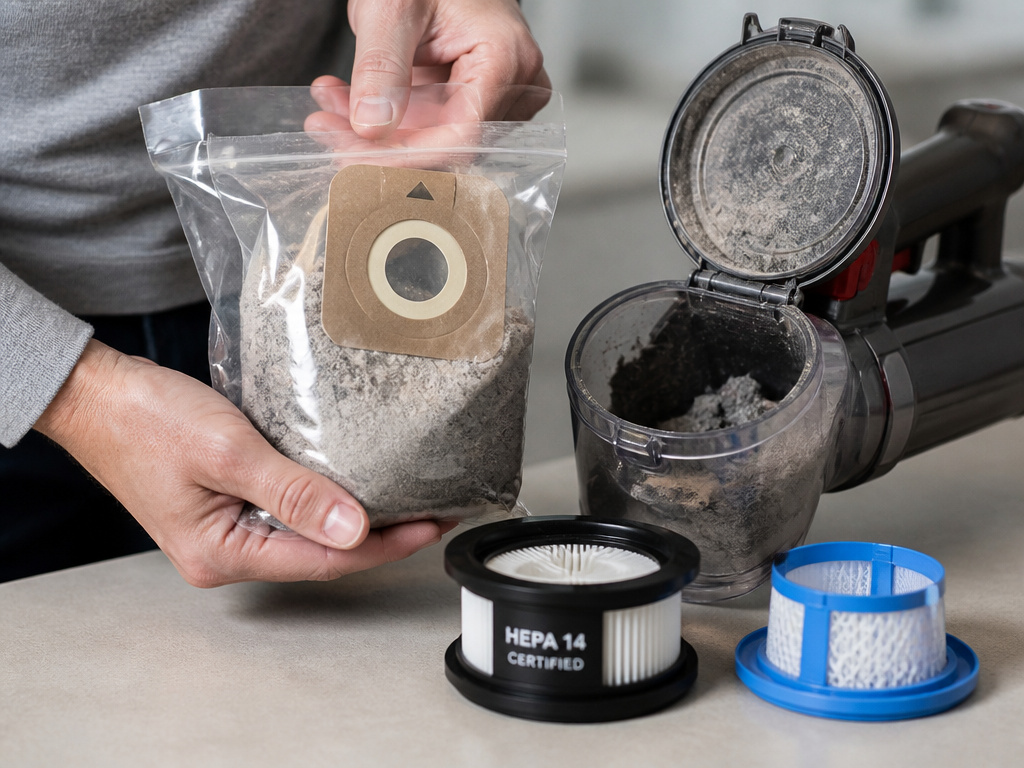
The gold standard is a HEPA 14 filter certified to DIN EN 1822:2019, like the one in the Kärcher T 11/1 Classic HEPA. This filter traps 99.995% of particles down to 0.3 microns, including viruses, aerosols, and allergens. It’s a sealed system, usually paired with a disposable bag, that makes the vacuum suitable for hospitals, clinics, and homes with severe allergies.
Most cordless sticks use a bagless, cyclonic system with a washable post-motor HEPA filter. While convenient, these filters are rarely certified to the same rigorous standard. They can also release a plume of dust when you empty the bin, defeating the purpose of high filtration.
Bagged vs. Bagless is a health and maintenance choice. A bagged canister seals dust away; you never touch it. A bagless cordless saves money on bags but requires you to handle dust and wash filters regularly. For a true allergy-friendly cleaning system, the sealed bag and certified HEPA filter of a canister are unmatched.
Where Each Type Actually Wins (And Where It Fails)
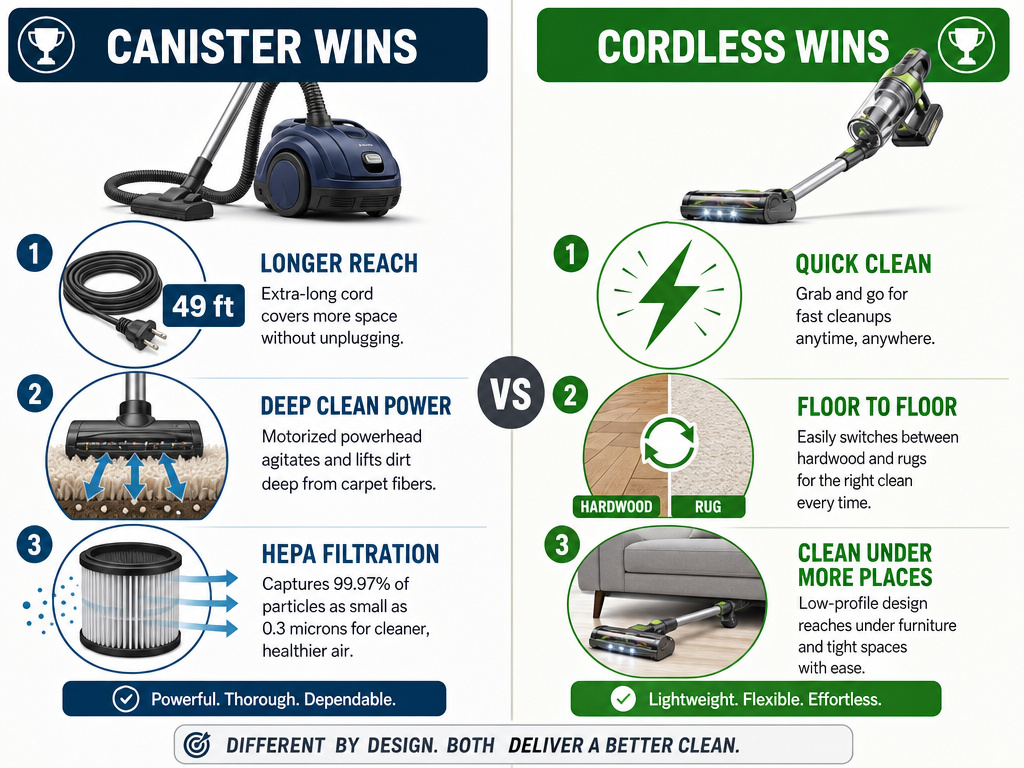
The debate isn’t abstract. Your floor types, room layout, and cleaning style create a clear winner.
The Canister Vacuum’s Domain
A canister vacuum is a system, not just a vacuum. It wins in three specific scenarios:
- Large, open commercial spaces. With a 49-foot power cord (like the Tennant V6) and a 9.5-quart bag, you can clean a hotel hallway or school classroom without changing outlets or emptying the unit.
- Deep carpet cleaning with a powerhead. For a full tutorial on this setup, see our guide on canister vacuums with powerhead attachments. The separate motor in the floor tool provides the agitation that a cordless stick’s brushroll simply cannot match.
- Hygienically sensitive environments. The sealed HEPA 14 system in models like the Kärcher T 11/1 is non-negotiable for medical offices or allergy sufferers.
Where this goes sideways: Using a canister in a cluttered, multi-room home with lots of furniture. You will spend more time managing the hose, wand, and cord than actually cleaning. The machine is efficient, but the process is not fast.
The Cordless Stick’s Domain
A cordless stick is an agile tool for modern living. It wins here:
- Daily quick cleans and spot cleaning. No plug, no cord, no setup. Grab it, clean a spilled mess in the kitchen, and put it back. Its convenience for pet hair cleaning vacuums is a major reason for their popularity.
- Homes with mixed hard floors and area rugs. Models with auto-detecting brushrolls, like the Bosch Unlimited 7, switch suction and brush speed seamlessly.
- Cleaning under and around furniture. The lightweight, slender design of a stick vacuum lets you reach under beds and sofas where a canister’s hose might not go.
Its failure mode is just as clear. No cordless stick on the market can deep-clean a large, plush carpet as well as a canister with a powerhead. The battery will die before the job is done, and the suction won’t be as sustained. For a whole-home deep clean on carpet, you need a cord.
The Cord & Battery Logistics: What You Give Up
Every choice is a trade-off. With a canister, you trade unlimited runtime for cord management. With a cordless, you trade cord freedom for battery anxiety and eventual battery replacement.
Cord Management is a real skill. A 40-49 foot cord (like on the Tennant V6 or Kärcher T 12/1) is a blessing in an open space but a tangling hazard in a room full of chair and table legs. You must plan your cleaning path around outlet locations.
Battery Logistics involve more than runtime. You must remember to charge the vacuum. After 3-5 years, the $100+ battery pack will need replacement, a cost you never have with a corded machine. For models that support it, a cordless vacuum with removable battery is a smart investment, letting you swap in a fresh pack for longer sessions.
| Logistics Factor | Canister Vacuum | Cordless Stick Vacuum |
|---|---|---|
| Setup Time | Longer (unwind cord, attach hose/tools) | Instant (grab and go) |
| Cleaning Range | Limited by cord length & outlets | Limited by battery charge |
| Long-Term Cost | Bags, filters, occasional belt | Battery replacements, filters |
| Storage | Requires more dedicated space | Stands upright or docks on wall |
| Maintenance Peak | When the bag is full | When the battery dies mid-clean |
The hassle you prefer is personal. Do you hate tripping over a cord and searching for outlets? Or do you hate stopping a cleaning session to recharge for three hours?
Head-to-Head: Five Real Cleaning Scenarios
Let’s apply the specs to real life. Here’s which type you should reach for.
-
Scenario: Weekly whole-house clean (2,000 sq. Ft., 50% carpet).
- Winner: Canister Vacuum. The sustained power of a model like the Tennant V6 will clean carpets more deeply, and you won’t stop to recharge. Use our comprehensive canister vacuum guide to pick the right model.
-
Scenario: Daily kitchen and living room tidy-up (hard floors, area rugs).
- Winner: Cordless Stick. The Shark PowerDetect or Bosch Unlimited 7 is perfect. It’s fast, easy to maneuver, and powerful enough for daily debris.
-
Scenario: Cleaning a commercial office after hours (cubicles, low-pile carpet).
- Winner: Canister Vacuum. The quiet operation (59.7 dBA), large capacity, and long cord allow for efficient, uninterrupted cleaning. A bagless canister could also work here to reduce bag costs.
-
Scenario: Apartment living with limited storage and mostly hard floors.
- Winner: Cordless Stick. Its slim profile and ability to mount on a wall save space. The runtime is more than enough for an apartment’s square footage.
-
Scenario: Home with severe allergies and multiple pets.
- Winner: Canister Vacuum (with HEPA bag). The sealed system of a bagged canister with a true HEPA filter, like the Kärcher T 11/1, is the only way to ensure allergens are trapped and not recirculated.
Before You Go: The One-Sentence Answer
Match the machine to the job’s dominant constraint. If your main limit is time and uninterrupted workflow, get a corded canister. If your main limit is effort and setup speed, get a cordless stick.
For most homeowners doing weekly cleans on mixed floors: a high-quality cordless stick like the Bosch Unlimited 7 covers 90% of cleaning needs. Its 40-minute runtime, auto-adjusting brush, and easy storage solve more daily problems than they create.
For dedicated deep cleaning, large spaces, or allergy control: a commercial-grade canister like the Kärcher T 11/1 Classic HEPA is a necessary investment. Its certified filtration, substantial capacity, and quiet operation handle the jobs a cordless stick cannot.
Check the specific numbers. CFM, dBA, filter certification, against your actual rooms and routine. The right vacuum has already been built; you just need to match its specs to your floor.
Frequently Asked Questions
Are cordless vacuums as powerful as canister vacuums?
On their highest setting for the first few minutes, some high-end cordless sticks can match the suction of a mid-range canister. However, they cannot sustain that power. A corded canister’s motor delivers its rated airflow (CFM) and water lift consistently until you turn it off, while a cordless vacuum’s power drops as the battery depletes. For deep, sustained cleaning, the canister wins.
How long do cordless vacuum batteries really last?
Manufacturer “maximum runtime” claims, like the Shark PowerDetect’s 70 minutes, are usually measured under ideal, low-power conditions. Real-world use with a motorized floor nozzle often cuts that time by 40-60%. Furthermore, the battery itself will degrade, holding less charge after 300-500 full cycles (about 2-3 years of regular use). Planning for eventual replacement is part of owning a cordless model.
Is a bagless or bagged vacuum better?
It’s a trade-off between convenience and cleanliness. Bagless vacuums save money on bags and let you see when the bin is full. However, emptying the bin often releases a cloud of fine dust back into the air. Bagged vacuums, especially those with HEPA seals, completely contain dust and allergens. They are more hygienic and better for allergies, but you have the ongoing cost of replacement bags.
Can you use a canister vacuum on stairs?
Yes, but it’s awkward. You must carry the canister body up and down the stairs or leave it at the bottom and use the full length of the hose and wand. This is one area where a lightweight, cordless stick vacuum has a clear advantage in maneuverability and ease of use.
What does HEPA 14 certification mean?
HEPA 14 is a classification within the DIN EN 1822:2019 standard. It means the filter is tested and certified to capture 99.995% of particles at the most penetrating particle size (MPPS), typically around 0.3 microns. This includes fine dust, pollen, mold spores, bacteria, and viruses. It’s the level required for use in hospitals and labs, and it’s a key feature of vacuums like the Kärcher T 11/1 Classic HEPA.