
Can I Empty Vacuum Into Toilet? What Manuals Actually Say
This post contains affiliate links. As an Amazon Associate, we earn from qualifying purchases.
You can empty a wet/dry vacuum into a toilet only if the liquid is non-hazardous water, the volume is under two gallons, and your toilet’s drain line is clear of existing clogs. Manufacturer manuals explicitly forbid dumping toxic, flammable, or corrosive materials. Doing so risks plumbing blockages, motor damage from the automatic shut-off float, and voiding your vacuum’s warranty.
That “deposit the liquid waste in a suitable drain” line in your Shop-Vac manual isn’t a green light for the toilet. It’s a conditional instruction with a list of exclusions longer than the safety section. The toilet bowl is a drain, but it’s connected to a system with a 1-inch orifice at the toilet base and pipes that can’t handle sudden sludge dumps.
What follows is a breakdown of three specific risks the manuals name, the one float mechanism that decides whether your vacuum motor survives, and a checklist that moves the job from the bathroom to a real drain.
Key Takeaways
- Shop-Vac and other OEM manuals explicitly warn against vacuuming toxic, carcinogenic, or combustible materials; emptying those into any drain, especially a toilet, violates the manufacturer’s safety rules.
- The automatic suction shut-off float inside the tank must seal properly; if you tip the vacuum over while it’s running or ignore the high-pitch motor noise, you can burn out the motor within seconds.
- RV and marine vacuum toilets like the Dometic VacuFlush have a 1-inch (25 mm) discharge orifice; any solid debris or thickened sludge will jam it, requiring a blunt rod to clear.
- Always empty the tank immediately after use; letting liquids sit promotes bacterial growth, odors, and can degrade tank seals.
- For static shock in low-humidity environments, add moisture to the air; do not modify the vacuum.
What Manufacturer Manuals Actually Say About Disposal
The consensus advice online is vague. The manuals are not. They draw bright lines between what you can vacuum and where you can put it afterward.
The primary source material here is the set of user manuals for Shop-Vac wet/dry vacuums. They share identical warnings. One line, buried in the operation section, reads: “deposit the liquid waste in a suitable drain.” The preceding twenty safety instructions define what makes a drain suitable—and what makes a waste illegal.
DO NOT vacuum toxic, carcinogenic, combustible or other hazardous materials such as asbestos, arsenic, barium, beryllium, lead, pesticides or other health endangering materials. Specially designed units are available for these purposes.
That’ s a direct quote from the Shop-Vac Model 970C manual. It’s not a suggestion. If your vacuumed liquid contains any of those, the toilet is off-limits. So is any other drain in your home. The manual’s instruction to use a “suitable drain” is voided by the prior safety rule.
The other critical clause is about spontaneous combustion. “To avoid spontaneous combustion, empty tank after each use.” This isn’t about fire in the toilet. It’s about fine, dry dust particles like sawdust or flour dust mixing with air in a closed tank. The risk is inside the vacuum canister itself. But it underscores a principle: these tanks are not for storage. You finish the job, you empty the tank. Letting anything sit, wet or dry, is asking for trouble.
So the manual gives you a two-part rule: know what’s in your tank, and get it out now. The toilet is a potential destination only after you’ve passed both checks.
What Happens When You Empty a Wet/Dry Vacuum Into a Toilet?
Household plumbing and vacuum toilets in RVs or boats are designed for specific waste streams. Dumping a vacuum tank ignores those designs.
Household Toilet & Plumbing:
Your home toilet drains through a 3-inch or 4-inch pipe, but the trapway inside the toilet itself has constrictions. It’s built for water, human waste, and toilet paper. Vacuum wastewater is a variable. It can contain: * Sediment: Fine sand, drywall dust, or concrete powder settles in the pipe’s horizontal runs. Add water, and it becomes a hard plug. * Debris: Small wood chips, plastic fragments, or hair can catch on existing pipe imperfections or mineral buildup. * Volume: A 12-gallon shop vac tank emptied in one flush is 12 gallons of water added to the 1.6 gallons in the bowl. That’s a 13.6-gallon slug hitting your drain system instantly. Older pipes with partial clogs can back up immediately.
RV/Marine Vacuum Toilets (like Dometic VacuFlush):
These are a different beast. They use a vacuum pump to pull waste through a 1-inch (25 mm) diameter orifice. The Dometic 4800 series troubleshooting guide lists “Blockage in toilet base” as a cause for no vacuum. The remedy? “Remove blockage or push blockage through 1-inch (25 mm) diameter orifice with small diameter blunt rod.”
The part nobody mentions: That 1-inch orifice is smaller than the drain hose on your wet/dry vac. Pouring thickened, dirty water from a vacuum tank into that bowl is a direct gamble. You’re betting nothing will stick in that narrow hole. Lose that bet, and you’re fishing with a rod.
The other system, the Jets Vacuumarator, lists “Drain blocked by foreign objects” as a failure mode. Their manual’s solution is simply “Remove foreign objects.” Neither manual has a section for “Vacuum Tank Waste.” It’s foreign by definition.
| System Type | Critical Limitation | Risk from Vacuum Waste |
|---|---|---|
| Household Gravity Plumbing | Pipe diameter (3-4 in), trapway design | Sediment buildup, volume overload, debris snagging |
| RV/Marine Vacuum Toilet | 1-inch (25 mm) discharge orifice | Instant blockage at the toilet base |
| Vacuum Toilet Collection Tank | Designed for macerated human waste | Sludge accumulation, altered bacterial balance |
The takeaway is mechanical, not philosophical. These systems have tolerances. Vacuum sludge routinely exceeds them.
The Hidden Risk Inside Your Vacuum: The Automatic Shut-Off
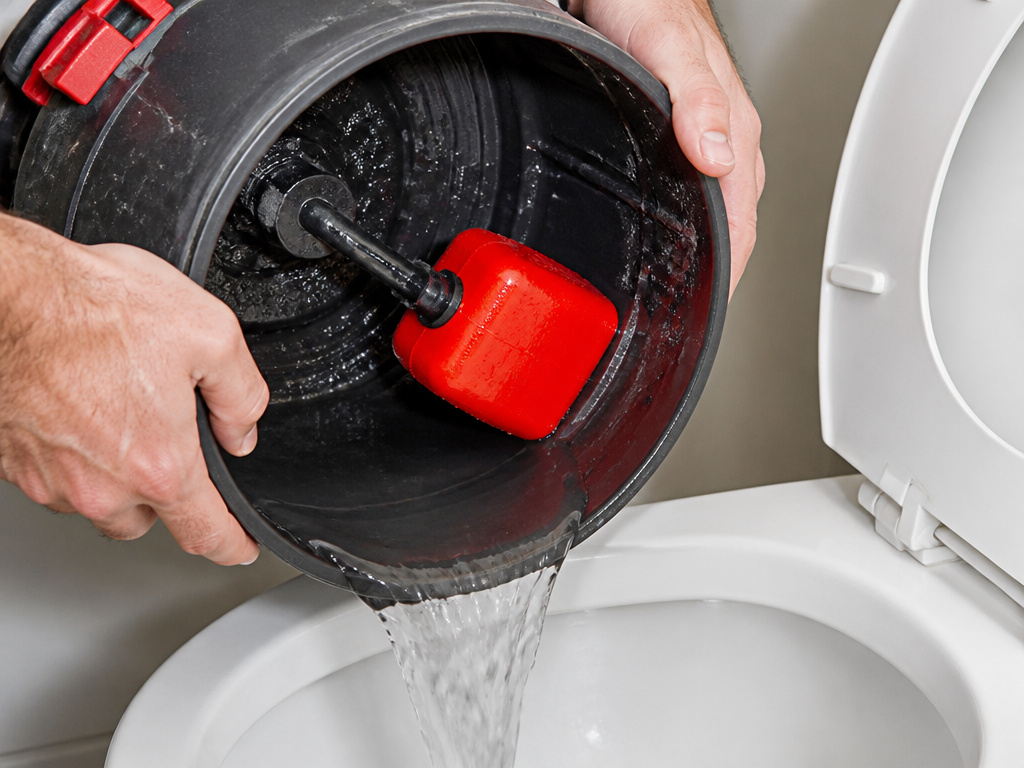
This is where a disposal mistake can break your vacuum, not your plumbing. Most wet/dry shop vacuums have an automatic suction shut-off powered by a float.
When you vacuum liquids, the tank fills. A plastic float rises with the liquid level until it seats against a seal at the motor intake. This shuts off suction to protect the motor from drawing in water. The manual is explicit about what happens next: “the motor will develop a higher than normal pitch noise and the suction is drastically reduced. If this occurs, turn unit off immediately.”
Failure to turn unit off after float rises and shuts off suction will result in extensive damage to the motor.
Now, connect that to toilet disposal. If your tank has this float mechanism and you upend it over a toilet bowl, the float can jam. It might not reseat properly. If you then turn the vacuum back on without checking, the motor could run without protection. Burnout follows quickly.
The manual even covers tipping. “IF ACCIDENTALLY TIPPED OVER, THE VACUUM COULD LOSE SUCTION. IF THIS OCCURS, TURN UNIT OFF AND PLACE VAC IN UPRIGHT POSITION. THIS WILL ALLOW THE FLOAT TO RETURN TO ITS NORMAL POSITION.” Pouring out a tank is a controlled tip. The same rule applies.
You might think you’re just dumping water. But you’re also handling a internal safety switch that expects to be treated a specific way. Ignoring that process is how you turn a simple cleanup into a repair bill.
The 3-Step Safe Disposal Checklist
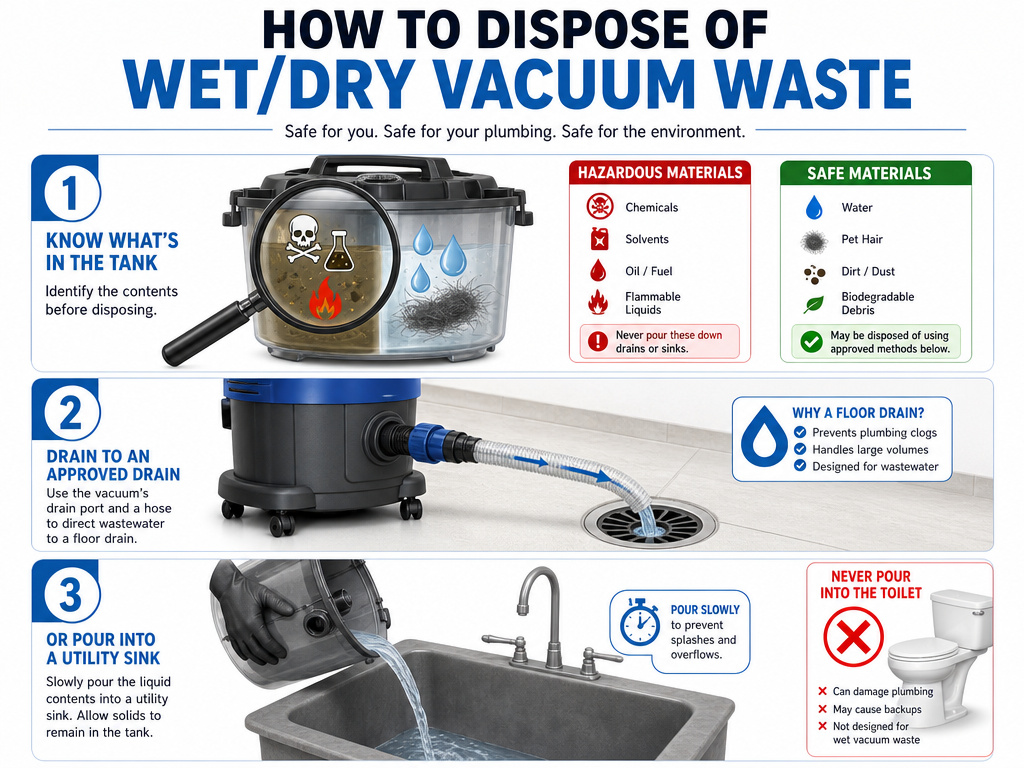
Forget the toilet for a moment. The safe path uses a drain that expects indeterminate wastewater. Follow this sequence every time.
1. Identify the Waste Before You Vacuum.
This is the first and most important filter. Refer to your manual’s “DO NOT” list. If the material is toxic (chemical residues), flammable (solvents), carcinogenic (asbestos, lead dust), or excessively fine (plaster dust, concrete powder), you need a specialty vacuum and licensed disposal. Do not use a standard shop vac. For a pet vacuum cleanup after shampooing carpets, the waste is likely soapy water and pet hair—annoying for drains but not hazardous. For a commercial vacuum used on a construction site, the contents are almost certainly off-limits for indoor drains.
2. Use the Vacuum’s Drain Port (If It Has One).
Many larger wet/dry vacuums, like the Shop-Vac 970C series, have a drain port on the tank. Place the vacuum near a floor drain, utility sink, or bathtub. Connect a hose to the port. Open the valve. This allows a controlled, low-sediment transfer. It keeps the tank upright and the float mechanism happy. It’s the method least likely to cause a mess or damage the vacuum. If you’re learning how to empty a Hoover commercial vacuum, this is the step you’ll use most often.
3. Dump & Rinse Into a Utility Sink or Floor Drain.
If there’s no drain port, you must dump the tank. The correct location is a utility sink in a laundry room, garage, or basement, or a dedicated floor drain. These drains are designed for non-sanitary wastewater. They typically have larger, straighter pipes and easier clean-out access. * Dump slowly. Let the liquid flow out to avoid stirring up sediment. * Rinse immediately. Fill the tank with a few gallons of clean water, slosh it around, and dump it into the same drain. This prevents residue from drying and sticking. * Clean the filter. For wet pickup, you should have removed the paper filter. If it got damp, let it dry completely before reusing or replace it. A clogged filter is a top cause of suction loss.
When the Toilet Might Be Acceptable (The Narrow Exception)
The only scenario where a toilet is remotely suitable is if you’ve vacuumed pure, clean water—like a spilled drink from a clean floor—and your tank is small (under 2 gallons). Even then, pour slowly between flushes to avoid overwhelming the trap. This is a rare case. For most jobs, the utility sink is a safer bet.
Common Mistakes and How to Avoid Them
Where this goes sideways: Assuming all liquids are the same. Vacuuming leftover cleaning solution from mopping and dumping it seems harmless. But many floor cleaners leave a slippery residue that coats pipes and catches other debris, accelerating clogs down the line.
Mistake 1: Storing a Full Tank.
The manual says, “Never allow liquids to sit in the tank for any extended period of time.” This isn’t just about smells. Stagnant water grows bacteria and mold. It can degrade the tank’s plastic and compromise seals. It turns a simple dump into a biohazard cleanup. Empty it as soon as you unplug the cord.
Mistake 2: Ignoring the Motor’s Sound.
That high-pitched whine after the suction stops is the float seal engaging and the motor straining. It’s an alarm. Turn the vacuum off within seconds. The “extensive damage” warning is not an exaggeration. The motor cools by drawing air through it; a sealed intake causes overheating fast.
Mistake 3: Misunderstanding Static Shock.
The Shop-Vac manual addresses dry environments: “Can cause static shock. Manufacturer suggests adding moisture to the air (if practical, use a console or installed humidifier).” This is a known issue with plastic hoses and dry air. It’s uncomfortable but not a vacuum defect. Don’t try to ground the hose or modify the unit; you’ll void the warranty.
Mistake 4: Using the Wrong Filter.
This is a pre-disposal error that changes what’s in your tank. For wet pickup, you must remove the paper filter. If you vacuum drywall dust with a standard filter, fine particles will pass through and end up in your wastewater. When you dump that slurry, you’re pouring plaster dust down the drain. It settles and hardens. Always match the filter to the job: no filter for liquids, a fine dust bag or HEPA filter for fine dry debris.
Frequently Asked Questions
Can I empty my Dyson cordless vacuum into the toilet?
No. A cordless vacuum like a Dyson typically collects dry debris only. Emptying a bin of dust, hair, and crumbs into a toilet will likely float and not flush away properly, leaving you to fish out a soggy clump. These should be emptied into a trash can. For guidance on specific models, see our article on how to empty a Hoover cordless vacuum.
What about the water from carpet cleaning machines?
This is a gray area. The water contains dirt, hair, and diluted cleaning solution. It’s generally not toxic, but the volume (often several gallons) and soapy nature make it a poor candidate for a toilet. It can foam and leave residue. The safest method is to use the machine’s drain hose into a utility sink or bathtub, then rinse the tub thoroughly.
My Shop-Vac manual says to use a “suitable drain.” Is my toilet suitable?
Only under the strict conditions outlined in the manual’s safety section first. If the waste is non-hazardous, purely liquid with no sediment, and you pour a small volume slowly, the toilet is a drain. However, the manual’s own troubleshooting section lists “Full tank” as a cause for “Loss of suction.” Their intended solution is “Empty tank” into a drain you can access without tipping the unit—like a floor drain or sink. The toilet is rarely the most suitable choice.
Are septic systems more at risk?
Yes, dramatically. Septic systems rely on bacteria to break down waste. Introducing a large volume of chemical-laden or sediment-heavy wastewater can shock or kill the bacterial colony. It can also cause solids to accumulate in the septic tank faster, requiring more frequent pumping. Never dump shop vac wastewater into a septic system.
How do I empty a vacuum without making a mess?
Use the drain port. If your vacuum lacks one, place the tank in a large, shallow tub or container before tipping it. Any spills are contained. For dry debris from a handheld vacuum or stick vacuum, hold the bin over a trash can and use the release mechanism; don’t just shake it out.
Before You Go
The question isn’t really “can I,” but “should I, and what happens if I do?” The manufacturer’s answer is layered: maybe, if you’ve followed all the other rules first. But the physical reality of plumbing and the mechanical reality of your vacuum’s float switch make the toilet a risky endpoint.
The safer path is always the dedicated drain. It’s designed for unknown wastewater. Your vacuum will last longer, your pipes will stay clearer, and you’ll never be the person on the forum asking how to unclog a toilet with a shop vac rod.
For specific steps on different vacuum types, from a Henry vacuum to a Roomba vacuum, our other guides break down the exact latches, bins, and filters. The principle remains: know what you’re picking up, and have a plan for where it goes next.