
Barrel vs Upright Vacuum: The Deciding Jobs for Each Tool
This post contains affiliate links. As an Amazon Associate, we earn from qualifying purchases.
An upright vacuum moves air to lift dry debris; a barrel pump moves liquid through positive displacement. They are different tools for different jobs, dry, fine particulates versus bulk liquid transfer. The overlap exists in three specific scenarios: cleaning up dry, non-abrasive spills like spilled flour or cement dust; evacuating fine powders from containers; and post-construction cleanup of drywall dust before wet trades begin.
That distinction isn’t academic. It’s the line between a tool that works and one that gets destroyed on first use. Put a barrel pump in a pile of sand and the gears strip. Run an upright vacuum over a wet spill and the motor arcs out.
What follows: the three specs that define each tool’s territory, the three jobs where they legitimately compete, and the one mistake that wrecks the motor before the bag is full.
Key Takeaways
- Mechanics define the job. An upright uses airflow (CFM and water lift) to lift and filter debris. A barrel pump uses a piston, gear, or diaphragm to push liquid. Comparing their “suction” is meaningless.
- Overlap happens with dry, fine particulates. The only times these tools compete is for non-clumping powders like flour, powdered cement, sawdust, or drywall dust. Anything abrasive, clumping, or wet immediately disqualifies one.
- The brush roll is the upright’s secret weapon. For carpets, the rotating brush roll (2700–3300 RPM on commercial models) is non-negotiable. No barrel pump has an equivalent.
- HEPA filtration is a vacuum standard. Commercial uprights like the Kärcher Sensor S2 HEPA filter 99.97% of particles at 0.3 microns. Barrel pumps have no filtration, they’re for closed liquid transfer.
- Pick the upright for 99% of indoor cleaning. For any carpeted or hard floor surface, a corded upright vacuum is the default. A barrel pump is a niche industrial transfer tool.
Upright Vacuum vs Barrel Pump: The Core Mechanics
The difference is in the first word of their names. One stands up; one goes into a barrel. The engineering that enables those forms dictates every task they can and cannot do.
An upright vacuum cleaner is an airflow machine. A motor spins a fan to create a pressure differential, lower pressure inside the machine than outside. This airflow, measured in cubic feet per minute (CFM), carries dirt and debris into the bag or bin. The motor’s pulling strength is measured as water lift (in inches of H2O). A commercial model like the Taski Pacer 12/15 UE generates 100 CFM and 92 inches of water lift. The rotating brush roll agitates carpet fibers to loosen embedded grit. A HEPA final filter then traps particles as small as 0.3 microns before air exits the machine.
A barrel pump is a positive displacement pump. A motor drives a piston, gear, diaphragm, or screw that physically pushes liquid from an inlet to an outlet. Its performance is measured in flow rate (liters per hour) and maximum delivery head (meters). For example, the DULCO®Trans 25/700 PP barrel pump moves 900 liters per hour to a height of 5.0 meters. There is no filtration stage. The pump’s wetted materials, like PP, Hastelloy C, or PTFE, are chosen for chemical compatibility with the liquid being moved, not for capturing dust.
The part nobody mentions: The “suction” at the end of a barrel pump’s hose is a side effect of it pulling liquid to prime itself. It is not a designed cleaning force, and it collapses the moment the liquid source is gone. An upright’s suction is its primary, sustained function.
This mechanical chasm makes direct comparison pointless. You don’t compare a hammer to a screwdriver. You learn which fastening job is in front of you.
| Specification | Upright Vacuum (e.g., Kärcher Sensor S2) | Barrel Pump (e.g., DULCO®Trans 25/700 PP) |
|---|---|---|
| Primary Function | Move air to lift & filter dry debris | Move liquid via positive displacement |
| Key Metric | Airflow (CFM), Water Lift (in. H2O) | Flow Rate (L/h), Max Delivery Head (m) |
| Filtration | Multi-stage, often HEPA (99.97% @ 0.3µm) | None (closed transfer system) |
| Typical Use Case | Cleaning carpets & hard floors | Transferring chemicals, oils, fluids from drums |
| Failure if Misused | Motor burn-out from liquid/clogs | Mechanical seizure from abrasives/dry running |
What’s the Physical Difference Between an Upright Vacuum and a Barrel Pump?
Look at the business end. An upright vacuum has a wide cleaning head, often 12 to 15 inches across, with a spinning brush roll and an intake slot. It’s designed to cover floor area. A barrel pump has a narrow suction tube, typically 25mm in diameter, meant to be immersed in liquid. It has no agitator, no wide intake, and no filter bag.
The upright’s form factor, handle, wheels, cord, is for maneuverability over flat surfaces. The barrel pump is a long stick with a motor on top; it’s static, placed into a container. One is pushed; the other is placed.
The 3 Jobs Where an Upright and a Barrel Pump Actually Compete
Forget liquids. The contested ground is dry, fine, non-abrasive particulates. In these three scenarios, both tools could technically remove the material. The choice comes down to speed, containment, and what you already own.
- Dry Bulk Spill Cleanup (e.g., flour, powdered sugar, cement dust). This is the most common overlap. A 50-pound bag of flour bursts on a warehouse floor. An upright vacuum with a HEPA filter bag can contain the fine dust efficiently. A barrel pump could be rigged with a dry pickup hose to vacuum it up, but it’s slower, risks damaging the pump if any clumping occurs, and offers no filtration, you’ll just blow dust out the exhaust. The upright is the clear winner for speed and air quality.
- Evacuating Powders from Containers. Think about emptying a barrel of titanium dioxide powder or dry powdered detergent. A barrel pump designed for dry materials (often with a pneumatic or specialized diaphragm mechanism) can do this. So can an industrial vacuum. The decision hinges on volume and dust control. For large volumes, a dedicated powder transfer pump is faster. For smaller amounts or where containing every speck is critical, a sealed vacuum system with 99.97% HEPA filtration is safer.
- Post-Construction Dry Debris Removal. After drywall sanding, before painters or floor installers begin, you need to remove fine gypsum dust from floors and cavities. A powerful commercial upright vacuum like a Nobles or Taski model is built for this. A barrel pump is the wrong tool, it’s not maneuverable, lacks a floor tool, and its intake tube would constantly clog on chunks of joint compound.
Where this goes sideways: Using a standard liquid barrel pump for dry cement mix. The powder abrades the pump’s tight internal tolerances, the fine dust bypasses seals, and the motor seizes within minutes. The repair bill exceeds the pump’s cost.
Upright Vacuum Strengths (Where a Barrel Pump Fails)
The upright vacuum owns the domain of surface cleaning. Its advantages are not about raw power but about integrated, purpose-built design.
Agitation and Filtration. The brush roll is non-negotiable for carpeted floors. Models like the Taski Pacer 12/15 UE spin at 3300 RPM to loosen dirt. The barrel pump has no equivalent. Furthermore, every modern commercial upright includes serious filtration. The Kärcher Sensor S2 HEPA uses a dual-stage system that extends filter life to 200-300 hours. You cannot filter air with a barrel pump.
Maneuverability and Storage. An upright vacuufix.com/guide-to-the-best-upright-vacuum-cleaner/) on wheels with a 40-foot cord cleans a large room without stopping. You store it in a closet. A barrel pump requires a drum to sit in, a power source, and discharge hose management. It’s a stationary transfer station, not a cleaning tool.
Tool Versatility. A good upright vacuum isn’t just for floors. The onboard hose, wand, and attachments let you clean upholstery, ceilings, and vents. The Shark Stratos even features a Lift-Away pod for canister-like versatility. A barrel pump has one job: move liquid from point A to point B.
Barrel Pump Strengths (Where an Upright Vacuum Fails)
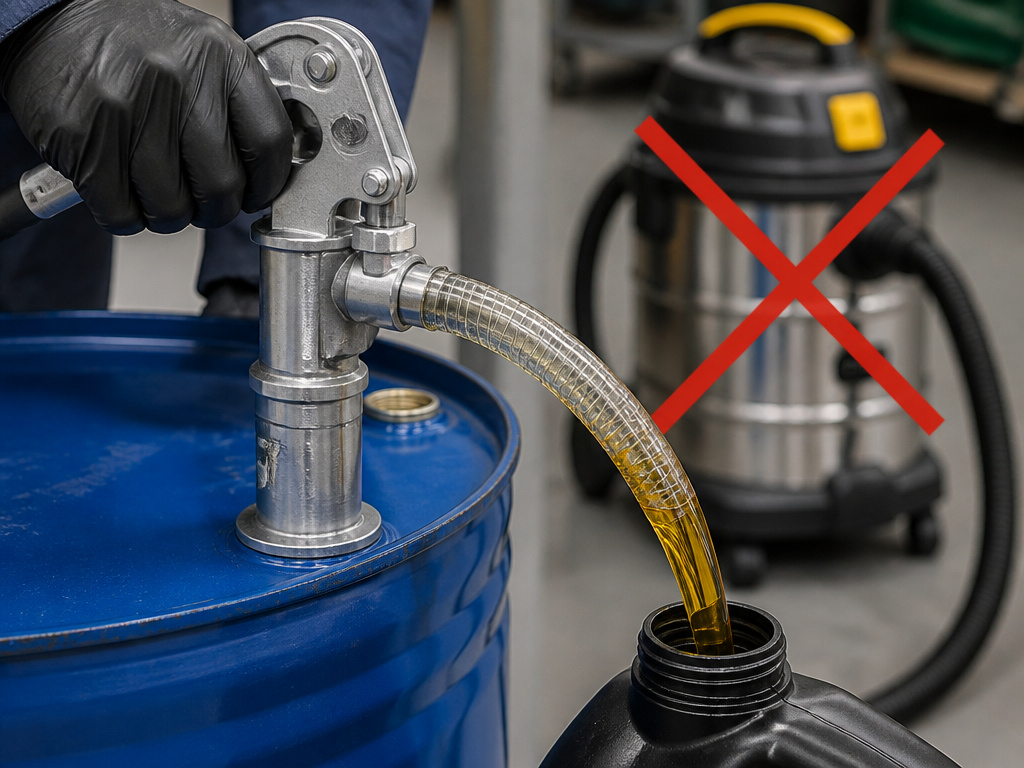 The barrel pump’s world is liquids, chemicals, and viscous materials. It excels where an upright would be dangerous, destructive, or simply useless.
Chemical Transfer and Containment. This is the core task. Pumping 55 gallons of solvent, acid, or lubricant from a drum into smaller containers or a process line. The pump’s wetted materials are chemically inert. The DULCO®Trans 25/700 PP uses PP, Hastelloy C, and ETFE for compatibility. An upright vacuum’s plastics and metals would corrode, and its filter would be destroyed instantly.
Handling Viscous Fluids. Gear pumps and progressive cavity barrel pumps are designed for thick fluids like greases, syrups, or adhesives with viscosities up to 1000 mPa·s and higher. An upright vacuum’s airflow cannot move these materials; they would instantly clog the intake and coat the fan.
Closed-System Safety. Barrel pumps often work with flammable or hazardous liquids. Pneumatic (air-powered) models eliminate explosion risk from electric motors. The system is closed, fluid goes from drum through hose to destination, minimizing exposure and spill risk. An upright vacuum would aerosolize the hazard.
| Scenario | Correct Tool | Why the Other Tool Fails |
|---|---|---|
| Cleaning office carpet | Upright Vacuum | Barrel pump has no brush roll, filtration, or floor tool. |
| Transferring 55 gal of hydraulic oil | Barrel Pump | Oil would destroy a vacuum’s motor, filter, and bag. |
| Cleaning drywall dust post-sanding | Upright Vacuum | Barrel pump clogs on debris, lacks maneuverability. |
| Dispensing food-grade syrup from a drum | Barrel Pump | Viscous fluid would jam a vacuum’s fan instantly. |
| Detail cleaning a car interior | Upright Vacuum | Barrel pump cannot use crevice tools or brushes. |
How to Choose: The Decision Flowchart
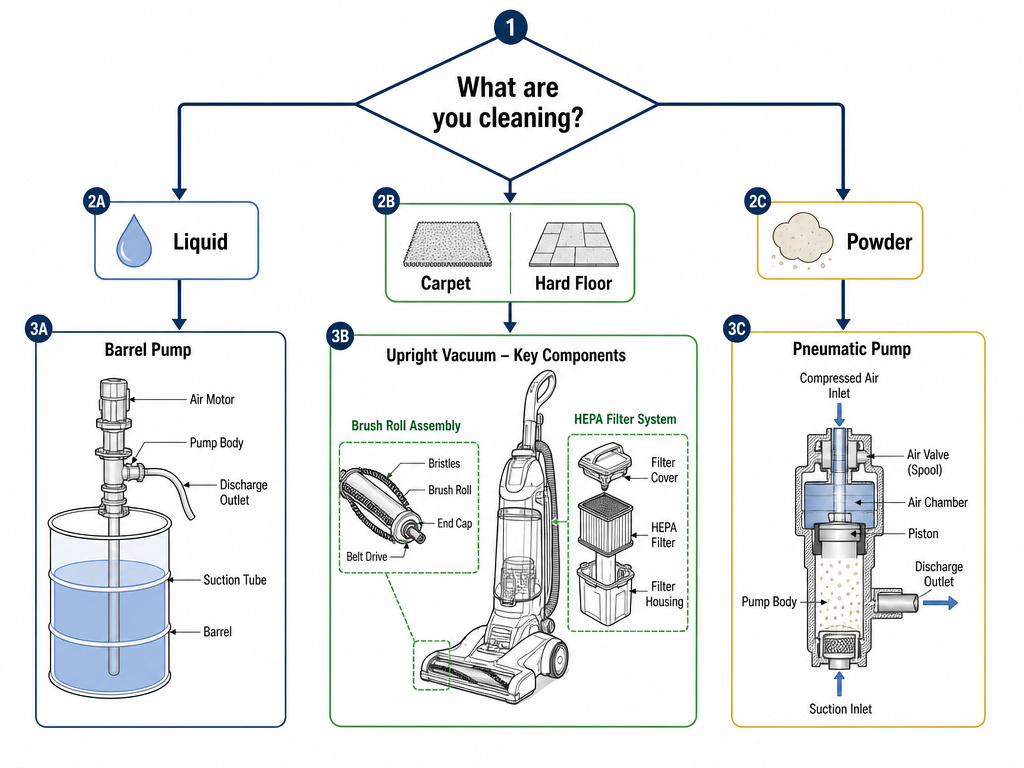 Stop looking at them as alternatives. Start with the material you need to move.
- Is it a liquid, grease, or chemical? → Use a barrel pump. The decision is over. Check the pump’s chemical compatibility chart for the specific fluid.
- Is it dry debris on a floor, carpet, or surface? → Use an upright vacuum. Now decide on the type of upright.
- For deep carpet cleaning, you need a model with a powerful brush roll and adjustable height, like a commercial upright.
- For hard floors and area rugs, a model with a brush roll shut-off or a soft roller head is ideal.
- For allergies, prioritize a sealed HEPA filtration system and bagged models to avoid dust exposure when emptying.
- Is it a dry, fine, non-abrasive powder in bulk? → This is the grey zone.
- If it’s on the floor: Use an industrial upright vacuum with a HEPA filter.
- If it’s inside a barrel/container and volume is huge: Consider a pneumatic diaphragm pump designed for dry materials.
- Never use a standard liquid-transfer barrel pump for dry powders.
This Consumer Reports upright vacuum guide offers robust performance ratings that can help you narrow down specific upright models once you know you need one.
Frequently Asked Questions
Can you use a barrel pump as a wet/dry vacuum?
No. A standard barrel pump is not a vacuum. It moves liquid via positive displacement, not by creating airflow. Submerging its intake in water will pump the water out. But point its intake at a wet floor puddle and nothing happens, it cannot pull liquid across an air gap like a true wet/dry vacuum’s fan system can.
What has more suction, an upright vacuum or a barrel pump?
The question is flawed. “Suction” in an upright is airflow (CFM) and vacuum pressure (water lift). “Suction” in a barrel pump is the negative pressure needed to prime the liquid column. They are different physical phenomena. A barrel pump might prime with 5-10 inches of suction lift. A commercial upright vacuum creates over 90 inches of water lift. By the vacuum’s metric, the upright is infinitely stronger. By the pump’s metric, the comparison is irrelevant.
Can an upright vacuum pump water?
Never. Even if the motor didn’t short-circuit immediately, water would ruin the filter, rust metal parts, and turn dust in the bag into a concrete-like sludge. Upright vacuums are for dry pickup only. For water, you need a dedicated wet/dry shop vacuum with a specialized, sealed motor and no paper filter in the path.
Are barrel pumps only for industrial use?
Primarily, yes. You’ll find them in factories, machine shops, chemical plants, and automotive shops for transferring lubricants, coolants, and solvents. A very small, electric barrel pump might be used in a restaurant to transfer cooking oil or in a farm for certain liquids. There is almost no residential use case.
What is the best upright vacuum for general home use?
For a balance of power, features, and price, a bagless upright vacuum with a brush roll shut-off and a decent hose/attachment set is the default for most homes. Brands like Shark and Kenmore consistently score well in independent tests for pet hair and multi-surface cleaning. Our guide to the best upright vacuum cleaners breaks down specific models by use case.
The Bottom Line
Stop comparing apples to wrenches. An upright vacuum cleans surfaces. A barrel pump transfers liquids. Their three lines of contact are thin and specific to dry industrial powders.
For your home, garage, or office, the answer is almost certainly a versatile upright vacuum. Focus your decision there, bagged versus bagless, corded versus cordless, commercial versus residential grade. For the shop floor where you need to move oil from a drum, that’s when you price out a barrel pump. They are tools from different drawers, each waiting for their own job to come along.