
Can I Vacuum Baby Powder? The Right Way to Clean Fine Dust
This post contains affiliate links. As an Amazon Associate, we earn from qualifying purchases.
You can vacuum baby powder, but only in very small amounts and with a filter bag installed. Most household vacuum manuals explicitly warn against fine dust like plaster, flour, or baby powder because it clogs pores instantly, overheats the motor, and voids warranties. The safe method requires matching your vacuum type to a specific set of rules.
That last clause, about warranties, is what most quick-answer articles skip. A Miele manual states fine dust will block a filter bag’s pores so completely that the bag-change indicator lights up prematurely, and continuing to run the vacuum trips a temperature limiter. An Electrolux manual says the same thing and adds a mandatory 30-minute cooldown. This isn’t a maybe. It’s a documented, mechanical failure sequence printed by the companies that would have to fix your machine.
What follows is a breakdown of those OEM warnings, the two vacuum types that can handle a light spill, and the five-step cleanup that swaps a ruined motor for a five-minute job.
Key Takeaways
- Fine dust clogs pores, not bags. Baby powder particles are smaller than the pores in a standard filter bag or HEPA filter. They seal the material shut, choking airflow and forcing the motor to overheat within minutes.
- The temperature limiter is your last warning. Vacuums like the Miele SFxxx_US_08012021 have an automatic shutoff that triggers when fine dust blocks airflow. Once it trips, you must wait 20–30 minutes for the motor to cool before restarting.
- Bagged vacuums are the only safe choice. A Kärcher 59510410 manual explicitly recommends a filter bag for fine dust. Bagless vacuums, especially cyclonic ones, let powder coat the internal cyclones and clutch the motor directly.
- “Small amounts” means a light dusting. OEM manuals use this phrase for a reason. Vacuuming a full spilled container is a guaranteed service call.
- Warranties exclude fine-dust damage. Both Miele and Electrolux state that misuse, including vacuuming fine dust against manual instructions, voids coverage for motor repairs.
The Real Risk Isn’t the Powder. It’s the Motor
Baby powder talc or cornstarch averages 10-50 microns in particle size. A household vacuum filter bag pore is about 100 microns. The powder doesn’t fill the bag. It passes through the pores and either coats the inside of the bag, creating a sealed, non-breathable layer, or it blows straight through to the motor protection filter.
A Miele SFxxx_US_08012021 operating manual states: “If fine dust, such as drilling dust, sand, plaster dust, or flour is vacuumed, the FilterBag pores block quickly… The FilterBag must be replaced in this case.” It further notes that a temperature limiter will switch off the vacuum if it overheats due to a blocked bag, requiring a 20–30 minute cooldown.
The physics are simple. A vacuum motor cools itself by pulling air through the system. Block that airflow, and the heat has nowhere to go. The windings inside the motor can hit temperatures that soften solder joints or warp plastic impellers. That’s why manuals treat fine dust as a misuse case, it attacks the machine at its most vulnerable point.
Bagless vacuums are worse for this job. The powder bypasses the primary cyclone, it’s too fine to be thrown to the bin walls, and coats the secondary filter, the pre-motor filter, and the exhaust HEPA. You’ll see the powder cloud blow right out the exhaust on many models. For a deep clean that tackles all dust types, a dedicated dusting vacuums is engineered with sealed filtration to prevent this.
Common mistake: Running the vacuum after the suction drops. When baby powder clogs the filter, the motor sound often gets higher-pitched as it strains against the blockage. That’s the sound of the temperature limiter about to trip. Turn it off immediately.
What Your Vacuum Manual Actually Says (And Why It Matters)
Manufacturer instructions are the criteria a service technician will use to determine if your motor repair is covered. Ignoring them turns a simple cleanup into an expensive lesson.
| Brand & Model | Direct Instruction on Fine Dust | Consequence Cited |
|---|---|---|
| Miele SFxxx_US_08012021 | “Fine dust… Will block pores quickly.” | FilterBag indicator shows “full” prematurely; temperature limiter trip. |
| Kärcher 59510410 | “We recommend using a filter bag to vacuum fine dust.” | Device damage if operated without required flat pleated filter. |
| Electrolux E4RM3Q | “Never use vacuum cleaner on fine dust, for instance plaster, concrete, flour.” | Overheating, motor damage not covered by warranty. |
| Dyson DC07 | “Fine dust such as plaster dust or… Flour should only be vacuumed… In small amounts.” | Implied risk of overload; specific consequence not detailed in sourced excerpt. |
The language is consistently cautious. Kärcher ties the advice directly to a physical part: the flat pleated filter. Their manual warns of “Device damage” if that filter is missing, which is likely because fine dust would then enter the motor chamber unimpeded. This level of specificity is what separates a real manual from generic web advice.
If your goal is a thorough refresh beyond spot cleaning, you’d look at deep cleaning vacuums built for sustained operation under load. They have larger filter areas and more thermal headroom, but even they have limits with powder.
Where this goes sideways: Assuming “small amounts” means a half-cup spill. In manual-speak, “small amounts” means a light sprinkling on a hard floor, the kind you’d wipe with a damp cloth. A volume bigger than a tablespoon overwhelms the system before you can lift your foot off the pedal.
Bagged vs. Bagless: The Only Safe Choice for Fine Dust
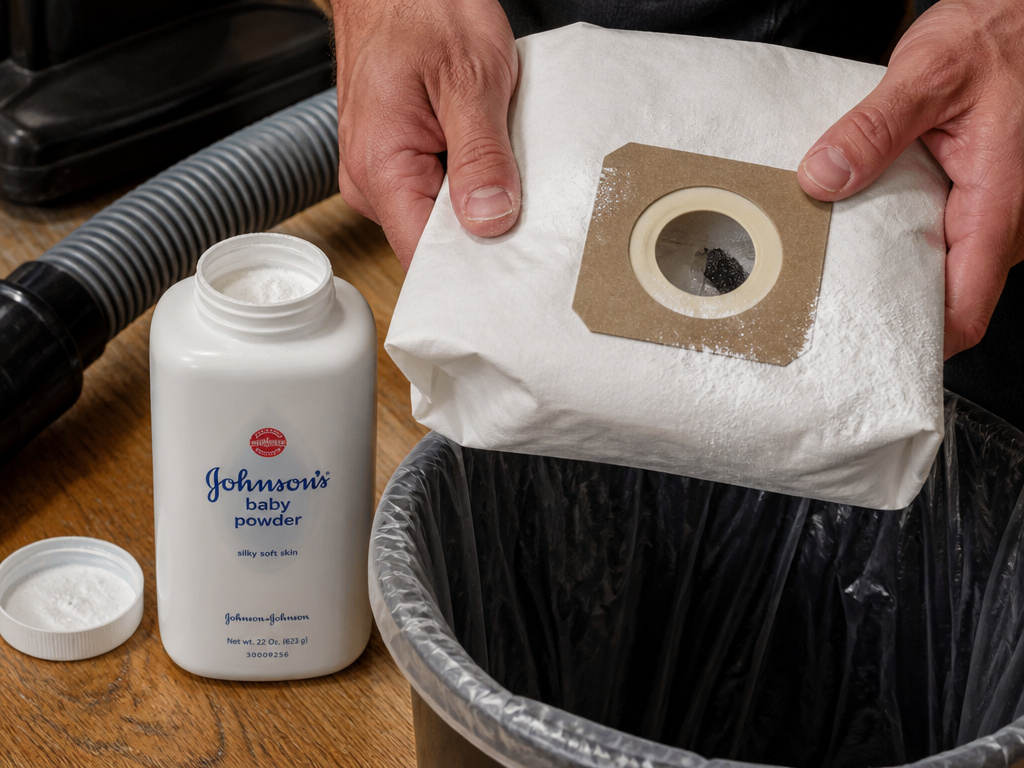
For baby powder, the type of vacuum you use is a determinant of success or failure. The rule is absolute: use a bagged vacuum if you have one.
Bagged Vacuums (The Safer Option)
A filter bag is a consumable, multi-layer barrier. The outer layer catches large debris; the inner micro-filter layer is designed to trap finer particles. While baby powder can still clog the micro-filter pores, the bag contains the disaster. When you’re done, you seal and discard the entire contaminated assembly. The motor and internal airways never see the powder. – Best for: Isolated, small-scale fine dust cleanup. – The catch: You must replace the bag immediately after. A bag used for baby powder is spent, even if it looks empty. – Product example: Miele Classic C1 Pure Suction. It’s a dedicated bagged canister that takes the guesswork out of filtration.
Bagless Vacuums (High Risk)
Bagless vacuums rely on cyclonic action and foam or felt pre-motor filters. Fine powder laughs at cyclones. It passes through, forming a dense cake on the pre-motor filter. This cake is the blockage that leads to overheating. Cleaning it is a messy, airborne hazard. – Worst for: Fine dust of any quantity. – The reality: If you must use a bagless vacuum, the pre-motor filter requires cleaning after every single use. Not later. Immediately. – This is why versatile vacuums for carpets and hard floors often include a dedicated hard floor setting that reduces suction, minimizing the kick-up of fine debris.
If your home has a mix of surfaces and you’re considering an upgrade, a vacuum for wood and carpet that offers a sealed allergen system is a better investment than a basic bagless upright for this specific hazard.
Before You Vacuum Baby Powder: The Pre-Flight Checklist
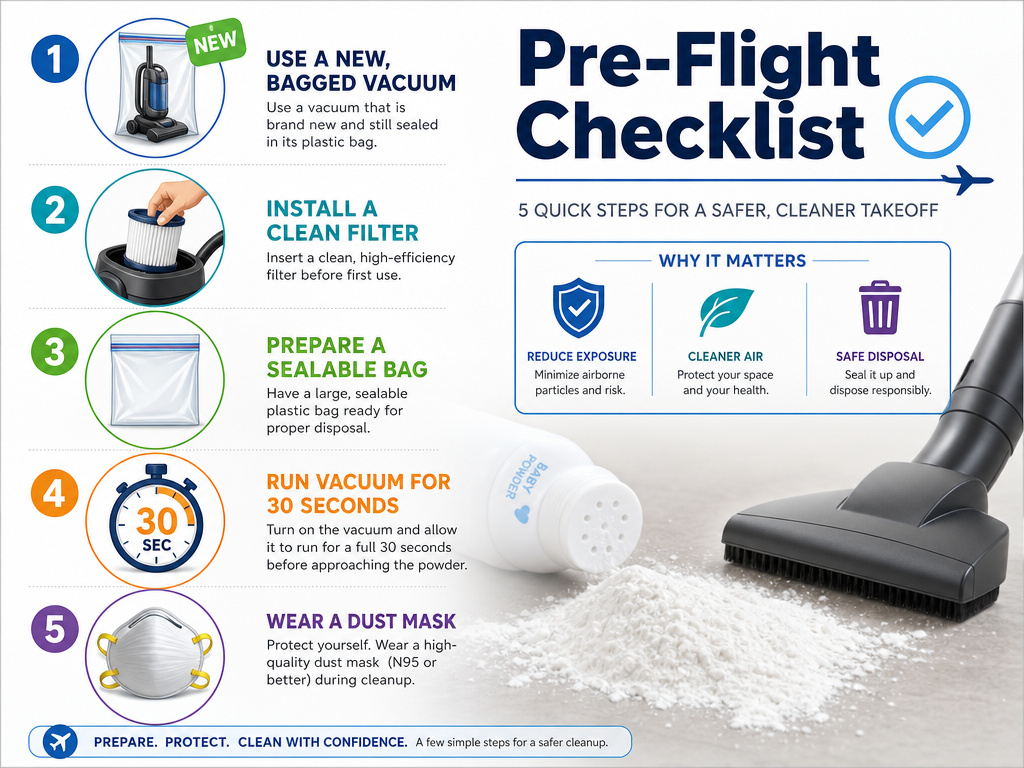
Do not plug in the vacuum yet. Run through this list first. Missing one step is how you end up with a machine that smells like hot electronics and has no suction.
- Identify your vacuum type. Is it bagged or bagless? Check the manual or the product model online. If bagless, consider an alternative cleanup method (damp cloth, dustpan, and brush).
- Install a new filter bag. If you have a bagged model, put in a fresh bag. Do not use a bag that’s already partly full. The Kärcher 59510410 manual is explicit: “The filter bag should be replaced more often in the case of fine dust.”
- Check all seals and filters. Ensure the pre-motor and exhaust filters are clean and properly seated. A missing or damaged seal lets powder into the motor. This is the “ATTENTION Missing flat pleated filter Device damage” warning from Kärcher.
- Plan for immediate disposal. Have a plastic bag ready next to the vacuum. The moment you’re done, you will need to remove and seal the dust bag or empty the bin outside.
- Set a time limit. Do not vacuum for more than 30 seconds continuously on the spill. Work in bursts. Listen for a change in motor pitch.
Before you start: Baby powder is a respiratory irritant when airborne. Wear a dust mask. Ensure the room is well-ventilated. Keep children and pets out of the area until the air clears.
After cleaning, the work isn’t over. For a bagged vacuum, remove and seal the bag immediately. For a bagless model, take the bin and filters outside. Dump the powder, then use a soft brush and running water to clean every filter. Let them dry completely before reassembly, a damp filter is a worse airflow block than a dusty one.
What If You Don’t Have a Bagged Vacuum? Your Alternatives
Sometimes the right tool for the job isn’t a vacuum at all. If you only own a bagless model or a stick vacuum with weak filtration, these methods are safer for your machine and your lungs.
The Damp Cloth Method
Lightly mist a microfiber cloth with water. Wipe the powdered area gently. The powder clumps and adheres to the cloth. Rinse the cloth frequently. This is the most effective method for small spills on hard floors, and it’s what many vacuums for hard floors are designed to complement, not replace.
The Dustpan and Brush Technique
Use a soft-bristled brush to gently sweep the powder into a dustpan. Do not vigorously sweep, as that creates a cloud. This is a slow, controlled method best for limited spills.
Employ a Wet/Dry Vacuum
A shop-style wet/dry vacuum is built for concrete dust and drywall debris. It has a large-volume tank and a simple foam filter that’s easy to clean. Even here, use it briefly and clean the filter immediately after. Some modern hybrids blur this line, like wet dry vacuum mops designed for mixed messes, but their filters are often still small and require vigilance.
When to call it: If an entire large container of powder has spilled, creating a pile more than an inch deep, do not use a household vacuum. The volume is too great. Use a dustpan for bulk removal, then a damp mop for the residue. For large-scale liquid and powder messes, a dedicated wet dry vacuum mops might be rated for it, but check its manual for “fine dust” limits first.
The One Time a Robot Vacuum Makes Sense
It sounds counterintuitive, but a robot vacuum can be a decent option for a light, even dusting of powder over a hard floor. Why? Their suction is generally low, and they move slowly. They don’t generate the same intense airflow that can force powder deep into filter pores on a full-power upright.
The key is maintenance. You must be prepared to completely dismantle and clean the robot’s bin, filter, and brushes immediately after the job. The powder will get everywhere inside it. – Best scenario: A barely-there film on tile or laminate. – Worst scenario: Any pile of powder, or carpeted area. The robot will grind it into the carpet fibers and its own brush roll. – Product example: A Roborock Q5+ with an auto-empty dock. The dock’s bag might contain the powder, but you’d still need to clean the robot’s internal filter meticulously.
For general automated cleanup of fine dust, a home robot vacuums with a high-efficiency filter is designed for daily pet hair and dust, not catastrophic spills. It’s a convenience tool, not a rescue tool.
Frequently Asked Questions
Can vacuuming baby powder ruin my vacuum?
Yes, absolutely. Fine powder clogs filter pores, blocking airflow and causing the motor to overheat. This can trip thermal protection, and repeated overheating can damage motor windings, leading to costly repairs not covered by warranty.
Is it safer to use a shop vac for baby powder?
Generally, yes. Shop vacuums (wet/dry vacuums) are built for construction debris like drywall dust. They have larger filters and more robust motors. However, you should still use a filter bag if available and clean the filter immediately after to prevent the same clogging issue on a larger scale.
How do I clean my vacuum after accidentally vacuuming baby powder?
First, unplug it. For a bagged vacuum, remove and seal the bag outdoors. Wipe the interior with a damp cloth. For a bagless vacuum, take the bin and filters outside. Empty them, then use a soft brush and water to clean every filter and the cyclone channels. Let all parts dry completely before reassembling.
Will baby powder damage a Dyson vacuum?
Dyson manuals, like the DC07 guide, caution vacuuming fine dust only “in small amounts.” Their cyclonic systems are highly effective for normal dust but are vulnerable to fine powders coating the internal cyclones and filters. The risk of clogging and overheating is significant, especially with bagless Dyson models.
Can I use my vacuum’s hose attachment without the floor brush?
Yes, and you should. Using the bare hose or a narrow crevice tool reduces the amount of powder ingested at once, giving the filtration system a better chance. It also lets you target the spill more precisely, avoiding stirring up a larger cloud.
Before You Go
Vacuuming baby powder is a calculated risk, not a standard chore. The manuals from Miele, Kärcher, and Electrolux are documenting a precise failure mode. Fine dust blocks pores.Blocked pores choke motors. Choked motors overheat and die.
The safe path is narrow: a bagged vacuum, a brand-new filter bag, and a “small amount” defined as a light sprinkle. For anything more, put the vacuum away. Reach for a damp cloth, a soft brush, and a dustpan. Your machine’s warranty, and its next five years of service, depend on that distinction.