
Canister Vacuum vs Bag: Which System Best Captures Allergens?
This post contains affiliate links. As an Amazon Associate, we earn from qualifying purchases.
Choosing between a canister vacuum with a bag or a bagless model comes down to three measurable things: filtration level (HEPA 13 or 14), operating noise (49 to 64 dB(A)), and long-term allergen containment. Bagged systems seal dust permanently and are the default for allergies; bagless models trade ongoing filter maintenance for no bag costs.
That filtration number isn’t marketing. It’s the physical barrier between the dust in your bin and the air in your lungs. A true HEPA 14 filter, like the one in the Kärcher T 11/1 Classic HEPA, captures 99.995% of particles down to 0.3 microns — viruses and aerosols included. A bagless vacuum with a good HEPA filter can match that capture rate on day one, but its reusable bin becomes a contamination source every time you empty it.
What follows: a breakdown of where each system actually wins, grounded in OEM spec sheets and lab data. You’ll get the decibel levels that let you clean during a work call, the motor wattage that predicts your electric bill, and the one physical failure that sidelines most budget bagless units within three years.
Key Takeaways
- Bagged canisters are the only choice for severe allergy sufferers because the bag is a primary filter and seals dust upon disposal, preventing re-exposure.
- For quiet daytime cleaning, target models under 60 dB(A), like the PPR 390 at 49 dB(A) or the Kärcher T 11/1 at 64 dB(A) — most uprights and cheaper bagless units run above 75 dB(A).
- The “powerful suction” claim is meaningless without airflow (CFM) and waterlift (kPa) numbers; a 680-watt motor with good design (like the PPR 390) can outperform a 1200-watt motor with poor airflow.
- Bagless models save on bag costs but require disciplined filter washing every 1-2 months; neglecting this clogs the cyclone, drops suction by over 40%, and can burn out the motor.
- Commercial-grade canisters (Tennant, Nilfisk) use structural foam housings and motors rated for 2,250+ hours; most residential motors are rated for under 1,000 hours.
How Filtration Works: The Physics of Clean Air
The core job is moving air and trapping dirt. Suction power pulls debris in, but the filter decides what gets blown back out. This is where spec sheets stop being boring.
A HEPA filter is a dense mat of glass fibers that creates a labyrinth for air particles. To be classified HEPA in the US, it must capture 99.97% of particles at 0.3 microns. That’s the most penetrating particle size — smaller and larger particles are actually easier to catch. The European standard (EN 1822) is stricter, with HEPA 13 at 99.95% and HEPA 14 at 99.995%. The Kärcher T 11/1 Classic HEPA uses a HEPA 14 filter certified to DIN EN 1822:2019.
A sealed HEPA 14 filter system traps particles down to 0.3 microns with 99.995% efficiency, including viruses and aerosols. This level of filtration is required in hygienically sensitive environments like hospitals and is certified to the rigorous DIN EN 1822:2019 standard.
In a bagged system, the bag itself is the first-stage filter. High-quality bags are made of felted material that captures fine dust while maintaining airflow. The motor’s exhaust air then passes through the final HEPA filter. When you dispose of the bag, the dust is sealed inside. In a bagless system, dust collects in a plastic bin. A cyclone uses centrifugal force to separate heavier debris, but the finest, most allergenic dust passes through to the main filter. Every time you empty that bin, a cloud of that dust becomes airborne.
The Bagged vs. Bagless Canister Showdown
This isn’t about good versus bad. It’s about matching a system’s inherent trade-offs to the problems you actually have in your home.
For allergy control, the evidence is straightforward. In its 2026 best canister vacuum review, Consumer Reports states that bagged vacuums are more likely to reduce your exposure to allergens. The sealed disposal is the reason. If anyone in your home has asthma, reactive airways, or dust mite allergies, start your search with a bagged canister vacuum. Models like the Bosch Series 4 BGL38BA3AU come with a washable HEPA 13 hygienic filter and are marked as suitable for allergy sufferers.
For everyone else, the decision hinges on maintenance tolerance and upfront cost.
| Decision Factor | Bagged Canister | Bagless Canister |
|---|---|---|
| Allergen Containment | Superior. Dust is sealed in bag upon disposal. | High risk during emptying. Fine dust becomes airborne. |
| Long-Term Cost | Higher. Requires buying replacement bags. | Lower. No bags to buy, but filters need replacement every 1-2 years. |
| Routine Maintenance | Simple. Swap bag every 1-3 months. | Involved. Empty bin every use, wash pre-motor filter monthly. |
| Suction Consistency | Excellent. Designed to maintain airflow as bag fills. | Can degrade. Clogged cyclones or full bins rapidly kill suction. |
| Best For | Allergy homes, large spaces, low-maintenance users. | Eco-conscious users, small spaces, those who monitor maintenance closely. |
Where this goes sideways: Neglecting the pre-motor filter wash on a bagless model. The cyclone clogs with fine dust, airflow plummets, and the motor overheats trying to pull air. You’ll hear a higher-pitched whine and feel almost no suction at the nozzle within three months of skipped cleaning.
Bagless advocates point to environmental savings from no bags. That’s valid. But consider the full footprint: a bagless vacuum with a burnt-out motor after five years versus a bagged model with a 10-year motor warranty. The bagless vs bagged debate often misses motor longevity.
When a Bagless Canister Makes Sense
Choose a bagless model if you vacuum small spaces frequently and don’t mind a monthly cleaning ritual. The Kenmore 22614 is a top performer in Consumer Reports’ tests for bare floors and pet hair. You must be the type of person who will: 1. Empty the dust bin after every use, outdoors or into a sealed bag. 2. Rinse the foam pre-motor filter with water every 3-4 weeks and let it dry completely for 24 hours before reinstalling. 3. Check the main HEPA filter for clogs every 6 months.
Fail that routine, and you’ll be shopping for a new vacuum sooner than you planned.
Decoding the Specs That Actually Matter
Ignore the big “Peak Horsepower” or “Max Watts” on the box. Focus on these three numbers, which are often buried in the manual or product spec sheet.
Airflow (CFM or l/s): This is the volume of air moving through the vacuum. More airflow means better debris pickup across a wider path. The Tennant V6 moves 85 CFM. The Nilfisk VP300 series moves 32 liters per second (about 68 CFM). Higher is better for deep carpet cleaning.
Waterlift (kPa or inches): This measures the vacuum’s maximum suction strength, its ability to pull air against a seal. It’s critical for pulling dirt from deep within carpets. The Kärcher T 11/1 has a waterlift of 2325 mm (about 91 inches). Many residential canisters list suction power in “air watts,” which combines airflow and waterlift — aim for 200+ air watts for decent carpet performance.
Sound Pressure Level (dB(A)): This is how loud the vacuum is from one meter away. This number dictates whether you can clean while someone is on a call or watching TV. The PPR 390 operates at a whisper-quiet 49 dB(A). The Philips FC8293/01 runs at 81 dB(A). For daytime cleaning, look for models under 65 dB(A).
| Model | Airflow | Waterlift / Suction | Noise Level | Best Fit Scenario |
|---|---|---|---|---|
| PPR 390 | Not Specified | 84% soil recovery | 49 dB(A) | Daytime office cleaning, noise-sensitive environments. |
| Kärcher T 11/1 | 89 CFM | 228 mbar / 2325 mm | 64 dB(A) | Hospitals, allergy homes, needs HEPA 14 certification. |
| Tennant V6 | 85 CFM | Not Specified | 59.7 dB(A) | Commercial spaces (schools, hotels), long daily runtimes. |
| Philips Performer Active | Not Specified | 99.9% dust pick-up* | Not Specified | Hard floors with crevices, proven bare-floor performance. |
*Per IEC62885-2 standard for hard floors.
The Commercial-Grade Advantage for Home Use
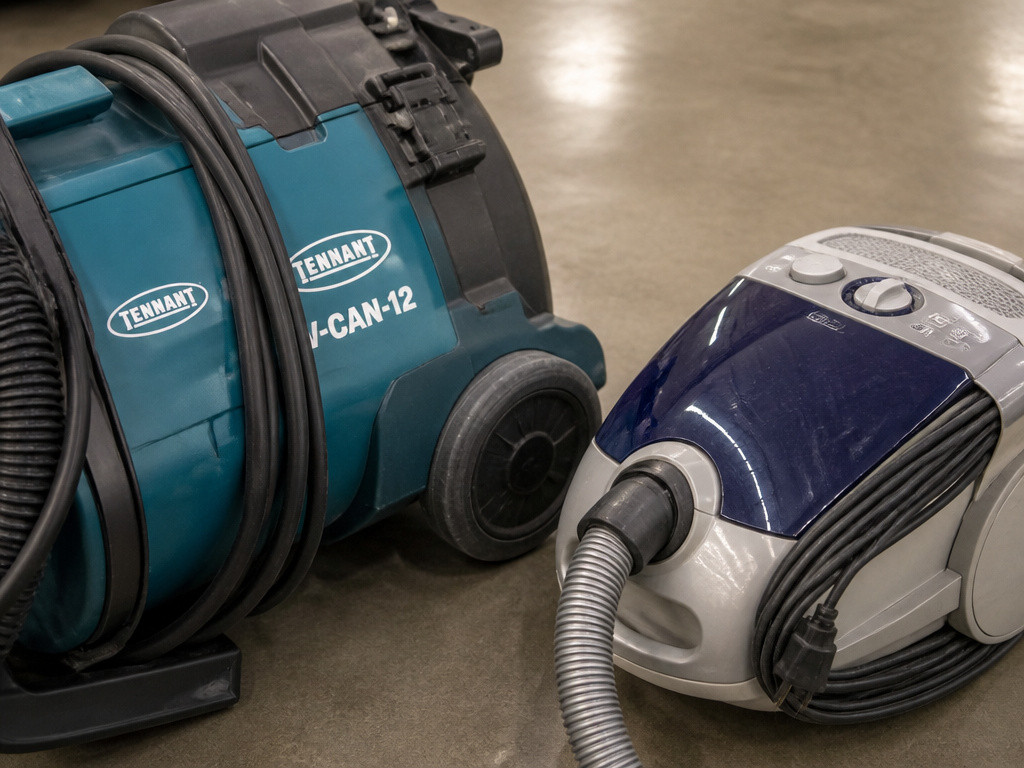 Residential vacuums are built for 1-2 hours of use per week. Commercial canisters are engineered for 1-2 hours of use per day, every day. This difference shows up in three places.
First, motor life. The PPR 390 motor is rated for 2,250+ hours. A typical home vacuum motor might be rated for 500-1,000 hours. That’s the difference between a vacuum that lasts a decade and one that needs a replacement in five years.
Second, construction. Commercial units like the Tennant V-CAN-12 use structural foam or reinforced plastic that can survive being knocked down a flight of stairs. The housing on a cheap plastic canister will crack the first time it tips over hard.
Third, cord and hose. A 49-foot cord on the Tennant V6 or a 40-foot cord on the Kärcher T 12/1 means you can clean an entire floor of a large home from a single outlet. Most home models have 20-30 foot cords, forcing multiple plug changes.
The part nobody mentions: The thermal overload protector. Commercial units have them to save the motor if a bag is overfull or a hose is clogged. Cheaper home models often lack this fuse. When they clog, the motor just burns out — and that’s the end of the vacuum.
The trade-off is weight and price. A Bosch Series 2 bagged vacuum weighs 3 kg (cylinder only). The Tennant V6 weighs 7.6 kg. You’re paying for durability and getting a heavier machine. For a large home where the vacuum sees daily use, that trade is worth it. For a small apartment, it’s overkill.
Matching the Canister to Your Floors and Pets
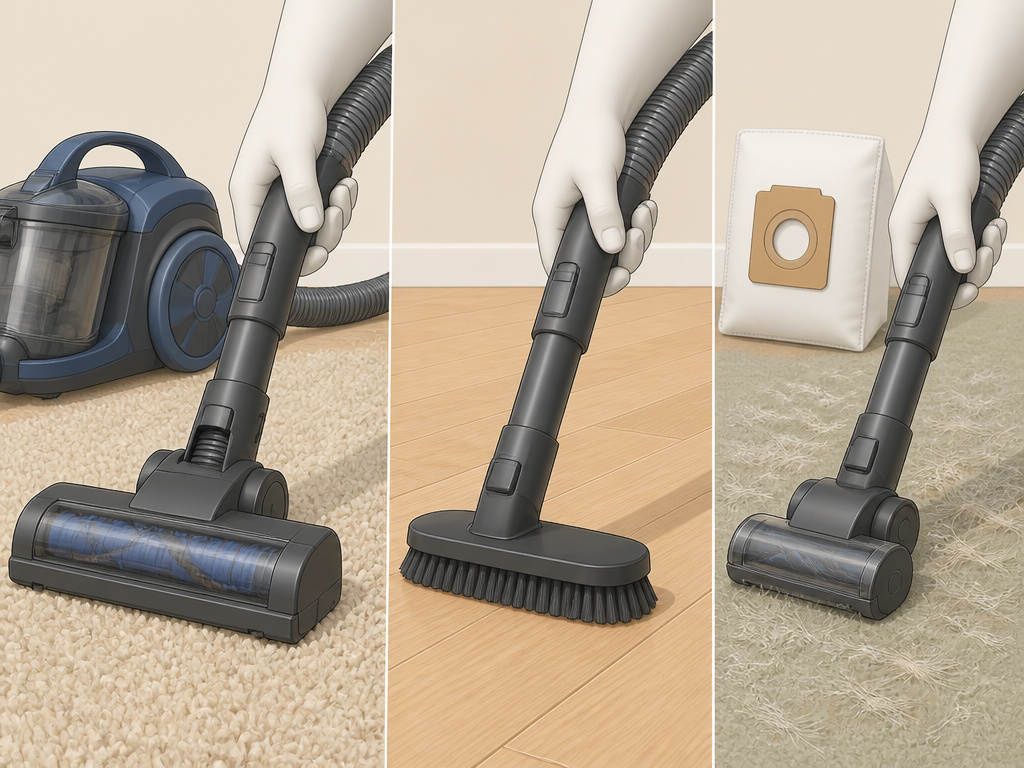 Your flooring type changes the required tool, not necessarily the vacuum itself. The best canister vacuum with powerhead is essential for carpeted homes.
- Carpet (Medium to High Pile): You need a motorized powerhead. The brush roll agitates the fibers to pull out embedded dirt and pet hair. No amount of suction from a bare floor tool will do this job well. Look for models that include a powerhead or offer one as an accessory.
- Hard Floors (Hardwood, Tile, Laminate): A soft bristle brush or a dedicated hard floor nozzle is key. The Bosch BGLS482200 includes a hard floor nozzle designed for crevices in tile and for gentle cleaning on sensitive surfaces like parquet. The brush should seal against the floor to create suction.
- Mixed Flooring: This is the most common home. The solution is a canister that allows you to easily switch tools. A combination floor tool that has a brush roll you can turn on for carpets and off for hard floors is the most convenient. The Philips models with their multi-purpose nozzles are built for this.
For pet hair, the tool is again more critical than the bag type. A turbo brush uses suction-driven rotation to pull hair from upholstery and low-pile carpet. The turbo brush on the Bosch BGLS482200 is marketed for removing fibers and pet hair. For a dedicated solution, see our guide on the best bagged vacuum for pet hair. Whether you choose a bagged or bagless canister, a powered brush roll or a turbo brush accessory is non-negotiable for pet owners.
Frequently Asked Questions
Is a bagged vacuum better for allergies?
Yes, unequivocally. A bagged vacuum provides two-stage containment: the bag captures and seals the majority of dust and allergens, and the exhaust HEPA filter cleans the air leaving the machine. When you dispose of the full bag, the allergens are sealed inside. With a bagless vacuum, you release a cloud of fine dust every time you empty the bin, even if you do it outside.
How often do you change a vacuum bag?
Change the bag when it is between 2/3 and 3/4 full. Do not wait until it’s packed solid. A overfull bag restricts airflow, causing the motor to overheat and drastically reducing cleaning performance. For an average home, this translates to every 1 to 3 months. Some models, like many Bosch canisters, have a bag-full indicator.
Are bagless vacuums cheaper in the long run?
They can be, but only if you maintain them perfectly. You save the ongoing cost of bags (typically $20-$50 per year). However, bagless vacuums require more frequent filter washing and eventual HEPA filter replacements ($30-$60 every 1-2 years). If you neglect the filter maintenance, a bagless vacuum will lose suction and may suffer motor damage long before a well-maintained bagged model fails.
What is the quietest type of canister vacuum?
Commercial-grade bagged canisters are often the quietest due to better motor engineering and sound-dampening housing. The PPR 390 operates at 49 dB(A), and the Tennant V6 at 59.7 dB(A). For comparison, many standard upright vacuums operate between 75-85 dB(A). If quiet operation is a priority, look for a decibel rating in the product’s technical specifications.
Can a canister vacuum clean stairs effectively?
Yes, this is one of a canister’s biggest strengths. You only need to carry the lightweight hose and wand upstairs, not the heavy canister body. Place the canister at the bottom of the stairs, and use the hose and a stair tool. This is far easier and safer than maneuvering a heavy upright vacuum on stairs.
Before You Go
The canister vacuum vs bag question resolves when you name your top priority. If it’s allergen control and low maintenance, a bagged model like the Bosch Series 4 or a commercial unit like the Kärcher T 11/1 is the only path. If it’s upfront cost and environmental waste, and you commit to a strict cleaning schedule, a high-performance bagless canister vacuum like the Kenmore 22614 can work.
For most homes with mixed flooring, a bagged canister vacuum with a HEPA filter and optional powerhead provides the best balance of clean air, consistent performance, and durability. Check the Consumer Reports specific model evaluation for the Eureka Mighty Mite 3670G to see how a budget bagged model performs on the metrics that matter. Your choice determines what stays in the bin and what ends up back in the air you breathe.