
Can I Vacuum Instead of Sweep? | The Surprising Trade-Off
This post contains affiliate links. As an Amazon Associate, we earn from qualifying purchases.
You can vacuum instead of sweep on hard floors like sealed hardwood, tile, laminate, and vinyl, provided you use a vacuum with a hard-floor setting, a soft roller, or a brushroll shutoff. The trade-off is suction versus agitation. A vacuum lifts fine dust and allergens a broom kicks into the air, but it can scatter heavier debris like sand or cereal unless the machine has a sealed, high-airflow system.
That gap between lifting dust and scattering debris is where the whole decision lives. A broom pushes everything in front of it. A vacuum pulls air from behind a sealed nozzle. The physics are different, and they fail on opposite problems.
What follows: the specific floor types where vacuuming wins, the three vacuum features that make it possible, the exact debris types that break the system, and the maintenance schedule that keeps a hard-floor vacuum from becoming a liability.
Key Takeaways
- Vacuuming beats sweeping for fine dust and allergens on hard floors because it captures particles instead of redistributing them into the air you breathe.
- Use a vacuum with a soft roller brush or brushroll shutoff for bare floors; a standard rotating beater bar will scatter debris and can scratch surfaces over time.
- Coarse, heavy debris like sand, kitty litter, or broken glass will scatter under a vacuum nozzle unless the machine has exceptional sealed suction, like a high-end canister.
- Never vacuum wet spills or standing liquid with a standard home vacuum, this can short the motor, ruin filters, and instantly void the warranty on most units.
- For a quick daily clean, a cordless stick vacuum like the LG CordZero A9 is ideal; for deep, whole-house cleaning, a powerful canister like the Sebo Sensor 2 provides the necessary sealed airflow.
The Physics of Vacuuming vs. Sweeping
A broom cleans through mechanical agitation. You push bristles against the floor, which loosens and gathers debris into a pile. The problem is airborne particulate. Every stroke launches dust, dander, and pollen into a cloud that settles elsewhere in the room, often on other surfaces.
A vacuum cleaner works on Bernoulli’s principle. A motor creates a pressure drop inside the machine, and atmospheric pressure pushes air, and the debris suspended in it, through the nozzle toward the low-pressure area. The goal is containment. A good seal at the floor and a clear air path to the collection bin are what separate a clean floor from a mess of scattered cereal.
The part nobody mentions: The suction rating on a vacuum’s box (measured in air watts or inches of water lift) matters less for hard floors than the machine’s airflow (measured in CFM, cubic feet per minute). High airflow carries heavier debris into the bin before it can bounce away. A canister vacuum like the Sebo Sensor 2 moves 106 CFM, which is why it can pick up a pile of sand in one pass where a low-airflow stick vacuum might just blow it around.
This is why the vacuum vs broom debate isn’t about which tool is universally better. It’s about which tool controls the specific debris on your specific floor. Sweeping is a brute-force gatherer. Vacuuming is a precision capture system that fails if the seal or airflow is weak.
Why Suction Alone Isn’t Enough
You can have immense suction power but still scatter debris. If the vacuum’s nozzle doesn’t sit flat, air rushes in from the sides, creating vortices that blow lightweight debris like flour or pet hair out from under the tool. This is the number one complaint with bulky upright vacuums on hard floors, their design prioritizes carpet penetration, not a perimeter seal.
The fix is a dedicated hard-floor tool. These attachments are wide, flat, and often have soft microfiber strips or static-cling brushes around the edge to create that critical seal. They contain the debris cloud so the suction can do its job.
| Debris Type | Best Tool (Broom vs. Vacuum) | Why It Wins | Common Failure if Wrong Tool Used |
|---|---|---|---|
| Fine Dust & Allergens | Vacuum with HEPA filter | Captures particles; prevents airborne redistribution. | Broom kicks dust cloud into air; settles on surfaces within 30 minutes. |
| Pet Hair | Vacuum with powered brushroll | Tangles and lifts hair from floor grooves. | Broom pushes hair into clumps but leaves strands behind. |
| Sand / Kitty Litter | Stiff broom (for large piles), then vacuum | Broom gathers heavy grains; vacuum gets final dust. | Vacuum nozzle scatters grains; they act like tiny ball bearings. |
| Cereal / Cracker Crumbs | Vacuum with high airflow | Carries pieces into bin before they bounce. | Low-airflow vacuum blows crumbs; broom crushes them into smaller pieces. |
| Coarse Dirt / Grass Clippings | Broom | Effective gathering of large, wet, or clumpy material. | Clogs vacuum hose or brushroll; reduces suction immediately. |
For most daily cleaning, the goal is dust and allergen removal. That makes a vacuum the better choice for health and air quality. The broom is for the preliminary heavy lift.
When You Absolutely Should Vacuum Instead of Sweep
The decision tilts hard toward the vacuum in three specific scenarios. Each one hinges on the vacuum’s ability to solve a problem a broom physically cannot.
First, allergen control. If anyone in your home has dust allergies or asthma, sweeping is the enemy. A HEPA-filtered vacuum traps particles as small as 0.3 microns. A broom just puts them back into your breathing zone. The IEC vacuum cleaner safety standard (IEC 60335-2-2:2026) defines test methods for containment, but the practical result is simple: a sealed vacuum system keeps allergens in the bag or bin.
Second, daily maintenance on hard floors. Sealed hardwood, laminate, LVT, these surfaces show every speck of dust and every pet hair. A quick daily pass with a cordless stick vacuum is faster than getting out a broom and dustpan. It’s also more thorough for the fine stuff. Models like the LG CordZero A9 have a hard-floor roller that uses soft, fluffy material to agitate and suction dust without scratching.
Third, homes with pets. Pet hair weaves itself into floorboard grooves and sticks to baseboards. A broom can gather some of it, but a vacuum with a motorized mini-tool is the only thing that truly extracts it. The agitation from the spinning brush loosens the hair, and the suction pulls it up and away. You’ll see the difference in the bin after the first use.
Where this goes sideways: Using a vacuum with a standard carpet beater bar on hard floors. The rotating bristles act like a paddle, flicking debris away from the suction path. You’ll hear the machine working, but you’ll be left with a halo of scattered crumbs around the cleaning path. Always switch to the hard-floor setting or a dedicated attachment.
This is the core of modern hardwood floor vacuuming. The right tool doesn’t just clean; it protects the floor’s finish while it works.
The 3 Vacuum Features That Make It Possible
Not every vacuum is built for hard floors. The machines that succeed have one or more of these three design elements. Missing them is why people go back to the broom.
1. A Soft Roller Brush or Brushroll Shutoff
This is non-negotiable. A soft roller (often called an “anti-tangle” or “fluffy” roller) is made of microfiber or foam. It polishes the floor as it picks up dust. A brushroll shutoff disengages the spinning bristles on carpets, turning the nozzle into a passive suction tool. Most cordless stick vacuums and all canister vacuums have this feature. If your vacuum doesn’t, you are sweeping with extra steps.
2. A Sealed Suction Path & High Airflow
Airflow is what carries debris. A sealed system means no leaks between the nozzle and the bin, so all that airflow is working for you. Bagged vacuums are inherently better sealed than many bagless models. A machine like the Sebo Sensor 2 is a masterclass in this, its entire airflow path is sealed, which is why it can pull a tissue off the floor through the hose from 20 feet away. This principle is central to the canister vs stick debate: canisters typically win on pure, sealed airflow.
3. A Swivel Head and Low-Profile Nozzle
Maneuverability matters. A swiveling head lets you glide around chair legs and under tables without scattering debris you’ve already passed over. A low-profile nozzle fits under toe-kicks and furniture where dust accumulates. This is a key advantage of stick vacuums and the reason many people choose them over uprights for daily hard-floor cleaning.
The combination of these features defines the best vacuums for wood floors. They turn the vacuum from a carpet-only tool into a universal hard-surface cleaner. Without them, you’re fighting the machine.
When a Vacuum Is the Wrong Tool (And What to Do Instead)
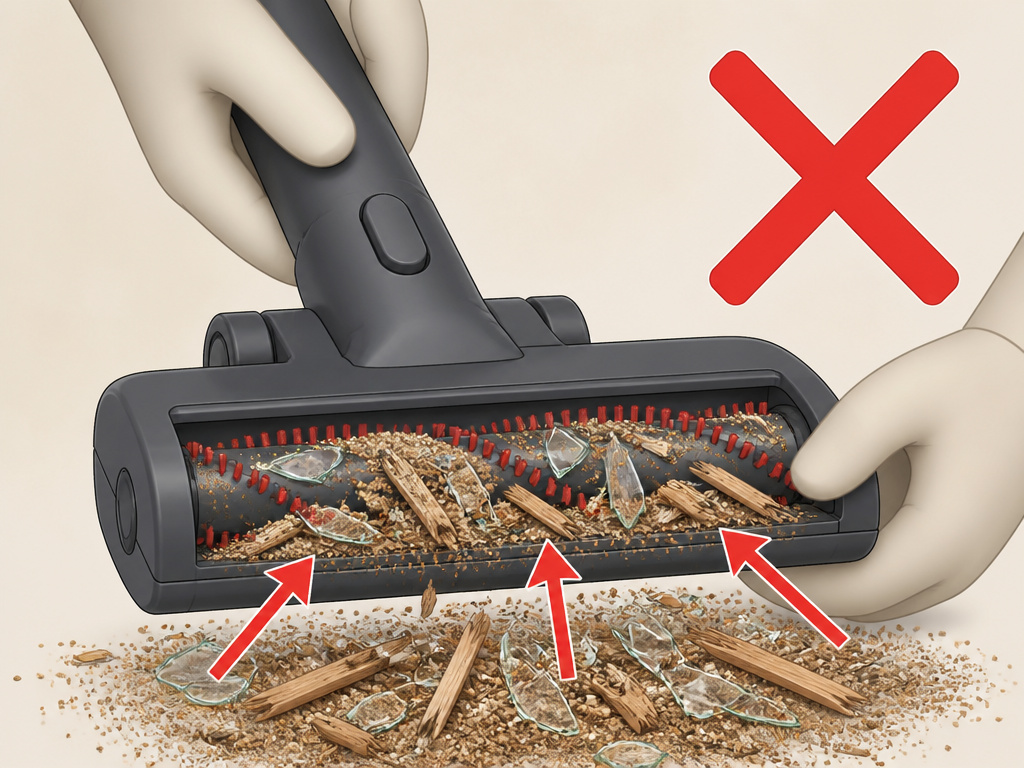
The vacuum’s weakness is its dependence on an unobstructed air path. Certain types of debris block that path immediately, turning a cleaning session into a repair job.
Coarse, Heavy Debris
Sand, kitty litter, broken glass, wood chips, and gravel. These materials are too dense for the airstream to carry efficiently. They will ricochet under the nozzle or, worse, fall into the brushroll chamber and jam the mechanism. For a large pile, always sweep first. Use the vacuum for the fine residual dust afterward.
Wet or Damp Spills
This is a hard rule. Standard home vacuums are not wet/dry vacs. Introducing liquid can short-circuit the motor, ruin the filters, and promote mold growth inside the bin. The Sweepovac manual states exposure to moisture “will cause product failure and invalidate the warranty.” The LG CordZero A9 manual is explicit: “Do not vacuum liquids.” For a wet spill, use a towel or a dedicated wet/dry vacuum.
Stringy or Clumpy Materials
Grass clippings, long human hair, Christmas tree needles, and lint balls. These materials wrap around the brushroll or form a plug in the hose. The vacuum’s motor will strain, overheat, and may trigger a thermal cut-off. If you must clean these up, use a broom or your hands first.
Common mistake: Vacuuming up ashes from a fireplace or fire pit. Even cold ashes are a super-fine dust that will blow straight through a standard paper filter, coating the motor and interior with abrasive powder. The motor will sound gritty within a few uses, and it’s a known killer of household vacuums. Use a dedicated ash vacuum or a very careful damp cloth.
Knowing these limits protects your investment. It also explains why the debate between bagless vs bagged systems matters here, bagged systems often handle fine dust better without clogging, while bagless bins can be easier to empty after picking up larger, dry debris.
Choosing the Right Vacuum for the Job
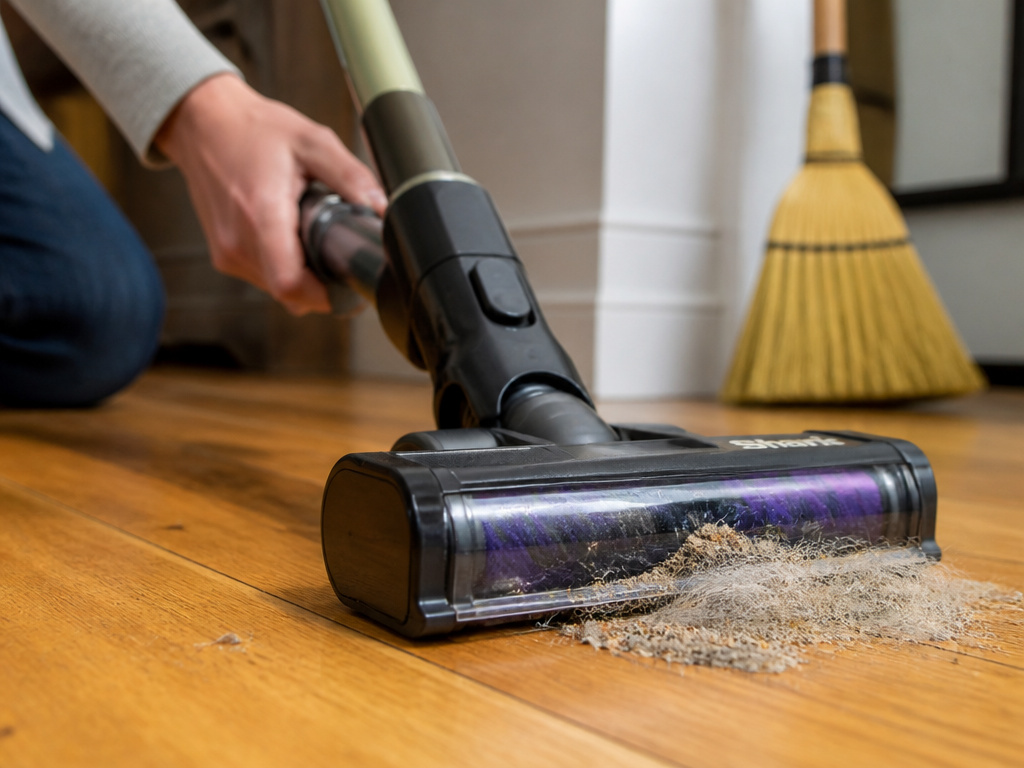
Your floor type and debris profile dictate the machine. This isn’t a one-vacuum-fits-all situation.
For daily quick cleans in apartments or small homes, a cordless stick vacuum is the default. The convenience is the feature. The LG CordZero A9 stands out for its dual batteries and dedicated hard-floor roller. The trade-off is power and bin capacity. They excel at dust and hair but bog down on larger messes.
For whole-house, deep cleaning of hard floors, a canister vacuum is unmatched. The Sebo Sensor 2, with its parquet floor tool, provides that sealed, high-airflow clean. The hose and wand reach under furniture, and the bagged system contains allergens perfectly. It’s less convenient but more powerful.
For automated maintenance, a robot vacuum like the Roborock Flexi can be set to run daily, keeping surface dust at bay between your manual cleanings. They’re excellent for hardwood floor vacuuming upkeep but cannot handle large debris or replace a full-sized vacuum for weekly chores.
The power source is the other critical branch. Cordless vs corded is a real debate. Cordless offers freedom but has a finite runtime (6 minutes in turbo mode for the A9). Corded vacuums offer unlimited power but come with the hassle of managing a cord. For a large, debris-heavy home, corded often wins. For quick daily touch-ups, cordless is king.
Maintenance: The Difference Between a Tool and a Liability
A vacuum that isn’t maintained becomes a broom that scatters dust. The filters clog, the suction drops, and the machine just pushes debris around. The schedule is simple but non-negotiable.
- Empty the bin or change the bag when it’s half to two-thirds full. A overfull bin chokes airflow.
- Clean the filters monthly for bagless models, or as specified. The Roborock Flexi manual calls for filter cleaning every month. A clogged filter is the number one cause of lost suction.
- Clear the brushroll weekly. Cut away wrapped hair and strings. A jammed brushroll burns out the drive motor.
- Check for blockages in the hose and nozzle if suction suddenly drops. This is the first step in any troubleshooting guide.
This routine maintenance is what separates a vacuum that lasts a year from one that lasts a decade. It also ensures that when you choose to vacuum instead of sweep, the machine is actually capable of doing the job you’re asking of it.
Frequently Asked Questions
Can vacuuming replace sweeping completely?
For fine dust, pet hair, and allergen removal on hard floors, yes, a good vacuum is superior. For large, coarse debris like sand, leaves, or broken glass, no. You will still need a broom for the initial gather. A vacuum handles the final, fine clean.
Will vacuuming scratch my hardwood floors?
It can, if you use the wrong vacuum. A vacuum with a standard rotating beater bar or stiff bristles can cause micro-scratches over time. Always use a vacuum with a soft roller, felt strips, or a brushroll shutoff feature specifically designed for hard floors.
Is it bad to vacuum every day?
No, it’s ideal for hard floors. Daily vacuuming with a soft roller prevents dust and grit from accumulating and acting as an abrasive underfoot. It’s the best way to maintain the finish and keep allergen levels low. Just ensure you’re maintaining the vacuum so it performs correctly.
Can I use my carpet vacuum on my tile or hardwood?
You can, but you shouldn’t without adjusting it. If your carpet vacuum has a height adjustment, set it to the highest setting or “hard floor” mode. If it has a brushroll on/off switch, turn it off. Using a carpet setting on hard floors will scatter debris and is inefficient.
What’s better for laminate floors: sweeping or vacuuming?
Vacuuming is better. Laminate is susceptible to scratching from grit pushed by broom bristles. A vacuum with a soft brush attachment lifts dust and grit away without dragging it across the surface. Avoid using a vacuum with a worn or damaged hard brush head.
The Bottom Line
You can vacuum instead of sweep for the majority of hard-floor cleaning. The vacuum wins on dust control, allergen removal, and speed for daily touch-ups. Its failure points are predictable: heavy debris, wet spills, and poor maintenance.
The choice comes down to your debris. For dust and hair, reach for a cordless stick or a canister with a hard-floor tool. For sand and cereal, grab the broom first. And never, ever plug in a standard vacuum for a wet mess, that’s a repair bill waiting to happen.
For most homes, the right answer is both tools. Use the broom for the weekly heavy lift and the vacuum for the daily polish. That combination keeps floors clean and machines running for years.