
Dyson Vacuum Head Keeps Falling Off: Fixes & Warranty Advice
This post contains affiliate links. As an Amazon Associate, we earn from qualifying purchases.
Your Dyson vacuum head keeps falling off for three concrete reasons: a snapped internal post on high-torque models, a blocked airway or brush bar triggering a safety shutoff, or the head was never fully clicked onto the ball joint. The fix depends entirely on which failure you have, reattaching, clearing a clog, or replacing the V-ball joint.
That distinction between a simple reattachment and a structural break is where most advice falls short. A loose head on a DC40 upright is a five-second click. A missing V-ball on a V15 is a repair that, if ignored, grinds the plastic neck into your floor within weeks.
What follows is a breakdown of the three failure modes, the model-specific fixes, and the one warranty clause that covers the repair if your machine is under two years old.
Key Takeaways
- On Dyson V11, V15, and Gen5 high-torque heads, a detached V-ball (large wheel) signals a broken internal plastic post. This is a structural repair, not a reattachment.
- All Dyson uprights and sticks have a thermal cut-out that shuts the motor off if the airway is blocked. The head may seem “dead” and detach more easily as a symptom.
- The standard Dyson guarantee covers parts and labor for 2 years from purchase. A broken V-ball joint on a newer model is a legitimate warranty claim if within this period.
- For older DC-series uprights, the head attaches with a firm push and a distinct click. If it’s loose, the electrical pins aren’t engaged and suction stops.
- Using the machine with a missing V-ball acts like a sander, wearing down the neck joint and leaving scratches on hard floors.
The Three Real Reasons Your Dyson Head Detaches
The problem is never just “the head falls off.” That’s a symptom. You have one of three underlying mechanical failures, and treating the wrong one wastes time and causes more damage.
First, the simple one: incomplete attachment. The Dyson DC40 manual is explicit. You must slide the head on until it clicks into place. If you don’t hear that click, the electrical pins in the twin-block connection aren’t seated. The head will be wobbly and may detach with a gentle tug. Suction to the head will be zero.
Second, and far more common on cordless sticks, is the V-ball joint failure. This isn’t about the head being loose; it’s about the large front wheel falling off completely. Inside that wheel is a bearing mounted on a thin plastic post molded into the neck joint. Impact, slamming into a stair edge or skirting board, snaps that post. Once the V-ball is gone, the raw plastic neck grinds directly on your floor. Every cleaning session then sands the joint down until the whole head assembly fails.
The V-ball failure on Dyson V11, V15 Detect, and Gen5 high torque heads is a structural break. The bearing post inside the neck joint snaps, letting the wheel drop off. From that moment, the plastic neck scrapes your floor.
Third is a blockage-induced shutdown. Dyson vacuums have a thermal cut-out to protect the motor. If a clog in the hose, cleaner head, or main airway causes overheating, the machine will pulse and shut off. A head on a powerless machine feels detached and floppy. This is a safety feature, not a breakdown, but it’s often misdiagnosed.
| Failure Mode | Primary Models | Tell-Tale Sign | Immediate Consequence |
|---|---|---|---|
| Incomplete Attachment | DC-series Uprights (DC40, DC24) | Head wobbles, no ‘click’ on installation, zero suction at floor. | Head detaches during use; no cleaning. |
| V-Ball Joint Break | V11, V15 Detect, Gen5 High Torque heads | The large front wheel (V-ball) is missing. Plastic neck shows wear marks. | Neck joint degrades; floor scratches appear within weeks. |
| Blockage & Thermal Cut-out | All Models (Uprights & Cordless) | Machine pulses and shuts off. Head is limp when power is cut. | No operation until blockage is cleared and unit cools (60+ minutes). |
Step-by-Step: Diagnose Before You Disassemble
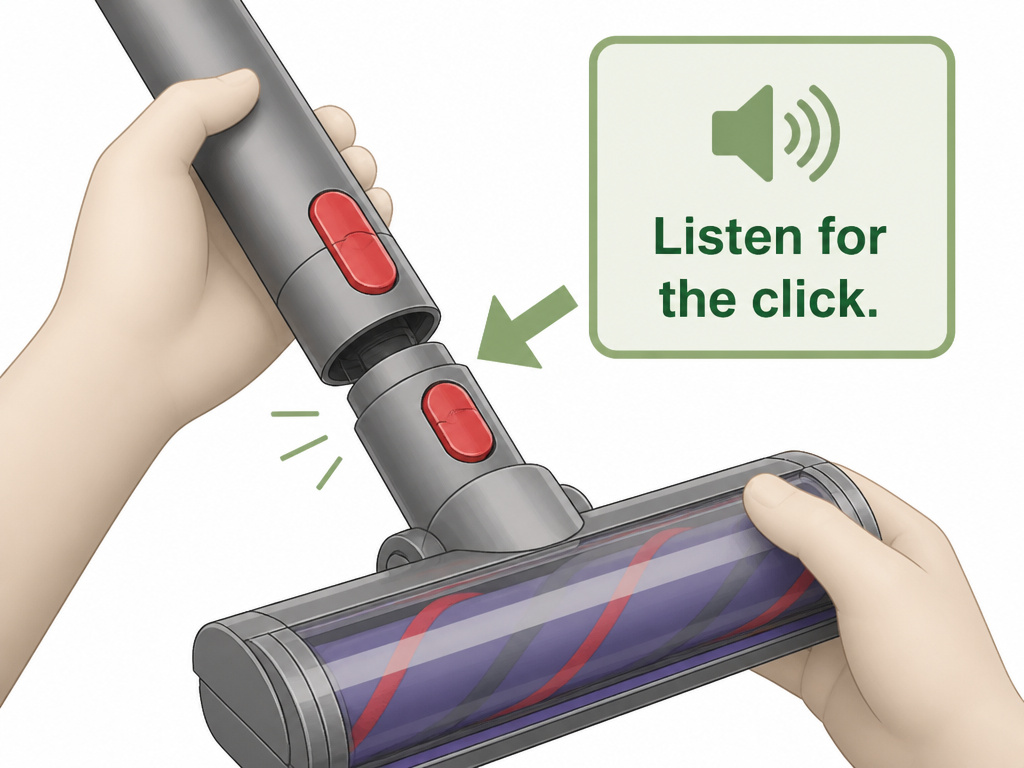 Don’t start taking things apart. Follow this sequence to isolate the problem. It saves you from unnecessary repair bills.
- Check for the Click. Unplug the machine. Remove the head and reattach it, listening and feeling for a solid click. On a DC40, this means the electrical plug is fully home. If it clicks and still falls off, move to step two. If it never clicks, you’ve found the issue, the latch or housing may be damaged.
- Look for the V-Ball. Turn your high-torque head over. Is the large, smooth plastic front wheel present and rolling freely? If it’s missing, you have a structural break. Stop using the vacuum immediately to prevent floor damage.
- Listen for the Cut-out. Plug in the machine (or ensure the battery is charged) and turn it on without the head attached. Does the motor run normally? If it pulses or dies immediately, you have a blockage elsewhere, likely in the hose, wand, or main airway. This is a common reason a Dyson vacuum keeps saying airway blocked.
- Inspect for Obstructions. With the power off, remove the head and look into the airway on the machine’s ball. Can you see light through to the bin? Check the head itself, is the brush bar tangled with hair or thread? A bound brush bar is a frequent cause of a Dyson vacuum brush not spinning, which can mimic detachment issues.
Where this goes sideways: Assuming a missing V-ball is just a “wheel fell off” problem. The wheel fell off because the post that holds its bearing snapped. Gluing the wheel back on will fail within minutes. The neck joint must be replaced.
The Model-Specific Fixes (And When to Call for Warranty)
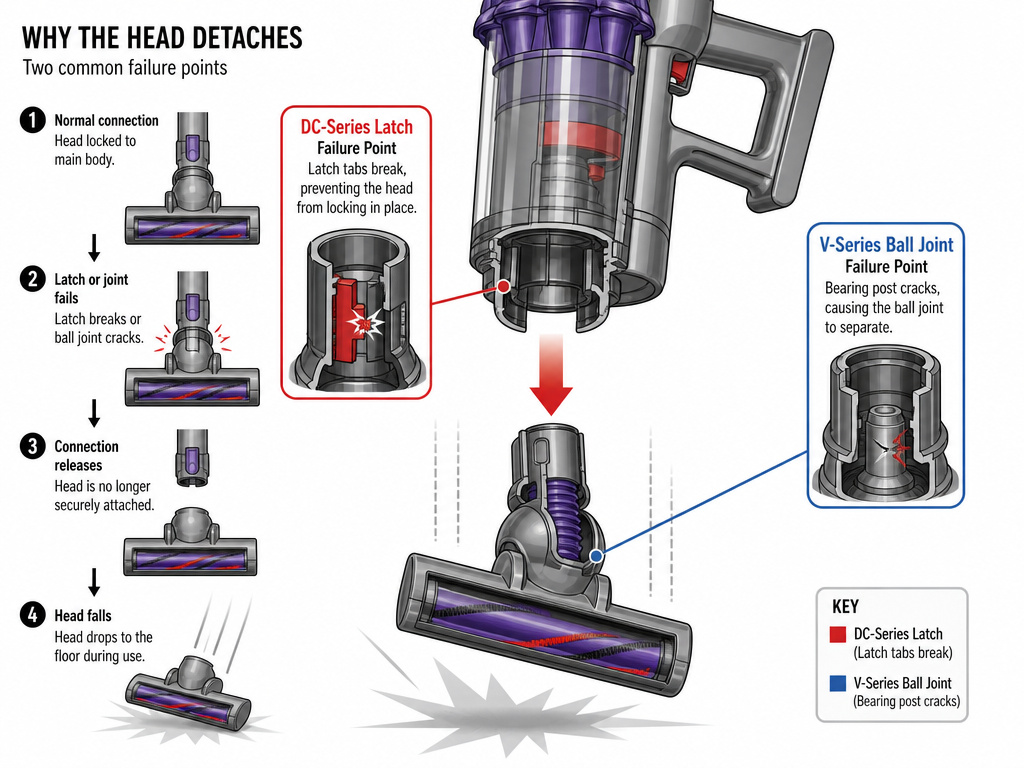 The repair path splits completely based on your Dyson’s generation. What works for an old upright will do nothing for a new cordless model.
For DC-Series Uprights (DC24, DC40, DC42)
These are the simplest cases. The head is a single mechanical and electrical unit that plugs into the ball.
- The Fix: Ensure the cleaner head and the machine’s ball socket are clean and dry. Align the head and push straight on with firm, even pressure until you hear and feel a definitive click. Tug gently to confirm it’s locked.
- If It Still Falls Off: The latch mechanism inside the head’s socket may be broken. This is a warrantable part. More commonly, the issue is a related brush bar obstruction. A seized brush bar creates drag that can pop the head loose. You’ll need to open the baseplate to clear hair and debris, a routine part of how to clean a Dyson upright vacuum head.
- Warranty Note: The DC40 guarantee covers “defective materials, workmanship, or function” for 2 years. A broken latch that prevents secure attachment qualifies.
For V-Series High Torque Heads (V11, V15, Gen5)
This is the repair most DIY guides miss. The V-ball joint is a known failure point.
- The Fix: You must replace the entire neck joint assembly, not just the wheel. Specialty repair shops like VacRevive sell the V-ball joint kit for this exact job. The repair involves disassembling the head, which requires a Torx screwdriver and about 30 minutes of careful work following a video guide.
- Why a Full Joint? The bearing post is molded as part of the neck. It cannot be glued or repaired. A new joint restores the wheel’s axle and the structural integrity of the head.
- Warranty Action: If your machine is under two years old, contact Dyson support first. A broken post from normal use, not obvious abuse, is a manufacturing defect. The service guarantee for a V11 covers labor and spare parts for 12 months, but the longer 2-year general guarantee may apply.
For All Models: The Blockage Protocol
A thermal cut-out is a safety reset, not a broken part.
- Switch off and unplug (or remove the battery).
- Let the machine cool for at least 60 minutes. The thermal cut-out needs this reset period.
- Systematically clear the airway. Start at the cleaner head, remove the bin, and check the hose and wand. A persistent Dyson vacuum keeps getting clogged often points to a frequent filter-washing habit.
- Reassemble and test. Once a clear path is verified, power the machine on without the head to confirm normal operation, then reattach the head.
What Not to Do: Three Mistakes That Make It Worse
Good intentions lead to costly repairs when you guess wrong.
- Don’t force the head on. If it won’t click, something is misaligned or broken. Forcing it can crack the plastic housing on the ball or shear the electrical pins. Check for debris in the socket first.
- Don’t ignore a missing V-ball. Continuing to vacuum grinds the neck joint down. You’ll turn a $30 joint replacement into a need for a whole new cleaner head, which costs over $100. You’ll also scratch hardwood or laminate floors.
- Don’t bypass the thermal cut-out. This is a critical motor protection. If your machine overheats and shuts off, the correct response is to find and clear the blockage, not to try and restart it repeatedly. That can burn out the motor.
These mistakes often transform a simple reattachment or clog-clearance job into a genuine Dyson vacuum not sucking or a completely dead machine.
Will Dyson Fix It For Free? Understanding Your Guarantee
The paperwork matters. Dyson’s standard guarantee is more specific than most owners realize.
The Dyson DC40 Operating Manual states the appliance is covered for parts and labour for 2 years from the date of purchase. This applies to defects in materials or workmanship. A cleaner head that detaches because a latch broke under normal use? That’s covered. A head that detaches because you used it on plaster rubble or stored it below 3°C (37.4°F)? That’s explicitly excluded.
For cordless models like the V11, Dyson offers a 12-month service guarantee on repairs. However, this runs alongside the 2-year general guarantee. If your V15’s V-ball joint broke in month 18, you have a valid claim under the longer coverage.
Common mistake: Assuming a broken plastic part is “wear and tear.” If the part broke under normal operating conditions within the warranty period, and there’s no sign of impact damage, Dyson should cover it. Have your serial number and purchase receipt ready.
The guarantee is void if repairs are done by a non-authorized agent or with non-Dyson parts. That’s why ordering a generic joint kit from an unknown seller can close the door on future support, even for unrelated issues.
Frequently Asked Questions
Why does my Dyson head click but then fall off while vacuuming?
If it clicks on securely but detaches during use, you have one of two problems. First, an obstruction is causing the head to catch and jerk loose, check for tangled hair around the brush bar. Second, on high-torque models, the internal clip that holds the head to the wand may be worn. This is different from the V-ball issue and may require replacing the head’s connection port.
Is the V-ball joint repair difficult?
It’s a moderate DIY job. You need a Torx screwdriver set and the replacement joint kit. The hardest part is keeping track of the screws and internal components during disassembly. If you’re comfortable following a detailed video guide and working with small plastic parts, it’s straightforward. If not, a local repair shop can do it in under an hour.
Can I just glue the V-ball back on?
No. The wheel attaches to a bearing that spins on the post. Glue will seize the bearing, stopping the wheel from rolling. The head will drag, the motor will strain, and the glue will fail from the torque. The correct fix is always a part replacement.
My Dyson head won’t spin and feels loose. Is it the same problem?
Possibly, but not necessarily. A head that won’t spin is often a separate brush bar issue. The looseness could be from a separate attachment fault. Diagnose the spin problem first using a guide for a Dyson vacuum cleaner head not spinning, then check the attachment.
How can I prevent my Dyson head from falling off again?
For uprights, always push straight on until it clicks. For cordless sticks with a V-ball, avoid driving the head hard into furniture legs, stair edges, or baseboards. The impact is what snaps the post. Regularly clear hair from the brush bar to prevent obstructions that strain the motor and attachment points.
Before You Go
Start with the click. If your Dyson head isn’t locked on, nothing else matters. If it’s on but the V-ball is missing, stop vacuuming and order the joint kit, your floors will thank you. For all other mysteries, remember the thermal cut-out: switch off, unplug, cool down, and hunt for the clog. And dig out that receipt. A two-year window is a long time, and a broken latch or joint on a premium vacuum shouldn’t be your expense to bear.