
How to Clean Dyson Stick Vacuum Head: Prevent Damage Guide
This post contains affiliate links. As an Amazon Associate, we earn from qualifying purchases.
To clean a Dyson stick vacuum head, first identify your model. For washable brush bars (Fluffy Optic on V15/V12, Fluffy on V8), remove the brush bar, rinse it under cold water, and let it dry upright for at least 24 hours. For non-washable heads (Motorbar on V11), only wipe the housing with a damp cloth and clear obstructions. Never submerge the motor or electronics.
That 24-hour drying rule is printed in every manual for a reason. A damp brush bar reinstalled early can short the motor’s carbon fiber filaments. The damage isn’t immediate—it builds over the next three to five cleaning cycles before the head stops spinning entirely.
What follows is a breakdown of the two head types, the model-specific steps Dyson actually requires, and the three edge cases that break the standard procedure.
Key Takeaways
- Check your model first. The Dyson V11 Motorbar head is not washable; attempting to wash it voids the warranty and can destroy the motor.
- Dry for 24 hours, minimum. Every Dyson manual for washable brush bars (V15, V12, V8, Digital Slim) states “at least 24 hours” drying time. This is non-negotiable for motor safety.
- Mind the end cap angle. On the V15 Detect Fluffy Optic head, the end cap must be reattached at an angle less than 90 degrees. A straight-on push will not lock it.
- Skip the motorized head on certain carpets. If your carpet fuzzes, Dyson’s official advice is to vacuum without the spinning head and consult the flooring manufacturer.
- Temperature matters. The machine will alert you and refuse to operate if stored or used outside its 50°F to 86°F (10°C to 30°C) range.
The Two Types of Dyson Heads (And Why It Matters)
Your cleaning method is decided by the head on your machine. Getting this wrong is the most expensive mistake you can make.
Dyson uses two broad categories: heads with washable brush bars and heads with non-washable, motorized brush bars. The difference is in the motor housing. On washable models like the Fluffy Optic (V15, V12) or the standard Fluffy head (V8), the brush bar is a removable, passive component. The drive motor that spins it is sealed inside the cleaner head’s body. You can soak the brush bar itself.
On non-washable heads like the V11’s Motorbar, the brush bar is directly integrated with the motor assembly. Submerging it drowns the bearings and electrical contacts. The official V11 manual is explicit: “Do not wash” the brush bar. Cleaning is limited to wiping the housing and clearing hair from the vanes.
Where this goes sideways: Assuming all Dyson heads are the same. Pouring water into a V11 Motorbar head fries the motor windings. The repair cost often exceeds the price of a new cleaner head.
Is Your Dyson Head Washable? (The V11 vs. V15 Split)
This table sorts the common models. If your head isn’t listed, check the underside for a removable brush bar or consult your manual.
| Dyson Model | Cleaner Head Name | Washable Brush Bar? | Key Identifier |
|---|---|---|---|
| V15 Detect | Fluffy Optic™ | Yes | Soft roller, green optic lens, removable end cap |
| V12 Detect Slim | Fluffy Optic™ | Yes | Soft roller, green optic lens, removable end cap |
| V8, V10 | Fluffy™ | Yes | All-blue soft roller, no optic lens |
| Digital Slim | Fluffy™ | Yes | Slim profile, soft roller |
| V11 | Motorbar™ | No | Stiff bristles, “de-tangling vanes” on sides |
| V11 | High Torque | No | Often has a suction slider on top |
If you have a V11, stop. Your cleaning process is different and far simpler. For everyone else, the wash process has specific steps that prevent jams and motor failure.
What You’ll Need Before You Start
Gather these items. Missing the drying time or using the wrong tool makes the whole exercise pointless.
- A coin or flathead screwdriver: For unlocking the end cap on most models.
- Cold tap water: Never use warm or hot water. Heat can warp the brush bar’s plastic mounts.
- A clean, lint-free cloth: For drying the head housing and wiping non-washable parts.
- A well-ventilated drying spot: Out of direct sunlight, with good airflow. A laundry rack or sink edge works.
- Patience: The 24-hour drying clock starts after the last drip leaves the brush bar.
Before you start: Unplug the vacuum and remove the battery. Never handle the cleaner head or attempt to remove a brush bar with the machine powered on. The trigger could be bumped, spinning the bar and catching your fingers.
Step-by-Step: Washing a Washable Brush Bar
This procedure applies to the Fluffy Optic (V15, V12) and standard Fluffy heads. The Dyson V15 Detect manual specifies a drying posture other models don’t mention.
- Detach the cleaner head from the wand. Press the quick-release button and pull straight off.
- Turn the head over and unlock the end cap. Locate the fastener on the side of the head. Insert a coin, turn it a quarter-turn counter-clockwise until it clicks, and rotate the cap to the open position.
- Slide the main brush bar out. Gently pull the long, fuzzy roller straight out of its channel. On some models, a smaller rear brush bar may also slide out—remove it too.
- Rinse under cold running water. Hold the brush bar under the tap. Gently rub the filaments with your fingers to dislodge ground-in dust and hair. Do not use soap, detergent, or any cleaning solution. Dyson’s manuals explicitly warn against it.
- Shake off excess water and position to dry. This is the critical step. For the V15 Detect Fluffy Optic, the manual says to “stand the brush bar upright, with the closed end at the top.” Other models just need to be stood on end. The goal is to let water drain from the central axle.
- Wait at least 24 hours. Place the brush bar in your drying spot. Do not reassemble it early. Do not use a hairdryer or place it on a heater. Ambient air drying is mandatory.
- Clean the head housing. While the brush bar dries, wipe the inside of the cleaner head’s channel with a damp cloth. Use a dry cloth to wipe the optic lens on Fluffy Optic models. Never submerge the head housing.
- Reassemble only when completely dry. Check the brush bar’s central spindle—it must be bone-dry. Slide it back in, reattach the end cap, and lock it with a coin turn clockwise.
I learned the drying lesson the hard way with a V8. The brush bar felt dry on the surface after 12 hours. I reinstalled it, and the vacuum worked fine for two days. On the third clean, the motor pulsed and cut out. The residual moisture in the spindle had finally reached the bearings, causing a short. The repair was a full head replacement.
The V15 Fluffy Optic End Cap Angle (A Specific Gotcha)
The Dyson V15 Detect Fluffy Optic head has a unique reattachment quirk. The manual states: “The end cap should be attached at an angle less than 90° for proper closure.”
If you try to push the end cap straight on, it won’t seat. You must tilt it, hook the top in first, and then swing the bottom into place before locking. Forcing it breaks the plastic tabs. It’s a small detail that causes big frustration.
How to Clean a Non-Washable Dyson Head (V11 Motorbar)
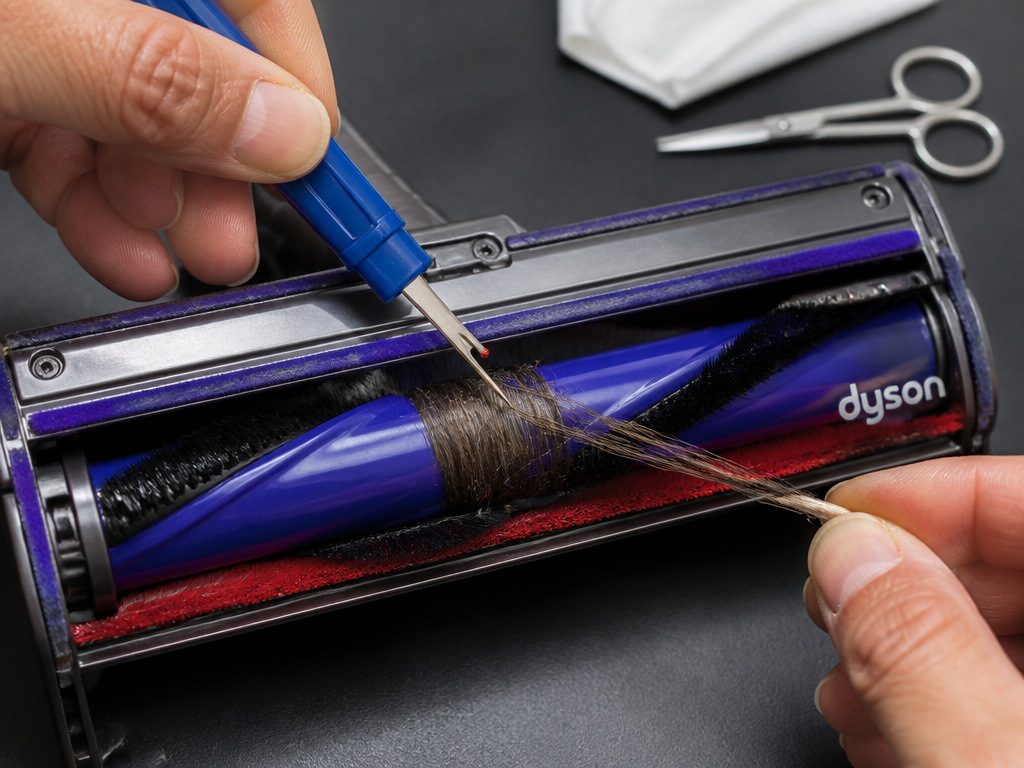
For the V11 Motorbar and similar fixed-brush heads, water is the enemy. Your tools are a cloth, your fingers, and maybe a pair of scissors.
- Detach the head and turn it over. Inspect the brush bar and the “de-tangling vanes” on each side.
- Remove wrapped hair and threads. Use your fingers or a seam ripper to pull debris from the vanes and the ends of the brush bar. Cut stubborn threads with scissors.
- Clear the suction path. Look through the opening where the head attaches to the wand. Shine a light to check for blockages.
- Wipe the exterior. Dampen a lint-free cloth with cold water, wring it out thoroughly, and wipe the plastic housing. Dry it immediately with another cloth.
- Check for obstructions in the brush bar. If the bar doesn’t spin freely, you may need to unlock it. The V11 manual instructs using a coin to turn the end cap a quarter-turn counter-clockwise to slide the brush bar out for obstruction removal only. Do not wash it. Clear the debris, then re-secure it.
This process also applies to troubleshooting a head that won’t spin. Often, the issue is a single wrapped hair jamming the bar at the bearing.
Three Edge Cases That Break the Rules
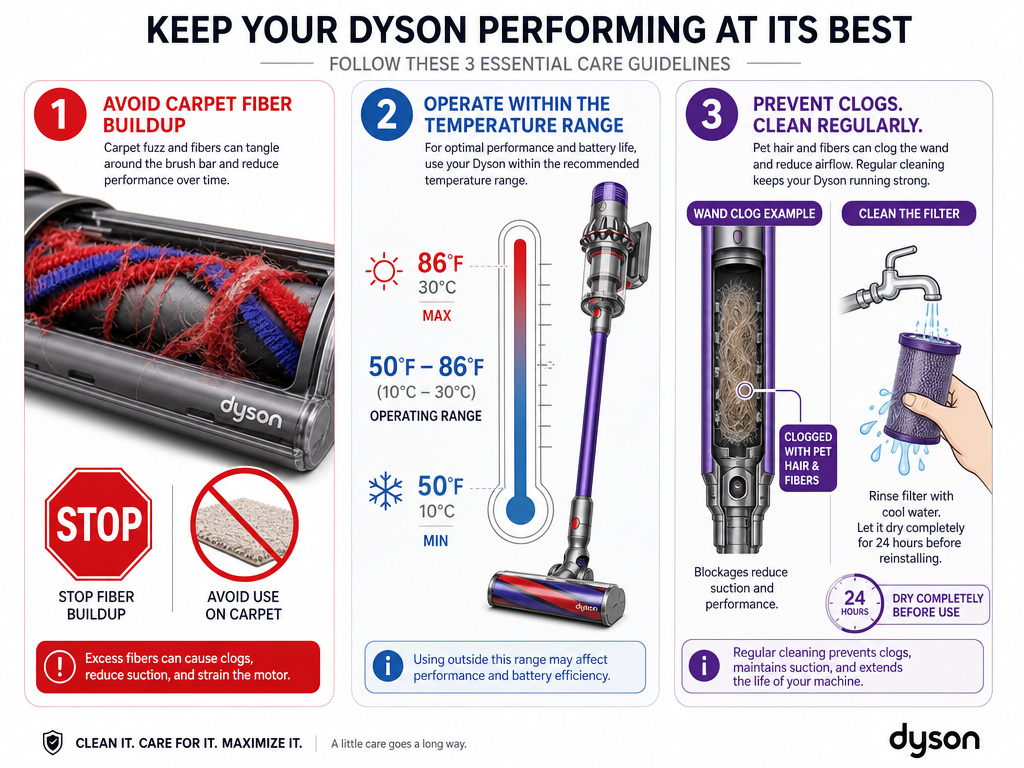
Sometimes, standard cleaning isn’t enough. These are the scenarios the manuals prepare for.
1. Carpet Fuzzing (The Manufacturer Warning)
Multiple Dyson manuals contain this specific warning: “Some carpets will fuzz if a rotating brush bar is used when vacuuming.”
If you see loose fibers collecting on your brush bar or a fuzzy patch on the carpet, stop. This isn’t a vacuum defect. Dyson’s official advice is to vacuum without the motorized floor tool (use a non-motorized tool instead) and consult your carpet manufacturer. The brush bar’s tension is incompatible with that carpet’s pile.
2. Temperature Alerts
Your Dyson is a computer with a motor. It monitors its own environment.
- “Machine too cold” alert: Appears if the vacuum is stored below 50°F (10°C). It will not operate. Move it to a warmer room and let it sit for an hour.
- “High temperature detected” alert: Triggers if the machine or battery overheats from extended use or storage in a hot place. Turn it off and let it cool down.
Operating outside the 50°F to 86°F (10°C to 30°C) range stresses the battery and can trip thermal protection, which feels like a loss of suction or sudden shutdown.
3. Persistent Clogs and Suction Loss
If you’ve cleaned the head but suction is still weak, the clog is elsewhere. The most common culprits are the wand, the bin inlet, or the filter. A full cleaning the attachments check is the next logical step.
For homes with lots of pet hair or long fibers, frequent clogs are a design reality of these high-suction machines. Regular pre-cleaning of the head is your best defense.
Maintenance Schedule and When to Go Deeper
Cleaning the head is reactionary. Maintaining it is preventive.
- After every use: Give the head a visual check for large debris or wrapped hair.
- Every month: Perform a full brush bar cleaning (washable) or deep debris clearance (non-washable).
- Every 3 months: Conduct a full system check. Clean the filter, empty and wash the bin, and inspect all stick vacuum attachments.
If your head is physically damaged, the brush bar is bald in spots, or it keeps falling off the wand, you’re past cleaning. You need a replacement part. For general performance issues, our guide on Dyson stick vacuum problems covers the diagnostic chain from a vacuum that won’t charge to a head not spinning.
Frequently Asked Questions
Can I use soap or disinfectant to clean the brush bar?
No. Dyson manuals explicitly warn against using detergents, polishes, or disinfectants. These can leave residues that attract more dirt, degrade the carbon fiber filaments, and potentially damage the plastics. Cold water and mechanical agitation are sufficient.
How do I know if my brush bar is completely dry?
The surface can feel dry while the central metal axle is still wet. The only reliable test is time. Wait the full 24 hours in a dry environment. Before reassembling, look into the ends of the brush bar; you should see no moisture on the metal spindle.
My V11 head is very dirty. Can I rinse it just a little?
Do not. Any water introduced into the V11 Motorbar head’s motor chamber can cause corrosion, short circuits, and bearing failure. This damage is not covered under warranty. Stick to wiping and dry debris removal.
Why does my Dyson vacuum smell bad after cleaning the head?
Foul, mildewy smell points to a damp component reinstalled too soon. The most likely culprit is a filter that wasn’t dried for 24 hours. Alternatively, if you washed the brush bar and reassembled it damp, mold can grow in the head housing. Disassemble everything, ensure all parts are fully dry, and run the vacuum in a well-ventilated area to evaporate any remaining moisture.
Can I clean my Dyson stick vacuum head in the dishwasher?
Absolutely not. No part of your Dyson vacuum cleaner—not the head, the brush bar, the bin, or the filter—is dishwasher safe. The heat and detergent will warp plastics and destroy components.
The Bottom Line
Cleaning your Dyson stick vacuum head boils down to one decision: is the brush bar washable? For Fluffy and Fluffy Optic heads, the ritual is a cold-water rinse followed by a strict 24-hour dry. For the V11 Motorbar, keep water away and focus on physical debris removal. Respect the drying time, heed the temperature alerts, and know when your carpet is telling you to stop. This isn’t just about cleanliness; it’s about preserving the motor that makes the whole system work. Do it right, and the head will last as long as the vacuum itself.