
A Guide on How to Use Shark Vacuum Attachments Effectively
This post contains affiliate links. As an Amazon Associate, we earn from qualifying purchases.
To use Shark vacuum attachments, first identify the correct tool for the surface, crevice tools for edges, dusting brushes for shelves, motorized brushes for carpets. Connect them by pressing the accessory into the wand or hose end until it clicks. For delicate fabrics, use the suction relief valve on the handle to prevent clogging; this is the single most overlooked control on models like the Shark Navigator.
That valve separates a functional clean from a jammed hose. Most attachments are universal across Shark’s upright and canister lines, but the motorized pet brush or the Dust-Away hard floor pad only work with specific models that deliver the right airflow or have the correct mounting latch.
What follows: a breakdown of the seven core attachments, the model-specific tools that actually matter, and the connection sequence that avoids breaking the hose clips. You will also get the OEM maintenance schedule that keeps suction strong, skip those filter rinses and the motor overheats within three months.
Key Takeaways
- The suction relief valve on the hose handle is critical for cleaning upholstery and delicate fabrics; turning it reduces airflow to prevent the material from getting sucked in and clogging the tool.
- Motorized brushes (Turbo Brush, Pet Power Brush) require the vacuum’s full airflow to spin; they only work when connected directly to the hose or wand, not through extension tubes.
- Filter maintenance is non-negotiable. Per the Shark Navigator manual, pre-motor foam and felt filters need rinsing every 3 months to prevent loss of suction; the post-motor HEPA filter needs cleaning every 2 years.
- Always turn off and unplug the vacuum before connecting or disconnecting any attachment, especially motorized nozzles. The hose contains electrical wires.
- For hard floors, the Dust-Away Hard Floor Attachment with a microfiber pad is superior to a standard floor nozzle; the pad should be replaced every 3-4 months for best results on models like the Shark Rocket.
The 7 Essential Shark Attachments and What They Do
Your vacuum came with a bag of tools. Each has a specific job, and using the wrong one wastes time and leaves debris behind. This isn’t about having more gadgets; it’s about matching the tool to the terrain.
The core set is mostly universal. Whether you have a Shark Navigator Lift-Away or a Shark CZ350 canister, you’ll recognize these.
The crevice tool, dusting brush, upholstery tool, and wide upholstery tool are the non-motorized core set. They work on any Shark vacuum with a hose or wand because they are passive, suction alone does the work.
| Attachment | Best For | Common Mistake |
|---|---|---|
| Crevice Tool | Tight spaces: between couch cushions, along baseboards, car seats. | Using it on large flat surfaces. The narrow channel limits airflow, so it’s inefficient for big jobs. |
| Dusting Brush | Blinds, lampshades, shelves, delicate surfaces. The bristles agitate dust without scratching. | Pressing too hard, which mats the bristles and reduces their sweeping effect. Let the vacuum’s suction do the work. |
| Upholstery Tool | Fabric surfaces: sofas, chairs, mattresses, car interiors. The wide head and sometimes felt strip protect fabric. | Using it on high-pile carpet. It lacks a motorized brushroll to dig out embedded dirt. |
| Wide Upholstery Tool | Larger fabric areas: bedspreads, drapes, area rugs. Covers more surface area faster. | Same as the standard upholstery tool—it’s for surfaces, not deep pile. |
| Turbo Brush (Air-Driven) | Low to mid-pile carpet, area rugs, stairs. Uses suction power to spin a brushroll for agitating dirt. | Connecting it through an extension wand. It needs maximum, direct airflow to spin effectively. |
| Pet Power Brush | Pet hair on furniture and carpets. Motorized bristles dig out embedded hair. | Using it on hard floors. The bristles can scatter debris, and it’s overkill. |
| Dust-Away Hard Floor Attachment | Sealed hard floors: hardwood, tile, laminate. The microfiber pad traps dust instead of blowing it. | Forgetting to replace the microfiber pad. A worn pad just pushes dirt around. |
Where this goes sideways: Using the turbo brush on a thick shag carpet. The brushroll can’t penetrate the deep pile, and the hair wraps around the axle instead of being sucked up. You’ll hear a high-pitched whine, and the brush stops spinning within minutes. For those carpets, you need a full motorized floor nozzle, not an air-driven attachment.
The Step-by-Step Connection Guide
Connecting an attachment seems trivial. You just shove it on, right? That’s how the hose end cracks. The connection points are standardized, but they have a specific feel when seated correctly.
Before you start: Turn off the vacuum and unplug it. This is in every Shark manual for a reason. The hose on models like the Shark NV600 Rotator contains electrical wires for the floor nozzle. Forcing a connection while the unit is on risks a short.
- Identify the connection point. On uprights like the Navigator, you usually press a button on the back of the pod to release the wand. The hose is stored on the accessory caddy. On canisters like the CZ350, the hose is the primary connection.
- Clear the port. Look into the end of the wand or hose. Make sure no debris is blocking it. A single Lego or a wad of hair here will kill suction for the entire tool.
- Align and press. The attachments have a rectangular or oval shape. Match it to the port and push straight on. You should feel a solid click or a firm stop. Do not twist.
- Tug test. Gently pull on the attachment. It should not come off. If it does, it’s not fully seated. Forcing it during use will strain the plastic latch inside the hose end.
- Power on and go. Plug in the vacuum, turn it on, and start cleaning. For motorized brushes, listen for the distinct whirl of the brushroll spinning. No spin means a blockage or insufficient airflow.
The part nobody mentions: That click isn’t just for security. On motorized tools, a full seat completes the electrical connection for the brushroll motor on models that power it through the hose. A half-connected pet brush might get suction but no agitation.
If the attachment feels loose or won’t click, check for a broken latch inside the hose end. This is a common wear point. You can order a replacement hose from sharkaccessories.com instead of replacing the whole vacuum.
The Suction Control Valve: Your Secret Weapon
 If you only remember one thing from this guide, it’s this: find the dial or slider on the hose handle. On the Shark Navigator, it’s a rotating ring. On other models, it might be a sliding switch. This is the suction relief valve, and it solves the most frustrating problem.
Here’s the scenario. You’re using the upholstery tool on a velvet couch or a knit throw. The fabric gets sucked into the tool, instantly clogging it. Suction drops to zero. You turn off the vacuum, pick out the fabric, and start again. The same thing happens.
The valve fixes this. It opens a bypass port, allowing some air to enter the hose behind the tool. This reduces the pulling force at the nozzle. You still have enough suction to lift dirt and hair, but not enough to swallow the fabric.
How to use it:
- Start with the valve closed (often marked “Max” or with a picture of a closed vent).
- If the fabric starts to get pulled in, turn the valve toward “Min” or open the vent icon.
- Find the point where the tool glides smoothly without grabbing. It’s usually about halfway.
- When you go back to cleaning floors or using the crevice tool, return the valve to “Max” for full power.
This one function turns a frustrating chore into a quick pass. It’s the difference between a tool you use and one that stays in the closet.
Model-Specific Attachments and Compatibility
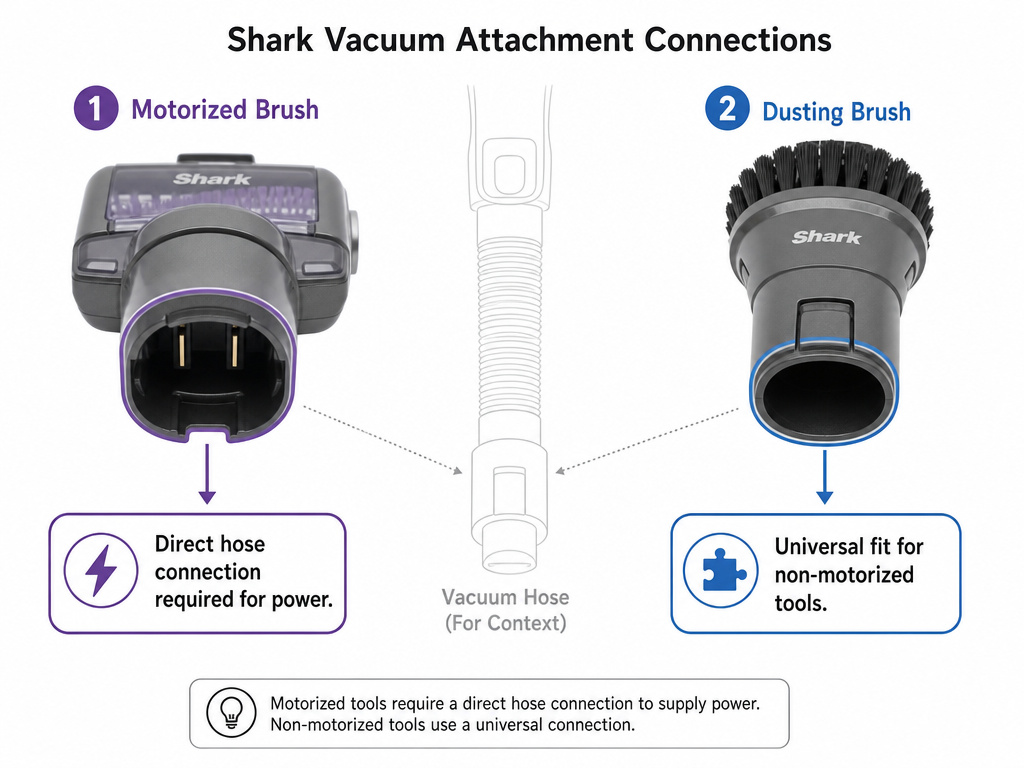 Not all attachments work with all vacuums. The box might say “universal,” but that only applies to the basic non-motorized set. The specialized tools have requirements.
Motorized Brushes (Turbo Brush, Pet Power Brush): These need high airflow to function. They are designed for vacuums with sufficient wattage and an open air path. A Shark Rocket HV300 (500W) might struggle to spin a turbo brush effectively compared to a Shark Navigator Lift-Away Pro (1200W). They also must be plugged directly into the hose. Adding an extension wand reduces airflow pressure and can stall the brush.
Dust-Away Hard Floor Attachment: This is a system. You need the attachment head and the microfiber pad that clips onto it. It’s compatible with many upright and canister models. The pad is the consumable. According to the Shark Rocket manual, the microfiber pad should be replaced every 3 to 4 months for best results. A dirty, compacted pad just smears dirt.
Under-Appliance Wand & 24” Crevice Tool: These are niche tools for specific Shark lines, like the CZ350 canister series. The under-appliance wand is a long, flat extension for reaching under refrigerators or low cabinets. The 24” crevice tool is for deep, narrow gaps. If your model didn’t come with one, check sharkaccessories.com for compatibility before buying.
The compatibility check is simple. Look at the connection end of your hose or wand. Now look at the connection end of the accessory you want to buy. They should match exactly. When in doubt, the product page on Shark’s official site or your vacuum’s manual will list the part numbers for compatible accessories, like the XFF350 filter set or the 119FFJC turbo brush.
Maintenance: Keeping Your Attachments (and Vacuum) Working
The attachments are useless if the vacuum has weak suction. Blocked airflow is the enemy, and it starts with poor maintenance. The schedule isn’t a suggestion.
Immediate Maintenance (After Each Use):
- Empty the dust cup. A full cup is the number one cause of lost suction. Do it after every cleaning session.
- Clear attachment blockages. Check the crevice tool and hose for clogs. A plumbing snake or a straightened coat hanger works.
- Remove hair from brushrolls. For motorized tools, cut hair wrapped around the brushroll with scissors. Don’t pull it.
Scheduled Maintenance (Per OEM Manual):
This is where most owners fail. The Shark Navigator Lift-Away Pro manual is explicit.
| Component | Action | Frequency | Consequence of Skipping |
|---|---|---|---|
| Pre-Motor Foam & Felt Filters | Rinse with water until it runs clear. Air-dry for 24 hours. | Every 3 months | Loss of suction occurs. The motor overheats, triggering the protective thermostat to shut the unit off. |
| Dust Cup | Empty and wipe clean. | After each use | Immediate suction drop. Debris can bypass into the filters, clogging them faster. |
| Post-Motor HEPA Filter | Rinse and air-dry completely. | Every 2 years | Reduced air quality output. Can cause the vacuum to overheat and shut down. |
| Brushrolls (Motorized) | Cut away wrapped hair and debris. | Monthly or as needed | The brushroll seizes, the belt snaps, or the motor burns out. |
| Microfiber Pads (Dust-Away) | Replace with new pad. | Every 3-4 months | The pad loses its electrostatic charge and simply pushes dust around instead of trapping it. |
Common mistake: Putting filters back in while damp. The Shark manual warns, “DO NOT operate the vacuum with WET filters.” Moisture gets sucked into the motor. That’s a repair bill, not covered by warranty.
Stick to this schedule. It’s the cheapest way to ensure your attachments, and your entire vacuum, last for years. For a deep dive on this, our guide on how to clean a Shark vacuum filter walks through the drying process step by step.
Frequently Asked Questions
Why won’t my Shark vacuum attachment stay on?
The plastic latch inside the hose or wand end is likely broken or worn. This is a common point of failure from attachments being forced on at an angle. You can purchase a replacement hose or wand section from sharkaccessories.com. It’s a more cost-effective fix than buying a new vacuum.
Can I use off-brand attachments on my Shark vacuum?
You can, but you shouldn’t. The Shark warranty for models like the Navigator states, “Only use Shark® branded filters and accessories. (Failure to do so will also void the warranty).” Off-brand attachments may not seal correctly, causing air leaks and reduced suction. They can also break the connection port.
What’s the best Shark vacuum for using lots of attachments?
Canister vacuum like the Shark CZ350 Series or a Lift-Away upright like the Shark Navigator Lift-Away Pro. Canisters are inherently designed for above-floor cleaning with a hose. Lift-Away models convert to a portable pod, making it easy to carry the motor unit while using attachments. Our review of the best Shark vacuum models breaks this down further.
How do I clean the hose attachments?
For non-motorized tools like the crevice tool or dusting brush, rinse them with warm water. Use a long brush to scrub the inside. Let them air-dry completely before storing. For motorized brushes, wipe the exterior with a damp cloth. Never submerge the motorized head in water. Always refer to your manual for specific cleaning instructions to avoid damaging the cleaning the dust cup and other components.
Do I need a different vacuum for carpets and hard floors?
Not necessarily. Many Shark models, like the Apex DuoClean, have a dual brushroll system for both surfaces. For others, the key is switching attachments. Use the motorized floor nozzle for carpets and the Dust-Away Hard Floor Attachment for hard floors. Choosing the right base model is crucial; see our picks for the best Shark vacuum for carpet and the best Shark vacuum for hard floors for targeted recommendations.
Before You Go
Using Shark vacuum attachments correctly boils down to three actions: match the tool to the surface, connect it with a firm click, and manage the suction with the relief valve for delicate jobs. The specialized tools, like the motorized pet brush or the Dust-Away system, are worth learning, they turn a good vacuum into a great one.
Remember the maintenance. A clogged filter or a full dust cup makes every attachment ineffective. Rinse those pre-motor filters every three months, let them dry for a full day, and your vacuum will maintain its power. Whether you have a powerful Shark upright vacuum or a nimble Shark cordless vacuum, the attachments are what let you clean everything, not just the floor. Keep them clean, store them properly, and they’ll last the life of the machine.