
Roomba Vacuum Types Explained: Four Families For Your Home
This post contains affiliate links. As an Amazon Associate, we earn from qualifying purchases.
Roomba vacuum types are defined by four core families: the 600 Series (random navigation), the i-Series (camera-based VSLAM mapping), the j-Series (obstacle avoidance), and the s-Series (high-power, D-shaped design). The right type for you depends on your home’s layout, floor types, and whether you need smart mapping or hands-off pet hair cleanup.
That division, random, smart, obstacle-aware, and power-focused, is what separates a $200 robot from a $1000 one. It’s not about getting a “better” clean in a single pass over a bare floor. It’s about which robot can finish the job in your actual home without getting lost, stuck, or leaving piles behind.
What follows: the exact runtime and navigation specs from iRobot’s own manuals, the maintenance schedule each type demands, and the one physical design quirk that makes the s-Series the only Roomba that cleans flush against baseboards.
Key Takeaways
- The Roomba 600 Series uses random bounce navigation. It’s affordable but inefficient for open floor plans, often missing spots and scattering debris with its fast side brush.
- i-Series models (i3, i4, i7, i8) use a top-mounted camera for VSLAM mapping. This allows room-by-room cleaning and no-go zones via the app, but the camera needs a clear view and can struggle in very dark rooms.
- The j-Series (j7, j9) moves the camera to the front, pairing it with sensors to avoid cords, pet waste, and socks. It’s the only Roomba with verified obstacle avoidance.
- The s-Series (s9+) is D-shaped with a wider, counter-rotating brush system and the strongest suction. It’s the best for deep carpet cleaning and edge work, but it’s the most expensive and has been discontinued, making parts scarce.
The 4 Core Roomba Families (and Where Your Home Fits)
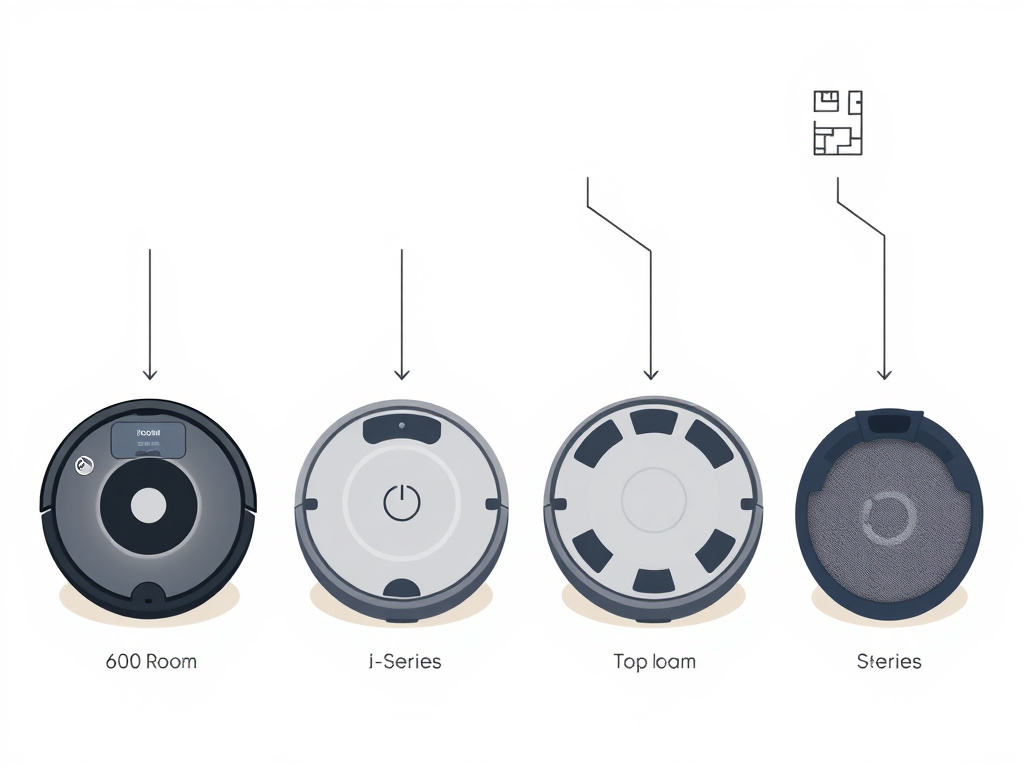
Choosing a Roomba involves matching a robot’s physical and digital design to the problems in your home. A 1200 sq ft apartment with mostly hard floors needs a different machine than a 3000 sq ft house with wall-to-wall carpet.
The chart below cuts through the marketing. It matches each family to the home layout it actually solves.
| Roomba Family | Best For This Home | The Trade-Off You Accept |
|---|---|---|
| 600 Series | Small, single-room spaces or secondary areas (garages, basements). Limited obstacles. | Random navigation. It will cover the same spot multiple times and miss others. Cleaning takes longer. |
| i-Series | Multi-room homes with consistent lighting. Owners who want scheduled, room-specific cleanings via app. | Requires some pre-clearing of floor clutter. The top camera can’t map in pitch darkness. |
| j-Series | Homes with daily floor clutter: pet toys, phone chargers, shoes. Pet owners worried about accidents. | Premium price for avoidance tech. The front camera is lower, so its mapping field of view is slightly different. |
| s-Series | Large homes with significant carpeted areas, especially high-pile. Perfectionists who want baseboards cleaned flush. | Highest cost, discontinued status, and a louder operating volume. The D-shape can get stuck in tight spaces a round robot would pivot out of. |
The iRobot HOME App is the control center for the i, j, and s-Series. For the 600 Series, the app only shows basic status, you control it with buttons on the robot itself.
Common mistake: Buying a j-Series for its obstacle avoidance in a home with no daily clutter. You’re paying for a solution to a problem you don’t have. The i-Series maps just as well for $200-$300 less.
Roomba 600 Series: The Budget Workhorse
These are the round, bump-and-run Roombas. They have no camera. Instead, they use a series of physical sensors, bumpers, cliff sensors, and an acoustic wall-following sensor, to navigate.
They come with a Dual Mode Virtual Wall accessory. This lets you block off a 10-foot wide opening or create a 2-foot protective halo around a dog bowl or floor lamp.
Their cleaning power is consistent with most other Roombas, but their method creates a specific flaw.
The fast-spinning side brush on 600 Series models often scatters debris piles before the vacuum channel can ingest them. You’ll find small piles of dirt pushed into corners after a run.
According to iRobot’s spec sheet, these models typically use an 1800mAh Lithium-ion battery and run for up to 60 minutes on a charge. They must complete cleaning within that window or be manually restarted, no recharge-and-resume feature.
Maintenance is hands-on. The bin must be emptied after every run. The filter needs weekly cleaning (twice weekly with pets) and replacement every two months. The extractors (brushes) need a full hair removal every week.
When to choose it: For a secondary space, a vacation home, or if your primary cleaning needs are simple and contained. It’s a capable cleaner that asks for patience in return for a lower price.
Roomba i-Series: The Smart Mapper
This family includes the i3, i4, i7, and i8. The leap here is VSLAM (Visual Simultaneous Localization and Mapping). A camera on top of the robot looks at your ceiling and landmarks to build a map.
That map unlocks everything: you can label rooms, tell the robot to clean only the kitchen, set no-go zones, and see its cleaning path in the app. The biggest practical benefit is Recharge & Resume. When the battery gets low, it docks, charges, and picks up exactly where it left off.
The i-Series camera needs contrast and light to see. It will struggle to map or navigate in a completely dark room. A nightlight or cracked blinds is often enough.
Run times here jump. An i3/i4 runs up to 75 minutes, while an i7/i8 can hit up to 90 minutes per the iRobot runtime chart. The optional Clean Base is a game-changer for i-Series models. It’s a docking station with a bag that automatically empties the robot’s bin after each job, giving you weeks of hands-off operation.
The maintenance schedule shifts slightly. Because the navigation is more efficient, the robot covers less ground redundantly, so the brushes and filter may not clog as quickly, but stick to the manual’s schedule.
When to choose it: For any multi-room home where you want set-and-forget automation. The i7+ with Clean Base is the sweet spot for most families looking at best Roomba vacuums.
Roomba j-Series: The Obstacle Avoider
The j7 and j9 look similar to the i-Series but have a critical redesign. The navigation camera is moved to the front, where it’s paired with a forward-looking sensor suite.
This system, called PrecisionVision Navigation, is trained to recognize common obstacles: cords, shoes, pet waste, and socks. When it sees one, it attempts to go around it and marks it on your map. It’s the only Roomba that actively avoids rather than just bumping into things.
The runtime is solid at up to 90 minutes, and it also supports the Clean Base. Its cleaning power is on par with the i-Series, the innovation is in intelligence, not suction.
Where this goes sideways: The obstacle database isn’t infinite. A unique toy or a specific type of cable loom might still be hit. The promise is “95% avoidance,” not perfection.
For homes with pets, this is the compelling choice. It directly addresses the two biggest pet-owner fears: the robot spreading a mess and the owner having to pre-clean the floors every day. It makes the best Roomba for pet hair title about reliability.
When to choose it: For busy households with daily floor clutter, or for pet owners who want the strongest guard against accident-related disasters.
Roomba s-Series: The Power Specialist
The s9+ is the outlier. It’s D-shaped, not round. This allows its PerfectEdge side brush to be mounted right at the front corner, letting it clean flush against baseboards and cabinets.
It also has the most powerful suction motor of any Roomba and a unique counter-rotating extractor system, two rubber rollers that spin in opposite directions to aggressively pull in debris and hair. For deep carpet cleaning, it’s unmatched in the iRobot lineup.
Its navigation uses the same top-camera VSLAM as the i-Series, and it works with the Clean Base. However, its high-power motor drains the battery faster; expect about 75 minutes of runtime, less on max carpet boost.
The s9+ has been discontinued. While still available through some retailers, replacement parts like the unique D-shaped side brush and the specialized extractors may become harder to find over time.
When to choose it: Only if your home has extensive medium- to high-pile carpet and you prioritize deep cleaning and edge performance above all else. For most homes with mixed hard floors and low-pile carpet, an i or j-Series is more practical.
What Really Changes Between Types: Specs Decoded
Beyond the family names, three technical specs dictate daily performance: navigation method, bin capacity, and runtime. These are physical constraints.
Navigation: From Bumpers to AI Vision
This is the largest differentiator. The method dictates how the robot moves, which directly affects how long cleaning takes and whether it can finish the job.
| Navigation Type | How It Works | Real-World Limitation |
|---|---|---|
| Random (600 Series) | Bumps, turns, follows walls. Uses an algorithm to theoretically cover area over time. | Highly inefficient. In a large room, it may never reach the far corner before the battery dies. |
| VSLAM (i, s-Series) | Top camera creates a persistent map for efficient, straight-line cleaning. | Requires ambient light. Can be confused by major furniture changes. |
| PrecisionVision (j-Series) | Front camera and sensors identify and navigate around specific obstacles. | Processing takes a split second, making the robot slightly slower in cluttered areas. |
A VSLAM robot will clean the same floor space in half the time of a random-nav robot. That efficiency is what you pay for.
Bin Capacity and Self-Emptying
A full bin stops the cleaning job. Capacity determines how much square footage a robot can cover before you must intervene.
- 600 Series Bin: ~0.3 liters. Must be emptied after every run, often mid-run for larger homes.
- i/j-Series Bin (with Clean Base): ~0.4 liters. The robot auto-empties into the base’s bag after each mission.
- i/j-Series Bin (without Clean Base): ~0.5 liters. Manual emptying required.
- s-Series Bin: ~0.5 liters. Also supports auto-emptying.
The Clean Base accessory, compatible with i, j, and s-Series models, holds a bag that typically needs replacing every 30-60 days. It transforms the experience from a daily chore to a monthly one. It’s a key reason the best Roomba vacuum and mop combos and high-end models bundle it.
Battery and Runtime: The Finish Line
Runtime determines if the robot can clean your entire floor level in one session. IRobot’s published runtimes are estimates for hard floors; carpet, especially with the boost feature on, reduces them.
Roomba 900 Series & 600 Series Maintenance: The owner’s manuals specify cleaning the filter once per week (twice with pets) and replacing it every 2 months. The extractors need a deep clean every 4 months (3 with pets).
Models with Recharge & Resume (all VSLAM robots) overcome limited runtime by breaking the job into chunks. A 75-minute robot can clean a 2000 sq ft home; it will just take two or three battery cycles.
Roomba Vacuum and Mop Combos: A Separate Category
Models like the Roomba Combo j5+ or Combo j9+ represent a distinct “type.” They are fundamentally j-Series vacuums with an added retractable mopping pad and a water tank.
The mopping function is a damp wiping pass, not a deep scrub. The robot must recognize carpet and retract the pad to avoid wetting it. This hybrid approach is ideal for homes with a mix of hard floors that need light mopping and carpets.
These combo units have all the navigation and avoidance features of their j-Series cousins but add the complexity of a water system that needs periodic filling, cleaning, and pad replacement. Your decision here is simple: do you want a robot that also damp-mops? If not, a standard vacuum-only model is less expensive and less complex. For a dedicated look, see our guide to the best Roomba vacuums and mops.
Frequently Asked Questions
What is the most popular type of Roomba?
The i-Series, particularly the i3/i4 and i7 models, is the most popular. It strikes the best balance between smart mapping capability and price. The i3 offers core mapping at an entry point, while the i7 adds more powerful suction and better multi-floor mapping.
Which Roomba type is best for pet hair?
The j-Series is the best overall for pet hair. Its obstacle avoidance prevents it from spreading accidents, and its rubber extractors resist tangling. For pure suction power on embedded pet hair in carpet, the s-Series is strongest, but its discontinued status makes the j7 or j9 a more future-proof choice among best Roombas for pet hair.
Do all Roomba types work with Alexa?
All Wi-Fi connected Roombas (600 Series 670+, i-Series, j-Series, s-Series) work with Alexa and Google Assistant for basic voice commands like “start cleaning” or “dock.” The 600 Series models with only physical buttons have no smart connectivity.
What’s the difference between Roomba i and j?
The i-Series has a top camera for mapping. The j-Series has a front camera and sensors for obstacle avoidance. The j-Series is essentially an i-Series with a more advanced front-end to avoid hitting things, making it better for cluttered homes.
How long do different Roomba types last?
With proper maintenance, most Roomba vacuums last 4-6 years. The first components to fail are usually the battery (2-4 years) and the side brush motor. Models with more complex systems, like the j-Series obstacle avoidance or s-Series dual rollers, have more parts that could potentially need service.
Before You Go
Skip the hype about the latest model number. Match the robot’s design to your home’s shape. Get a 600 Series for a simple, contained space. Choose an i-Series for efficient, mapped cleaning in a multi-room home. Invest in a j-Series if your floors are never clear. Only consider the s-Series if deep carpet cleaning is your non-negotiable priority.
For most people, the answer is an i-Series model with a Clean Base. It delivers the core promise of a robot vacuum, true autonomy, without the premium cost of obstacle avoidance. Check the latest reviews on the best Roomba vacuum cleaners to see which specific i-Series model fits your budget.