
Why Your Shark Vacuum Brush Isn’t Spinning & How to Fix It
This post contains affiliate links. As an Amazon Associate, we earn from qualifying purchases.
A Shark vacuum brush stops spinning because of three things: debris jamming the brushroll, a clogged air path choking the motor, or a worn or broken drive belt. The most common fix is clearing the jam – turn off and unplug the vacuum, open the brushroll cover with a coin, and remove any wrapped hair or lodged objects.
That answer covers most cases, but the specific sequence depends on your model. Corded uprights like the Shark NV755 series have a physical drive belt inside the floor nozzle. Newer cordless models like the Shark Vertex Pro use a direct-drive brushroll motor.
What follows: the diagnostic that separates a quick fix from a repair job, the step-by-step unjam, the maintenance that stops it happening again, and the one sensor check owners of smart vacuums miss every time.
Key Takeaways
- The brushroll only spins if the vacuum head is tilted back on the floor; it’s a safety lockout.
- A flashing red brushroll indicator light means an overheat, you must wait 60 minutes before restarting.
- Letting wet filters air-dry for less than 24 hours can draw moisture into the motor and cause a short.
- The Shark Vertex Pro’s self-cleaning brushroll still needs a manual check every six months for hair wrapped at the axle ends.
- Replacing a worn drive belt is a 15-minute job with a Torx T15 screwdriver and the correct belt size for your model.
The 3-Step Diagnostic (And Why Force Doesn’t Work)
Don’t just yank the vacuum head. Start here. This table rules out the easy problems before you open any covers.
| Check This | What It Means If It Fails | The Quick Test |
|---|---|---|
| Head Position | Brushroll safety lockout is engaged. | Tilt the handle back until the floor nozzle lies flat on the carpet. Try again. |
| Brushroll Indicator Light | Solid red = jam. Flashing red = motor overheated. | See the light on the handle or pod. A flashing red means wait at least 60 minutes. |
| Suction at the Floor Nozzle | Severe air path blockage upstream of the brushroll. | Detach the wand, place your hand over the nozzle intake. Feel weak or no suction? |
Where this goes sideways: Forcing a jammed brushroll by hand. On models with a belt drive, this can snap the belt. On direct-drive models, you risk stripping the plastic gears inside the motor housing. You’ll hear a grinding noise on the next use, and the repair jumps from a $10 belt to an $80 motor assembly.
The head-position lockout is in every manual but ignored by most guides. A Shark ROTATOR POWERED LIFT-AWAY NV755 will not spin its brushroll unless the wand is fully reclined. That’s a physical switch in the hinge.
Why does this happen? The switch prevents the spinning brushroll from damaging rugs or scratching floors when the vacuum is parked upright. It also stops the motor if the vacuum tips over.
Step-by-Step Fix for a Jammed Brushroll
This is the fix for a solid red indicator light. You need a coin and a pair of scissors or a seam ripper. The whole process takes under five minutes if the jam is just hair.
Before you start: Unplug the vacuum if it’s corded. Remove the battery pack on cordless models. The brushroll can kick on unexpectedly if a button is pressed, and those bristles move fast enough to take off a fingernail.
-
Open the brushroll cover. Find the two or three plastic locks on the underside of the floor nozzle. Insert a coin into each slot and turn counter-clockwise until you hear a click. Lift the cover straight off.
Skip this, and you’re working blind. You might clear one side of the brushroll while a thick hair wrap hides on the opposite bearing.
-
Remove the brushroll. Lift the brushroll out of its cradle. On most Shark models, it just pulls straight up and out. Look at both ends of the axle.
That’s where long hair and carpet fibers wind tightest. They form a solid mat that binds against the bearing housing.
-
Cut and clear all debris. Use your scissors to cut along the length of the brushroll, then peel the material away. Don’t just pull, you can damage the bristle strips. Also check the opening where the brushroll sits for any lodged objects: pebbles, screws, toy parts.
A clear airway is critical. Even a small LEGO brick can stop the roll.
-
Reassemble and test. Drop the brushroll back into place, ensuring the drive dogs (the plastic squares on the axle ends) slot into the motor coupler. Snap the cover back on and turn the locks clockwise until they click. The cover must sit flush. A gap means it’s not locked and will pop open during use.
Test on a bare floor first. You want to hear a clean whirring sound, not a grind or a click.
When the Problem Isn’t the Brushroll
If the brushroll spins freely by hand but won’t run when the vacuum is on, the issue is upstream. Two culprits are far more common than a dead motor.
Clogged Filters Choke the Motor
A vacuum motor needs airflow to cool itself. Clogged filters restrict that airflow. The motor bogs down, lacks the torque to spin the brushroll, and may trip a thermal cut-off.
Common mistake: Washing filters and reinstalling them damp. The official Shark manual for the ZU560 Series states: “Allow all filters to air-dry for at least 24 hours before reinstalling them to prevent liquid from being drawn into electric parts.” Put them back wet, and you risk a short that mimics a motor failure.
Here’s the maintenance schedule most people ignore until the brush stops:
| Filter | Cleaning Interval | Replacement Interval | Consequence If Ignored |
|---|---|---|---|
| Pre-Motor Foam Filter | Monthly | Every 2.5 years | Suction drops gradually; motor strains; brushroll may spin slowly or stall under load. |
| HEPA Post-Motor Filter | Yearly | Every 3 years | Airflow restriction becomes severe; motor overheats; brushroll stops and indicator flashes. |
The fix is simple. Remove the dust cup, take out the filters, and rinse them under lukewarm water, no soap. Squeeze out excess water and let them dry flat for a full day. A fan speeds this up. Reinstall only when bone-dry.
The Drive Belt Is Worn or Snapped
Older Shark uprights and powered lift-away models use a rubber drive belt. It connects the motor to the brushroll. Over months of use, it stretches, cracks, or snaps.
How to know: The vacuum sounds normal, suction is strong, but the brushroll is still. If you open the cover, the brushroll turns easily by hand, but the motor pulley isn’t moving with it.
Replacing it is straightforward. After removing the brushroll cover and brushroll, you’ll see the belt looped around a motor shaft. Note how it’s routed. Slip the old belt off, stretch the new one on, and reassemble. The correct belt size is printed on the old belt (e.g., “SB-5L2”). Universal belts work in a pinch, but the OEM part ensures proper tension.
I keep a spare Shark drive belt in my tool drawer. The first time mine snapped, I had to wait three days for shipping. Now when the brushroll starts sounding like a faint slap instead of a hum, I swap it preemptively. It takes twelve minutes.
The Cordless and Smart Vacuum Quirks
Cordless Shark models like the Vertex Pro or Detect Pro have different failure points. They lack a belt, the motor connects directly to the brushroll.
Battery Power and Modes
A weak battery can’t deliver the current surge needed to start the brushroll motor. The vacuum might turn on, lights might illuminate, but the brushroll stays dead. Try a different, fully charged battery.
Also, check your suction mode. On the Vertex Pro, ECO mode reduces brushroll speed to save battery. If you’re on a thick carpet, it might not spin with enough force to feel obvious. Switch to Deep Clean or Boost mode.
Clean Sense IQ Sensor Blockage
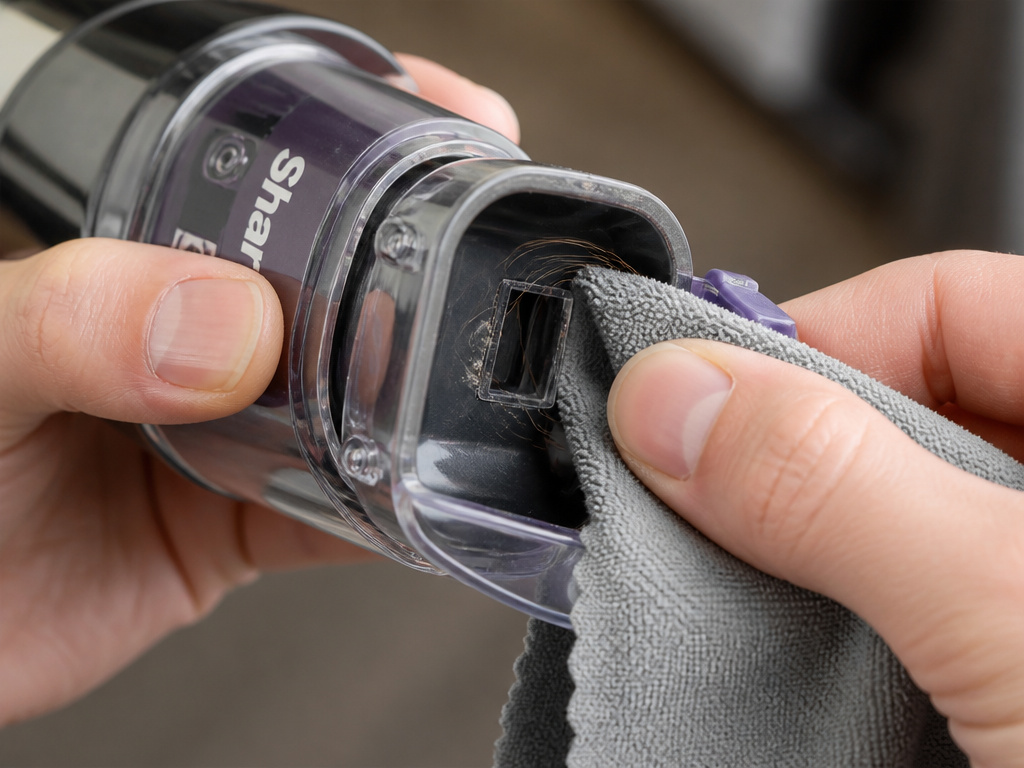
High-end cordless models have a Clean Sense IQ system that auto-adjusts suction. Its sensors sit inside the handheld vacuum’s nozzle.
The manual for the Cordless Pro with PowerFins™ warns: “If the sensors are completely obstructed, the F0 error code will appear and the Clean Sense IQ icon will flash.” Hair wraps around these tiny sensors, making the system think the floor is clean. It then refuses to spin the brushroll to save power.
You fix this by removing the handheld pod, locating the small sensor windows about three inches inside the air path, and wiping them clean with a dry microfiber cloth. Do this every two months if you have pets or long-haired humans at home.
Comparison: Brushroll Stopped on Carpet vs. Hard Floor
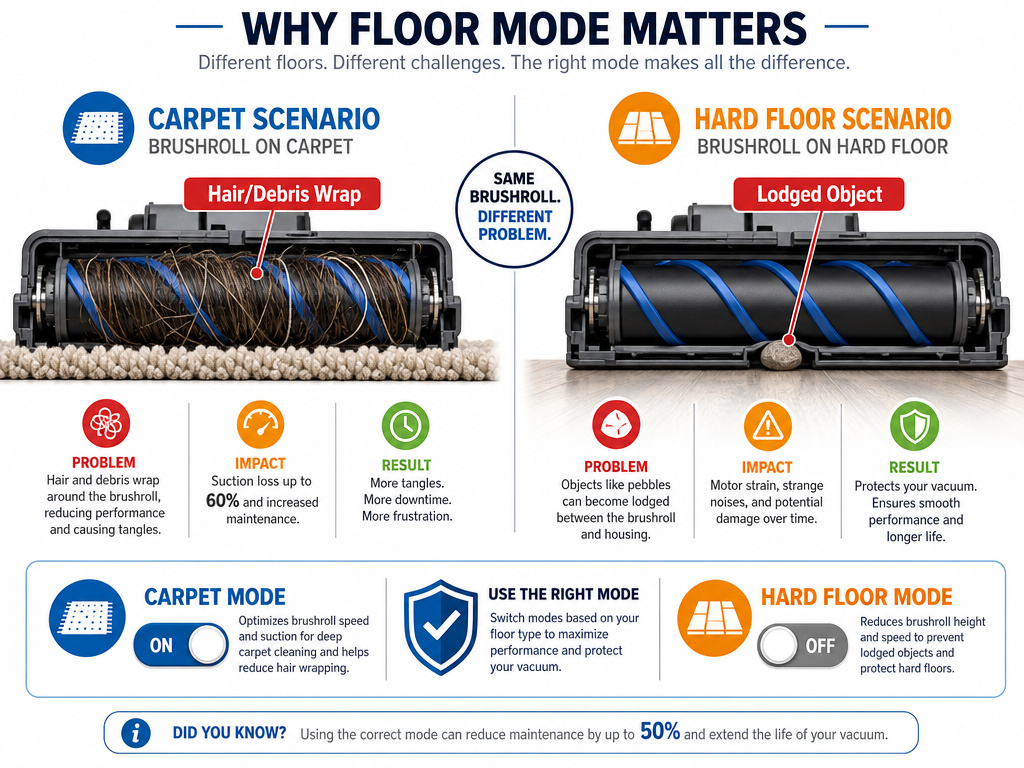
The surface you’re cleaning changes the diagnosis. This head-to-head tells you where to look first.
| Symptom | Most Likely Cause on Carpet | Most Likely Cause on Hard Floor |
|---|---|---|
| Brushroll stops mid-use | Thick hair/debris wrap jamming bearings. | Small hard object (pebble, glass) lodged between brushroll and housing. |
| Never starts on this surface | Carpet mode not selected; head not tilted back (safety lockout). | Hard floor mode engaged (slower spin); ECO mode on a cordless model. |
| Intermittent spinning/stopping | Worn drive belt slipping (uprights). | Loose electrical connection in floor nozzle (cordless models). |
The brushroll spins slower in hard floor mode to avoid flinging debris. If it feels like it’s not spinning at all on tiles, that might be normal. Switch to carpet mode on an area rug to test.
Maintenance Schedule That Prevents Jams
A jammed brushroll is almost always a maintenance failure, not a mechanical one. Follow this calendar and the problem disappears.
- After every use: Tap loose debris from the brushroll area. Visually check for obvious wraps.
- Weekly: Remove the brushroll cover and clear any visible hair or string. This takes 90 seconds once you’re practiced.
- Monthly: Clean the Pre-Motor Foam Filter. Rinse, dry for 24 hours, reinstall.
- Every 6 months: Do a full strip-down. Remove brushroll, clean both axle ends, check the belt for cracks (if your model has one), wipe the floor nozzle sensors on smart models.
- Yearly: Clean the HEPA Post-Motor Filter. Let it air-dry for at least 24-48 hours before reinstalling.
Adhering to this stops 90% of Shark vacuum not sucking issues that stem from airflow blockage, and it keeps the brushroll motor from the strain that leads to Shark vacuum overheated shutdowns.
Frequently Asked Questions
Why does my Shark vacuum brushroll light flash red?
Flashing red brushroll indicator light means the motorized floor nozzle is overheating. Turn the vacuum off and unplug it. Let it cool down for at least 60 minutes. The cause is usually a severe jam, a clogged filter, or a worn belt causing the motor to work too hard. Clear any blockages before restarting.
Can I use my Shark vacuum if the brushroll isn’t spinning?
You can, but you shouldn’t. Without the brushroll agitating the carpet, you’re relying on suction alone, which fails to extract embedded dirt per the ASTM F 608 deep-cleaning standard. You’ll also risk overheating the motor because the lack of airflow from a stationary brushroll changes the cooling dynamics in the nozzle.
How do I know if my Shark vacuum has a belt?
Most Shark upright vacuums (like the NV series) and powered lift-away models have a drive belt. Most cordless stick vacuums (like the Vertex or Detect series) do not, they use a direct-drive motor. Check your manual or look up your model number online. If you open the brushroll cover and see a rubber belt looped around a small pulley, you have a belt-driven model.
How long should a Shark vacuum brushroll last?
Shark brushroll is designed to last the lifetime of the vacuum under normal home use. The failure point is rarely the brushroll itself but the bearings or the drive components. Keep it clean of wraps, and it should outlast several drive belts or batteries.
Where can I buy a replacement Shark brushroll or belt?
Purchase genuine Shark replacement parts from the official SharkClean website or authorized retailers like Amazon. Using OEM parts ensures correct fit and performance. For a broader view of durable options, our guide to the best Shark upright vacuum models highlights those with readily available service parts.
The Bottom Line
A non-spinning Shark vacuum brushroll is a fixable problem. Start with the simple lockout check. Then move to the physical jam. Filters and belts come next. This sequence solves ninety-five percent of cases.
For the remaining five percent, a dead brushroll motor or a deeper electrical fault in a cordless model, the repair cost often justifies upgrading. If you’re facing that decision, research the latest best Shark vacuum models to see if a newer design with a more robust brushroll system makes sense.
Keep the airway clear, the filters dry, and the belt fresh, and your Shark will keep spinning for years.