
Dyson Vacuum Not Working After Cleaning Filter: Fix It Now
This post contains affiliate links. As an Amazon Associate, we earn from qualifying purchases.
A Dyson vacuum not working after cleaning the filter is almost always caused by reinstalling a damp filter. The moisture blocks airflow, triggering the machine’s protective shut-off. If the filter was still wet, water can be sucked into the motor head, causing a short circuit that requires a full motor replacement. The fix is to remove the filter, verify it is completely touch-dry, and reinstall it correctly with a firm clockwise turn until it clicks.
That 24-hour drying rule is the physical minimum for the dense foam and pleated paper inside a Dyson filter to shed all internal moisture through evaporation alone. Put it back damp, and you create two simultaneous failures: an airflow block the machine detects instantly, and a slow water migration that kills the motor over the next few uses.
What follows is the diagnosis sequence. We’ll start with the instant check, is the filter wet or loose, then move to the less obvious culprits: a clogged cyclone, a filter worn past its two-year lifespan, and the motor-head failure that means a repair bill. The goal is to get your machine running in five minutes or tell you exactly why you can’t.
Key Takeaways
- A damp filter is the #1 cause. The machine’s sensors detect blocked airflow and shut down to prevent overheating. You must dry the filter for a full 24 hours with good airflow, no heat, no shortcuts.
- Improper installation is next. The filter must be pushed in and turned clockwise until it audibly clicks and seats flush. An unsealed filter breaks the vacuum seal.
- If the machine ran with a wet filter, water ingress can short the motor head. This is a permanent failure requiring a motor replacement, not a simple fix.
- Fine dust from frequent use or Eco mode operation clogs filters faster, requiring washes every two weeks instead of once a month.
- Dyson HEPA filters have a functional lifespan of about two years with regular cleaning. A collapsed or saturated filter won’t pass air even when clean and dry.
The Immediate Fix: Is Your Filter Wet or Loose?
Check this first. The problem is usually in your hands, not inside the machine.
Remove the filter again. Press it against your cheek or the back of your wrist, the skin there is sensitive to dampness. If it feels cool or clammy, it’s still wet inside. Look at the pleated paper element. If any of the folds look darker or feel stiff, moisture is trapped.
Now, check the seating. Is the filter fully pushed into the machine’s body? On a Dyson V11 or V7, you must turn the filter clockwise until you feel a distinct click and the housing sits completely flush. A half-turn won’t seal it.
Common mistake: Assuming “mostly dry” is good enough. The foam element holds water like a sponge. If the outside feels dry but the inside is damp, you have the same airflow block.
If it’s wet, proceed to the drying protocol below. If it’s dry and seated correctly, but the machine still won’t run, the issue is deeper.
Why a Wet Filter Shuts Down Your Vacuum
This is a direct, mechanical response.
The vacuum motor pulls air through the machine at a high rate. That air must exit freely through the filter. A wet filter’s pores are blocked by water surface tension. Airflow drops to a trickle.
The machine’s thermal sensors detect the motor working too hard against this blockage and overheating. To prevent a burn-out, the protection circuit cuts power. On cordless models, this often looks like the machine pulsing on and off every second. On corded models, it might simply not start or shut off after a few seconds.
The real danger comes next. If you force the issue by trying to use the vacuum, that suction can pull microscopic water droplets from the damp foam, straight into the motor chamber.
Where this goes sideways: Water meets the motor’s electrical components. A short circuit follows, arcing across the windings. The damage is immediate and permanent. The repair is a full motor-head replacement, which Dyson quotes at a significant fraction of a new vacuum’s cost.
The takeaway is simple. A wet filter causes a protective shutdown. A very wet filter can cause a kill.
| Filter Condition | Machine Symptom | Internal Risk | Timeline to Failure |
|---|---|---|---|
| Slightly damp | Intermittent pulsing, loss of power | Overheating stress on motor | Minutes to hours of use |
| Moderately wet | Will not start, or shuts off in 2-3 seconds | High probability of water ingress | Within the next cleaning cycle |
| Soaking or recently washed | No power, possible error code | Immediate short-circuit risk | Instant upon triggering suction |
The Step-by-Step Dry-and-Reinstall Protocol
If your filter failed the damp test, follow this. Rushing it guarantees a repeat.
- Shake, don’t bake. Hold the filter over a sink, foam element down, and snap your wrist sharply several times. This forces trapped water from the pleats. Never use a hair dryer, oven, microwave, or place it in direct sun. Heat warps the plastic housing and degrades the filter media.
- Airflow is everything. Place the filter on a towel, open-end up, in front of a fan or in a breezy room. A stuffy cupboard adds days. The Dyson V11 manual mandates “a minimum of 24 hours in an environment with good airflow.” That’s the benchmark.
- The touch test. After 24 hours, feel the inside of the foam element and the deepest part of the paper pleats. If any spot feels cool or yields moisture under pressure, give it another 12 hours. “Touch dry” means completely dry to the skin.
- Reinstall with authority. Align the filter, push it firmly into the machine, and rotate clockwise until it clicks and sits flush. Listen for the click. Look for a seamless fit.
Skip the fan or cut the time short, and you’ll be back at step one in two days. The 24-hour rule exists because physics says so.
When a Dry, Seated Filter Still Fails
Your filter is bone-dry and clicked in place. You pull the trigger. Nothing. Now you move to the less common, but more serious, diagnostic tree.
A Clogged Cyclone or Airway
The filter is the final barrier. Everything behind it can also clog.
- Disconnect the wand and clean the cyclone. Remove the bin. Use a dry microfiber cloth to wipe the interior cyclone shroud, especially the small inlet holes. Pet hair and dust bunnies love to lodge here.
- Check the hose and brush roll. Detach the floor tool. Look through the wand for obstructions. Clear any thread or hair wrapped around the brush bar.
A blockage here mimics a bad filter, airflow drops, the machine overheats and shuts down. The fix is physical removal.
The Filter Is Just Worn Out
Dyson’s HEPA filters are washable, but not immortal. The official line is a two-year lifespan with monthly washing. Vacuuming fine dust like plaster or fireplace ash packs the pores permanently.
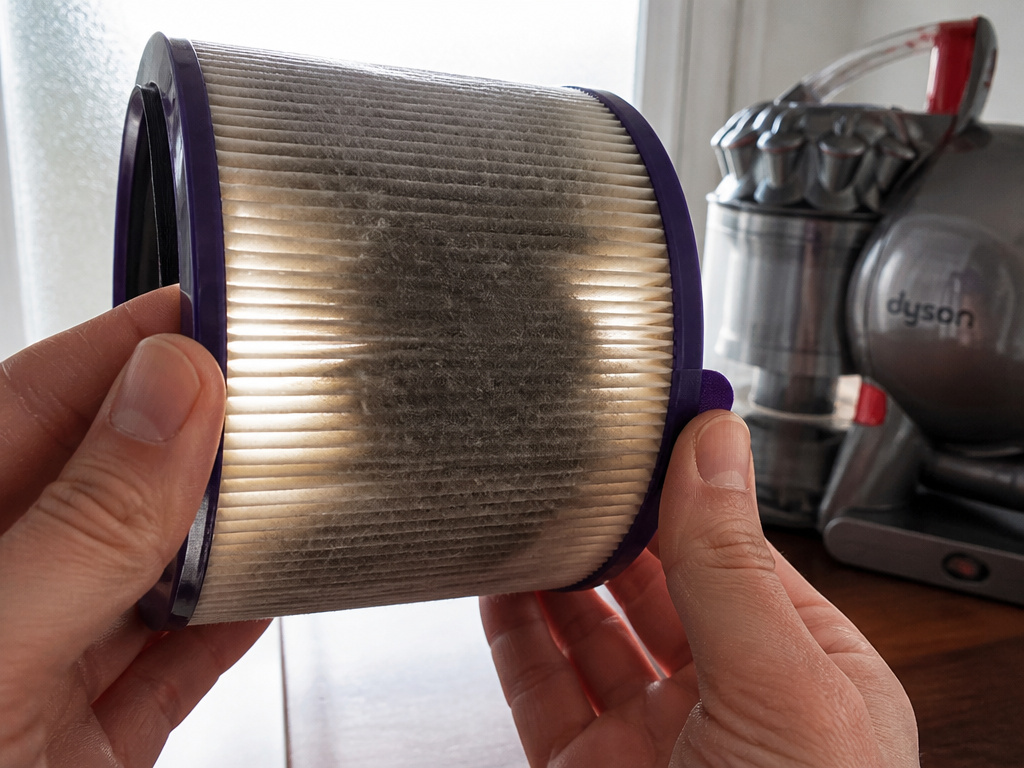
How to tell: Hold the clean, dry filter up to a bright light. Can you see light through most of the pleated paper? If large sections look matted and opaque, the filter is saturated. It won’t pass sufficient air even when clean. This gradual loss of suction is often mistaken for a battery issue.
When this happens, you need a new filter. Buy it directly from Dyson or an authorized seller. Third-party filters often have inconsistent density, causing immediate airflow errors.
Motor Head Failure: The Worst-Case Scenario
This is what happens when the “wet filter” warning goes unheeded.
The symptom is definitive: a completely dead vacuum. No lights, no trigger response, no pulse, just silence. Sometimes, there’s a faint burnt-electrical smell from the motor housing.
The cause is water-induced short-circuiting inside the motor. The fix is a motor head replacement. This is not a user-serviceable part for most people. It requires opening the chassis, desoldering connections, and installing a new motor assembly.
The part nobody mentions: Dyson’s 12-month service guarantee covers labor and parts for defects. Water damage from a user-washed filter is explicitly not a defect. You’ll pay for this repair out of pocket.
If you suspect motor failure, contact Dyson Support. They can run remote diagnostics on newer connected models and confirm. For older models, a local appliance repair shop can give you a quote. Often, the cost approaches a new mid-range cordless vacuum.
How to Stop This From Happening Again
A little routine prevents the panic.
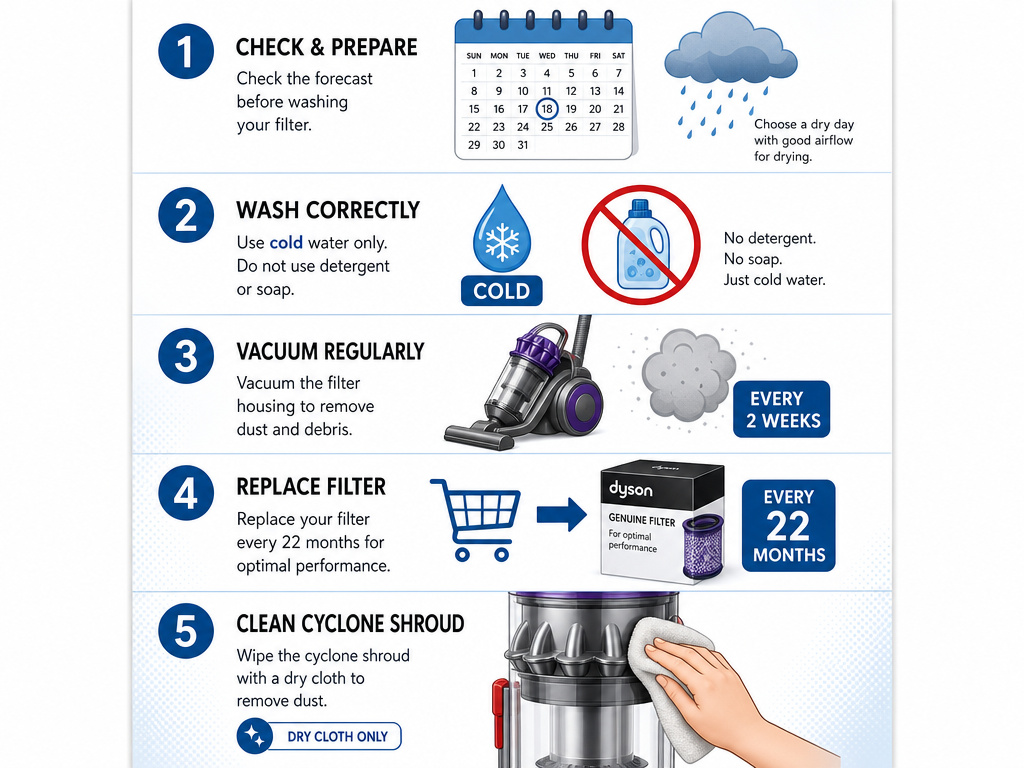
- Schedule washes around weather. Don’t wash your filter if you’ll need the vacuum within the next 48 hours. A rainy, humid day extends drying time to 36 hours.
- Wash with cold water only. Detergent leaves residue. Hot water can damage the filter media.
- Adapt frequency to your use. Using Eco mode or vacuuming fine, powdery dust? Wash the filter every two weeks, not once a month. The manual states this clearly.
- Mark your calendar. Note the date you purchased your vacuum. Start shopping for a genuine Dyson replacement filter around the 22-month mark.
- Clear the cyclone monthly. When you empty the bin, take an extra 30 seconds to wipe the cyclone shroud with a dry cloth. It prevents secondary blockages.
This five-minute ritual keeps a $700 machine running for a decade.
Frequently Asked Questions
Why does my Dyson pulse after I cleaned the filter?
The filter is damp. The machine is detecting low airflow, overheating, and cycling the power on and off to protect the motor. Remove the filter and dry it completely for 24 hours with airflow. This pulsing is the primary symptom of a filter not sealed correctly or a wet blockage.
Can a wet filter ruin my Dyson?
Yes, permanently. If a significantly wet filter is used, suction can draw water into the motor head, causing an electrical short. This kills the motor. The repair is a full motor replacement, which is often costly. This is a distinct failure from the common loss of suction from a simple clog.
How long does it really take for a Dyson filter to dry?
The official Dyson manual for the V11 and V7 states “a minimum of 24 hours” in a well-ventilated area. In humid conditions, it can take 36. Using a fan directly on it can ensure it meets the 24-hour mark. Do not use heat.
My filter is dry and clicked in, but the machine is dead. What now?
You likely have a different issue. Check for a clean filter alert or error codes on the screen. If there’s no power at all, suspect a battery fault, a faulty charger, or, worst case, motor failure from prior water damage. A machine that exhibits intermittent power points to a battery or thermal issue.
Are all Dyson filters washed the same way?
Mostly. The core rule, cold water, no detergent, air dry, is universal. The removal direction varies: V11 filters turn counterclockwise (US manual) or anticlockwise (CA manual) to remove. V7 post-filters also turn anticlockwise to unlock. Always confirm by checking the arrows or dots on your specific filter housing.
Before You Go
The sequence is fixed. Feel the filter for dampness. Listen for the click on reinstall. If it’s dry and seated, look for a clog in the cyclone or a worn-out filter. Remember the 24-hour dry rule is the time needed to avoid a $200 motor.
For cordless models, this protective shutdown is a feature, not a bug. It’s trying to save itself from your damp filter. Heed the warning. Dry it fully, click it home, and your machine should come back to life. If it doesn’t, the problem was already in the motor, and your cleaning day just got a lot more expensive.