
How to Clean a Dyson Upright Vacuum Filter: The Right Way
This post contains affiliate links. As an Amazon Associate, we earn from qualifying purchases.
To clean a Dyson upright vacuum filter, you must wash two specific filters with cold water only, no detergents, and let them air dry completely for a minimum of 24 hours before reinstalling. Using a damp filter can damage the motor. The filter in the ball (Filter B) will turn grey; that’s normal and does not mean it’s dirty.
That 24-hour drying window isn’t a suggestion. It’s the line between a filter that works and one that lets moisture into the motor chamber, which triggers the thermal cut-out within a few cleaning cycles. Every Dyson manual from the UP13 to the DC41 states the same drying time.
What follows: the exact filter locations for five common models, the physical steps to wash them without breaking the material, and the three mistakes that cause most post-cleaning suction loss.
Key Takeaways
- Wash only with cold tap water. Detergents, soaps, or warm water clog the filter’s micro-pores and reduce airflow permanently.
- Air dry for a full 24 hours minimum. Placing a damp filter back in the machine is the fastest way to cause a motor-overheat fault.
- The ball filter (Filter B) naturally turns grey with use. Do not scrub it white; you’ll damage the material.
- If you vacuum fine dust like plaster or flour, wash the filters monthly. For normal household dust, every three months is sufficient.
- Always unplug the vacuum before removing any filter. This is a non-negotiable safety step.
The Two Filters and Where to Find Them
Your Dyson upright has two washable filters. They are not interchangeable, and each has a specific home. Filter A lives in the cyclone handle above the bin. Filter B is inside the ball assembly at the machine’s base.
Filter A (Cyclone Handle): Captures fine particles after cyclonic separation. It’s a cylindrical pleated filter. On UP19/UP20/UP13 models, a catch on the front of the handle releases it. On the UP30, you push up a catch on the bin handle. Filter B (Ball Assembly): Acts as a final pre-motor filter, protecting the engine from any debris that gets past Filter A. It’s a dome-shaped, dense foam filter. It turns grey over time, this is expected and noted in the DC24 manual.
Locating them is the first hurdle people face. The design varies just enough between model generations to confuse anyone working from memory.
Model-by-Model Filter Removal
This isn’t a one-size-fits-all process. The mechanism changes.
| Dyson Model | Filter A Removal | Filter B Removal |
|---|---|---|
| UP19, UP20, UP13 | Release the catch on the front of the cyclone handle. | Turn the yellow (or blue) central locking dial on the ball cover counter-clockwise, lift cover, turn filter 1/4 counter-clockwise. |
| UP30 | Push up the catch on the front of the bin handle. | Turn the yellow central locking dial counter-clockwise, then twist the filter itself one-quarter turn counter-clockwise. |
| DC24 | Not explicitly shown; typically accessed by removing the cyclone/bin unit. | Accessed via the ball cover. Rinse and “tap out until the water runs clean.” |
The UP30‘s Filter B removal is a two-step twist. Most people miss the second twist on the filter itself and pull, which can tear the foam rim. If the filter doesn’t lift out after you unlock the dial, give it a quarter-turn.
Step-by-Step Washing Process
Once the filters are out, the cleaning method is uniform across all models. The water temperature and drying discipline matter more than how hard you scrub.
Before you start: Unplug the vacuum. This is critical. You are handling components that channel air directly to the motor. Any accidental activation while a filter is out could suck in debris and cause immediate damage.
-
Rinse with Cold Water Only. Hold Filter A under a cold tap. Run water through the open end until it runs clear. Turn it upside down and tap it out. For Filter B, rinse it under cold water, tapping it on the plastic rim (not the filter material) until the water runs clear.
- Skip this, and you’ll leave a clay-like dust paste inside the pleats. That paste hardens as it dries, blocking up to 40% of the airflow.
-
Clean the Exterior. Run water over the outside of both filters. For Filter A, this means water over the pleated cylinder. For Filter B, water over the foam dome. Continue until the runoff is clear.
- This removes the surface layer that would otherwise re-contaminate the clean interior.
-
Remove Excess Water. Squeeze and twist Filter A with both hands. Do not wring it like a towel, you’ll misalign the pleats. For Filter B, tap it vigorously on its plastic rim until no more droplets fly out.
- Consequence: Leaving filters sopping wet extends the drying time to 36+ hours. In a humid basement, they might never fully dry, leading to mildew inside the filter.
-
Dry for 24 Hours. Stand both filters on their wide, open ends in a warm, well-ventilated area. A sunny room is ideal. Do not use a hair dryer, radiator, oven, or microwave.
- The Dyson UP30 manual specifies “at least 24 hours in a well-ventilated, warm place.” This is the sourced-number that prevents motor damage.
Common mistake: Drying filters on a flat surface or on their sides. Water pools in the bottom pleats or the foam core, and the center stays damp for days. That damp center is what gets sucked into the motor on the first post-cleaning use.
The 24-Hour Dry Rule and What Happens If You Cheat
The mandatory drying period exists for a mechanical reason, not corporate caution. The filter material must be completely dry to allow unrestricted airflow. A damp filter restricts airflow, which makes the motor work harder to pull the same suction.
The motor then overheats. Dyson uprights have a thermal cut-out, a safety switch that shuts the motor off when it reaches a critical temperature. If you restart the vacuum with a still-damp filter, the cycle repeats. After a few episodes, the machine may shut off and refuse to restart until it cools for an hour or two.
This is why a Dyson upright vacuum overheating or a Dyson vacuum keeps overheating is a common search right after a filter wash. The problem isn’t the vacuum; it’s the filter schedule.
| Symptom | Likely Cause | Timeline |
|---|---|---|
| Vacuum shuts off after 5-10 minutes of use. | Damp Filter B installed. | Immediate on first post-cleaning use. |
| Reduced suction, motor sounds strained. | Filter A pleats clogged with detergent residue or hard water scale. | Develops over 2-3 washes with incorrect cleaning. |
| Filter light flashing or constant clean filter alert. | Moisture or debris on filter sensor, or severely clogged filter. | Can appear during or right after a wash if filter isn’t dry. |
If your Dyson vacuum is not working after cleaning the filter, the first step is to remove both filters and verify they are bone-dry inside. Re-wash if needed, and give them another full day to dry.
How Often Should You Clean Dyson Upright Vacuum Filters?
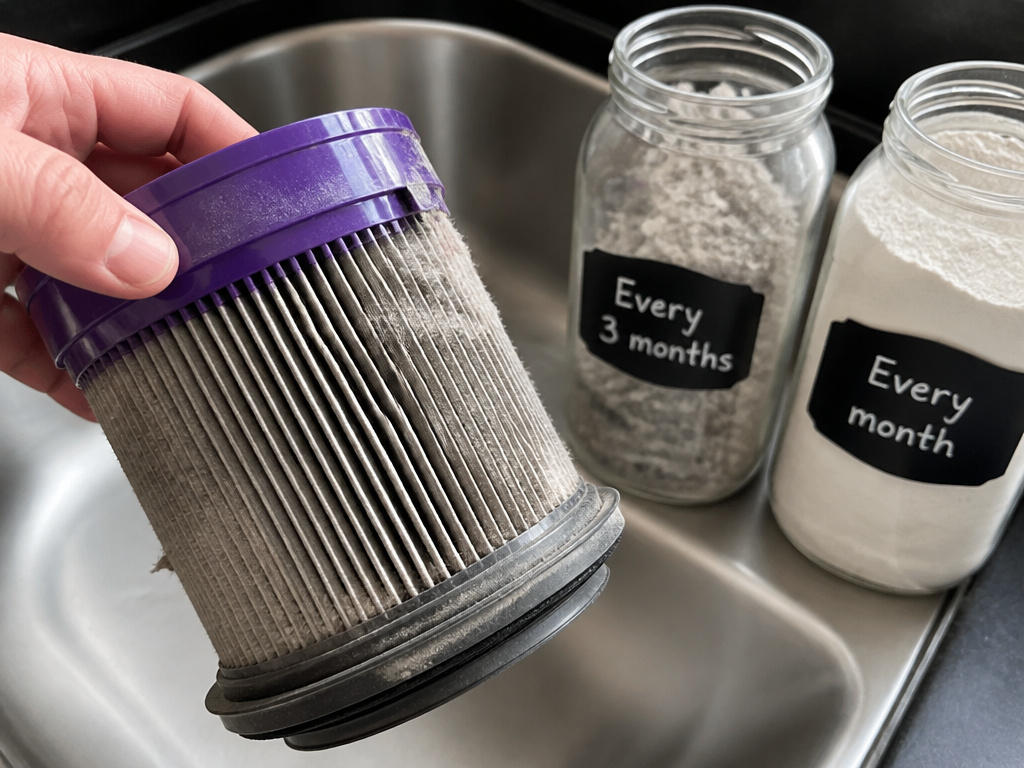 The schedule depends entirely on what you’re vacuuming. The manuals state filters “may require more frequent washing if vacuuming fine dust.”
- Normal household dust and debris: Every 3 months.
- Fine dust (construction dust, plaster, flour, pet litter): Every month. This dust is finer than the cyclone can separate, so it loads the filters faster.
- Pet hair (with no fine dander): Every 2 months. Hair itself doesn’t clog filters quickly, but the accompanying dander does.
- After vacuuming a major spill like flour or drywall dust: Wash immediately after the job.
There’s no sensor that knows if you’ve been vacuuming fireplace ash or just carpet lint. The machine’s filter maintenance indicator is usually timer-based. If the light comes on early, wash the filters. If it hasn’t come on in 6 months, wash them anyway.
What Not to Do: The Banned List
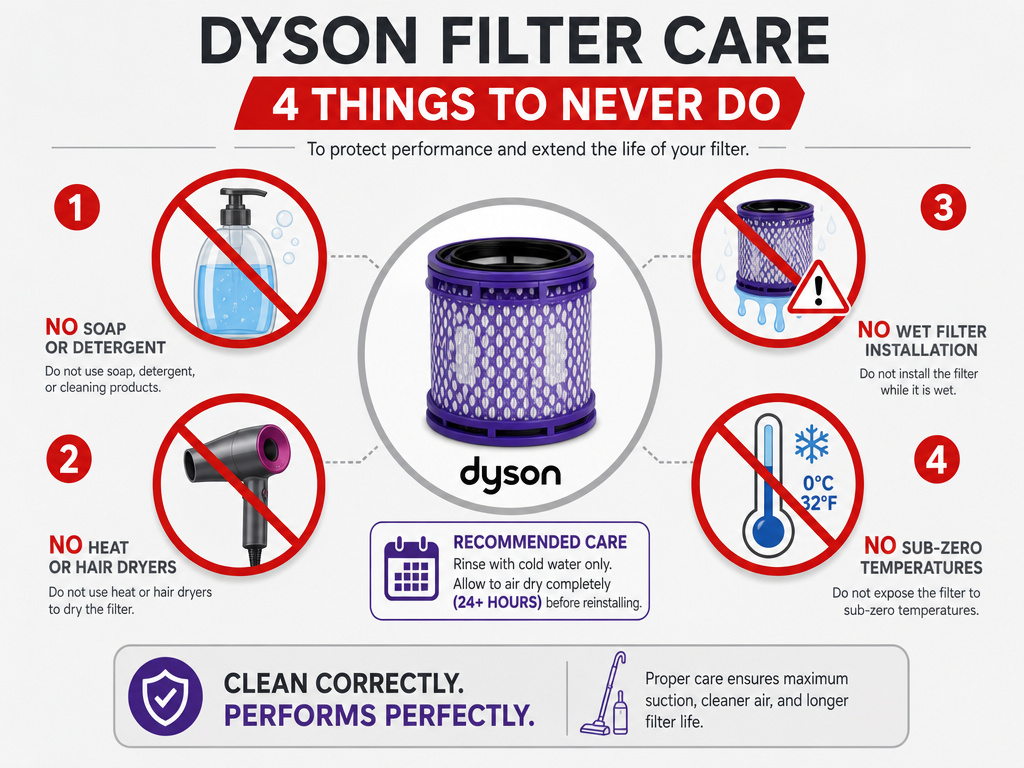 Dyson’s manuals are explicit about what voids warranties and breaks filters. This isn’t scare talk; it’s the list of repairs they won’t cover.
Never use detergents, soaps, or cleaning agents. They leave a film that attracts more dust and permanently reduces porosity. Rinse with cold water only. Never use heat to dry. No dishwashers, washing machines, tumble dryers, ovens, microwaves, or hair dryers. Heat melts the fine fibers in Filter A and deforms the foam in Filter B. Never operate the vacuum with a damp filter. This is the direct path to motor overheating and a tripped thermal cut-out. Never store or use the machine below 3°C (37.4°F). Let it reach room temperature before operating. Cold plastic is brittle, and cold filters can retain moisture.
If you’ve used a detergent, the filter is compromised. You might not notice a loss of suction immediately, but it will build. The only fix is a replacement filter.
Reassembly and Verification
A clean, dry filter installed wrong is as bad as a dirty one. The seal must be perfect.
- Insert Filter A. Place it back into its housing in the cyclone handle. On UP19/UP20/UP13 models, swing the handle back until the latch clicks. You should hear and feel a positive engagement. A filter not sealed here lets dirty air bypass the filter entirely.
- Click the cyclone unit. Push the cyclone and clear bin unit back onto the main body until it clicks. Tug gently on the carry handle to confirm it’s locked.
- Insert Filter B. Place it onto the ball posts. Turn it clockwise until the white arrows align (or it feels seated). Refit the ball cover and turn the central locking dial clockwise until it clicks.
- Power Test. Plug in the vacuum. Turn it on and listen. The motor should sound smooth, not labored. Place your hand over the hose inlet to feel strong suction.
If the motor sounds rough or suction is weak, immediately turn it off and unplug it. Check that both filters are fully seated and dry. A common culprit is Filter B not twisted fully into its locking position.
Troubleshooting Post-Cleaning Problems
Sometimes, things don’t go right. Here are the fixes for the usual suspects.
- Vacuum won’t turn on: Check that it’s plugged in and the outlet works. Verify no filter warning light is flashing a fault code. Ensure filters are correctly installed.
- Weak suction or suction problems: Check for a blockage in the hose, wand, or cleaner head. Ensure the clear bin is empty and the bin base is clicked shut. Verify filters are completely dry.
- Motor runs but brush head doesn’t spin: This is unrelated to filter cleaning. The brush bar may be obstructed or the belt broken. See our guide on cleaning the Dyson upright vacuum head.
- Burning smell: Turn off and unplug immediately. This indicates a severe blockage or a damp filter causing the motor to overheat. Let it cool for two hours, then check all airways and filters.
These steps are the same whether you own a UP19, a DC24, or an older UP13. The principle is universal: clean filters need water, time, and a perfect seal.
Frequently Asked Questions
Can I use warm water to clean my Dyson filter?
No. Use cold water only. Warm water can cause fine dust particles to clump and bind to the filter material, creating a paste that is impossible to rinse out. It also risks damaging the filter’s glue or foam structure.
Why did my Dyson filter turn grey?
The foam Filter B in the ball assembly is designed to turn grey with normal use. The Dyson DC24 manual explicitly states, “It is normal for the filter in the ball to turn grey in colour.” This is not dirt; it’s a natural discoloration of the material. Do not try to scrub it white.
How do I clean my Dyson filter without a tap?
If you lack a tap, use a large bowl or bucket of cold water. Submerge the filter and agitate it vigorously. Pour out the dirty water and repeat with fresh cold water until the water remains clear. The key is multiple rinses with plenty of fresh water movement.
What’s the difference between cleaning an upright filter and a Dyson canister filter or Dyson cordless filter?
The core rules are identical: cold water, no detergent, 24-hour dry. The difference is the filter’s shape, location, and removal mechanism. Canister and cordless models often have a single, combined filter, while uprights have two separate filters in specific locations.
Can I speed up the 24-hour drying time?
No. Forced air from a fan in a warm room can help, but do not apply heat. The filter must be air-dried at ambient temperature. Placing it in sunlight is acceptable, but direct, hot sun for hours could potentially degrade the materials over many cycles.
Before You Go
Cleaning your Dyson upright’s filters is simple if you follow the manual’s three laws: cold water, no soap, and a full day to dry. The 24-hour dry is the guard rail. Cheat it, and you’ll meet the thermal cut-out. The filter in the ball will grey, let it. Your job is to rinse the debris out, not the color. Keep a second set of filters on hand if you can’t wait a day between cleans. That’s the only shortcut that works.