
Can I Just Vacuum My Air Filter? Safe Cleaning Tips & Warnings
This post contains affiliate links. As an Amazon Associate, we earn from qualifying purchases.
You can vacuum some air filters, but only if they are a removable prefilter made of foam or a non-woven synthetic mesh designed for surface cleaning. The Breville Smart Air Connect manual explicitly recommends vacuuming its prefilter monthly. You must never vacuum the main carbon or HEPA filter inside the same unit, as the suction and brush will shred the delicate media and destroy its filtration capability.
That answer depends entirely on which layer of your air cleaner you’re looking at. Manufacturers give clear, conflicting instructions for different parts of the same machine.
The rest of this guide breaks down the three filter types you’ll encounter, the exact models where vacuuming is in the manual, and the one measurement that tells a whole-house system it’s time for service, not guesswork.
Key Takeaways
- Vacuuming is only for prefilters. The Breville Smart Air Connect and Resideo F300 manuals specifically instruct using a vacuum with a brush attachment.
- Never vacuum a carbon or true HEPA filter. The suction and agitation will damage the fine fibers and carbon granules, ruining their ability to trap pollutants.
- A whole-house electronic air cleaner, like the Resideo F300, needs service when the pressure drop across it reaches 0.5 inches of water column, a spec your HVAC tech can measure.
- Your environment dictates the schedule. Homes with pets, smoking, or woodworking need to clean prefilters far more often than the manual’s base recommendation.
- If your air purifier has a sealed, disposable filter cartridge (like many Aprilaire models), vacuuming isn’t an option. You replace it.
The Prefilter Exception: When Vacuuming Is Officially Recommended
Look at the front grille of your air purifier. If there’s a thin, washable foam or mesh screen tucked behind it, that’s the prefilter. Its job is simple: catch the big stuff. Pet hair, lint, dust bunnies. This coarse layer protects the expensive, fine-filtering media behind it from clogging too fast.
For this layer alone, vacuuming isn’t just allowed, it’s the manufacturer’s first-choice cleaning method.
The Breville Smart Air™ Connect Purifier (BAP308) instruction manual states: “The quickest and easiest way to clean your prefilter is to use the brush attachment of your vacuum cleaner to vacuum the lint off the dirty side of the prefilter.”
The manual calls for this at least monthly. The Resideo F300 Electronic Air Cleaner manual gives the same advice for its prefilter, recommending a cleaning every six months. They both specify a brush attachment. The soft bristles dislodge dust without pushing it deeper into the foam.
This is maintenance with a real purpose. A clogged prefilter chokes airflow. Your system’s fan works harder, moving less air and straining the motor. The main filter behind it also gets less air to clean, so overall efficiency plummets.
Where this goes sideways: Using the vacuum’s bare hose or a powered brush roll. The high suction can stretch and tear the foam. The rotating bristles of a powerhead can shred it. Use the hand-held upholstery tool.
| Filter Type | Vacuum Safe? | Tool Required | Manufacturer Example |
|---|---|---|---|
| Foam Prefilter | Yes | Vacuum with soft brush attachment | Breville Smart Air Connect |
| Synthetic Mesh Prefilter | Yes | Vacuum with soft brush attachment | Resideo F300 |
| Carbon Filter | No | Replace only | Breville Smart Air Connect |
| Pleated HEPA | No | Replace only | IQAir HealthPro Series |
| Disposable Media Filter | No | Replace only | Aprilaire 1000/2000 Series |
Clean the prefilter over a trash can. Tap it gently first to knock off loose debris, then use the vacuum brush in slow, overlapping strokes. If the filter is greasy from kitchen air, vacuuming won’t cut it, you’ll need to wash it with mild detergent as a second step.
The Carbon and HEPA Rule: Why Vacuuming Destroys Them
Behind the prefilter lives the real workhorse: the carbon or HEPA filter. This is where the answer flips to a hard no.
A carbon filter is a bed of activated granules. Vacuuming pulls those granules right out of the fabric holding them, like sucking sprinkles off a donut. You’re left with a hollowed-out shell that does nothing for odors or gases.
A true HEPA filter is a dense web of ultra-fine glass fibers. The fibers are bonded in a specific, delicate matrix. The force of vacuum suction, and the abrasion from any brush, snaps these microscopic fibers. Each broken fiber creates a larger hole in the filter media.
Common mistake: Vacuuming a HEPA filter to “extend its life.” You might see dust come off the surface, but you’re creating micro-tears that let smaller particles pass through. The filter’s efficiency rating is now a guess.
The damage isn’t always visible. A filter that looks cleaner might actually be performing worse. You’ve turned a precision filter into a loose net.
This is why brands like IQAir are unequivocal. Their HealthPro Series manual details replacing the HyperHEPA filter, with zero mention of cleaning it. The Breville manual is even more direct, warning against vacuuming the carbon filter as it can cause damage. These filters are consumables. Their job is to load up with contaminants until you swap in a fresh one.
For a Dyson canister filter or a Hoover HEPA filter, the safe cleaning method is always a gentle tap and rinse (if washable), never the vacuum hose.
What About My Whole-House System or Furnace Filter?
The rules change scale but not logic. A large, permanent electronic air cleaner installed in your HVAC ductwork has its own service manual.
Take the Resideo F300. It has an aluminum prefilter, a set of electronic cells, and a final postfilter. The manual says to vacuum the lint off the prefilter. The electronic cells get washed in a sink or shower. The postfilter gets replaced.
The critical metric for these systems isn’t a date on a calendar. It’s pressure.
The Resideo F300 manual states the air cleaner must be cleaned when the pressure drop across it reaches 0.5 in. W.c. (0.1 kPa), or at least annually.
Pressure drop is the resistance the filter creates against the airflow. As it loads with dirt, resistance increases. Your blower motor strains to push air through. Measuring this requires a manometer, a tool your HVAC technician has. This is the professional, accurate way to know it’s time for service, not a guess.
Disposable pleated furnace filters, like those from Aprilaire, follow the replace-only rule. They’re constructed like a cardboard frame holding a giant, shallow HEPA media. Vacuuming bends the pleats and compromises the material. You can’t clean them; you replace them every 6-12 months.
If you’re using a best HEPA vacuum for your home, you’re already tackling the source of the dust that clogs these filters.
How to Actually Clean a Vacuum-Safe Prefilter (Step-by-Step)
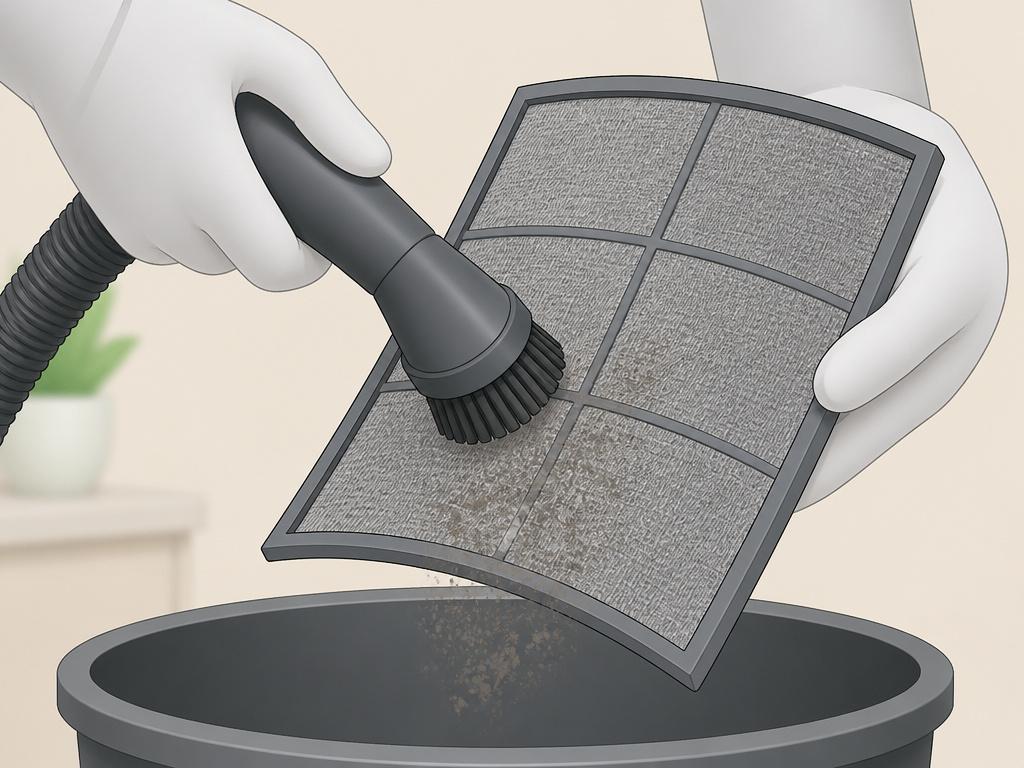
When the manual gives the green light, do it right. Here’s the sequence that matches the OEM instructions.
- Unplug and Access. Turn off and unplug your air purifier. Remove the outer grille or cover to access the prefilter. Consult your manual, some twist off, some clip.
- Remove the Prefilter. Gently pull the foam or mesh screen from its frame. Handle it by the edges to avoid pushing dirt into the material.
- Initial Debris Removal. Take it to a trash can and give it several firm taps against the inside wall. This dislodges the heaviest, driest dust.
- Vacuum with Brush Attachment. Fit your vacuum hose with the soft brush tool. Use slow, gentle strokes across the surface of the filter. Go in one direction, then rotate the filter and go the opposite way. The goal is to lift dust, not grind it in.
- Inspect and Wash (If Needed). Hold the filter up to a light. If you still see matted debris or grease stains, it needs washing. Use lukewarm water and a drop of mild dish soap. Gently squeeze and rinse until the water runs clear. Never wring or twist.
- Dry Completely. This is the mandatory step. Let the filter air-dry for 24 hours, or until every part is bone-dry. A damp filter in a dark unit is a mold incubator.
- Reassemble. Once dry, snap the prefilter back into its frame, replace the cover, and plug the unit back in.
Skip the drying step, and you’ll send musty air through your living room within a day. The motor can also suck in moisture.
Signs Your Filter Needs More Than a Vacuum
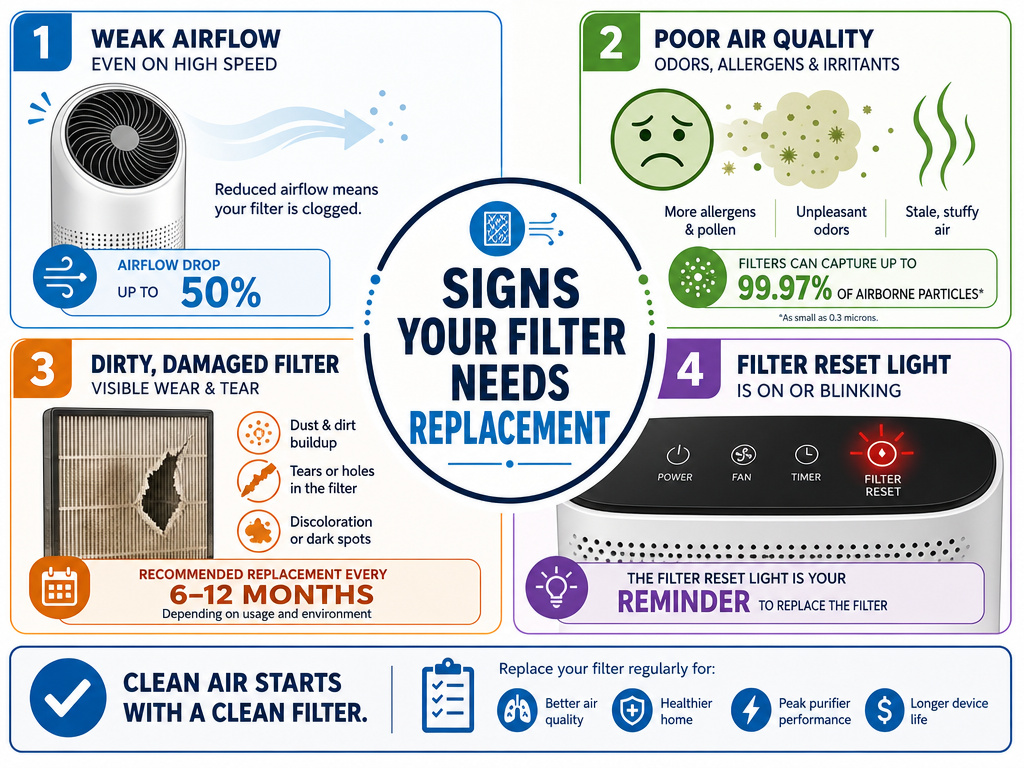
Cleaning a prefilter is interim maintenance. All filters eventually wear out. Watch for these signals that it’s time for a replacement, not another cleaning.
- Increased Noise or Weak Airflow: The fan is straining against a clog. This is the most common sign for both room purifiers and whole-house systems.
- Persistent Odors or Allergy Symptoms: The carbon is saturated, or the HEPA media is compromised. If your allergies flare up or smells linger with the unit on, the filter is done.
- Visible Damage or Permanent Staining: The foam is torn or misshapen. The mesh has a permanent grey or brown stain that washing won’t remove.
- The Filter Reset Light is On: Modern units like the Breville have a timer. The filter reset light blinks after 4,320 operating hours. That’s the manufacturer’s calculated end-of-life.
For whole-house systems, the only reliable sign is that pressure drop measurement. If you haven’t had it serviced in over a year and you have pets, assume it’s overdue.
Choosing a vacuum for asthma or a vacuum for dust with a sealed HEPA system reduces how fast your air purifier’s filters load up in the first place.
Frequently Asked Questions
Can I vacuum a HEPA filter to make it last longer?
No. Vacuuming a HEPA filter damages the fragile glass fibers. This creates micro-tears that allow allergens and fine particles to pass through, defeating its purpose. You replace HEPA filters. For specific guidance, see our article on whether you can vacuum a HEPA filter.
My air purifier manual doesn’t mention cleaning. What should I do?
If the manual only discusses replacement, your unit uses sealed, disposable filter cartridges. Do not attempt to clean them. Follow the replacement schedule, which is often based on runtime (e.g., 6 months at 24/7 operation). Brands like Aprilaire design their air cleaners this way.
How often should I vacuum my air purifier’s prefilter?
Start with the manufacturer’s base schedule, monthly for the Breville, every six months for the Resideo. Then adjust for your home. Double the frequency if you have multiple pets, someone smokes indoors, or you live in a dusty area. The filter’s appearance is your best guide.
Is it safe to use compressed air to clean a filter?
Never use compressed air on a carbon or HEPA filter. The high-pressure blast will force debris deeper into the media and likely rupture it. For a sturdy foam prefilter, it’s less damaging than vacuuming but can blow dust everywhere. The vacuum-with-brush method is the controlled, manufacturer-approved standard.
Can I wash a carbon filter?
Almost never. Most carbon filters are not designed to be washed. Water deactivates the carbon, rendering it useless for adsorption. It can also cause the filter media to break down or promote mold growth. Always check your manual. The default rule is replacement.
Before You Go
So, can you vacuum your air filter? Yes, but only the first line of defense, the prefilter. Use the soft brush tool, and do it over a trash can.
The main carbon and HEPA filters are off-limits. Their design is too delicate for suction and abrasion. Vacuuming them is a shortcut that leads to worse air quality and a sooner replacement.
Your manual has the final say. The Breville and Resideo guides explicitly recommend vacuuming the prefilter. The Aprilaire and IQAir manuals skip cleaning and go straight to replacement. Find your model’s book, look for the words “prefilter” and “vacuum,” and follow those instructions to the letter. That’s how you keep the air clean without breaking what cleans it.