
Vacuum Cleaner vs Carpet Cleaner: Key Differences Explained
This post contains affiliate links. As an Amazon Associate, we earn from qualifying purchases.
A vacuum cleaner removes dry debris from surfaces using suction and filtration. A carpet cleaner injects hot water and cleaning solution into carpet fibers, then extracts the dirty liquid to lift deep-set stains and grime. You need a vacuum for daily dirt, pet hair, and dust. You need a carpet cleaner for spills, pet accidents, and periodic deep cleaning.
That gap between surface cleaning and deep extraction is where the whole decision lives. One machine pulls, the other pushes and pulls. Using a vacuum on a wet stain just grinds it in. Using a carpet cleaner for daily dust is a massive, messy overkill.
What follows: the three mechanical specs that separate them, the specific jobs each one is built for, and the one mistake that wrecks both the machine and your floor.
Key Takeaways
- Vacuums operate on dry suction only; carpet cleaners use a hot water injection and extraction cycle that physically floods the carpet pile.
- Using a standard vacuum on liquid forces moisture into the motor, causing a short-circuit failure within minutes.
- Carpet cleaners have a limited operational radius of about 8 meters (per the Kärcher SE 4001 manual) due to their dual tanks and hose, making them poor tools for whole-home cleaning.
- For most homes, the default is a powerful canister or upright vacuum for regular use, with a dedicated carpet cleaner rented or used 1-2 times a year for deep cleaning.
- The BISSELL Big Green Machine 86T3 represents the professional-grade deep clean; the Philips PowerPro Expert FC9747/09 represents the high-filtration daily driver.
The Core Mechanical Difference: Suction vs. Extraction
This isn’t a matter of one being stronger. They are different tools using fundamentally different physics. A vacuum creates an area of low pressure to pull air and dry particulates into a bag or bin. A carpet cleaner is a small, mobile hot water extraction unit.
A vacuum cleaner’s performance is measured by airflow (in liters per second) and sealed suction. The Philips PowerPro Expert FC9747/09, for example, generates a maximum airflow of 32.5 l/s and filters 99.9% of fine dust on hard floors per the IEC62885-2 test standard. Its job is to move air efficiently and trap debris.
A carpet cleaner’s performance is measured by water lift (in inches of H2O), water temperature, and recovery tank capacity. The machine pumps hot, soapy water down into the carpet at pressure, agitates it with brushes, then uses a powerful vacuum motor to suck the now-dirty liquid back up into a separate tank. The Kärcher SE 4001 has a working width of 227 mm and a 4-liter dirty water tank because its job is to move liquid, not air.
Where this goes sideways: Putting a wet mess into a dry vacuum. The moisture bypasses the filter, coats the motor’s electrical components, and causes a short. For bagless models, the damp dirt then cakes onto the cyclone walls and creates a mold colony. The machine might not die immediately, but its suction will drop permanently within a few uses.
What Does a Carpet Cleaner Do That a Vacuum Can’t?
It removes the sticky, dissolved grime that adhesion keeps glued to carpet fibers. Dust and dry sand are held by gravity; vacuum suction overcomes that easily. Grease, soda, mud, and protein-based stains (like pet urine) bind to the carpet at a molecular level.
Hot water and detergent break that bond. The simultaneous extraction removes the suspended dirt before it can settle back down. No amount of vacuum suction, even from a commercial wet-dry vacuum, can replicate this chemical and thermal process. A wet-dry vac is for large liquid spills, not for cleaning the carpet itself.
| Aspect | Vacuum Cleaner | Carpet Cleaner |
|---|---|---|
| Primary Mechanism | Airflow & suction | Hot water injection & extraction |
| Target Debris | Dry particulates (dust, hair, sand) | Dissolved, sticky grime & stains |
| Key Metric | Airflow (e.g., 32.5 l/s) | Water lift (e.g., 90 in.) |
| Liquid Handling | None (will break) | Core function |
| End Result | Clean, dry surface | Deep-cleaned, damp carpet (requires drying time) |
When You Absolutely Need a Carpet Cleaner
The decision point is the nature of the soil. Think about what you’re cleaning, not just where.
For pet accidents, a vacuum is useless. It removes surface solids but drives urine deeper into the pad. You need a carpet cleaner with an enzymatic solution to break down the uric acid crystals and extract them. The BISSELL Big Green Machine 86T3 is certified “Pet Proven” for this reason—its 9-foot hose and Tough Stain Tool target specific spots.
For periodic deep cleaning, carpet fibers trap oily residues from cooking, outdoor soil, and skin cells. This is the grime that makes carpets look dull. A vacuum can’t touch it. A carpet cleaner resets the carpet by stripping this buildup. Industry guidelines suggest a deep clean every 12-18 months, depending on traffic.
For set-in stains like wine, coffee, or mud, a carpet cleaner is your only real shot. The hot water and agitation are necessary to lift the stain from the backing. Popular Mechanics’ review of the Tineco Carpet One Cruiser noted its sensor automatically adjusted power for ground-in peanut butter, lifting it after a few passes—something no vacuum setting could achieve.
Common mistake: Using a steam vacuum or a vacuum with a “wash” function for a true deep clean. These are typically light-duty hybrids. They dampen the surface but lack the separate, powerful vacuum motor needed to fully extract dirty water, often leaving carpets too wet for too long.
When a Vacuum is the Right (and Only) Tool
Your daily or weekly cleaning routine is vacuum territory. This is about maintenance, not remediation.
For dust, allergens, and pet hair, a vacuum with a HEPA 13 or equivalent sealed system is mandatory. The Philips PowerPro Expert FC9747/09 uses an Allergy H13 filter system to capture >99.9% of fine dust, per the DIN EN 60312/11/2008 test. A carpet cleaner has zero filtration for airborne particles; it would blow them around the room.
For hard floors and area rugs, you need the agility and appropriate brush roll of a vacuum. The TriActive+ LED nozzle on the Philips model lights up hidden dust. A carpet cleaner is too heavy, too wet, and its brushes are designed for carpet pile, which can scratch hardwood or laminate.
For whole-home efficiency, a vacuum’s cord length and maneuverability win. The Philips has a 7-meter cord and a 10-meter action radius. A carpet cleaner like the Kärcher SE 4001 has an 8-meter operating radius, tethered by its hose and tank weight. You don’t push a carpet cleaner up stairs or under beds.
If your goal is maintaining the best vacuum for carpet between deep cleans, focus on suction, brush-roll design, and filtration. According to Consumer Reports vacuum cleaner ratings, models like the Kenmore BU1018 and Shark PowerDetect AZ4002 excel at removing embedded dirt from carpets without moisture.
The 4-Step Carpet Cleaner Process (And Why It’s Slow)
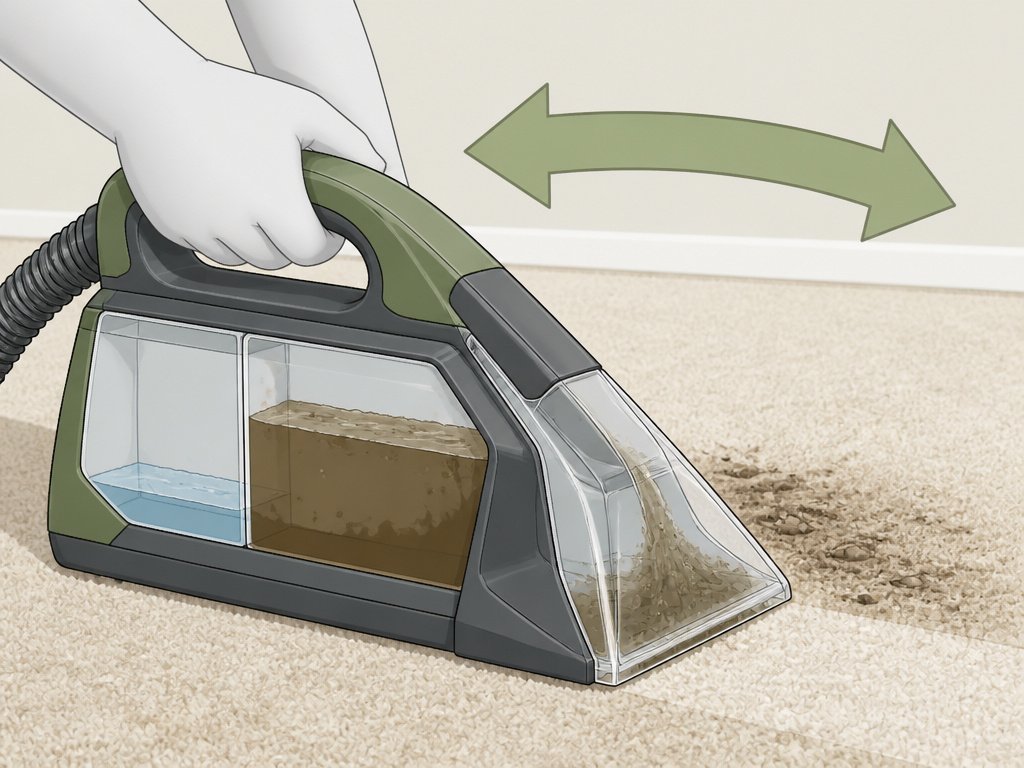
Understanding the steps explains the time commitment and the machine’s limitations.
- Pre-treatment. You often spray a stain pre-treat solution on heavy soils. Skip this, and the main cycle works harder, using more water and requiring more passes to dry.
- Fill and mix. You fill the clean water tank (usually 1-4 gallons) with hot water and a specific cleaning formula. Using plain water or the wrong solution leaves a residue that attracts dirt faster.
- Clean pass. You push the machine forward; it sprays solution and scrubs. You pull it back; it suctions the dirty water. Each pass requires this deliberate, slow back-and-forth motion. The Tineco Carpet One Cruiser has a 1-gallon total tank; the reviewer could clean only half an 8×10 rug before needing a refill.
- Drying. This is the critical, often overlooked phase. Even with a “drying mode” (like the Tineco’s 167°F air), carpets need 4-6 hours to dry completely. Running a vacuum or walking on it before then re-soils the damp fibers.
The part nobody mentions: The empty-and-clean ritual after use. You must immediately empty the foul dirty water tank, rinse both tanks, and run a cleaning cycle through the machine’s internal hoses to prevent mold. A vacuum just needs a bag change or bin dump.
Head-to-Head: Picking the Machine for Your Situation
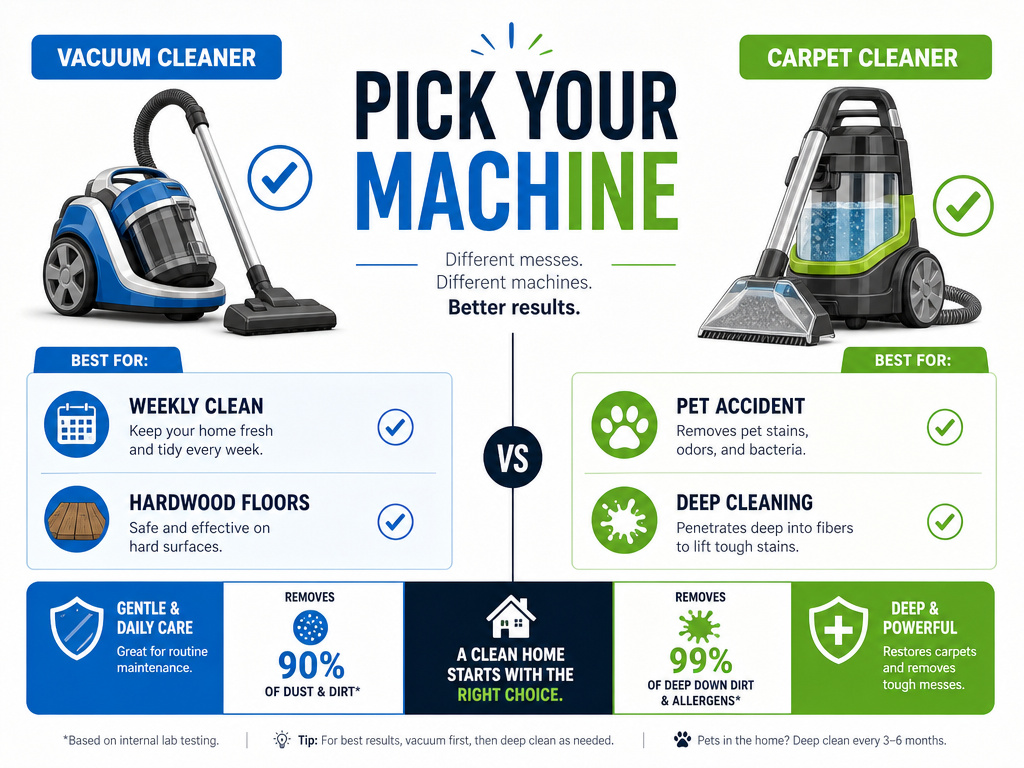
This is where abstract advice fails. Your floor type, mess type, and tolerance for hassle decide.
| Your Scenario | Tool to Reach For | A Specific Model to Consider | Why It Wins Here |
|---|---|---|---|
| Weekly living room clean | Vacuum Cleaner | Bosch Unlimited 8 Gen2 (BCS8224GB) | Cordless, 65-min runtime in Eco mode, flexible nozzle for under furniture. No tanks to fill. |
| Pet accident on bedroom carpet | Carpet Cleaner | BISSELL Big Green Machine 86T3 | Long hose and dedicated stain tool for targeted extraction. Built for bio-stains. |
| Deep cleaning entire wall-to-wall carpet | Carpet Cleaner (Rental or Pro) | Rug Doctor Mighty Pro X3 | Large tanks, commercial power. The 7-year warranty indicates durability for the job. |
| Hardwood floors with area rugs | Vacuum Cleaner | Philips PowerPro Expert FC9747/09 | TriActive+ LED nozzle for hard floors, mini turbo brush for rugs. Sealed HEPA filtration. |
| Quick refresh of a high-traffic carpet | Vacuum Cleaner | A high-performance upright vacuum for carpet | Powerful suction and a motorized brush roll lift packed-down dirt without the moisture wait. |
For apartments or small spaces: A cordless stick vacuum like the Kärcher VC 7 Signature Line handles daily debris. For occasional spills, a compact carpet cleaner vacuums like the Tineco Cruiser might suffice, but acknowledge its tank-size limitation.
For homes with thick, plush carpet: You need a vacuum with strong suction and an adjustable brush roll that won’t bog down. Look for a model specifically designed as a vacuum for thick carpet. Deep cleaning will require a carpet cleaner with strong water lift to penetrate and extract from the dense pile.
The Hybrid Trap & The Professional Baseline
The market offers “all-in-one” machines that promise to vacuum and wash. Tread carefully.
These 2-in-1 carpet washer vacuums typically have a small, clean-water tank and a mediocre extraction system. They are fine for a very small, occasional spot clean. They are terrible as your primary vacuum (weak suction, poor filtration) and inadequate for a whole-room deep clean (tiny tanks). You often get the downsides of both and the strengths of neither.
When in doubt, separate the tools. Invest in a quality vacuum you’ll use weekly. For the deep clean, either rent a professional-grade machine like the Rug Doctor Mighty Pro X3 or hire a service that uses a truck-mounted Kärcher Commodore™ DUO Extractor (which has 19-gallon tanks and 63 dBA noise level). The cost of a rental a few times a year is less than the cost of a mediocre hybrid sitting in your closet.
The baseline for a true deep clean is a machine with dual tanks, a separate vacuum motor for extraction, and a heating element. The BISSELL Revolution ExpressClean or the Shark CarpetForce EX502 meet this spec for home use. They are appliances, not quick tools.
Frequently Asked Questions
Can I use my regular vacuum to clean a wet carpet?
No. Do not use a standard dry vacuum on a wet carpet. You will almost certainly damage the motor and void the warranty. The moisture will also ruin paper filter bags and cause dust to clump irreversibly in bagless cyclones. For liquid spills, use towels to blot, then use a dedicated wet vacuum for carpet or a carpet cleaner in extraction-only mode if it has one.
How often should I deep clean my carpets with a carpet cleaner?
For an average household with no pets or allergies, a full deep clean every 12 to 18 months is sufficient. Homes with pets, children, or high traffic should aim for every 6 to 12 months. This resets the carpet and removes the deep-down grime that a vacuum can’t reach. Daily maintenance should still be done with a vacuum.
Are carpet cleaners difficult to use and maintain?
They are more involved than vacuums. The process requires filling tanks, mixing solution, slow methodical passes, and a mandatory cleanup of the machine itself to prevent mold. However, models like the Hoover carpet cleaner or the Bissell TurboClean are designed for consumer use with clear guides. The maintenance is non-negotiable but straightforward.
What’s better for pet hair: a vacuum or a carpet cleaner?
For loose, shed pet hair on the surface, a vacuum with a powerful suction and a motorized brush roll is essential. For pet stains (urine, vomit) and the oily residue pets leave in carpets, you need a carpet cleaner with an enzymatic formula. You will likely need both tools. A carpet washing vacuum hybrid is not typically strong enough at either task for serious pet owners.
Can a carpet cleaner replace my vacuum?
Never. A carpet cleaner is a specialized, occasional-use appliance for deep cleaning. It is too heavy, too slow, and leaves carpets damp. It does not effectively pick up dry debris like dust, crumbs, or pet hair from hard surfaces. Your vacuum is for maintenance; the carpet cleaner is for periodic restoration.
The Bottom Line
Buy a vacuum for everything dry. Buy (or rent) a carpet cleaner for everything wet and deep-down dirty. They are not rivals; they are different chapters in the same cleaning manual.
The Philips PowerPro Expert FC9747/09 or a comparable best vacuum for deep cleaning carpets is your workhorse. The BISSELL Big Green Machine 86T3 or a commercial rental is your reset button. Trying to make one machine do both jobs leads to a half-clean home and a broken appliance. Pick the right tool for the soil, not just the surface.