
The Wet Dry Vacuum vs Carpet Cleaner Guide | Uses Compared
This post contains affiliate links. As an Amazon Associate, we earn from qualifying purchases.
A wet dry vacuum is for removing standing liquid and dry debris from hard surfaces. A carpet cleaner is for extracting water, detergent, and dissolved dirt from carpet fibers. The difference is in the mechanism, not the power. A carpet cleaner like the Rug Doctor TruDeep Cleaner has 30% more suction power (by ASTM F558 standard) specifically to pull moisture from deep within a carpet pad, which a standard wet vac cannot do.
That power gap is about water recovery, not just pickup. A wet vac’s motor pulls air to move liquid through a hose into a tank. A carpet cleaner’s motor must first spray a cleaning solution, agitate the fibers, then generate enough vacuum lift, measured in inches of water, to pull that solution back out before mold sets in. Use the wrong one and you leave the carpet wet for days or burn out a motor on drywall dust.
What follows: the three specs that actually matter (CFM, waterlift, water recovery), the two failure modes that happen within a week of using the wrong tool, and the head-to-head comparison that names which machine wins for your floors.
Key Takeaways
- Carpet cleaners have 30% more suction power than wet dry vacuums when measured at the cleaning head (ASTM F558 standard). This extra lift is solely for extracting moisture from deep carpet padding.
- Water recovery capacity, not tank size, is the critical spec. A machine that picks up 2 gallons of spilled water might only recover 0.5 gallons of cleaning solution from a carpet before the tank is full of foam and dirt.
- Using a wet dry vac on carpet leaves it soaked. Without a spray-and-agitate system, you only remove surface liquid. The pad stays wet, leading to mildew odor in 48-72 hours.
- Using a carpet cleaner as a wet vac burns the motor out. The fine dust filter clogs with dry debris, the motor overheats straining against the blockage, and the bearing fails within 10-15 hours of dry use.
- For homes with only hard floors and area rugs, a wet dry vacuum is sufficient. For homes with wall-to-wall carpet, especially with pets or kids, a dedicated carpet cleaner is a non-negotiable tool.
The Core Difference: Suction vs. Extraction
The job defines the tool. You wouldn’t use a hammer to turn a screw, even though both deliver force. The same logic applies to moving liquid off a floor versus pulling it out of a sponge.
A wet dry vacuum is a liquid mover. Its motor generates airflow (CFM) to create suction at the end of a hose, pulling unattached water and debris into a tank. Think of a shop vac sucking up a basement flood or sawdust. The RIDGID 1650RV, for example, delivers 141 CFM, enough to move a large volume of air and light liquid quickly.
A carpet cleaner is a liquid extractor. It must first inject a heated cleaning solution into the carpet, scrub the fibers with motorized brushes, then generate extreme suction pressure (waterlift) to pull the now-dirty solution back out. The Rug Doctor TruDeep Cleaner is engineered for this, boasting 30% more suction power than a comparable wet vac when measured at the cleaning foot per the ASTM F558 test standard. That power is intended to defeat the capillary action holding moisture in the carpet pad, not for spills.
Where this goes sideways: Using a wet dry vac on a carpet stain. You’ll suck up the surface coffee, but the sugar and pigment soaked into the fibers remain. You add water to rinse, which the wet vac cannot extract. The pad stays wet, and the stain resurfaces as a dark, smelly shadow in two days.
The Wet Dry Vacuum: Specs That Matter
Forget peak horsepower. That’s an inertial marketing number, as Shop-Vac’s own website admits. Three specs decide if a wet vac will handle your mess: CFM, waterlift, and accessory diameter.
CFM (Cubic Feet per Minute) is air movement. Higher CFM means faster pickup of water and light debris like leaves or sawdust. The RIDGID 1650RV’s 141 CFM clears a flooded floor fast. The Shop-Vac 20V cordless model‘s 41 CFM is for small, contained spills.
Waterlift (inches) is suction strength at zero airflow, its ability to pull water up a tube. This matters for deep, narrow spills. A wet vac with high waterlift can empty a sink clog; one with low waterlift will leave an inch of water at the bottom.
Hose and accessory diameter dictates what you can pick up. A 1 7/8″ hose on the RIDGID RV2600B handles nails and chunks of drywall. A 1 1/4″ hose on the DEWALT DCV581H is for finer debris. Try to vacuum gravel with the small hose and it jams at the coupling.
| Best For | Example Model | Key Spec | What It Can’t Do |
|---|---|---|---|
| Shop/Jobsite Floods | RIDGID 1650RV | 141 CFM, 2.5″ hose | Fine dust clogs the standard filter instantly. |
| Vehicle & Workshop | DEWALT DCV581H | Cordless/Corded, 5′ hose | Limited 2-gallon tank fills fast. |
| Quick Indoor Spills | Shop-Vac 20V Cordless | 41 CFM, cordless | Struggles with thick mud or long runtime. |
A wet dry vacuum is a universal liquid and debris pump. Its strength is versatility across surfaces, concrete, hardwood, tile. Its weakness is any task requiring chemical action or deep fiber penetration. It can’t clean; it can only remove.
The Carpet Cleaner: Mechanism Over Muscle
A carpet cleaner’s power is useless without the correct mechanism. It’s a three-stage system: spray, agitate, extract. Skip one stage and the job fails.
The spray system delivers heated detergent solution. The BISSELL PROheat 2X heats tap water up to 190°F. Heat matters, it dissolves greasy stains and reduces drying time. Cold water from a wet vac does neither.
The agitation system is almost always dual motorized brushes. The Rug Doctor Deep Carpet Cleaner uses Dual Cross Action Brushes, one vibrates fibers, another rolls to groom. This mechanical scrubbing is what loosens ground-in dirt. A wet vac’s suction alone cannot do this.
The extraction system combines high waterlift and a dedicated recovery tank. This is where the 30% more suction power claim is proven. The machine must overcome the wet carpet’s resistance to pull the dirty solution into a separate tank, leaving the carpet “clean damp,” not soaked.
Common mistake: Judging a carpet cleaner by its clean water tank size. The Tineco Carpet One Cruiser has a 1-gallon total tank, but half is for clean water, half for dirty. In a real-world test, a reviewer had to stop cleaning a mid-size rug after six refills. Tank capacity is less important than water recovery rate, how much dirty liquid it can pull per pass.
Wet Dry Vacuum vs Carpet Cleaner: Direct Comparison
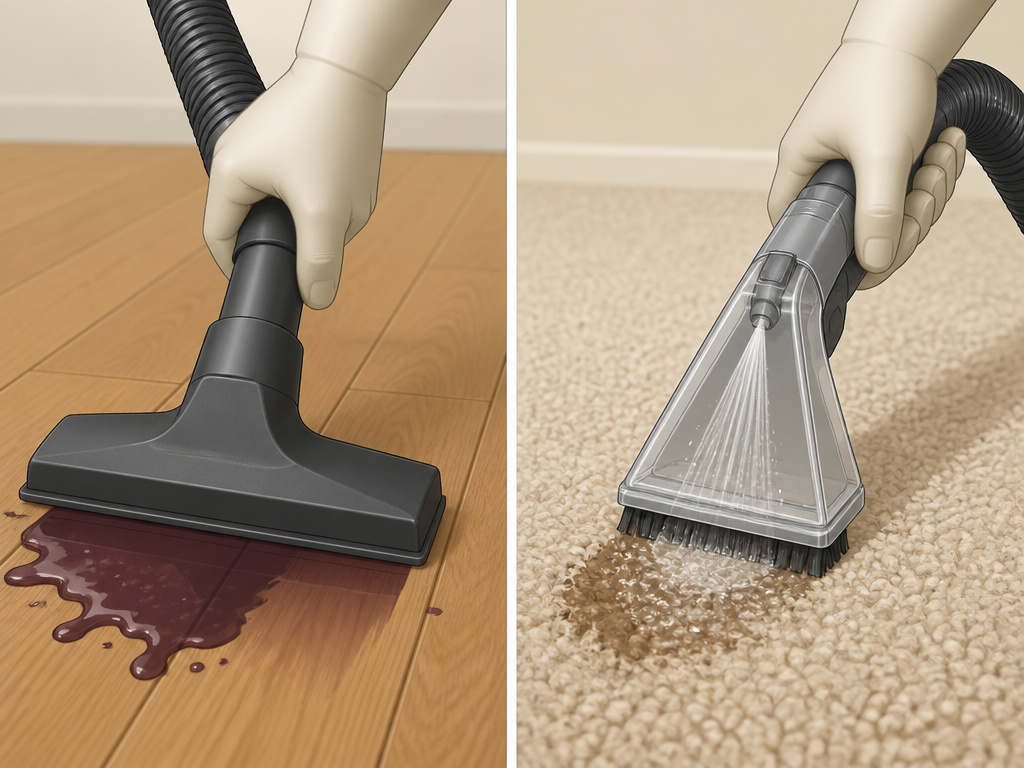 This discussion concerns which machine is right for the specific physical problem at hand. They overlap only in the area of picking up clear water from a carpet after a pipe burst.For everything else, the choice is binary.
| Task | Wet Dry Vacuum | Carpet Cleaner | Winner & Why |
|---|---|---|---|
| Clean spilled juice on hardwood | Excellent. Wide floor tool sucks it up in seconds. | Poor. Would spray soap, over-wet the floor, risk damage. | Wet Dry Vac. No agitation or chemicals needed. |
| Remove old pet stain from carpet | Poor. Removes surface residue, leaves odor and enzymes deep in pad. | Excellent. Spray breaks down stain, brushes lift it, extraction removes it. | Carpet Cleaner. Only extraction removes the source. |
| Vacuum drywall dust after renovation | Excellent (with fine dust filter). High CFM clears air. | Terrible. Dust will clog spray nozzles and ruin pump. | Wet Dry Vac. A carpet cleaner is not a dust extractor. |
| Deep clean a low-pile area rug | Fair. Can surface clean with attachment, will leave rug damp. | Excellent. Designed for this; proper extraction enables fast drying. | Carpet Cleaner. Proper drying prevents mold. |
| Empty a clogged sink or toilet | Excellent. High waterlift can pull a water column. | Impossible. Not designed for bulk liquid; would damage internal parts. | Wet Dry Vac. This is its core function. |
The YouTube test between a Bissell spot cleaner and a Kärcher wet/dry vac is telling. The Kärcher, used with a separate spray bottle, left the upholstery visibly drier. The dedicated spot cleaner with its built-in sprayer left more moisture behind. Why? The Kärcher likely had higher pure suction power (waterlift) for extraction, even though the Bissell had the “correct” spray mechanism. Mechanism needs to be matched with adequate power.
When You Might Need Both
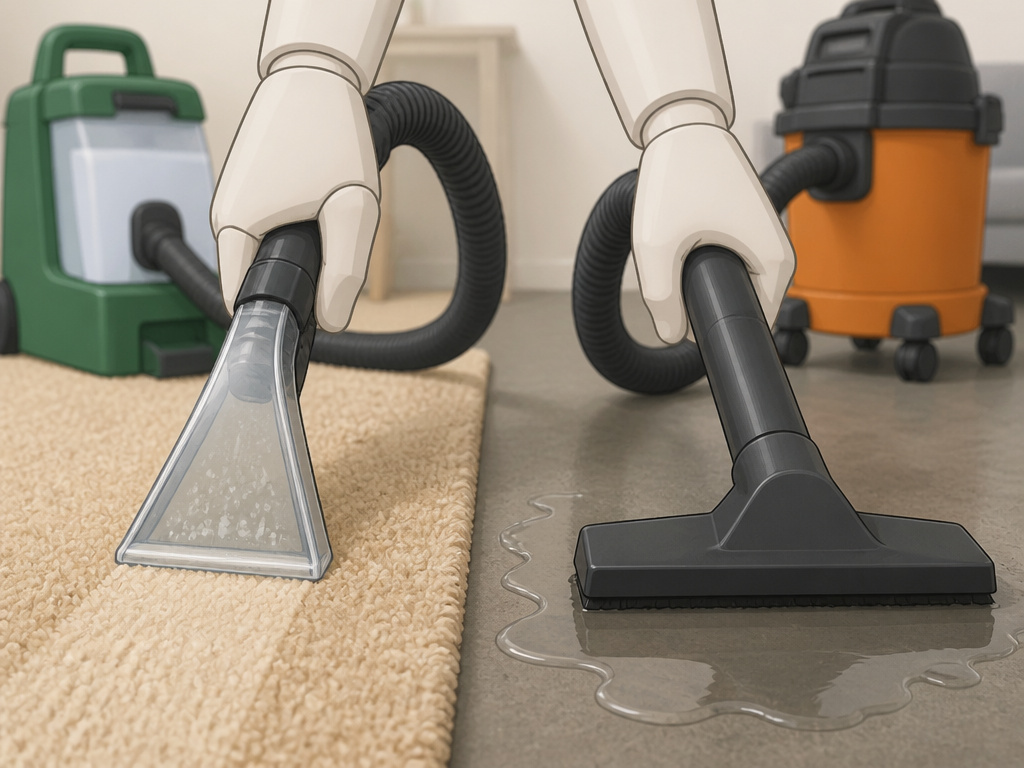 Most homes can survive with one or the other. But two specific scenarios make owning both a logical, not extravagant, choice.
Scenario 1: The Home with Wall-to-Wall Carpet AND a Workshop/Basement. Here, a carpet cleaner maintains the living spaces. A wet dry vacuum handles workshop sawdust, basement seepage, or washing the car interior. Using the carpet cleaner for shop dust destroys its pump. Using the wet vac on carpet leads to mildew. This is the clearest case for a two-machine fleet.
Scenario 2: The Pet Owner with Mixed Flooring. Accidents happen on hard floor and carpet. A cordless wet dry vacuum like the DEWALT DCV581H is for the quick, daily liquid pickup on tile or laminate. The carpet cleaner is for the weekly deep clean or set-in stain treatment. Trying to use one for both roles means compromised cleaning and a high risk of tool failure.
The part nobody mentions: If you try to use a carpet cleaner as a wet vac for something like spilled cereal, the milk sugar will solidify inside the internal pumps and hoses. The repair requires a full strip-down, a cost often higher than just buying a cheap wet vac.
How to Choose: Your Flooring Decides
Stop looking at marketing. Look at your floor. The ratio of hard surface to carpet, and the carpet’s pile height, gives you the answer.
Choose a Wet Dry Vacuum If:
- You have all hard floors (tile, laminate, hardwood, vinyl).
- Your only carpets are low-pile, washable area rugs you can take outside.
- Your primary needs are spills, workshop debris, or car cleaning.
- You want one tool for liquid and dust.
- Start with: A 10-16 gallon model like the RIDGID 1650RV for homes, or a cordless wet dry vacuum for apartments.
Choose a Carpet Cleaner If:
- You have any wall-to-wall carpeting, especially medium or high pile.
- You have pets, children, or a high-traffic home.
- Your goal is stain removal and deep sanitization, not just spill pickup.
- You are willing to use a separate vacuum for dry cleaning.
- Start with: A BISSELL PROheat 2X for most homes, or the Rug Doctor TruDeep Cleaner for heavy pet use.
Consider a “Home & Garden” Extractor If: You have mostly hard floors but one or two large area rugs. Machines like the Kärcher SE 4 function as a wet/dry vacuum and a carpet extractor. The compromise is that it’s less powerful than a dedicated tool at either job, but it covers both bases without requiring two separate units.
Frequently Asked Questions
Can I use my wet dry vacuum to clean my carpets?
You can use it to pick up standing liquid from a carpet, like after a flood. You cannot use it to clean carpets. It lacks the spray-and-agitate mechanism to loosen dirt and the sustained high-waterlift suction to extract cleaning solution from the pad. You will leave the carpet soaked and the stain untreated.
What is more powerful, a wet vac or a carpet cleaner?
It depends on how you define power. A wet dry vacuum often has higher CFM (airflow) for moving large volumes of debris. A carpet cleaner is engineered for higher waterlift (suction pressure) at the tool head to extract moisture. By the ASTM F558 standard measured at the cleaning foot, a carpet cleaner like the Rug Doctor has 30% more suction power for the specific task of drying carpet.
Is a carpet cleaner just a vacuum with water?
No. It is a three-stage system: a pump to spray heated detergent, motorized brushes to agitate fibers, and a high-lift vacuum motor to extract the dirty solution. A standard vacuum, wet or dry, only performs the suction stage. The addition of water and agitation is what defines the deep-cleaning process.
Can I use a carpet cleaner on hard floors?
Generally, no. Most manufacturers, like Tineco, explicitly warn against it. The hard floor can scratch the machine’s cleaning head, and the machine can spray water into gaps, damaging the floor. Some models come with a hard floor attachment, but a wet dry vacuum is still the safer, more effective tool for hard surface spills.
Why is my carpet still wet after using a carpet cleaner?
Two likely reasons. First, the machine’s water recovery power is insufficient for your carpet’s thickness. Second, you may be overwetting, applying too much solution per pass. The machine can only extract what the carpet’s density releases. Always make slow, overlapping passes and use the machine’s drying mode if it has one.
The Bottom Line
A wet dry vacuum is a remover. A carpet cleaner is an extractor. One deals with unattached matter on a surface; the other performs a chemical-mechanical process within a fabric.
If your floors are hard, buy a wet dry vacuum. The RIDGID 1650RV is a benchmark. If your home has carpet, buy a carpet cleaner. The BISSELL PROheat 2X series is the default for a reason. Owning both only makes sense if you have two distinct zones: a clean, carpeted living area and a messy workshop or basement. Using one tool for both roles is how you end up with a moldy carpet or a broken machine, the physics of water and fiber don’t compromise.