
How to Clean a Bissell CrossWave Vacuum After Every Use
This post contains affiliate links. As an Amazon Associate, we earn from qualifying purchases.
To clean a Bissell CrossWave after use, empty the dirty water tank immediately, rinse it and its filter, then run the 40-second clean-out cycle on the dock. Let all parts air-dry for 24 hours before reassembly. Skipping the clean-out cycle allows wet debris to harden inside the fluid path, which causes motor-clogging jams and a sour mildew smell within 48 hours.
That 24-hour drying rule is the manufacturer’s mandatory guard against the single biggest point of failure: a damp filter reinstalled in a sealed tank becomes a petri dish. The smell is evidence of bacteria actively degrading the filter material, which then sheds fibers into the pump.
What follows is the breakdown every model shares, plus the specs that change between a CrossWave Cordless Max and an OmniFind. You’ll get the seven physical steps, the two tools that prevent clogs, and the one mistake that voids warranties.
Key Takeaways
- Run the 40-second clean-out cycle every single time. It’s the only way to flush debris from the internal tubing before it sets like concrete.
- Air-dry the float filter, tank lid, and brush roll for a full 24 hours. Reassembling them damp guarantees mildew and sensor errors.
- Use only Bissell CrossWave formulas. Other cleaners create suds that overwhelm the pump and leave a sticky residue on the brush roll.
- Never store the machine with fluid in the clean or dirty tanks. Residual moisture corrodes internal valves and attracts pests.
- Identify your model. A CrossWave X7 has a clean-out tool; a Cordless Max has a digital full-tank alert. The core clean-out cycle is universal.
The Non-Negotiable 40-Second Clean-Out Cycle
Press the clean-out cycle button on the dock. The machine will run for 40 seconds, pulling fresh water (and optional cleaner) through its internal fluid path to eject leftover grime. This maintenance step is mandatory.
The mechanism is simple but critical. During cleaning, a slurry of dirt, hair, and formula travels from the brush roll up through a narrow tube into the dirty tank. When you stop, some of that slurry remains in the tube. If it dries there, it forms a plug. That plug blocks suction entirely. The 40-second cycle forces clean water back through that pathway, pushing the residual gunk out before it can harden.
Common mistake: Skipping the clean-out cycle because the tank “isn’t that dirty.” The debris that jams the pump is never in the tank you can see, it’s in the inch of tubing you can’t.
Skipping this cycle even once lets organic matter begin to decompose inside a dark, wet tube. You’ll notice the smell on the next use. By the third skipped cycle, the restriction can cause the pump to overheat. Most “loss of suction” diagnoses on these machines trace back to a hardened clog in this exact spot.
Your CrossWave Model Dictates the Details
While the core clean-out cycle is universal across the Bissell CrossWave line, your specific model changes the indicators and tools you have. Using the wrong assumption can lead to confusion when the machine behaves differently.
| Model Series | Full Tank Alert | Unique Tool | Key Spec |
|---|---|---|---|
| CrossWave / Pet Pro | High-pitched sound | None | Filter requires 24h dry time |
| CrossWave Cordless Max | Orange flashing icon on display | None | Self-cleaning cycle = 40 seconds |
| CrossWave X7 | Audible alert | Included clean-out tool | 24h dry time for filter & screen |
| CrossWave OmniFind | Display alert | None | Clean-out uses warm water (140°F max) |
If you own a CrossWave X7, find the small plastic clean-out tool in your box. It’s designed to clear the brush roll housing if a large debris clogs it during the clean-out cycle. For the CrossWave OmniFind, note the warm water requirement for the clean-out tray, hotter water can warp the plastic dock.
The best way to confirm your model’s specifics is to check the manual or look up your best CrossWave model’s support page. Don’t guess. A procedure for a Cordless Max won’t mention the physical clean-out tool an X7 owner needs.
Step-by-Step Post-Use Cleaning Process
Follow this sequence after every cleaning session. The order matters because running the clean-out cycle with a full dirty tank can cause an overflow.
Step 1: Empty the Dirty Water Tank
Press the release button on top of the machine, grab the tank’s handle, and pull it straight out. Carry it to a utility sink or toilet. Hold the tank lid near its sides (avoid pressing the center where the filter is) and pull up to open.
Pour out the dirty water. Then, pull the rectangular plastic strainer out of the lid. This catches hair and large debris. Dump this debris into the trash, not the sink. Rinse the empty tank and the strainer under warm tap water. Look for cracks in the tank, if you see any, you need a replacement.
Step 2: Rinse the Float Filter
The float filter is a white, rectangular piece of foam snapped into the underside of the tank lid. Pinch its sides and pull it straight out.
This foam filter is what keeps dirty water from being sucked into the machine’s pump. When it’s saturated with fine silt, airflow stops.
Rinse it under lukewarm running water until the water runs clear. Gently squeeze it, don’t wring or twist, to remove excess water. This filter must be completely dry before it goes back in. That takes a full day.
Step 3: Wipe the Sensors (OmniFind & Cordless Max Models)
On OmniFind and some Cordless Max models, optical water-level sensors are located on the inner sides of the dirty tank lid. If these get coated in grime, the machine cannot detect when the tank is full. Use a soft, damp cloth to wipe these small clear windows clean. A cotton swab works for the edges.
Step 4: Run the Clean-Out Cycle
Place the empty dirty water tank back into the machine. Set the CrossWave onto its docking station. Fill the clean-out tray on the dock with warm tap water to the line marked on the tray. For best results, add 2 ounces of Bissell FreshStart Clean-Out Formula.
Press the clean-out cycle button once. The machine will run for exactly 40 seconds, flushing its internal system. You’ll see dirty water and foam ejected into the dirty tank. When it finishes, remove the dirty tank and empty it again. Yes, you empty it twice.
Step 5: Clean the Brush Roll and Window
Lay the machine on its back. Press the two release tabs on the brush roll cover and remove it. Pull the brush roll straight out. Use scissors or the edge of the clean-out tool (X7 models) to cut away hair and threads wound around the ends. Rinse the brush roll under water.
Wipe the clear plastic brush roll window inside the foot of the machine. This window gets spattered, blocking your view of potential jams. A clean window is a diagnostic tool.
Step 6: The 24-Hour Air-Dry Marathon
This is the step that prevents 80% of functional problems. Do not reassemble anything wet. – Lay the float filter on its side on a towel. – Place the tank lid upside down. – Set the brush roll on its provided drying tray or a towel. – Leave the empty dirty tank open. – Let all components air-dry for a full 24 hours in a well-ventilated area.
Reassembling a damp filter traps moisture against the sensors and guarantees a musty odor. That odor means mold, and mold degrades the filter foam. A degraded filter then sheds into the pump.
Step 7: Final Reassembly and Storage
After 24 hours, snap the completely dry float filter back into the tank lid. Click the lid onto the clean, dry tank. Insert the dry brush roll into the machine, ensuring the ends seat fully in the bearings. Snap the cover back on.
Store the CrossWave on its dock, with both the clean and dirty water tanks empty. If storing for more than a month, ensure the battery is fully charged first to prevent cell damage.
The Two Biggest Cleaning Mistakes (And Their Consequences)
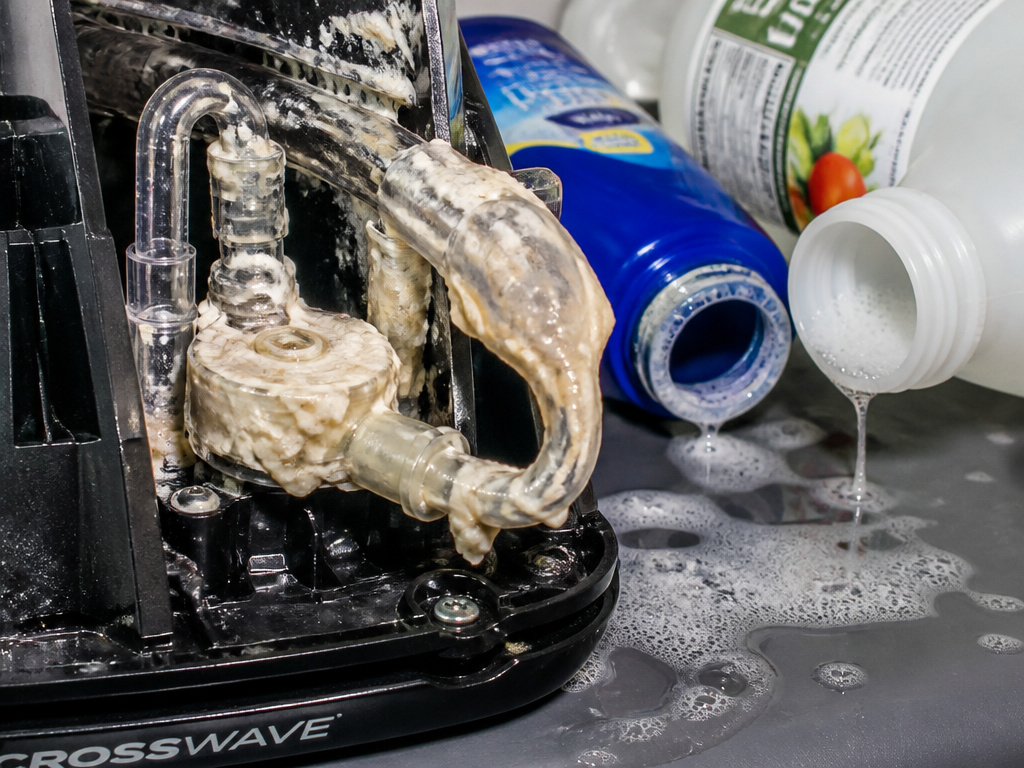 Owners often develop shortcuts that seem logical but break the machine’s specific design.
Mistake 1: Using Vinegar or Generic Floor Cleaners
Bissell formulas are non-sudsing. Household cleaners or vinegar create suds. Suds expand when pumped, overwhelming the fluid system and leaving a sticky residue on everything. This residue attracts dirt faster, making your next clean less effective and gumming up the pump check valves. Stick with the Bissell CrossWave formulas designed for the system.
Mistake 2: Putting Parts Away Damp
Maybe you only mopped one room. The filter just looks damp, not wet. You reassemble it. The consequence isn’t immediate. The sealed tank environment allows bacteria from the dirty water to multiply on the filter foam. Within 48 hours, a distinct sour smell develops. That’s the smell of microbial waste breaking down the foam. Eventually, the filter disintegrates, sending particles into the pump and causing a loss of suction.
The same logic applies to the brush roll. A damp brush roll stored in a dark housing can warp or develop mildew on its fins, leading to an unbalanced spin and eventual brush not spinning errors.
How This Compares to Other Bissell Cleaners
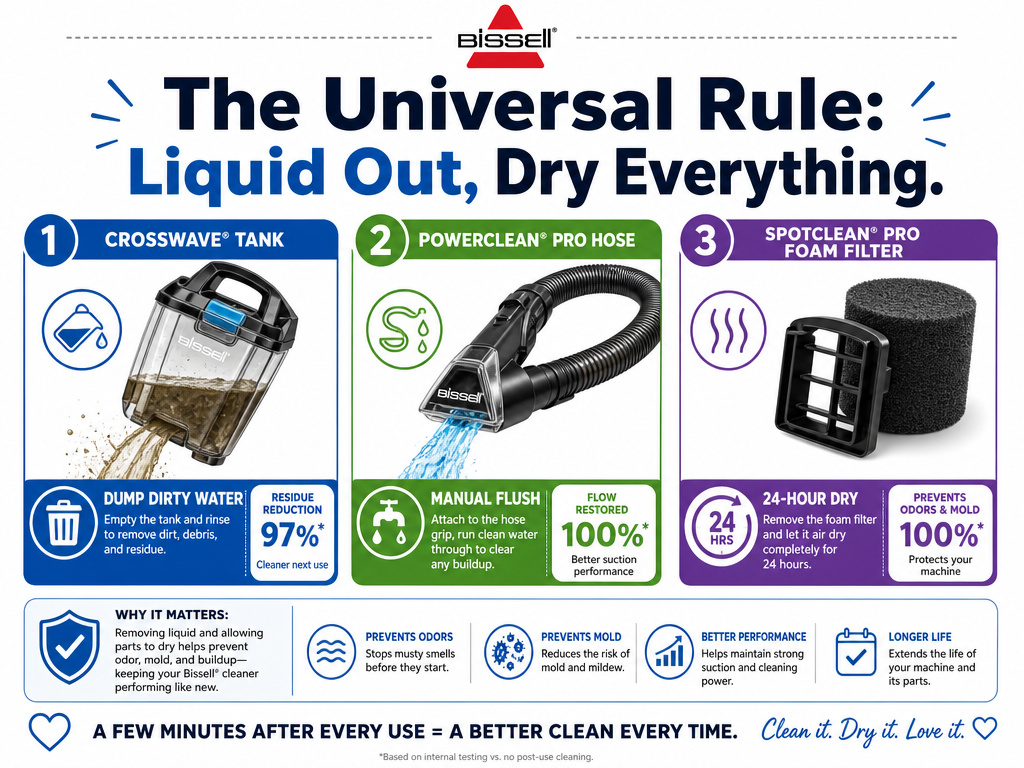 The CrossWave’s wet/dry vacuuming is unique, but its post-use discipline shares DNA with Bissell’s other deep cleaners. The principle is always “liquid out, dry everything.”
- Vs. A Bissell PowerClean Pro: The PowerClean Pro has a separate hose and nozzle system to rinse, but the same 24-hour dry rule for its filters. Its clean-out cycle is manual through the hose.
- Vs. A Bissell SpotClean Pro: The portable SpotClean Pro has a much smaller tank but an identical foam filter that must be dried. It lacks an automated clean-out cycle, so you must manually flush its hose with clean water.
- Vs. A Bissell Little Green: The Little Green is the simplest. You empty its tank, rinse it and the hose, and let the tools dry. No internal pump flush is needed because its fluid path is shorter and wider.
The discipline you learn on the CrossWave applies directly to maintaining a Bissell ProHeat Pro or a TurboClean PowerBrush. Dry the parts that touched dirty water. Every time.
Troubleshooting Post-Cleaning Problems
What if you followed the steps and something still seems off? Here’s the likely culprit.
| Symptom | Most Likely Cause | Immediate Fix |
|---|---|---|
| Musty smell on next use | Filter or brush roll stored damp. | Disassemble, re-clean, and ensure 24h dry. Replace filter if smell persists. |
| Clean-out cycle won’t start | Battery is too low, or dirty tank is full. | Dock machine for 30+ minutes to charge, then empty tank and retry. |
| Water leaking from tank during cycle | Dirty tank was overfull when cycle started. | Empty tank completely before running clean-out cycle. |
| Reduced suction/poor pickup | Clog in internal tubing from skipped clean-out cycles. | Run multiple clean-out cycles with FreshStart formula. Check for suction problems. |
| Error light on display | Wet sensors or clogged filter. | Dry all parts for 24h, clean sensor windows, ensure filter is snapped in fully. |
For persistent leaks or error lights, the issue may be a cracked tank or faulty sensor. Contact Bissell support with your model number ready.
Frequently Asked Questions
Can I use the CrossWave without running the clean-out cycle?
Technically, yes. Once. The machine will work. But you are leaving a wet paste of dirt and formula inside the pump tubing. It will dry into a cement-like restriction. The loss of suction and potential motor damage is inevitable. The 40-second cycle is cheaper than a repair.
Why does the filter need 24 hours to dry?
The foam is dense and designed to trap microscopic silt. That silt holds water deep within the foam’s matrix. Surface drying in a few hours is a trap, the core remains damp. Only a full day of airflow ensures the entire mass is dry, preventing the mildew that breaks down the foam from the inside out.
Is the FreshStart Clean-Out Formula necessary?
It’s highly recommended but not strictly mandatory for every cycle. The formula contains surfactants that break down greasy residues and odors that water alone can’t touch. Using it once a month, or after cleaning a particularly greasy area, will maintain peak performance and prevent lingering smells.
How do I clean my CrossWave Pet Pro after use?
The process is identical to the standard CrossWave. The CrossWave Pet Pro may have upgraded brush rolls for hair, so be extra diligent about cutting wrapped hair from the roll ends. The dry-time requirement is the same.
What if I need to use it again before 24 hours are up?
This is the real-world compromise. If you must, have a second float filter. Buy a replacement filter and keep it dry in a cabinet. Swap the wet one out for the dry one, then let the wet one begin its 24-hour dry period. This is the only way to avoid the mildew cycle without waiting.
Before You Go
Cleaning the Bissell CrossWave after use is a seven-step ritual that pivots on two things: the 40-second clean-out cycle and the 24-hour dry time. Skip either, and you trade five minutes of work for a hundred-dollar repair and a machine that smells like a wet basement.
The takeaway is cause and effect. The clean-out cycle clears the pipes.The dry time starves the bacteria. Do both, and the machine lasts for years. Your model, whether it’s a Cordless Max, an X7, or an OmniFind, only changes the alert sound and the tools in your hand. The discipline is the same.