
How to Clean Your Dyson Cordless Vacuum’s Filter Correctly
This post contains affiliate links. As an Amazon Associate, we earn from qualifying purchases.
To clean a Dyson battery vacuum filter, remove it, tap out loose debris, rinse it under running tap water until the water runs clear, and let it dry completely for at least 24 hours before reinstalling. The water temperature matters: use cold tap water for older handhelds and warm for newer cordless models like the V11, V15 Detect, and Outsize. A damp filter can damage the motor.
That last sentence is the one people read and then ignore. They think “mostly dry” is good enough, or that a sunny windowsill cuts the time in half. It doesn’t. The motor damage warning in the manual describes the real consequence of moisture being sucked into the sealed cyclone system.
What follows: the exact steps broken down by model type, the two drying methods that actually work, and the troubleshooting steps for when the vacuum won’t start after you’ve put it all back together. By the end, you’ll know why the 24-hour rule exists and how to avoid the single most common post-cleaning failure.
Key Takeaways
- Always use cold tap water for older Dyson handhelds (like the DC56) and warm tap water for newer cordless models (V11, V15 Detect, Outsize). Hot water or detergents can damage the filter material.
- The filter must dry for at least 24 hours in a well-ventilated area. The older DC56 model requires 12 hours. Rushing this is the #1 cause of “my Dyson won’t work after cleaning.”
- Never use the vacuum with a damp filter. Ingress of moisture can trigger a thermal cut-out or cause permanent motor damage, which is not covered under warranty.
- Clean your filter once a month to maintain suction. If you vacuum fine dust like flour or plaster, or use max power mode often, you may need to clean it every two weeks.
- If your Dyson has an LCD screen, it will display a filter maintenance alert. This is a reminder, not a real-time moisture sensor, you still must do the 24-hour dry time.
The Core Cleaning Steps for Any Dyson Battery Vacuum
The process is universal, but the specifics of water temperature and dry time change with your model. Getting the sequence right prevents debris from washing deeper into the filter and ensures you don’t break the internal seals.
First, power off the vacuum and remove the battery pack if possible. This eliminates any risk of electrical short. Locate the main filter, it’s usually at the top of the handle or behind a panel on the main body. Turn it counter-clockwise and pull it straight out.
Common mistake: Rinsing the filter without tapping it out first. Caked-on dust turns into a paste that blocks the filter’s inner layers, reducing airflow more than the original dirt did.
Step 1: Dry Removal. Tap the filter firmly against the inside of a trash can to dislodge loose dust and hair. Do this over a sink, and you’ll just make a muddy mess.
Step 2: The Rinse. Hold the filter under a gentle stream of tap water. For most modern cordless Dysons like the V11 or V15 Detect, use warm tap water. For older handheld units like the DC56, the manual specifies cold tap water only. The temperature difference matters because the filter media in newer models is designed to handle mild warmth without warping. Never use hot water, soap, or detergents.
Step 3: The Shake Test. Fill the filter cavity with water, cover the ends with your palms, and shake it vigorously. Empty and repeat until the water runs completely clear. This agitation is what dislodges the microscopic particles trapped in the electrostatic layer.
Step 4: Remove Excess Water. Shake the filter over the sink with force to eject as much water as possible. Then, gently squeeze it, don’t wring or twist. The goal is to get it from sopping wet to damp.
Cold Tap vs. Warm Tap Water: Why Your Model Manual Decides
This isn’t a suggestion. The Dyson DC56 handheld manual states “wash the filter with cold water only.” The general cordless filter care page says “wash your filter with warm tap water.The discrepancy results from the filter’s construction and the machine’s operating pressure.
| Model Type | Recommended Water | Source | Risk If Ignored |
|---|---|---|---|
| Dyson DC56 Handheld | Cold tap water only | DC56 User Manual (Source 3) | Possible damage to filter media not rated for warmth; voids compliance with manual. |
| Dyson V11, V15, Outsize | Warm tap water | Dyson UK Support Page & Discover Insights Article (Sources 2 & 4) | Cold water may not effectively break down fine dust oils, leading to quicker re-clogging. |
| General Cordless Models | Warm tap water | Dyson.com Support Page (Source 1) | Using hot water can degrade the filter’s electrostatic charge, permanently reducing its efficiency. |
Newer cordless models operate at higher suction pressures. The warm water helps dissolve the microscopic oils in household dust that cold water leaves behind. For the simpler filter in a DC56, cold water is sufficient and safer for the material.
The rule is simple: check your manual. If you don’t have it, default to warm water for a cordless stick vacuum and cold for a handheld. When in doubt, cold is the safer bet, it won’t damage any filter.
The 24-Hour Dry Time Is Non-Negotiable
This is the step every single person tries to shortcut. You think a few hours in the sun is enough. It isn’t. The at least 24 hours directive is printed in the support guides for a reason. The filter is a dense, multi-layered foam. The center holds moisture long after the surface feels dry.
Your filter(s) must be completely dry before you put it back into the machine, or it could damage the motor. Be sure to physically check for moisture with a touch test before reinstalling the filter. Dyson.com Support Page
Why 24 hours? The filter needs to air-dry uniformly to prevent mold growth inside its core. Even a slightly damp filter can introduce moisture into the vacuum’s sealed airway. When that moist air hits the motor, it can cause a short or trigger the thermal cut-out protection.
How to dry it right:
- Shake out all excess water over the sink.
- Place the filter on a dry towel in a well-ventilated room. Near a fan or an open window is ideal.
- Let it sit, untouched, for a full 24 hours. Rotate it once after about 12 hours if you want to be thorough.
- Perform the “touch test”: press the filter against your cheek or the inside of your wrist. If it feels cool at all, it’s still damp. Give it more time.
The older DC56 model has a shorter 12-hour dry time because its filter is smaller and less dense. But the same rule applies: it must be completely dry to the touch before refitting.
What Happens If You Use a Damp Filter?
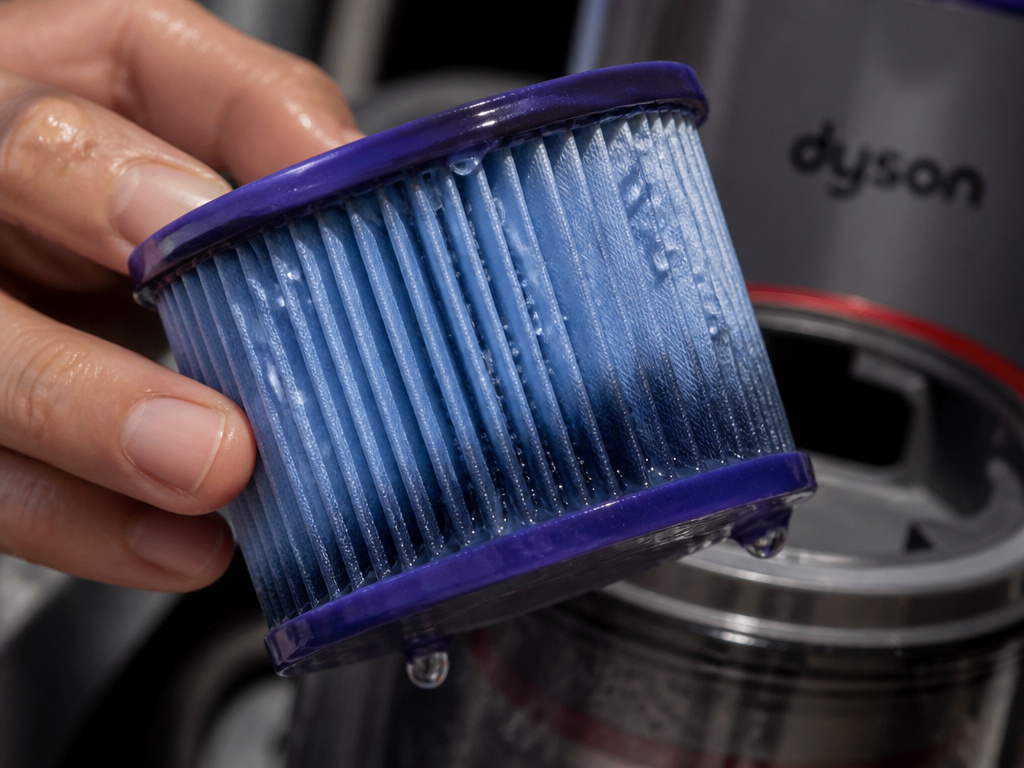 You’ll know within minutes. The most common outcome is that the vacuum simply won’t start. This is often the thermal cut-out protecting the motor. The machine detects an abnormal condition, like a blocked airway from a damp, restrictive filter, and shuts down to prevent overheating.
If it does start, you might hear the motor straining or a change in pitch. Suction will be weak. This is because the damp filter restricts airflow, causing the motor to overwork. Continuous operation in this state can lead to permanent motor damage. The HH12 manual states it plainly: “Your machine could be damaged if used with a damp filter.”
This is also the primary reason for a Dyson vacuum not working after a filter clean. The solution is always the same: remove the filter, confirm it’s bone-dry, and wait longer. If the vacuum still doesn’t start, check for a filter that is not sealed properly in its housing.
Troubleshooting the “Clean Filter” Light and Other Alerts
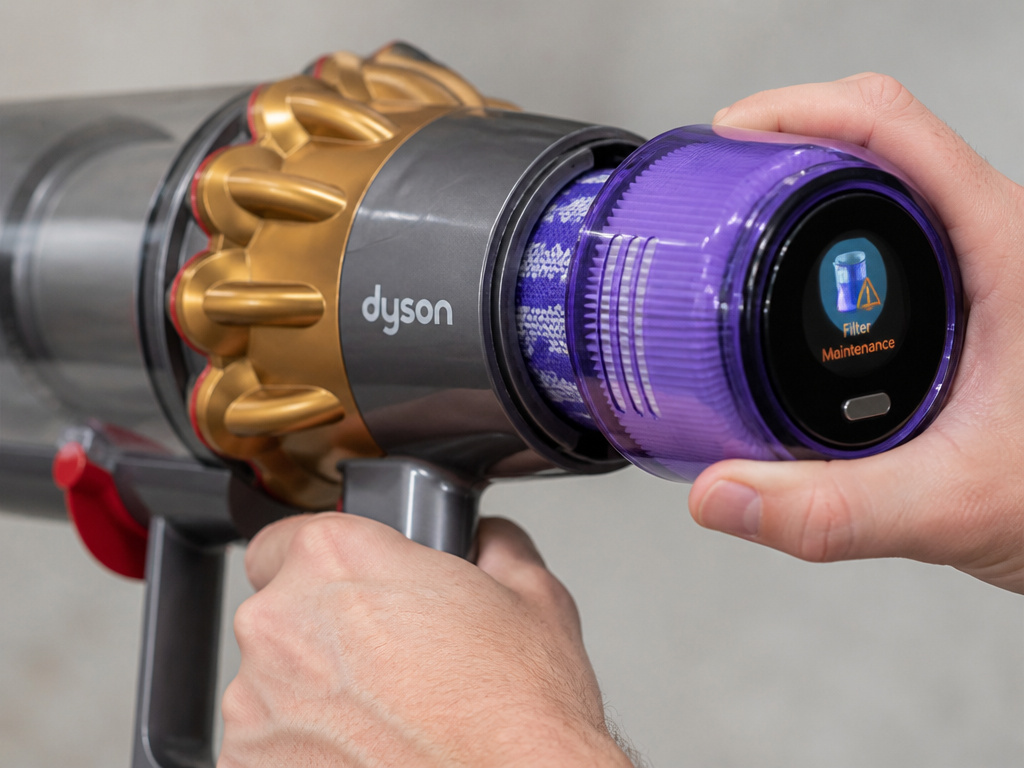 Newer models like the V11, V15 Detect, and Outsize have an LCD screen that displays a filter maintenance reminder. This alert is based on a timer or usage algorithm, not a sensor that detects dirt. It’s a prompt, not an emergency.
If the light won’t go off after cleaning: The reset procedure is usually to hold the power button for 10-15 seconds with a clean, dry filter installed. Consult your specific model’s manual. A persistent flashing filter light could indicate a different issue, like a blockage elsewhere.
If suction is still weak after cleaning: You might have a different problem. A thoroughly cleaned and dried filter should restore near-original suction. If it doesn’t, you likely have a blockage in the hose, wand, or cleaner head. Follow our guide to troubleshoot lost suction for a step-by-step check.
If your Dyson keeps asking to clean the filter on an abnormally short cycle, say, weekly, you’re probably vacuuming fine dust or running it on max power constantly. Both scenarios clog the filter faster. You may need to clean it every two weeks. For persistent alerts, this guide on repeated filter alerts dives deeper.
How Cleaning Compares Across Dyson Vacuum Types
The core steps are identical, but the filter’s location and design vary. Knowing which type you have helps you find the filter quickly.
- Dyson Cordless Stick Vacuums (V8, V11, V15): The filter is typically at the top of the handle. The process is exactly as described above. For model-specific nuances, our Dyson cordless filter guide has visuals.
- Dyson Handheld Vacuums (DC56, HH12): The filter is usually on the back of the main body. Removal often involves a simple twist. The dry time may be shorter (12 hours for DC56). See our Dyson handheld filter article for details.
- Dyson Upright Vacuums: These often have a pre-motor and a post-motor HEPA filter. Both need cleaning. The post-motor filter is usually a sealed unit that you tap out, not wash. Check our Dyson upright filter instructions.
- Dyson Canister Vacuums: Similar to uprights, with multiple filters. The main exhaust filter is washable. The cleaning instructions for Dyson canister filters are more specific due to the machine’s design.
No matter the type, the principles of monthly cleaning, correct water temperature, and complete drying unite them all. A filter on a stick vacuum fails the same way as a filter for upright models when it’s put back wet.
Frequently Asked Questions
Can I use soap or cleaner on my Dyson filter?
No. Do not use detergents, polishes, or air fresheners. These chemicals can coat the filter’s fibers, destroying its electrostatic charge and leaving a residue that actually attracts more dirt. Water alone is sufficient.
Can I speed up drying with a hair dryer or heater?
Do not use a hair dryer, space heater, oven, microwave, or place it in direct sunlight. High heat can melt, warp, or shrink the filter foam, ruining it. It can also drive moisture deeper into the core. Air drying at room temperature is the only safe method.
How do I know if my filter is damaged and needs replacement?
Damaged filter will have visible tears, holes, or a warped shape that prevents a proper seal. If it’s falling apart or no longer clicks securely into place, it needs replacement. Even with perfect care, a filter will eventually degrade; most last several years with monthly cleaning.
My filter is clean and dry, but the vacuum still has weak suction. What now?
The filter is only one part of the airflow path. The problem is likely a blockage in the bin, hose, wand, or cleaner head. Empty the bin completely, detach all tubes and tools, and visually check for obstructions. A clogged brush roll is also a common culprit for poor suction power.
Is the filter in my Dyson a HEPA filter?
Dyson cordless vacuums use “whole-machine filtration” that captures 99.97% of particles as small as 0.3 microns, which meets the HEPA standard. The washable main filter is a key part of this system, but it works in tandem with sealed cyclones to achieve that level of filtration.
Before You Go
Cleaning your Dyson’s filter is simple, but the details decide between a machine that lasts for years and one that dies an early death. Use the right water temperature for your model. Give it the full 24 hours to dry, no shortcuts. And listen to the machine. If it won’t start after you reassemble it, the filter is almost certainly still damp. Wait longer.
That monthly maintenance ritual sustains strong suction and prevents the motor from burning out on a clogged, wet piece of foam. Do it right, and the only light you’ll see is the one on the brush bar.