
How a Wet Dry Vacuum Cleaner Works: The Complete Mechanism
This post contains affiliate links. As an Amazon Associate, we earn from qualifying purchases.
A wet/dry vacuum cleaner works by using a sealed electric motor to spin an impeller, creating suction that pulls debris and liquid into a collection tank. A critical float valve automatically seals the motor inlet when liquid reaches a certain level, preventing motor damage. For dry pickup, a filter traps dust before air exits; for wet pickup, this filter is removed or swapped for a foam sleeve.
That distinction between wet and dry modes is where most people get confused. The machine isn’t magic, it’s a series of simple mechanical failsafes that let one tool do two jobs without destroying itself.
What follows is a breakdown of the three systems that make it possible: the motor and airflow path, the filter assembly, and the liquid safety shut-off. By the end, you’ll know exactly why your vac needs a different setup for sawdust versus a flooded basement, and what happens inside when you get it wrong.
Key Takeaways
- The motor is physically sealed and mounted high in the unit; it never contacts the water it’s sucking up.
- A float valve is the critical safety component, it rises with the liquid level to block the inlet and protect the motor from flooding.
- Using a wet filter for dry pickup clogs it instantly with a concrete-like paste of dust and residual moisture.
- Manufacturer specs like the Scheppach F-WDV30P‘s 36-month warranty and IP24 protection rating are verifiable guarantees of build quality.
- For large liquid spills over 4 inches deep, you must remove the dry filter entirely to prevent misting and motor strain.
The Core Components of a Wet/Dry Vacuum
Look past the plastic shell and casters. Every wet/dry vac is built around three non-negotiable systems: the power unit, the separation system, and the safety interlock. Get these right, and the machine runs for years. Miss one, and you’re buying a new motor.
A wet/dry vacuum’s motor is a sealed unit rated for continuous duty, typically drawing between 7.5 and 12 amps at 120V. It drives a centrifugal impeller that creates a partial vacuum, pulling air at speeds up to 16 kPa (kilopascals) of suction power. This airflow carries debris through the hose into the collection tank, where heavier particles and liquids fall out before the air passes through a filter and exits the exhaust.
The Motor and Airflow Path
The motor doesn’t get wet. It’s housed in a separate compartment at the top of the machine, often called the power head. When you turn it on, the motor shaft spins a fan called an impeller. This spinning impeller throws air outward from its center, creating a low-pressure zone at its intake. That low pressure is your suction.
Air rushes in through the hose to fill this void, carrying whatever is in front of the nozzle with it. The air/debris mix travels into the collection tank. Here, the tank’s large volume causes the airspeed to drop suddenly. Heavier stuff, nails, wood chips, water, falls out of the airstream due to gravity. The now-cleaner air makes a sharp turn upward, passes through a filter to catch any remaining fine dust, and is expelled out the back or sides of the power head. This path is why you can vacuum a bucket of water without drowning the motor.
The Collection Tank and Float Shut-Off Valve
The tank is just a bucket. Its genius is in the accessory mounted inside it: the float shut-off valve. This is a plastic ball or cup that sits loosely over the motor inlet port inside the tank.
When you vacuum water, the level rises. Once the liquid gets deep enough, the float ball is lifted by buoyancy. It seals against the inlet port. This blocks any more water (or air) from reaching the motor. The motor, now starved of airflow, labors loudly, that’s your signal to turn it off and empty the tank. It’s a purely mechanical, foolproof safety device. The Task Pro shovelnose wet-dry vacuum manual explicitly states that foam in the tank won’t activate this float, which is why they include a dedicated foam suppression bag.
The Filter System: The Part You Change
This is the most hands-on component. The filter’s job is to protect the motor from fine dust during dry pickup. For wet pickup, that filter must be removed or replaced with a different type, or it will be destroyed.
| Filter Type | Used For | What Happens If Used Wrong |
|---|---|---|
| Pleated Paper or Cloth Filter | Dry debris (dust, sawdust, drywall sanding dust). | If used wet, it clogs into an immovable brick. If used for fine dust like cold ashes without a pre-filter, dust passes through and is blown back into the room. |
| Foam Sleeve Filter | Wet pickup or very fine, damp debris. | If used for fine dry dust, the dust embeds in the foam and drastically reduces suction. It must be rinsed and dried completely before dry use. |
| No Filter / Bag | Large-volume liquid pickup (e.g., >4 inches of water). | Using no filter for dry debris allows dust to enter the motor, coating the impeller and windings, causing overheating and failure. |
The RIDGID manual is blunt about this: “If you use your Vac to pick up dust when the filter is wet, the filter will clog quickly and be very difficult to clean.” That’s not a suggestion. It’s the predictable outcome of ignoring the system’s design.
How It Handles Dry Pickup Versus Wet Pickup
The switch between modes isn’t a setting on a dial. It’s a physical change you make to the machine. Getting this procedure right is the difference between a tool that lasts a decade and one that dies on its first big job.
The Dry Pickup Process
For dry materials, the filter is everything. You install the pleated paper or cloth filter, sometimes with an additional disposable bag inside, and secure the lid. When you vacuum, the suction pulls debris into the tank. The filter over the motor inlet catches the fine particles that didn’t fall out in the tank. Clean air exits.
Where this goes sideways: Vacuuming cold fireplace ash or drywall dust with a standard filter. The particles are so fine they pass right through the filter media. The RIDGID manual warns this dust “may pass through the filter and be exhausted back into the air.” You need a HEPA or fine dust filter for those jobs, which has a much finer mesh.
The process is simple, but the consequence of a missing filter is severe. Without it, dust is sucked directly into the motor compartment. It coats the impeller blades, unbalancing them and causing vibration. It builds up on the motor windings, acting as an insulator that traps heat. The motor overheats and burns out. This is why the Kärcher manual capitalizes the warning: “ATTENTION Missing flat pleated filter Device damage Always work with the flat pleated filter inserted.“
The Wet Pickup Process
For liquids, you either remove the dry filter completely or replace it with the included foam sleeve. The foam acts as a rudimentary barrier against accidental splashes but doesn’t restrict airflow like a clogged paper filter would. The critical player is the float valve.
As you vacuum water, the tank fills. The float rises. The moment the tank is full, the float seals the inlet. The motor sound will change to a high-pitched whine as it struggles against the blocked airflow. That’s not a suggestion to keep going, it’s a command to shut off and empty. The Task Pro manual notes that for wet pickup, its included “bubble buster” foam suppression bag must be used, or the vacuum motor warranty is void.
Common mistake: Trying to vacuum up a large, deep spill (like a broken aquarium) with the dry filter still installed. The RIDGID manual advises: “When picking up large amounts of liquid (more than 4 inches of liquid in the bottom of the drum) we recommend that the filter be removed. If the filter is not removed, it will become saturated and misting may appear in the exhaust.” That mist is water being pulled through the filter and atomized by the impeller, a direct path to motor corrosion.
Common Mistakes and Failure Modes
Wet/dry vacs are simple, but they fail in specific, predictable ways. Here’s what breaks, and how.
- Running a Wet Filter for Dry Pickup. This is the top killer. Moisture in a foam sleeve combines with drywall dust or sawdust to form a plaster-like coating. Suction drops to zero. The motor overheats trying to pull air through the cement block you’ve created.
- Ignoring the Float Valve Warning Sound. That strained, screaming motor noise means the float has sealed and the motor is fighting a vacuum. Continuing to run it in this state for more than a few seconds overheats the windings. Do it repeatedly, and the insulation fails.
- Vacuuming Hot or Smoldering Debris. Embers from a fireplace or a cigarette butt can be sucked into the tank. In a dry pickup scenario with a paper filter and dusty bag, this is a fire hazard. In a wet tank, it’s less likely but still a risk to plastic components.
- Using the Wrong Filter for Fine Dust. As noted, standard filters won’t catch plaster dust or cold ash. You’ll think the vac is working, but it’s just recirculating the finest, most breathable particles back into the room. For ash, the Kärcher manual is explicit: “Only vacuum cold ash with an ash pre-separator.”
Specifications and What They Actually Mean

Manufacturer spec sheets are a glossary of what the machine can survive. They’re not marketing fluff.
| Specification | What It Means | Real-World Implication |
|---|---|---|
| Suction Power (kPa) | The maximum negative pressure the impeller can generate. A Scheppach model lists 16 kPa. | Higher kPa means better pickup on deep debris, but airflow (measured in CFM or L/s) matters more for moving bulk material like leaves. |
| Tank Capacity (Liters/Gallons) | The volume of the collection tank. A RIDGID WD19560 holds 60 Liters (16 gal). | Larger tanks mean less stopping to empty, but a full 16-gallon tank of water weighs over 130 pounds—you won’t be carrying it far. |
| Amperage (A) | The electrical current the motor draws under load. A RIDGID HD09001 draws 8.3 A. | Higher amperage usually indicates a more powerful motor, but it also requires a heavier-gauge extension cord if you must use one (though manuals universally warn against it). |
| IP Rating (e.g., IP24) | Ingress Protection rating. IP24 (common on Scheppach) means protected from solid objects >12.5mm and water splashes from any direction. | The motor housing can handle spills and splashes. It does NOT mean the unit is waterproof or submersible. Don’t leave it in the rain. |
| Warranty Period | The manufacturer’s guarantee against defects. The Scheppach F-WDV30P offers a 36-month warranty from date of purchase. | This is a direct signal of expected durability. A one-year warranty is standard; three years suggests confidence in the motor and seals. |
These numbers let you compare apples to apples. A 5-horsepower claim is meaningless without context. Amperage, tank material, and the IP rating are the facts that tell you how the vac will hold up on a jobsite or in a flooded garage.
Wet/Dry Vacuum vs. Other Cleaning Tools
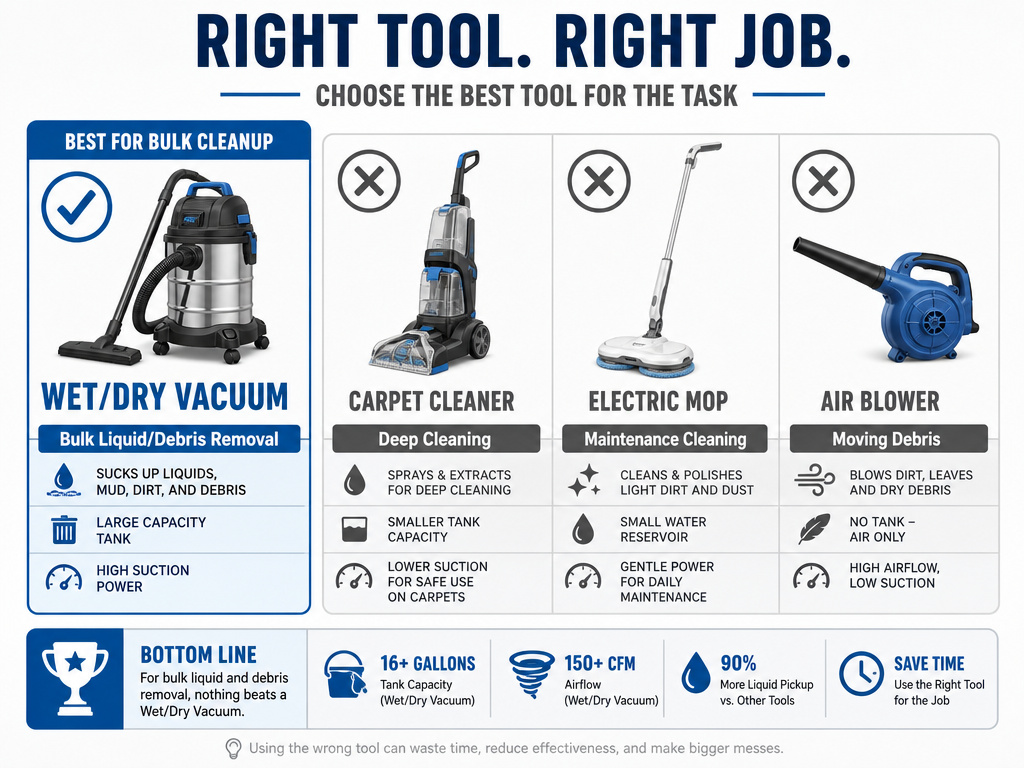
It’s not the only tool for messes. Knowing where it wins and loses saves you time and money.
- Wet/Dry Vacuum vs. Carpet Cleaner: A wet dry vacuum vs carpet cleaner is a fundamental comparison. Your vac sucks up free-standing liquid and debris. A carpet cleaner (or extractor) injects hot, soapy water into carpet fibers, agitates it, and then sucks the dirty water back out. It’s for cleaning, not disaster recovery. You can’t extract a carpet with a shop vac.
- Wet/Dry Vacuum vs. Extractor: Following that, an extractor vs vacuum is a more professional-grade version of the above. Extractors are built for chemical and hot water recovery. Their pumps and tanks are designed for soapy, foamy liquids. Using a standard wet/dry vac for extractor fluid will ruin its filter and likely clog its float valve with foam.
- Wet/Dry Vacuum vs. Electric Mop: An electric mop comparison is about daily maintenance versus major cleanup. An electric mop scrubs and spreads a thin film of cleaning solution. It’s for cleaning already-maintained floors. A wet/dry vac is for removing volume, a gallon of spilled milk, mud tracked in from the garden, or sand after a drywall job.
- Vacuum vs. Air Blower: Sometimes, moving debris is better than sucking it. A vacuum cleaner vs air blower decision comes down to the space. Use a blower to clear leaves from a garage floor or sawdust from a workbench into a pile. Then use the wet/dry vac to collect that pile. The vac is for targeted collection; the blower is for broad movement.
The wet/dry vac is your bulk-removal workhorse. It’s the first tool you reach for after a plumbing leak or a workshop project. For detailed cleaning of surfaces or fabrics, you step up to the specialized tool.
Frequently Asked Questions
Can a wet/dry vacuum suck up anything?
No. It cannot safely suck up hot ashes, burning materials, flammable liquids (like gasoline), or fine, toxic dusts (like asbestos) without specialized, sealed HEPA filtration. The motor sparks can ignite vapors, and toxic dust can be blown through a standard filter. Always check the manual for prohibited materials.
Why does my wet/dry vacuum lose suction?
The cause is almost always a clog. Check the hose, the nozzle, and the inlet at the tank. For dry pickup, a full filter bag or clogged filter is the culprit. For wet pickup, a saturated foam sleeve will kill airflow. If suction is weak on both settings, check for a crack in the hose or a poor seal where the lid meets the tank.
Do I need to use a filter for wet pickup?
It depends on your model. Most manuals instruct you to remove the dry paper/cloth filter for large liquid spills to prevent clogging and misting. Some models, like the Task Pro, require a specific foam suppression bag for all wet pickup to control foam. Never run the motor with no barrier at all if there’s a chance of sucking in dry debris.
How do I clean a wet/dry vacuum filter?
Rinse foam sleeves with water until they run clear, then squeeze (don’t wring) and let them air-dry completely, this can take 24 hours. For pleated paper filters, tap them gently to dislodge dust. Most are not washable; submerging them destroys their paper structure. Cloth filters can often be shaken out or lightly rinsed, but must be bone-dry before reuse.
What’s the difference between a shop vac and a wet/dry vac?
They are different names for the same basic tool. “Shop vac” is a brand name (from Shop-Vac) that became generic, often implying a larger, more powerful model for garage or jobsite use. “Wet/dry vacuum” is the functional description. Any unit that can handle both water and debris is a wet/dry vac.
Before You Go
A wet/dry vacuum works because of a sealed motor, a mechanical float valve, and the correct filter for the job. Its versatility comes from these simple, robust systems. The failure modes are just as straightforward: a wet filter turns to concrete with dust, a missing float valve floods the motor, and the wrong filter lets the mess you’re trying to clean end up back in the air or inside the machine itself.
For most home garage and basement cleanup, a mid-sized model from a brand like RIDGID or a recommended wet dry vac from our reviews will handle everything. The key is to respect the switch between wet and dry mode, it’s a physical change you make to the machine, not just a different setting. Do that, and the motor will run for years. Skip it, and you’ll learn how it works by taking it apart for repairs.