
FoodSaver Not Vacuuming? Follow These Simple DIY Fixes Now
This post contains affiliate links. As an Amazon Associate, we earn from qualifying purchases.
To fix a FoodSaver not vacuuming, check three things in this order: the lid gasket, the bag placement, and the bag contents. A compressed gasket needs 10 to 20 minutes to recover if the latch was left closed. The bag edge must stay inside the vacuum channel, with at least 3 inches of empty space between the food and the open end. Moisture from unfrozen meat will flood the pump and cause permanent damage if it’s not caught in time.
The 3-inch rule isn’t a suggestion. It’s the physical space the machine needs to pull a vacuum before it can seal. Less than that, and the air has nowhere to go.
What follows is a walk-through of those three failure points, the physical reason each one stops the vacuum, and the exact steps to reverse them. You’ll also get the one warning sign that means you should stop trying and call for service.
Key Takeaways
- A compressed lid gasket is the most common cause. If the latch was stored in the closed position, open it and wait 10 to 20 minutes for the seal to re-expand.
- The bag must have at least 3 inches of empty space between the food and the open end. The edge of the bag must not extend past the vacuum channel inside the drip tray.
- Liquid or moisture from food will flood the vacuum pump. Pre-freeze moist items for 1-2 hours or use a paper towel barrier.
- If the “Seal” light flashes, the unit is overheated. Unplug it and let it cool for several minutes before trying again.
- For models with non-removable gaskets, visible damage means you must contact FoodSaver service; a user cannot replace them.
The Gasket Compression Problem (and How to Reverse It)
Your FoodSaver works by creating an airtight chamber over the bag. The soft rubber gasket around the lid is the only thing sealing that chamber. When the latch is left closed, in the “On” or “Seal” position, for storage, the gasket stays compressed.
A compressed gasket cannot spring back to form a seal. The VS7850 manual specifies a recovery time of 10 to 20 minutes after releasing the latch to the “Open” or “Store” position.
That flat, hardened strip of rubber lets air leak in as fast as the pump tries to pull it out. You’ll hear the motor running, but the bag won’t tighten.
The fix is passive. Open the latch fully. Don’t just unlock it; move it to the storage position. Then walk away. Set a timer for twenty minutes. That waiting period lets the rubber slowly regain its original shape and sealing ability. This one step resolves more than half of all “no vacuum” complaints.
Common mistake: Storing the unit with the latch closed. This permanently flattens the gasket over months, requiring a replacement.
If the gasket is cracked, brittle, or visibly torn, it’s done. You need a new one. Refer to your model’s part number, for many V2000 and V3000 series units, it’s T91000075.
The Bag Placement Mistake That Looks Right
You can do everything correctly and still fail here. The bag must be seated in a specific zone within the drip tray.
Look inside the drip tray. You’ll see a raised ridge or channel where the vacuum pulls air from. The open end of your bag must sit inside this vacuum channel. If the bag material rides up over this ridge, it gets pinched when the lid closes. That pinched seal blocks the vacuum port entirely.
The second rule is the 3-inch space. You need a minimum of three inches of empty bag between your food and the top of the bag. This isn’t about neatness. The machine needs that volume of air to evacuate to create a pressure differential. Stuff the bag to the top, and the air has nowhere to go, the pump runs, but the bag stays slack.
| Bag Placement Error | What Happens | How to Fix |
|---|---|---|
| Bag edge over vacuum channel | Lid pinches material, blocking port | Re-insert bag, ensuring edge stays inside the channel |
| Less than 3 inches of space | No air volume to evacuate | Re-bag with adequate headspace or use a larger bag |
| Bag folded or creased at seal | Air leaks around the crease | Smooth bag material flat before closing lid |
When the Problem Is What’s Inside the Bag
The pump pulls air. It cannot pull liquid. Introducing moisture into the vacuum system is the fastest way to cause a failure that requires professional repair.
Moist foods, fresh meat, marinated items, soft fruits, release liquid under vacuum pressure. That liquid gets sucked into the machine’s air path. It coats the internal valves and can reach the pump motor itself. Once inside, it causes corrosion and mechanical seizure.
Where this goes sideways: Sealing unfrozen steak. The juices flood the channel in seconds, and the next time you use the sealer, it might not start at all.
The manufacturer’s workaround is straightforward: pre-freeze moist items for 1 to 2 hours. This solidifies surface moisture. The alternative is to place a folded paper towel between the food and the open end of the bag. Keep the towel at least 3 inches from the bag’s end so it doesn’t interfere with the seal.
For soups or sauces using the liquid mode, keep the bag walls clean. Any drip or smear above the liquid line can clog the narrow vacuum pathway.
Step-by-Step Diagnosis: From “No Suction” to a Tight Seal
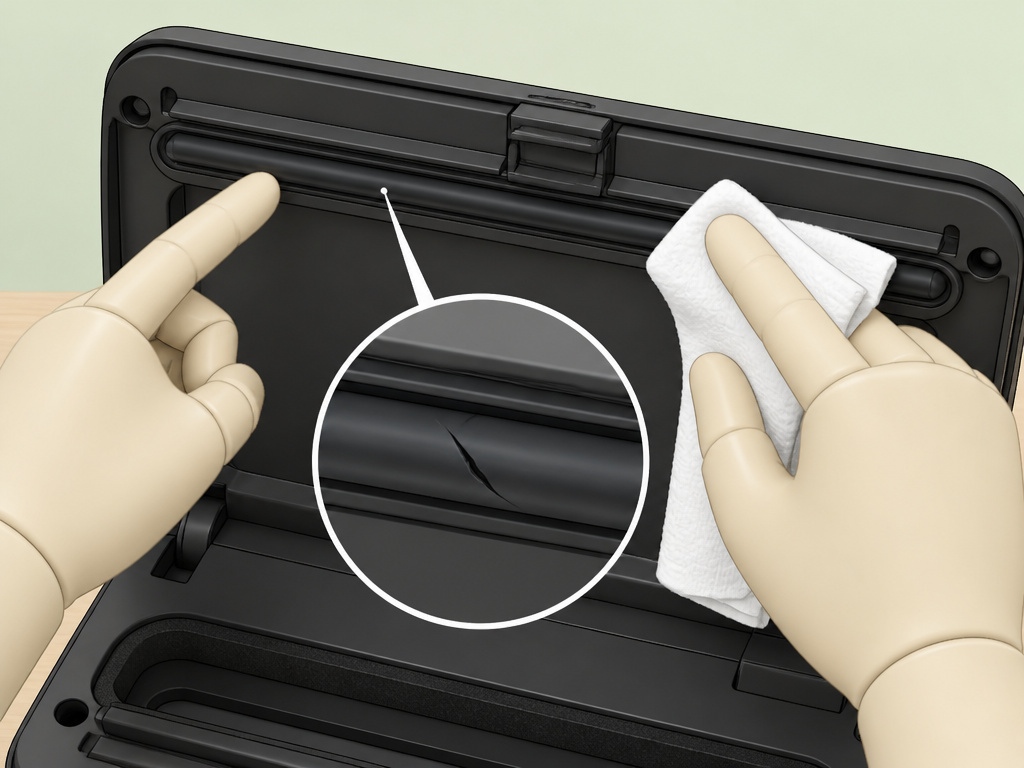
Follow this sequence. Do not skip steps, as each one eliminates a major failure point.
-
Unplug and Inspect. Safety first. Open the latch and examine the lid gasket. Look for cracks, deep compression lines, or debris. Wipe it clean with a damp cloth. Skip this, and you might miss obvious damage.
-
Address Gasket Compression. Move the latch to the full “Open” or “Store” position. Set a timer for 20 minutes. Do not touch the unit. This single wait fixes most issues.
-
Prepare the Bag Correctly.
- Cut a new bag with at least 3 extra inches of length.
- Place food inside, ensuring the 3-inch headspace rule.
- For moist food, insert a paper towel barrier or pre-freeze.
-
Insert the Bag Precisely. Thread the open end through the vacuum view window. Ensure the bag edges are seated down inside the drip tray’s vacuum channel, not riding over it.
-
Initiate the Cycle. Press and release the vacuum seal bar with both hands. Listen. You should hear the pump tone change as air is evacuated, followed by the sealing element heating up.
-
Interpret the Lights. If the “Seal” light flashes, stop. The unit is overheated. Unplug it and let it cool for 10 minutes before retrying.
If after these steps the pump runs but the bag still doesn’t vacuum, the issue is likely a blocked internal air path or a failed pump.
Internal Blockages and Pump Failure
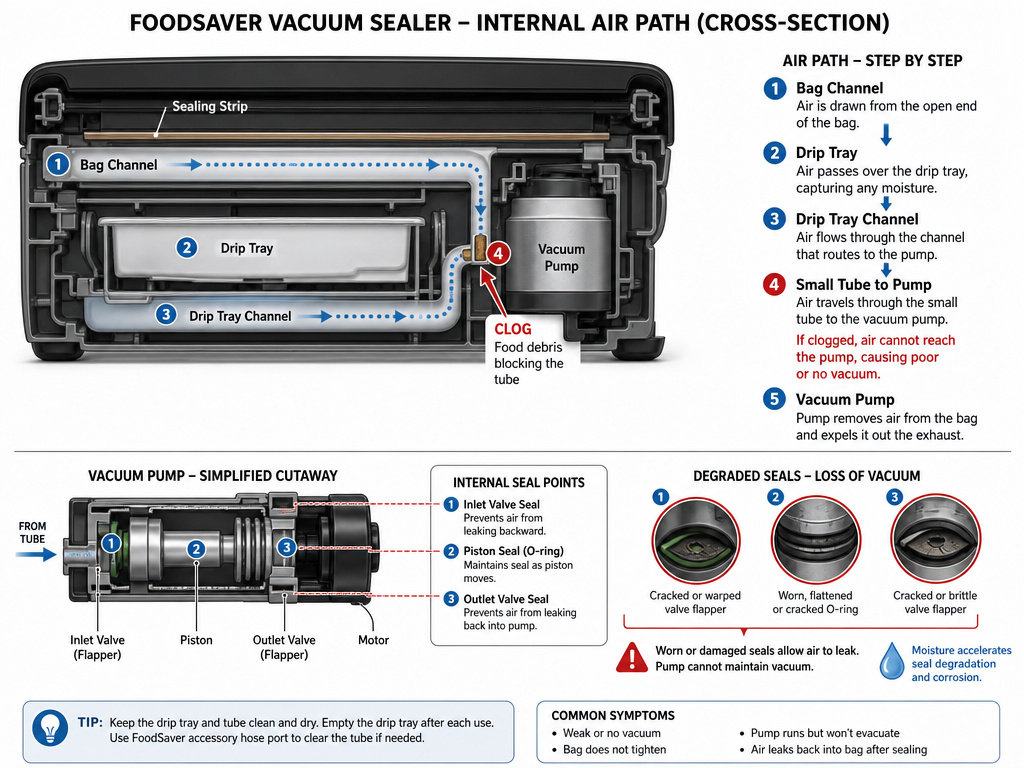
When basic fixes don’t work, the problem is inside the machine. Two main culprits exist: a clogged air path or a worn-out vacuum pump.
A clog happens when food particles or solidified liquid debris block the small tube that runs from the drip tray channel to the pump. You can sometimes access this by removing the drip tray and checking for visible obstructions. Use a pipe cleaner or compressed air to clear it.
Pump failure is more serious. The motor might hum but not create pressure. This is often the end result of repeated moisture exposure. If your sealer is older and has sealed many wet items, the pump seals degrade.
There’s no agreed standard for pump lifespan. Anyone who gives you a hard number is guessing. Heavy weekly use might get you five years; monthly use could last a decade.
For internal repairs, your decision point is cost. A replacement pump for a common model might run close to the price of a new, entry-level sealer. If your unit is under warranty, contact FoodSaver service immediately.
Model-Specific Notes and Non-Removable Parts
Not all FoodSavers are user-serviceable. Knowing your model type changes your repair ceiling.
Many newer models, particularly certain FM and VS series units, have non-removable gaskets. They are glued or molded into the lid. If these gaskets are damaged, the official stance is to contact FoodSaver Consumer Service. Attempting to pry them out usually ruins the lid.
Similarly, internal components like the solenoid valve that controls airflow are often not designed for end-user repair. The service manual for your specific model is the only authoritative guide. Searching for “[Your FoodSaver Model] service manual” is the best first step for advanced troubleshooting.
If you’re frequently running into issues, it might be worth exploring more robust vacuum sealer machines. Some FoodSaver models are built for lighter, occasional use.
Frequently Asked Questions
Why does my FoodSaver run for 3 minutes and then stop?
The unit has a built-in safety timeout. If it cannot achieve a vacuum within 3 minutes, it stops to prevent pump burnout. This almost always indicates a major air leak, check your gasket and bag placement first.
Can I use any brand of bag with my FoodSaver?
You can, but it’s a gamble. Generic bags are often thinner and can melt or wrinkle in the heat seal bar, causing a leak. Official FoodSaver bags are gauged to work with the machine’s specific temperature and pressure profile. A bad seal mimics a vacuum failure.
Is a flashing “Seal” light a serious problem?
It’s a thermal cutoff. The sealing bar has overheated. Unplug the machine and let it cool for at least 10 minutes. If this happens repeatedly on short sessions, the thermostat might be failing, which is a repair job.
How do I find my FoodSaver’s model number?
Look on the bottom or rear of the unit. It’s usually on a silver sticker, formatted as something like “VS7850” or “FM5200.” This number is critical for ordering the correct replacement gasket or finding your manual.
My FoodSaver has never worked right. What should I do?
First, verify you’re following the 3-inch and vacuum channel rules perfectly. If it’s still under warranty, call service. If not, consider the cost-benefit of repair versus replacement. A consistently faulty new unit might be a lemon.
The Bottom Line
A FoodSaver not vacuuming usually fails at one of three seals: the lid gasket, the bag in the channel, or the bag’s own seal against moisture. The gasket needs time to recover, the bag needs specific geometry, and wet food needs a barrier. Start with the twenty-minute gasket reset. If that doesn’t work, measure your bag headspace and check the channel alignment. Avoid moisture at all costs, it’s the one error that can kill the pump for good. For everything else, your model’s service manual has the final answer.